Cell Bio- Lecture #2 (Epithelium and Connective Tissues)
 Call Kai
 Learn
Learn Practice Test
 Spaced Repetition
 Match
Match Flashcards
 Knowt Play
1/37

There's no tags or description
Looks like no tags are added yet.
Name | Mastery | Learn | Test | Matching | Spaced | Call with Kai | Chat |
|---|
No analytics yet
Send a link to your students to track their progress
38 Terms

Apical membrane
The free surface of epithelial cells

Microvilli
Increase surface area (to facilitate absorption); found on apical membrane
Cilia
(On ciliated epithelium) move fluids outside the cell; found on apical membrane
Basolateral membrane
The attached surface of epithelial cells

Basal lamina
What epithelial cells are attached to, which facilitates interaction with connective tissue; a narrow strip of dense matrix filled with collagen and laminin proteins that allows strong attachment of epithelia to underlying connective tissue
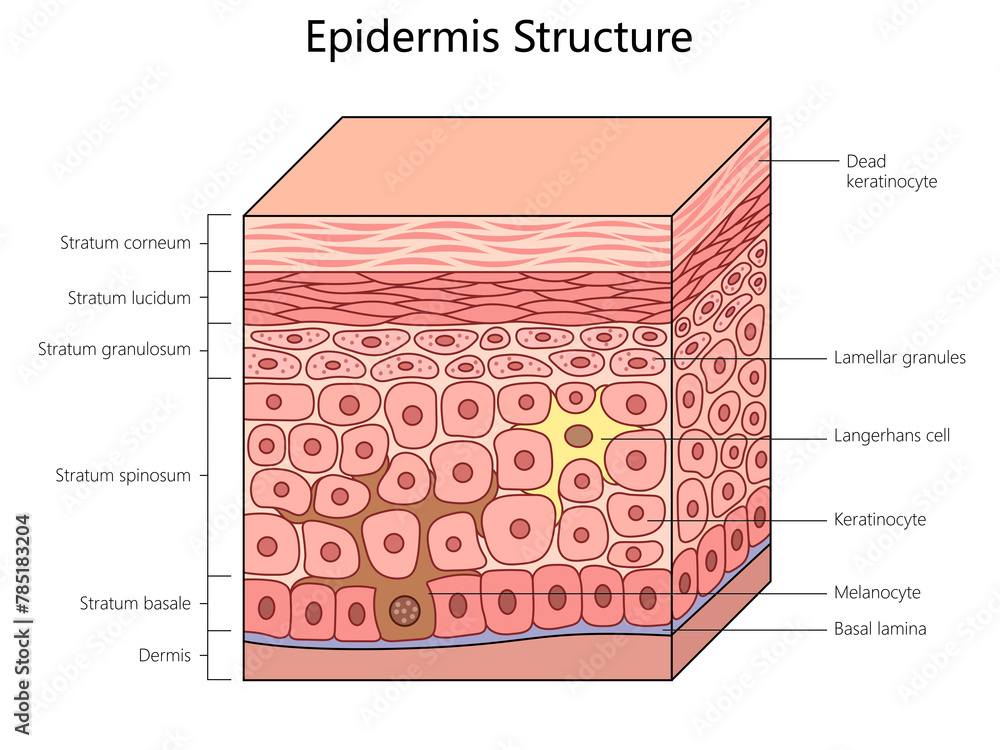
Simple epithelium
Single layer of cells

Stratified epithelium
Several layers of cells
Squamous epithelia
Thin and flat
Cuboidal epithelia
Cube shaped

Columnar epithelia
Tall, slender rectangles
Adherens junctions
Hold neighboring cells firmly to each other; formed by interaction of cadherin proteins from both cell membranes, attached to actin filaments intracellularly
Desmosomes
Create very strong, localized attachments between neighboring cells; formed by a plaque of specific cadherin proteins from both cells, attached to intermediate filaments like keratin
Tight junctions
Create a semipermeable or impermeable seal in the extracellular space between neighboring cells; formed by claudin proteins from the membranes of both cells
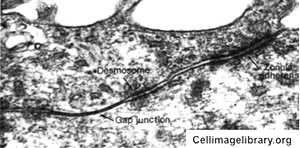
Gap junctions
Create a small pore through the membranes of two neighboring cells, allowing exchange of small cytoplasmic solutes and communication; formed by hemichannels made of 6 connexin proteins in each cell
Cadherin
Proteins from both cell membranes that form adherens junctions
Plaque
Structure formed by specific cadherin proteins from both cells in a desmosome
Claudin
Proteins from the membranes of both cells that form tight junctions
Connexin
Proteins that form hemichannels (6 per cell) making up gap junctions
Fibroblasts
Cells that secrete fibers in connective tissue

Collagen fibers
Strong & flexible; resist force in 1 direction (bundled collagen)

Reticular fibers
Strong & flexible; resist force in many directions (collagen matrix)
Elastic fibers
Stretch and return to original length; made of elastin protein
Structural fibers
large macromolecular fibers that provide a strong structure to maintain tissue structure and organization (collagen, elastin proteins)
Hydrated matrix
Extremely large macromolecular structures that act as flexible 'filler' for the space between cells (proteoglycans, glycosaminoglycans, glycoproteins)
Adhesive molecules
Allow cells to attach to the extracellular structures (integrin and laminin proteins)
Collagen
A trimeric, helical protein that is secreted; assembles into fibrils in the extracellular space, which then associate into very strong but flexible fibers
Procollagen
Assembled in the endomembrane system, but does not associate with other molecules until it is secreted and processed by a peptidase enzyme
Elastins
Protein fibers that are crosslinked with each other; work like springs to help maintain the shape of tissues subject to a lot of movement

Proteoglycans
Fill the remainder of the extracellular space in animals; formed of many glycosaminoglycans (GAGs) attached to an organizing core protein; look like bottle brushes
Glycosaminoglycans (GAGs)
Very long carbohydrates with disaccharide repeats attached to a core protein
Hyaluronic acid
A massive GAG (up to 20,000 disaccharide repeats) that aggregates proteoglycans (the metal core of the bottle brush)
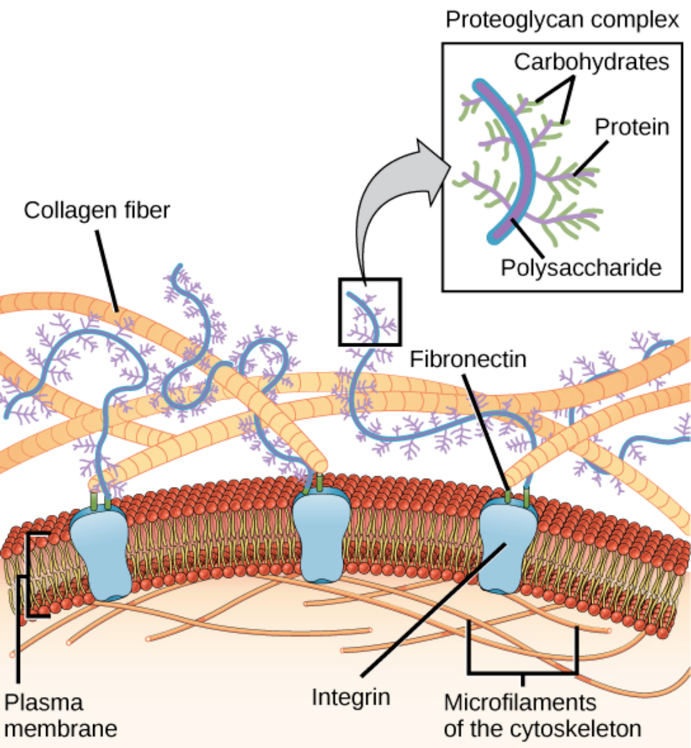
Fibronectins
Large secreted glycoproteins that bind to sugar moieties; form fibrils with each other and attach to both GAGs and to integrin proteins
Laminins
Secreted proteins that allow direct attachment to collagen fibers for maximal support of thin layers of epithelia; one end binds integrins on the basolateral membrane, the other end binds collagen fibers in the ECM
Epithelial Tissue Functions
Provide protection, control access (permeablity), sense phenomena, produce sercretions
Epithelial Tissue Characteristics
Polarized, primarily cellular, cell junctions, attached to connective tissue, avascular, regenerate
Connective tissue characteristics
Doesnt contact external world, specialized and extracellular, highly vascularized
List of loose connective tissue
Areolar, adipose, reticular
Dense Regular list
Tendon, ligament