NR 304 Final Exam questions and answer with detailed rationales
 Call Kai
 Learn
Learn Practice Test
 Spaced Repetition
 Match
Match Flashcards
 Knowt Play
1/84

There's no tags or description
Looks like no tags are added yet.
Name | Mastery | Learn | Test | Matching | Spaced | Call with Kai | Chat |
|---|
No analytics yet
Send a link to your students to track their progress
85 Terms
Techniques used in musculoskeletal asessment include _____ and ______
inspection
palpation
Which factors have a positive impact on bone health? Select all that apply.
Vitamin D
Exercise
Calcium
Proteins
A nurse is evaluating a right ankle injury. Which should be included as part of the musculoskeletal assessment of the right extremity?
Neurovascular
Which information obtained during the health history of a healthy 40-year-old client may indicate the risk of musculoskeletal problems?
The client does not exercise.
Joints
Inspect for size, symmetry, color, swelling, masses, deformities, and alignment
Muscles
Inspect for size, swelling or wasting, tremors, and masses
Bones
Inspect for deformities
Which statements describe a proper musculoskeletal assessment? Select all that apply.
Comparing one side to the other
Demonstrate expected movements
Stopping if client reports pain
The 5 Ps of Neurovascular Assessment
Pain
Pulses
Pallor
Paresthesia
Paralysis
Dupuytren's contracture
inability to extend the fourth and fifth fingers
Degenerative joint disease
thickened synovial fluid, fragmented connective tissue, and scarring with joint calcification
Carpal tunnel syndrome
pain, tingling, numbness of the thumb and forefinger, weakness when grasping or making a fist
Bursitis
localized joint pain with swelling, heat, and redness
Gout
a type of arthritis caused by uric acid crystal deposits in the joints
Scleroderma
damage to the skin, blood vessels, and joints caused by collagen build-up
Ulnar deviation
metacarpophalangeal and interphalangeal joint inflammation, leading to the hand turning outward
Hallux valgus
big toe abnormally adducted at the metatarsophalangeal joint
A client presents to the emergency department (ED) with an obvious deformity of the right forearm due to an accident. Which items should the nurse include in the neurovascular assessment? Select all that apply.
Sensation
Skin color
Pulses
Age Related Findings:
Older Adults
Osteoporosis
Osteoarthritis
Kyphosis
Age Related Findings:
Children
Scoliosis
Age Related Findings:
Pregnancy
Softening of pubis joints
Waddling gait
What assessment finding is illustrated in this picture? spine is curved
scoliosis
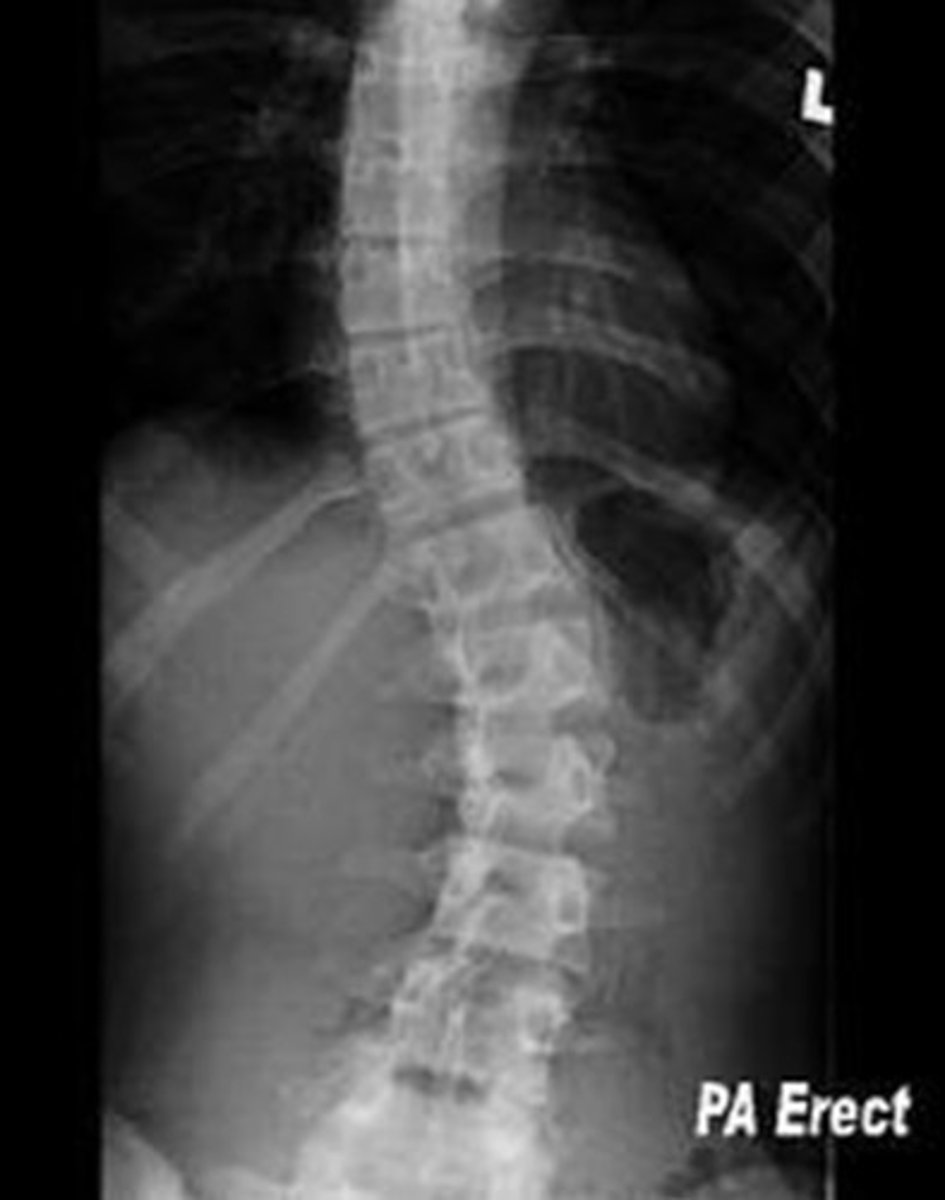
What are the signs or symptoms of idiopathic scoliosis? Select all that apply.
Asymmetry of shoulder blades
Back pain
Poor posture
Uneven gait
A client with scoliosis asks the nurse how physical therapy will help with breathing. Which response by the nurse is correct?
"Certain exercises can help expand the rib cage, increasing lung capacity."
Which treatment interventions could be considered for scoliosis depending on the severity of spinal curvature? Select all that apply.
Pain medication
Physical therapy
Spinal fusion
Brace
A client with mild scoliosis is being observed at this time with no further treatment recommendations. What may indicate to the client that the scoliosis is worsening? Select all that apply.
The client experiences increased shortness of breath.
The client notes an increased height of one shoulder compared to the other.
The client notes muscle spasms located in the back.
The client experiences increased back pain.
A 16-year-old client is at a yearly physical and the nurse assesses their spine. Which findings are indicative of mild scoliosis? Select all that apply.
Curved spinal column
Prominence of one scapula
Prominence of one scapula
Which x-ray image would the nurse expect to see in a client with moderate thoracic and lumbar scoliosis?
Slight curve in the middle and lower back
Which assessment findings would the nurse expect for a client with moderate thoracic and lumbar scoliosis? Select all that apply.
Muscle spasms
Chronic back pain
Family history of scoliosis
Which treatments are anticipated for a client with moderate scoliosis (35 degrees)? Select all that apply.
Counseling
Physical therapy
Brace
Pain medication
Which question is important to ask an adult female during a urinary health history?
"Do you urinate after having sexual intercourse?"
The nurse is performing a focused reproductive interview with a 28-year-old female client. Which statement by the client is unexpected?
"My breasts seem swollen all the time."
The female reproductive organs include
the vagina, uterus, fallopian tubes, and ovaries.
The female urinary system include
the urethra, bladder, ureters, renal pelvis, and kidneys
Normal finding when palpating the lymphatic system include
nonpalpable and nontender nodes
Normal findings of the inspection of the breasts include
even color and slight asymmetry
Which tests could provide valuable information about the female reproductive and genitourinary systems?
Blood urea nitrogen BUN
Ultrasound
Creatinine
Cytoscopy
Breast self examination BSE can be taught to be performed...
5 days after the start of the mentrual period
When should a clinical breast examination be preformed?
Every 3 years when women are in their 30s and 40s
Fibrocystic Breast Disease
Lumps, breast pain, or tenderness, and nipple discharge. Treatment includes pain relievers and hormones
Bacterial Vaginitis
Creamy gray to white discharge that has a fishy odor. The client may also experience burning, itching, pain, and dysuria. Treatment includes antibiotics
Fibroadenoma
Asymptomatic; usually occurs as a single tumor near the nipple
Cystocel/Rectocele
The bladder or rectum starts protruding out of the vagina
Atrophic Vaginitis
Estrogen deficiency in postmenopausal females results in dryness, itching, and burning.
Incontinence
the uncontrollable leakage of urine from the bladder. Caused by bladder muscle weakness
Urinary Tract Infection UTI
usually caused by bacterial overgrowth in the bladder, which can spread to the kidney.
Renal Calculi
Urinary stones are produced, which causes blockage of the ureters or urethra
The client reports a consistent, achy pain in their lower back and suprapubic regions. The nurse interprets that this finding could indicate a problem of which structure?
Bladder
The nurse is assessing a client admitted for oliguria of unknown origin. Which factors affect urine output? Select all that apply.
Medications
Fluid intake
Bladder size
The nurse observes a reddened, painless sore on the client's labia. This is consistent with which sexually transmitted infection?
Syphilis
The nurse is planning to assess the external genitals of an adult female. What should be done first?
Provide for privacy and display empathy.
Which finding most likely causes symptoms, including erythema, pain, and enlargement of one of Bartholin's glands?
Cyst
The _____ is located at the opening of the uterus and can be seen with a ____ examination.
cervix
pelvic
Which genitourinary changes are expected as a female ages? Select all that apply.
Reduced vaginal lubrication
Decrease in pubic hair
Decreased estrogen production
What would a nurse expect to find in an older adult client with a urinary tract infection?
dysuria
frequency
urgency
bacteriuria
During a pelvic exam, which position should the client be placed in for the best evaluation?
Lithotomy position
When assessing a young adult male, which statement made by the client indicates the need for more education?
"Condoms are unnecessary as long as the female partner is taking birth control pills."
The nurse is performing a focused reproductive interview with a 55-year-old male client. Which client statement indicates a need for more male reproductive health education?
"Because I am circumcised, I am at higher risk of getting sexually transmitted infections."
It is recommended to do a testicular self-exam _____. Adolescent males should begin self exams by the age of ____
monthly
14
You are a school nurse, and a transgender child is in your office reporting urgency and burning with urination. Which questions would you ask when assessing the child? Select all that apply.
"How much water do you drink during the day?"
"Do you feel comfortable using the school bathroom?"
"When did the urgency and burning begin?"
Phimosis
In an uncircumcised male, the foreskin is retracted and cannot be returned. This can result in strangulation of the glans (head of the penis). Symptoms include pain, venous engorgement, and edema of the glans. Treatment includes circumcision. This can be a urological emergency.
Inguinal Hernia
The small bowel is pushed through the inguinal canal into the scrotum.
Testicular Torsion
This occurs when the testicles rotate, reducing or stopping the blood flow to the testicle. This is an emergent problem and requires immediate surgery. Symptoms include severe pain.
Prostatitis
inflammation of the prostate is usually caused by a sexually transmitted infection or other bacteria. Symptoms include pain with defecation and difficulty urinating.
HPV
known as genital warts, mostly asymptomatic, though a painless lesion may be present
syphilis
nontender lesions appear as round reddened ulcers
Herpes
Small vesicles appear in clusters and are painful
Gonorrhea
Yellow or green discharge caused by bacteria
Chlamydia
Dysuria, frequency, or urgency caused by bacteria
Trichomoniasis
Parasites cause irritation during urination.
Which factors should the nurse consider when providing contraceptive education to a client?
Age
Religious Beliefs
In an uncircumcised male, the foreskin is retracted and cannot be returned. This can result in strangulation of the glans (head of the penis). This describes which condition?
Paraphimosis
Which condition is a common cause of urinary retention in an older male adult?
Prostate enlargement
Which factor demonstrates culturally competent care during a reproductive assessment?
The nurse asks a male colleague to perform the examination, as requested.
What is a common cause of anorexia nervosa in an adolescent?
Negative body image
Which items are risk factors for benign prostatic hypertrophy? Select all that apply.
Advanced age
Male gender
Which assessment technique assesses the size of the prostate?
Rectal exam
A client living with benign prostatic hypertrophy was started on the alpha-adrenergic blocking medication tamsulosin. Which statement best describes how this medication works?
Tamsulosin relaxes the muscles in the prostate and bladder.
What symptom is consistent with badder cancer?
Hematuria
Which radiologic examinations are used to visualize the bladder and prostate?
Computerized tomography (CT)
Magnetic resonance imaging (MRI)
What is the most common cue to indicate a client is at risk of clinical deterioration?
Change in one or more vital signs
Changes in which assessment data may indicate failure to rescue?
Oxygen saturation
Heart rate
Level of consciousness
Which key attributes contribute to the failure to rescue? Select all that apply.
Lack of clinical decision-making
Failing to communicate changes
Omission of care
Overlooking changes in the client's status
Which nursing action is most likely to prevent failure to rescue?
Recognizing early signs of clinical deterioration
Which factor is most important for the nurse to consider when deciding how to respond to a reduction in a client's physical condition?
Severity of decline