lung imaging theory 1
 Call Kai
 Learn
Learn Practice Test
 Spaced Repetition
 Match
Match Flashcards
 Knowt Play
1/12

There's no tags or description
Looks like no tags are added yet.
Name | Mastery | Learn | Test | Matching | Spaced | Call with Kai | Chat |
|---|
No analytics yet
Send a link to your students to track their progress
13 Terms
What can be seen
Lung nodules and tumors
Pneumonia
Emphysema
Interstitial Lung Disease
Pleural effusion
Four distinct tests
CXR, CT scan, MRI, PET scan ultrasound becoming more popular
Radiation Exposure
Background radiation = 3mSv
CXR radiation = 0.1mSv
Indications for chest x ray
Detect alterations in lung pathology
Determine appropriate therapy
Evaluate therapy
Determine position of tubes and catheters
Follow disease progression
Assessing the patient after an invasive procedure
Views
PA (Posterior-anterior) view, Most common and most useful
AP (Anterior-posterior) view
Lateral, Lateral decubitus, Apical lordotic, Oblique
Radiopaque
X-ray beam cannot pass as easily through dense objects and
appear white
Bones, infiltrates, consolidation
Radiolucent
Air cannot stop x-ray beam and appears black
Air filled organs or cavities like the trachea, mainstem bronchi
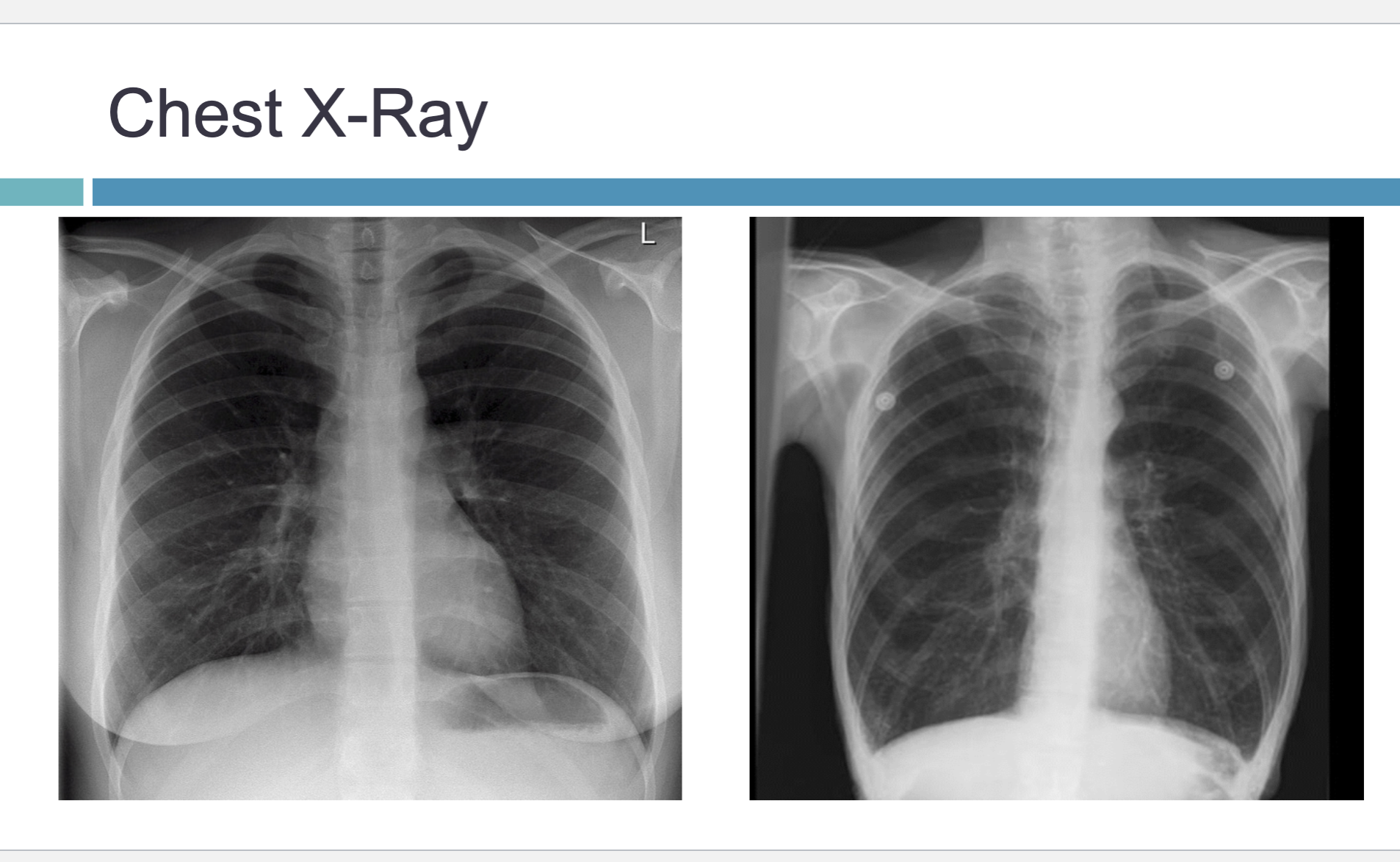
Chest X-Ray image

Lateral decubitus Chest X-Ray
Performed while patient is laying on their side
More sensitive than others for detecting small pleural effusions
Apical lordotic cxr
Used to evaluate upper lung fields
Lung tumors
Apical TB
Picture angle eliminates clavicles obstructing view
Rarely used
CT is much better
Oblique cxr
Helpful in evaluating heart size
Can be taken right and left oblique
Rarely used due to widespread use of echocardiography
Patient is positioned facing the film, but rotated
Cardiac Silhouette
Checking size of heart in relation to the space it occupies in the thorax
The size of the heart should occupy half the space of the total thorax
When it occupies more it can be a sign of
Congestive heart failure
Diaphragm
Look for sharp costophrenic angles
Blunting
pleural effusion if fluid
May be able to see a water line
Flattened diaphragms
Possible COPD if approximately 90 degrees
Look at cardiophrenic angles as well
Left hemi-diaphragm is usually lower than the right
Why? The liver pushes up the right hemidiaphragm