H4 Lewis- Interactions among populations IV: Ecological networks - mutualists and antagonists
 Call Kai
 Learn
Learn Practice Test
 Spaced Repetition
 Match
Match Flashcards
 Knowt Play
1/5

There's no tags or description
Looks like no tags are added yet.
Name | Mastery | Learn | Test | Matching | Spaced | Call with Kai | Chat |
|---|
No analytics yet
Send a link to your students to track their progress
6 Terms
what is the small world property of ecological networks? what are the implications of this?
the nodes of a network are typically very closely connected (by edges/links)
on average every species is two links apart, and 95% are within three links of each other
this is important because:
changes in the abundance of one species will propagate rapidly through the network
biodiversity loss, over-harvesting and species invasions may affect more species than previously thought
how can we quantify the connectedness of networks?
the connectance, C, of a network is equal to the number of links that occur, L, divided by the number of possible links, S
C = L/(S(S-1)/2)
S(S-1)/2 on the bottom, not S², because we aren’t considering interactions within species (same as S!, S factorial)
what is an issue with relying on observation for ecological network analysis?
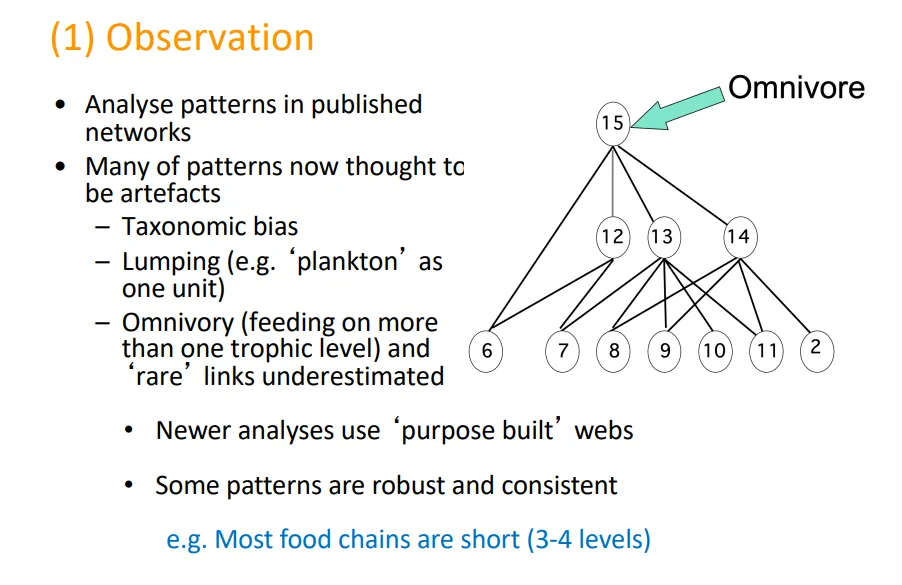
studying patterns observed in previously published networks is somewhat problematic, because:
taxonomic bias (too little priority given to smaller organisms eg. bacteria/insects)
lumping (many individuals of one species being considered as one eg. plankton)
omnivory (feeding on more than one trophic unit)
this is why newer analyses use purpose built webs that don’t have these biases
why are food chains short?
productivity:
energy is lost/wasted (eg. by respiration, incomplete digestion) at every trophic level, so there isn’t enough energy near the top for further levels to exist
communities which are more efficient should have longer food chains eg. ectotherm chains longer than endotherms
communities with more efficient primary production should have longer food chains
trophodynamics (instability of long chains):
lower trophic levels are dependent on the stochasticity of food availability, so the populations are variable
chance variations in population size are amplified up the food chain, so they become even more unpredictable for the top levels
how does network complexity impact stability?
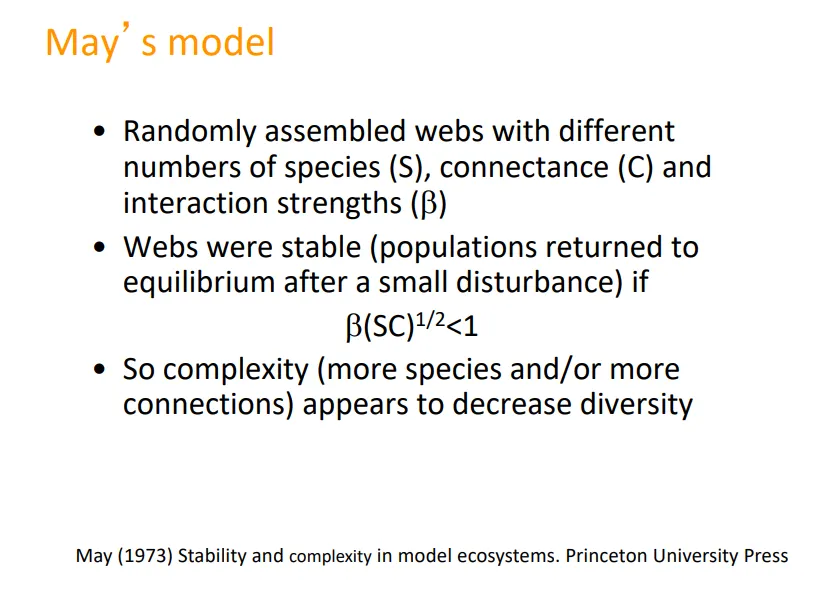
according to may’s model, randomly-generated webs were stable as long as B(SC)1/2 < 1, where:
B (beta) is the strength of interactions
S is the number of species
C is the connectedness
this predicts that increased network complexity reduces stability- this is because:
many components have to be balanced very precisely
there is more potential for trophic cascades
this goes against previous predictions (eg. elton) that increasing complexity would increase stability because there is more buffering against fluctuations
what factors are integral in defining the structure of ecological networks?
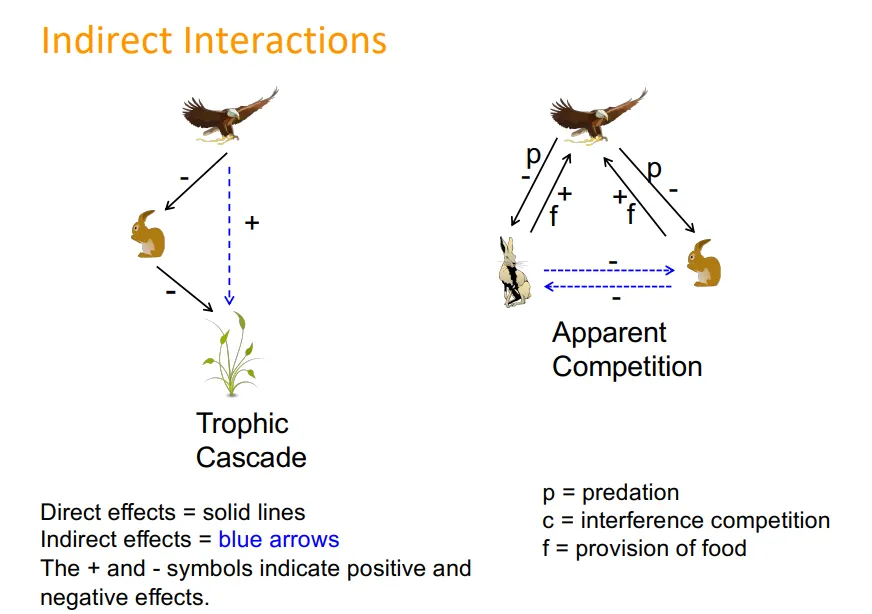
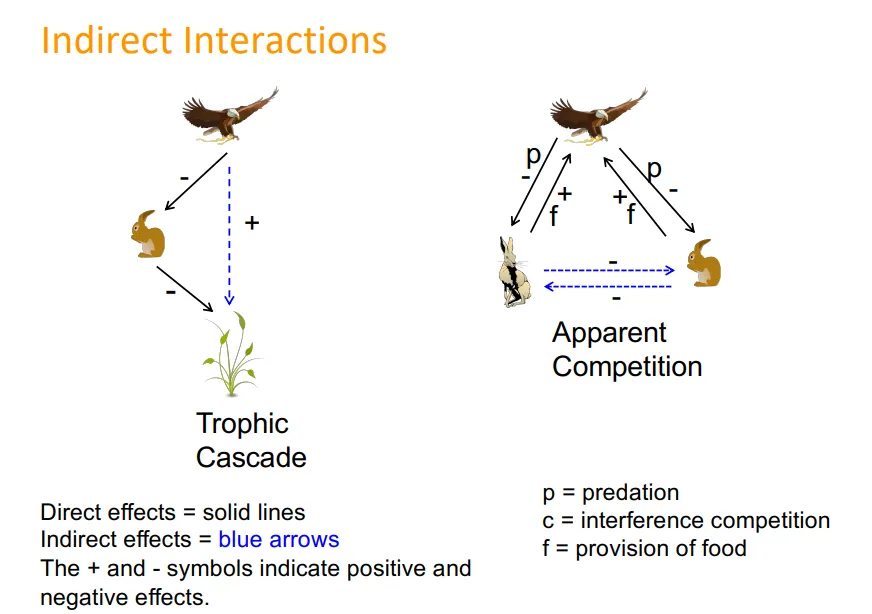
indirect interactions, eg:
between two species on one trophic level which have apparent competition for not being preyed upon, etc- eg. red vs grey squirrels with the squirrel pox virus
tropic cascades
keystone species:
species with much larger impacts on the ecosystem than might be expected from its abundance
if these were to go extinct, the effects will be widespread, often but not always predators