IB Bio HL: Unit 4B
 Studied by 0 people
 Call with Kai
 Learn
Learn Practice Test
 Spaced Repetition
 Match
Match Flashcards
 Knowt Play
1/54

There's no tags or description
Looks like no tags are added yet.
Name | Mastery | Learn | Test | Matching | Spaced | Call with Kai |
|---|
No study sessions yet.
55 Terms
ATP
Adenosine Triphosphate
Monomer of ATP
modified nucleotide
Organelle that produces ATP
Mitochondria
Aerobic Cellular Respiration
Process of producing ATP
Processes ATP is used for
active transport
anabolic reactions
muscle contractions
movement of cells or parts within cells
Diagram of ATP
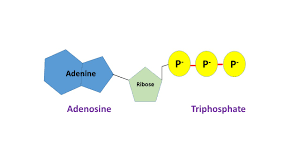
Why is ATP like a spring
phosphate groups have negative charges and repel each other
keeping the phosphate groups in close contact, creating bonds, is similar to compressing a spring
How is energy released from ATP
when the 3rd phosphate is broken off
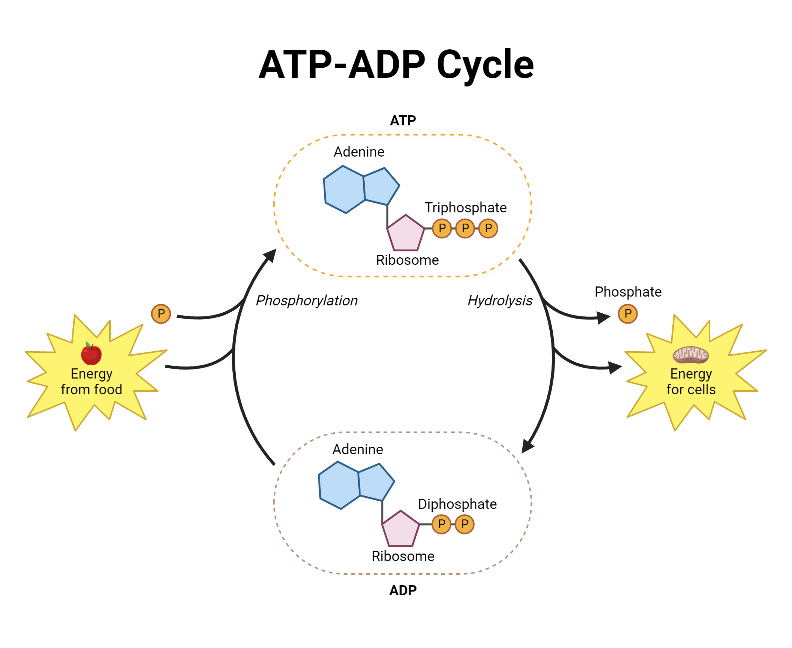
ATP Hydrolysis
process of releasing energy from ATP
a water molecule is used to break the bond between the 2nd and 3rd phosphate groups
an exergenic reaction occurs and energy is released
Products in ATP Hydrolysis
ADP + P
ADP
Adenosine Diphosphate
ADP Phosphorylation
process of ATP regeneration from ADP
adding a phosphate group to ADP
requires energy, making a bond
removing a water molecule
an endergenic reaction occurs, storing energy
Where do humans get the energy needed to perform ADP Phosphorylation? Where does the energy ultimately come from?
from energy from the glucose humans consume in food
photosynthesis; therefore, sunlight
Diagram of ATP-ADP cycle
ATP and active transport
transport of molecules across membranes can be a passive process, but when molecules need to be moved against their concentration gradient, active transport is required
for this process to occur transport proteins are needed and ATP is used
ATP binds to the transport protein, releasing the third phosphate, and energy is transferred to the transport protein allowing it to move the molecule across the membrane
ATP and anabolic reactions
formation of the bonds in these molecules requires energy and the energy comes from ATP
bonds need to be formed and that requires a source of energy
the enzymes that catalyse the reactions that form the bonds require ATP to function properly
ATP and movement
involves the cell moving or the movement of components within the cell
cell movement will involve the cytoskeleton of protein filaments. ATP is used to grow these filaments by providing the energy to bond fragments of the filaments together
the growth and contraction of these extensive networks of filaments produce changes in cell structure, which can lead to movement
when a phagocyte moves to engulf an invading bacterium, it is the movement of the cytoskeleton, using ATP that causes the membrane of the phagocyte to extend around the bacterium, leading to its destruction
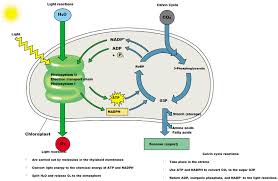
Location of Light Reaction
Thylakoids
Location of Calvin Cycle
Stroma
Description of Light Reaction
utilizes photosynthetic pigments to absorb light
Description of Calvin Cycle
uses ATP and NADPH from the light reaction
Inputs and Outputs of Light reaction
light energy splits H2O and produces O2 as a byproduct
creates ATP and NADPH to be used by Calvin cycle
Inputs and Outputs of Calvin cycle
carbon fixation of CO2 from the atmoshpere
produces sugar
How are the Light reaction and the Calvin cycle linked together
the light reaction produces the inputs of the Calvin cycle
happen simultaneously
producing O2 is waste, but humans need it
light reaction charge the ATP and that is needed to make sugars in the Calvin cycle
Diagram of the Light Reaction and Calvin Cycle
Where does O2 come from in photosynthesis
it comes from the 12 H2O by becoming 6 O2, no change in numbers
the C in CO2 actually goes to the glucose
Reduction
gaining electrons
the charge is “reduced” because it becomes more negative
Oxidation
loses electrons
OIL RIG
Oxidation Is Losing, Reduction Is Gaining
LEO says GER
Loss of Electrons (oxidation), Gain of Electrons (Reduction)
Photosystems
integral protein complexes located within the phospholipid bilayer
Location of Photosystems in Chloroplasts
the thylakoid membrane
Location of Photosystems in Cyanobacteria
the cell membrane, no chloroplasts in prokaryotes
why can photosystems absorb light
they contain chlorophylls and other accessory pigments that will absorb light
process of photoactivation in photosynthesis
photons of light strike the pigment molecules within the photosystems
excites the electrons in the pigments contained in the photosystems
excited electrons are transferred between the array of pigments within the photosystem
excited electrons finally reach the reaction center: a special chlorophyll a molecule
at the reaction center, the excited electrons will be emitted from the photosystem
are photosystems reduced or oxidized after photoactivation
the photosystem has been oxidized
photosystem I vs photosystem II
PSII comes before PSI
PSII is 680nm
PSI is 700nm
most important particle during light reaction
electron
photosystem undergoing photo activation first
photosystem II
where the electron goes after it leaves PSII
after the electron is emitted from PSII, it is transferred from the reaction center to the first Electron Transport Chain (ETC)
PSII is now missing an electron: this is very unstable
electrons are replaced during the process of photolysis
photolysis
process of using light energy to break water molecules in order to replace missing electrons in PSII
occurs in the thylakoid space (lumen)
equation of photolysis
2 H2O → 4H+ + O2 + 4e-
e → e → e
H2O PSII ETC
where photolysis occurs
in the thylakoid space (lumen)
what happens to the H+ produced during photolysis
H+ remain in the thylakoid space, beginning to build a concentration gradient
what happens to the O2 produced during photolysis
O2 diffuses out of the chloroplast → cell → leaf → atmosphere
what happens to the e- produced during photolysis
e- from H2O are transferred to PSII
structure of the 1st ETC
a series of integral protein complexes within the thylakoid membrane
the 1st ETC receives excited electrons from the PSII
functions of the 1st ETC (2)
transfer electrons from PSII to PSI
harness extra energy from excited electrons + use it to pump H+ into the thylakoid space (lumen) - this establishes a protein concentration gradient: high (H+) in the thylakoid, low (H+) in the stroma
location of high concentration vs low concentration of protons
high concentration in the thylakoid space, low concentration in the stroma
ways protons concentrated inside the thylakoid (3)
H+ produced in the thylakoid during photolysis
H+ pumped into the thylakoid by the first ETC
thylakoids are small spaces so H+ accumulates quickly
what is able to occur once the proton gradient is established
the proton concentration