lab final
 Call Kai
 Learn
Learn Practice Test
 Spaced Repetition
 Match
Match Flashcards
 Knowt Play
1/68

There's no tags or description
Looks like no tags are added yet.
Name | Mastery | Learn | Test | Matching | Spaced | Call with Kai | Chat |
|---|
No analytics yet
Send a link to your students to track their progress
69 Terms
1. Which of the following best reflects proper laboratory safety and behavior?
A. Eating and drinking are allowed as long as you wear gloves.
B. Used microscope slides should be left on the lab bench for the instructor to clean.
C. Dispose of chemical waste according to your instructor’s guidelines and never pour chemicals down the sink unless instructed.
D. Safety goggles are optional when working with chemicals if you’re careful.
C. Dispose of chemical waste according to your instructor’s guidelines and never pour chemicals down the sink unless instructed.
2. Which of the following steps is essential when designing a scientific experiment to test a hypothesis?
A. Avoid collecting data to prevent bias.
B. Change multiple variables at once to speed up results.
C. Include a control group and clearly define independent and dependent variables.
D. Analyze results only if they support your original hypothesis.
C. Include a control group and clearly define independent and dependent variables.
3. Which of the following best describes the primary purpose of a semester-long research project in a biology course?
A. To memorize key biological terms and definitions.
B. To design, conduct, and report original research using scientific methods.
C. To replicate published experiments without modification.
D. To complete weekly quizzes on laboratory safety protocols.
B. To design, conduct, and report original research using scientific methods.
4. Students at Columbus State Community College have to design a semester-long research project. What is the first step that they must take in designing their research project?
0/1
A. Identify the variables that they will be testing
B. Conduct a literature review on existing research on the topic
C. Conduct statistical analyses
D. Draw a conclusion
A. Identify the variables that they will be testing
5. A researcher wants to test whether a new fertilizer increases the growth rate of tomato plants compared to plants grown without it. Which of the following correctly states the null and alternative hypotheses?
1/1
A. Null Hypothesis (H₀): The fertilizer has no effect on tomato plant growth. Alternative Hypothesis (H₁): The fertilizer increases tomato plant growth.
B. Null Hypothesis (H₀): The fertilizer increases tomato plant growth. Alternative Hypothesis (H₁): The fertilizer has no effect on tomato plant growth.
C. Null Hypothesis (H₀): Tomato plants grow faster with fertilizer. Alternative Hypothesis (H₁): Tomato plants grow slower with fertilizer.
D. Null Hypothesis (H₀): Tomato plants grow at random rates. Alternative Hypothesis (H₁): Tomato plants grow consistently.
A. Null Hypothesis (H₀): The fertilizer has no effect on tomato plant growth. Alternative Hypothesis (H₁): The fertilizer increases tomato plant growth.
6. A scientist is testing the effect of different amounts of sunlight on the growth of tomato plants. She places plants in three different locations: full sun, partial sun, and shade. After two weeks, she measures the height of each plant.
Which of the following correctly identifies the independent and dependent variables in this experiment?
A. Independent Variable: Type of plant. Independent Variable: Type of plant
B. Independent Variable: Amount of sunlight. Dependent Variable: Plant height
C. Independent Variable: Plant height. Dependent Variable: Location of the plant
D. Independent Variable: Soil type. Dependent Variable: Plant color
B. Independent Variable: Amount of sunlight. Dependent Variable: Plant height
7. A student is investigating how different concentrations of salt in water affect the rate at which radish seeds germinate. She prepares three groups of seeds, each watered with a different salt concentration (0%, 2%, and 5%). All seeds are kept in identical containers, under the same light and temperature conditions, and watered with the same volume of solution daily.
Which of the following correctly identifies the variables in this experiment?
A. Independent Variable: Type of seed, Dependent Variable: Amount of water, Constant Variables: Salt concentration, light, temperature
B. Independent Variable: Salt concentration, Dependent Variable: Germination rate, Constant Variables: Light, temperature, container type, water volume
C. Independent Variable: Germination rate, Dependent Variable: Salt concentration, and Constant Variables: Type of seed, amount of salt, temperature
D. Independent Variable: Water volume, Dependent Variable: Type of seed, and Constant Variables: Germination rate, salt concentration
B. Independent Variable: Salt concentration, Dependent Variable: Germination rate, Constant Variables: Light, temperature, container type, water volume
8. A group of biology students conducts an experiment to test the effect of sunlight on plant growth. They grow one set of plants in full sunlight and another in partial shade for two weeks. After analyzing their results, they find that the plants in full sunlight grew significantly taller. To ensure their findings are valid, their instructor suggests they repeat the experiment with a new set of plants.
Why is it important to use a control?
A. It allows the students to use different types of plants to get a variety of results.
B. It helps confirm that the results are consistent and not due to random chance or experimental error.
C. It gives the students more time to complete their lab reports.
D. It ensures that the plants receive more sunlight overall.
B. It helps confirm that the results are consistent and not due to random chance or experimental error.
9. A student is testing the effectiveness of a new antibacterial soap by comparing bacterial growth on petri dishes. She sets up three groups:
Group A: Petri dishes treated with the new antibacterial soap.
Group B: Petri dishes treated with a standard antibacterial soap known to kill bacteria.
Group C: Petri dishes treated with plain water.
Which group serves as the best example of a negative control?
A. Group A
B. Group B
C. Group C
D. All groups are positive controls
C. Group C
10. Which of the following best explains why scientists use statistics when analyzing results?
A. Test hypotheses
B. Draw inferences
C. Establish the accuracy and reliability of the data
D. All of the above
D. All of the above
1. During a lab experiment, a student observes that a plant placed in a sealed container with high carbon dioxide levels grows faster than a plant in normal air conditions. However, the faster-growing plant also receives more light than the other.
What is the most reasonable interpretation of these findings?
A. The increased carbon dioxide is definitely the only reason for the faster growth.
B. The plant in normal air conditions is defective.
C. The difference in light exposure may also be influencing the growth rate, so further testing is needed.
D. The experiment proves that light has no effect on plant growth.
C. The difference in light exposure may also be influencing the growth rate, so further testing is needed.
12. Students at Columbus State Community College are conducting experiments on the effects of different variables on the growth of Brassica rapa.
What can students expect with to see when measuring the effect of light intensity on the growth of Brassica rapa?
A. Plants will grow taller if exposed to higher light intensity because light is essential for photosynthesis.
B. Plants will grow taller because water is important for photosynthesis.
C. Plants will grow taller because they need soil nutrients.
D. Plants will grow taller regardless of light intensity because genetics determines growth.
A. Plants will grow taller if exposed to higher light intensity because light is essential for photosynthesis.
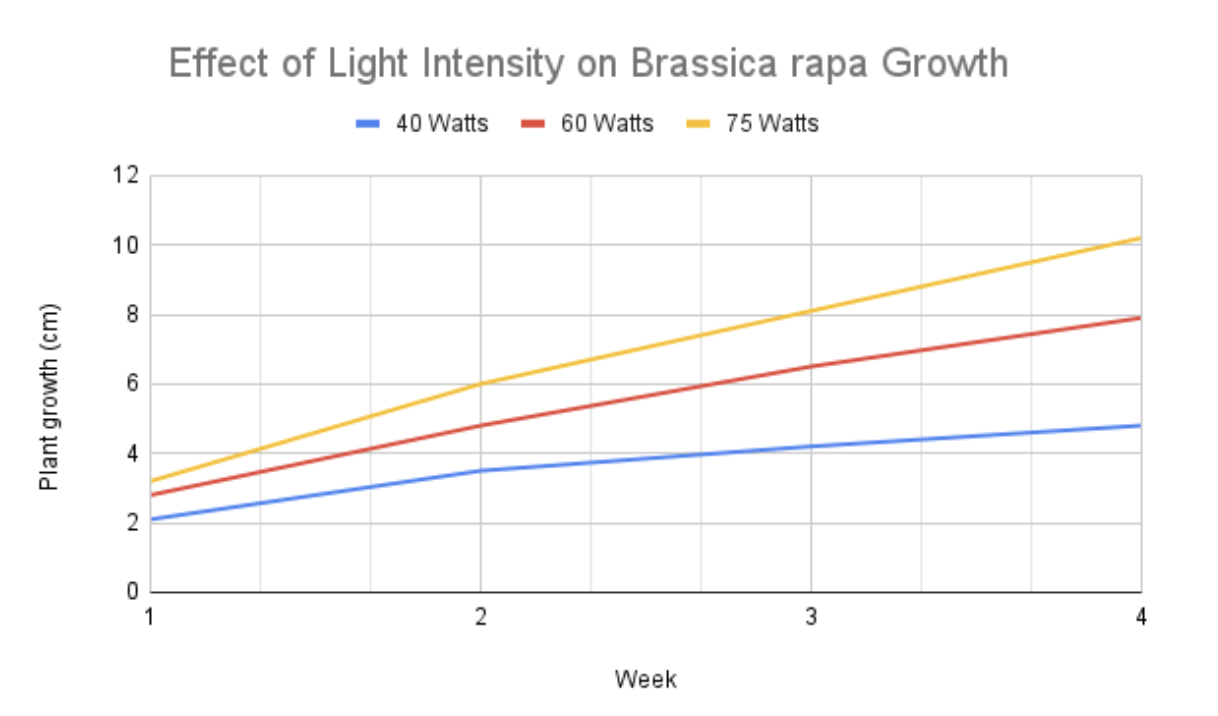
13. Students at Columbus State Community College are conducting experiments on the effects of light intensity on the growth of Brassica rapa. Observe the graph below.
Which light intensity was most effective for plant growth?
A. 40 watts
B. 60 watts
C. 75 watts
D. None of the above was effective for plant growth
C. 75 watts
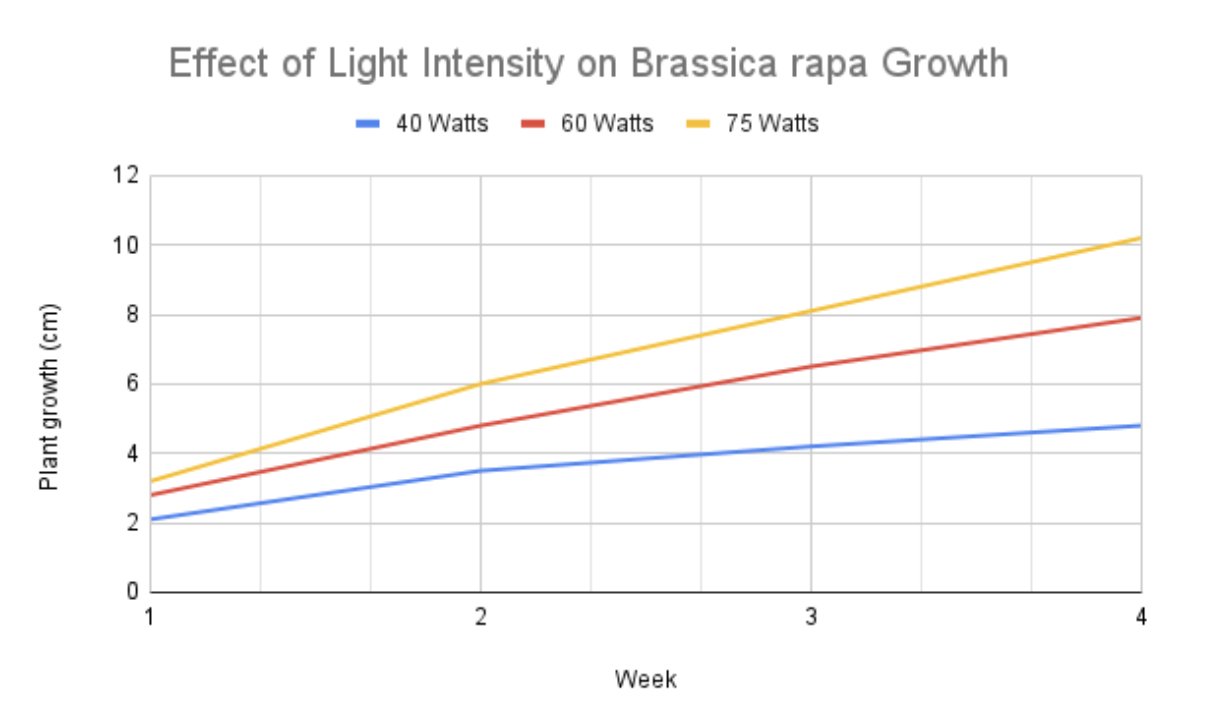
14. Students at Columbus State Community College are conducting experiments on the effects of light intensity on the growth of Brassica rapa. Observe the graph below.
Based on the results, why would light intensity affect plant growth?
A. Plants will grow taller because water is important for photosynthesis.
B. Plants will grow taller if exposed to higher light intensity because light is essential for photosynthesis.
C. Plants will grow taller because they need soil nutrients.
D. Plants will grow taller regardless of light intensity because genetics determine growth.
B. Plants will grow taller if exposed to higher light intensity because light is essential for photosynthesis.
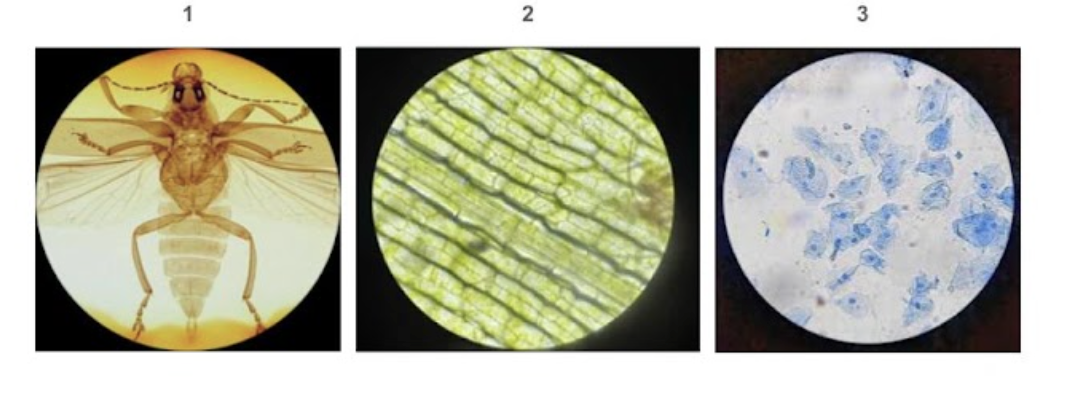
15. Which of the following correctly identifies the cell type and the microscope used to observe it?
A. 1 = Insect, stereomicroscope, 2 = Elodea, light microscope, 3 = Cheek cells, light microscope
B. 1 = Pollen, stereomicroscope, 2 = Elodea, stereomicroscope, 3 = Cheek cells, light microscope
C. 1 = Insect, light microscope, 2 = Lilly anther, light microscope, 3 = Cheek cells,stereomicroscope
D. None of the above is correct
A. 1 = Insect, stereomicroscope, 2 = Elodea, light microscope, 3 = Cheek cells, light microscope
16. Which of the following correctly identifies the four major categories of organic molecules found in cells?
A. Sugars, salts, acids, and bases
B. Proteins, carbohydrates, lipids, and nucleic acids
C. Water, oxygen, carbon dioxide, and glucose
D. Enzymes, hormones, vitamins, and minerals
B. Proteins, carbohydrates, lipids, and nucleic acids
17. A student at Columbus State Community College is testing a known sample of pepsin-treated protein albumin. The solution turns a light, clear blue, indicating a negative result.
Which of the following correctly indicates why the student received a negative result?
A. The Biuret assay is intended to react with hydrogen bonds in carbohydrates, not peptide bonds in proteins
B. The enzyme pepsin breaks the peptide bonds between the amino acids and Biuret does not react with individual amino acids
C. The student did not use a high enough concentration of the Biuret solution
D. The test resulted in a false negative
B. The enzyme pepsin breaks the peptide bonds between the amino acids and Biuret does not react with individual amino acids
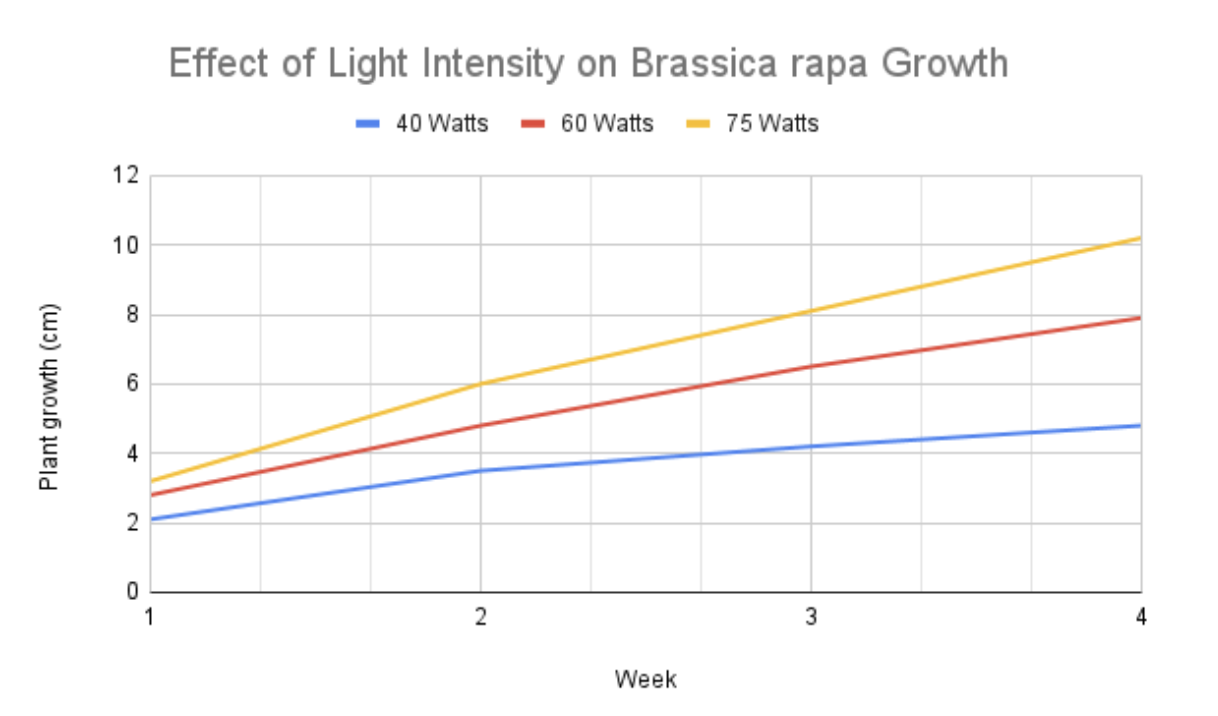
18. A student at Columbus State Community College predicts that increasing light intensity will increase plant growth in Brassica rapa. They set up three groups of plants under low (40 watts), medium (60 watts), and high (75 watts) light levels, followed the procedure carefully, recorded weekly height measurements, and analyzed the data. Observe the graph below. Which of the following is the most appropriate conclusion if the high light group grew significantly taller than the others?
A. The prediction was supported; higher light intensity promotes plant growth.
B. The prediction was incorrect; light intensity does not affect plant growth.
C. The procedure was flawed; the results cannot be used to make any conclusion.
D. The prediction was partially supported; all plants grew at the same rate.
A. The prediction was supported; higher light intensity promotes plant growth.
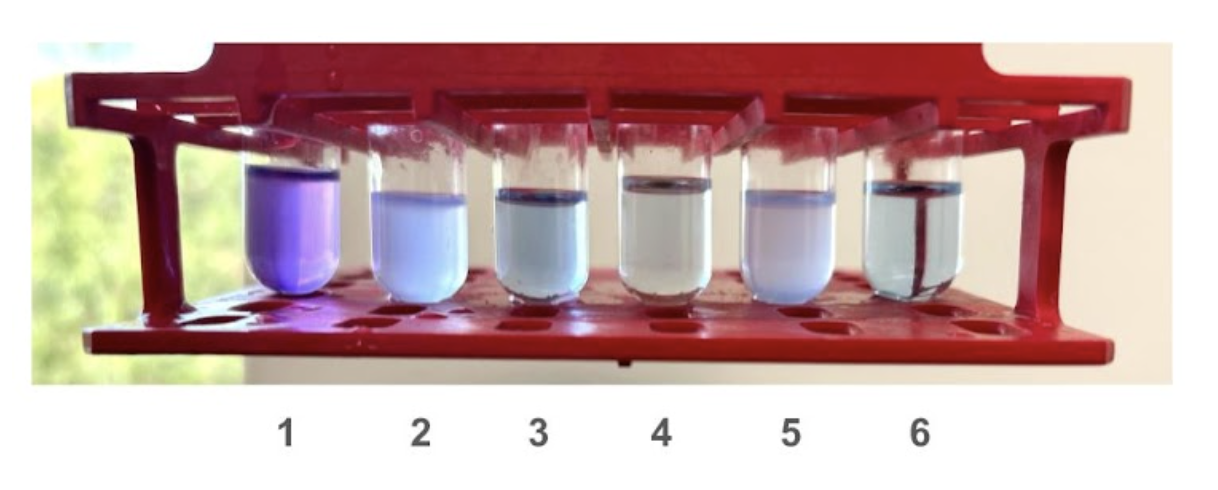
19. A student at Columbus State Community College was conducting biochemical assays. They performed a Biuret assay on unknown samples. Observe the image below.
Which samples clearly indicate a positive result?
A. 3 and 5
B. 2 , 3, and 6
C. Only 4
D. Only 1
D. Only 1
20. A student at Columbus State Community College is conducting biochemical assays on a food sample. They get a positive result for Biuret's and Benedict's tests.
Which of the food samples did they likely test?
A. Vegetable oil
B. Potatoes
C. Baby food with meat
D. Applesauce
C. Baby food with meat
21. Which of the following strategies is most effective when presenting scientific research to an audience?
A. Use technical jargon extensively to demonstrate expertise.
B. Present data clearly with visuals and explain key findings in simple terms.
C. Avoid summarizing conclusions to keep the audience thinking.
D. Focus only on methods and skip results to save time.
B. Present data clearly with visuals and explain key findings in simple terms.
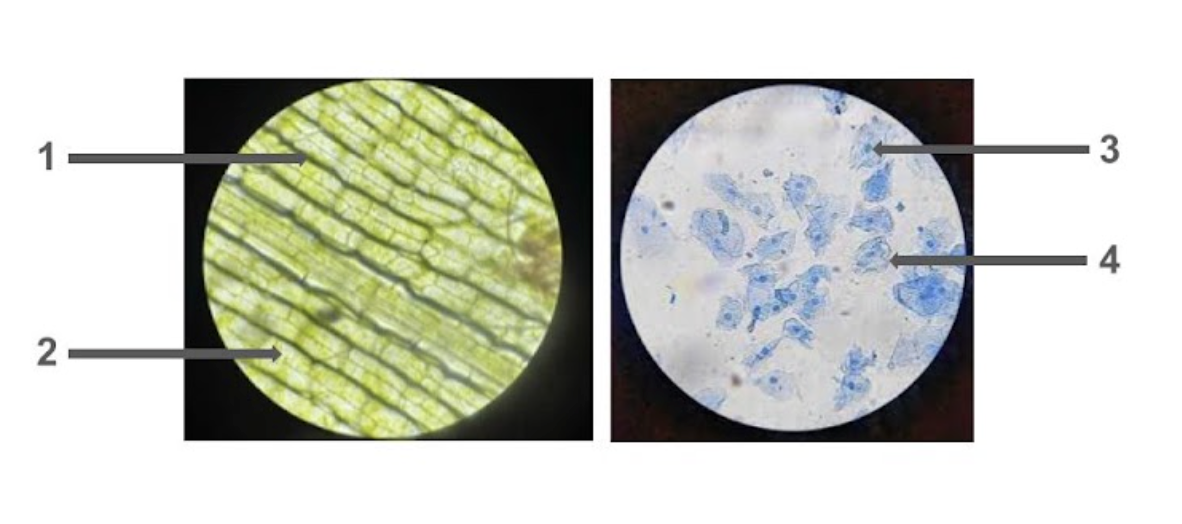
22. Observe the micrographs below. Which of the following correctly identifies the structure responsible for maintaining cell shape and protection in plant cells and the location of DNA in animal cells?
A. 1 = Cell wall, 3 = Nucleus
B. 2 = Chloroplast, 3 = Cell wall
C. 1 = Chloroplast, 3 = Cell membrane
D. 1 = Cell wall, 4 = Nucleus
A. 1 = Cell wall, 3 = Nucleus
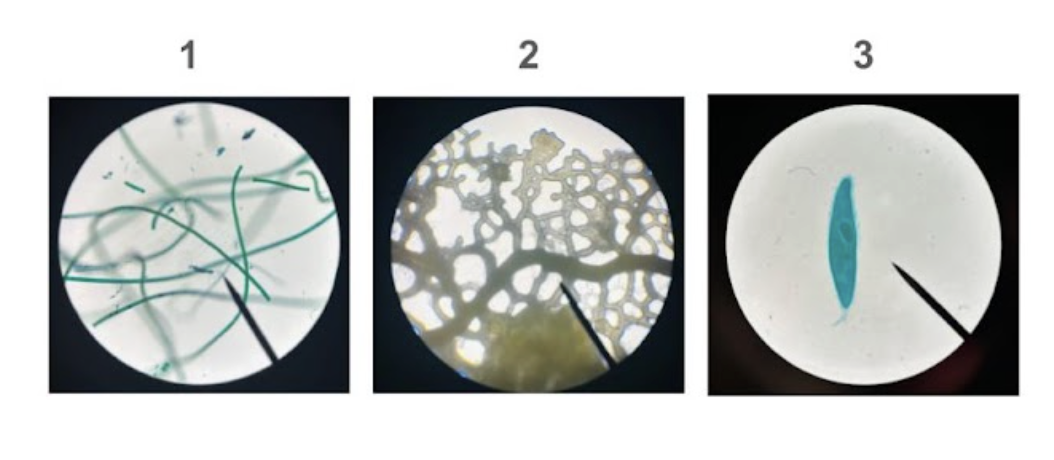
23. Observe the micrographs below. Which of the following correctly identifies the bacteria, protists, and eukaryotes?
A. 1 = Eukaryote, 2 = Prokaryote, 3 = Protist
B. 1 = Eukaryote, 2 = Protist, 3 = Prokaryote
C. 1 = Prokaryote, 2 = Eukaryote, 3 = Protist
D. 1 = Prokaryote, 2 = Prokaryote, 3 = Protist
C. 1 = Prokaryote, 2 = Eukaryote, 3 = Protist
24. When using a compound microscope, which of the following steps should you perform first to properly focus on a specimen?
A. Adjust the fine focus knob while using the highest power objective lens.
B. Start with the lowest power objective lens and use the coarse focus knob.
C. Center the specimen and immediately switch to the oil immersion lens.
D. Close the diaphragm completely to increase image contrast before focusing.
B. Start with the lowest power objective lens and use the coarse focus knob.
25. When analyzing prepared slides under a compound microscope, which observation best distinguishes a plant cell from an animal cell?
A. Presence of a nucleus and mitochondria
B. Presence of a rigid cell wall and chloroplasts
C. Presence of a plasma membrane and cytoplasm
D. Presence of multiple small vacuoles instead of one large vacuole
B. Presence of a rigid cell wall and chloroplasts
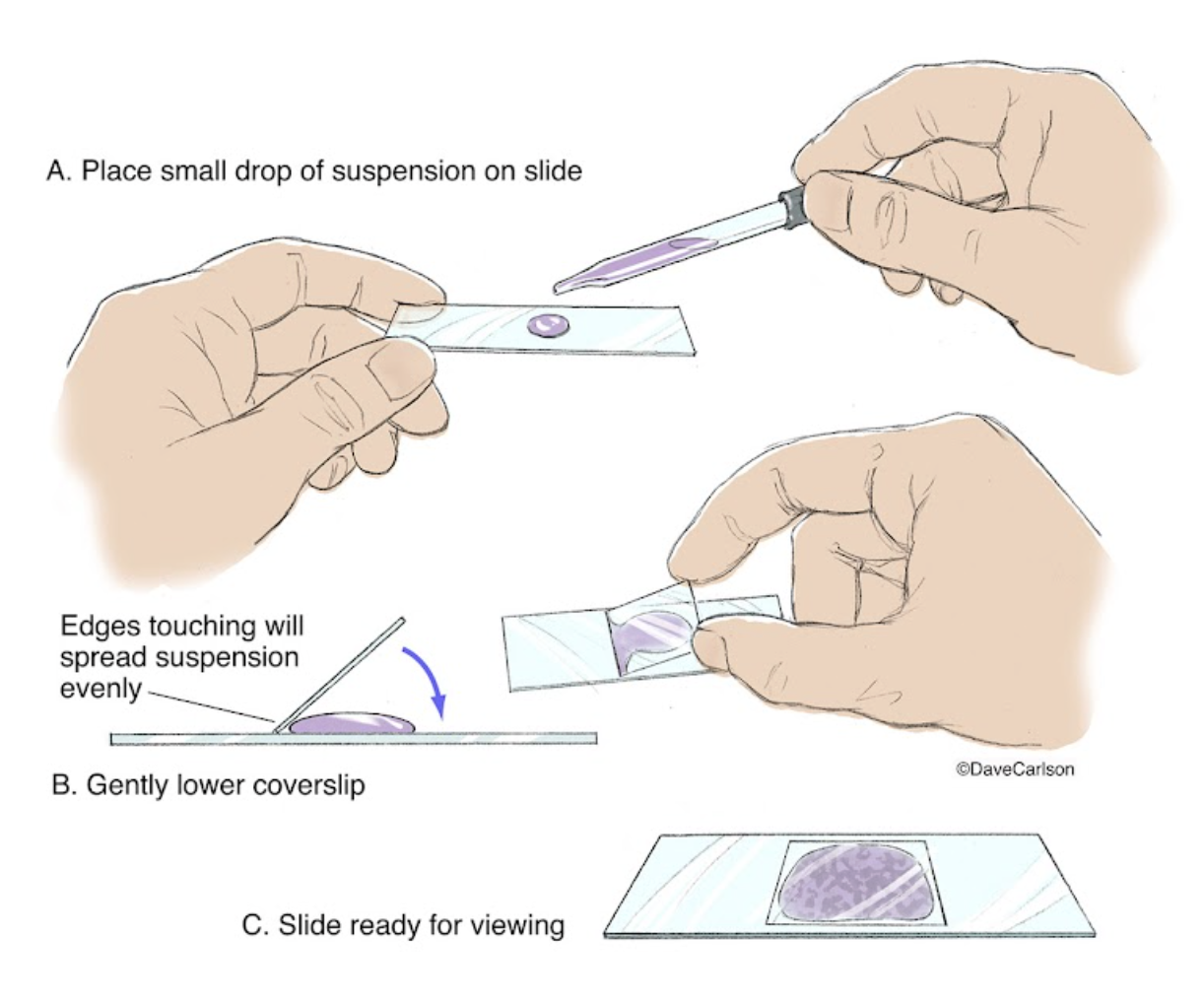
26. Observe the diagram below. When preparing a wet mount slide to observe onion root tip cells under a microscope, which step(s) are essential for obtaining a clear view of cell structures?
A. Place the onion skin directly on the slide without adding any liquid.
B. Add a drop of water and gently lower the coverslip to avoid air bubbles.
C. Use dry mounting to prevent distortion of the cells.
D. Apply multiple layers of coverslips for better magnification.
B. Add a drop of water and gently lower the coverslip to avoid air bubbles.
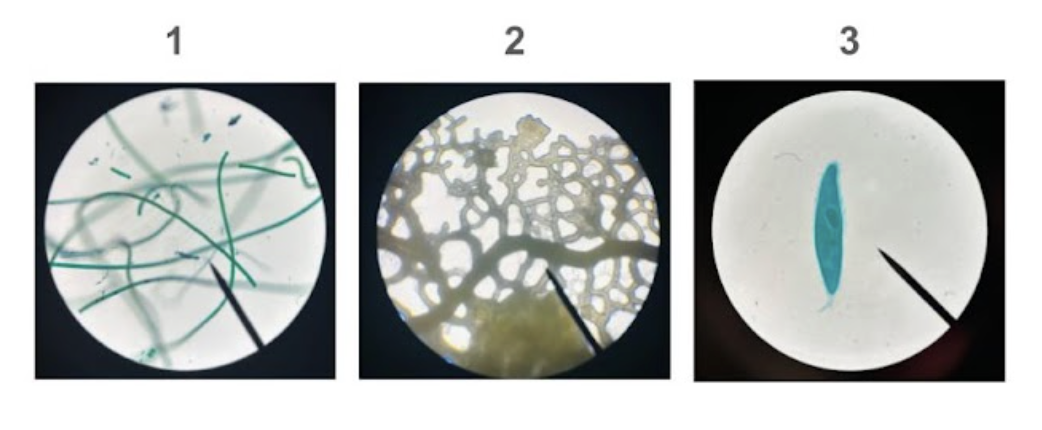
27. Students at Columbus State Community College are observing three different specimen under the microscope.
Which of the following represents the best conclusion that can be drawn based on their observations?
A. Specimens 1 and 3 are eukaryotic
B. Specimens 1 and 2 are prokaryotic
C. Specimens 2 and 3 are photosynthetic
D. Only specimen 2 is eukaryotic
D. Only specimen 2 is eukaryotic
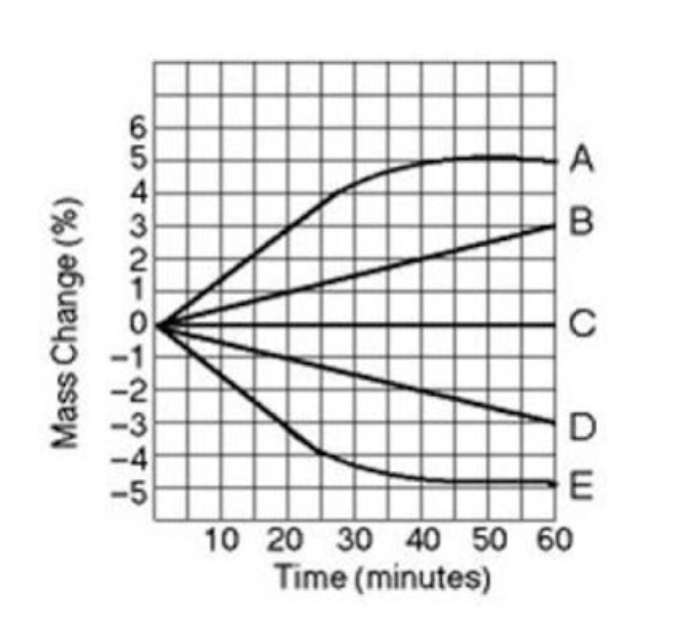
28. Five dialysis bags, constructed of a type of membrane that is permeable to water and impermeable to sucrose, were filled with various concentrations of sucrose and then placed in separate beakers containing an initial concentration of 0.6 M sucrose solution. At 10-minute intervals, the bags were massed (weighed), and the percent change in mass of each bag was graphed. Observe the graph below.
Which line in the graph represents the bag that contained a solution isotonic to the 0.6 M solution at the beginning of the experiment?
A. A
B. B
C. C
D. D
C. C
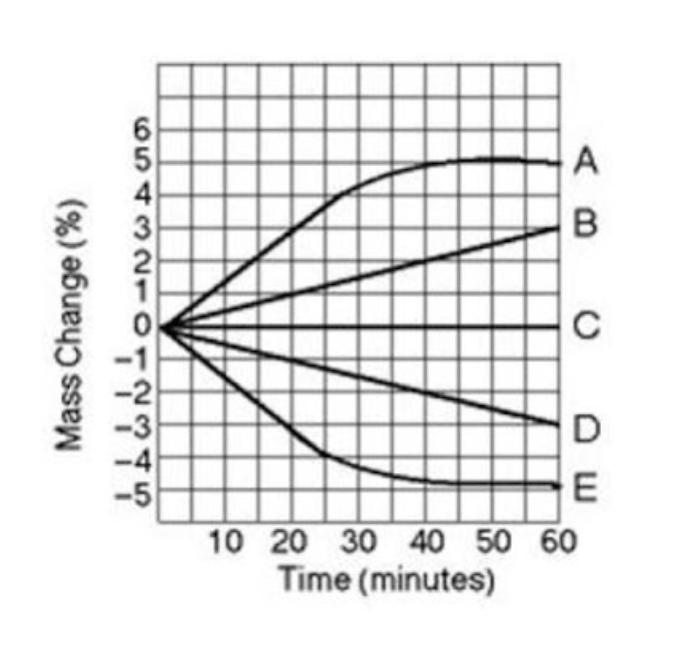
29. Five dialysis bags, constructed of a type of membrane that is permeable to water and impermeable to sucrose, were filled with various concentrations of sucrose and then placed in separate beakers containing an initial concentration of 0.6 M sucrose solution. At 10-minute intervals, the bags were massed (weighed), and the percent change in mass of each bag was graphed. Observe the graph below. Which line in the graph represents the bag with the highest initial concentration of sucrose?
A. A
B. B
C. C
D. D
A. A
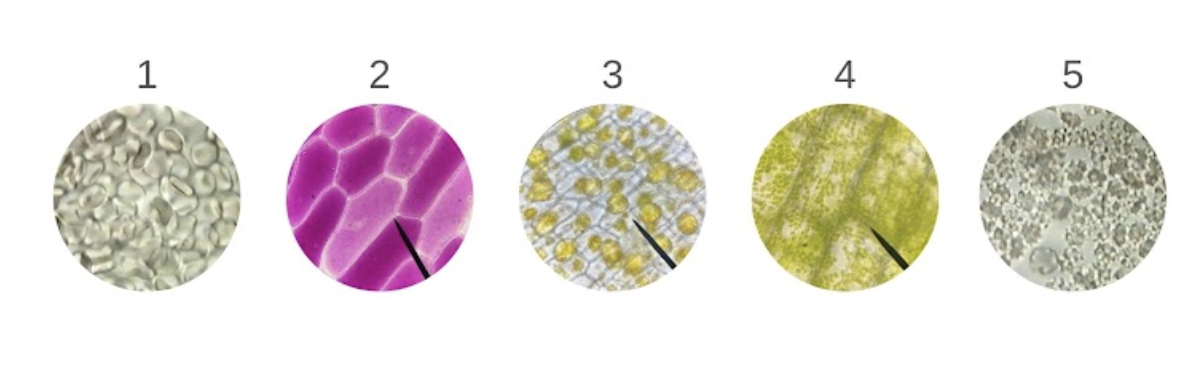
30. Observe the micrographs below. Which of the following micrographs represents a cell in a hypertonic solution?
A. 1 and 2
B. 3 and 5
C. 2 and 4
D. 3 and 4
B. 3 and 5
31. Two beakers are set up:
Beaker A: A semi-permeable membrane separates pure water from a 10% sugar solution.
Beaker B: A semi-permeable membrane separates pure water from a 1% sugar solution.
Which beaker will show a faster rate of osmosis, and why?
A. Beaker A, because a larger concentration gradient causes water to move more quickly toward the sugar solution.
B. Beaker B, because a smaller concentration gradient reduces resistance to water movement.
C. Both beakers will have the same rate because osmosis does not depend on concentration gradient.
D. Neither beaker will show osmosis because sugar molecules cannot pass through the membrane.
A. Beaker A, because a larger concentration gradient causes water to move more quickly toward the sugar solution.
32. A student places red blood cells in three different solutions:
Solution A: Distilled water
Solution B: 0.9% NaCl (isotonic solution)
Solution C: 10% NaCl
After 10 minutes, the student observes the following:
In Solution A, the cells swell and some burst.
In Solution B, the cells appear normal.
In Solution C, the cells shrink and become crenated.
What is the best explanation for these observations?
A. Osmotic pressure causes water to move into cells in Solution A and out of cells in Solution C.
B. Osmotic pressure has no effect; the changes are due to temperature differences.
C. Cells in Solution B shrink because water leaves the cell.
D. All solutions cause water to move equally in and out of the cells.
A. Osmotic pressure causes water to move into cells in Solution A and out of cells in Solution C.
33. What happens to animal cells when placed in isotonic, hypertonic, and hypotonic solutions?
A. Isotonic: Cells swell and burst, Hypertonic: Cells remain normal, Hypotonic: Cells shrink
B. Isotonic: Cells remain normal, Hypertonic: Cells shrink due to water loss, Hypotonic: Cells swell and may burst
C. Isotonic: Cells shrink, Hypertonic: Cells swell, Hypotonic: Cells remain normal
D. All three solutions cause cells to swell equally
B. Isotonic: Cells remain normal, Hypertonic: Cells shrink due to water loss, Hypotonic: Cells swell and may burst
34. Which of the following best explains how a spectrophotometer determines the concentration of a solute in a solution?
A. It measures the temperature change of the solution as light passes through.
B. It calculates the solute concentration by measuring the volume of the solution.
C. It determines the concentration by measuring the amount of light absorbed by the solution at a specific wavelength.
D. It identifies solute concentration by detecting changes in pH levels
C. It determines the concentration by measuring the amount of light absorbed by the solution at a specific wavelength.
35. Which statement best explains how enzymes catalyze chemical reactions?
A. Enzymes increase the activation energy required for a reaction to occur.
B. Enzymes act as reactants that are consumed during the reaction.
C. Enzymes lower the activation energy, speeding up the reaction without being used up.
D. Enzymes change the products of the reaction to make them more stable.
C. Enzymes lower the activation energy, speeding up the reaction without being used up.
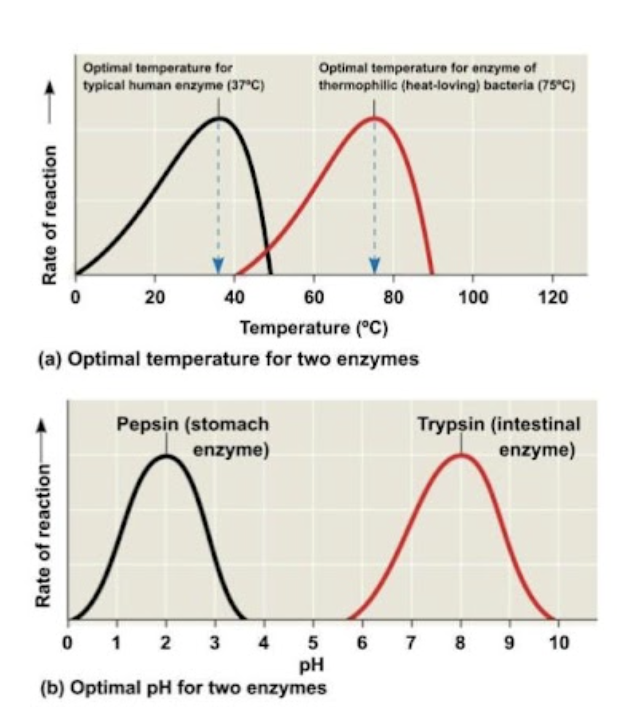
36. Observe the graphs of enzyme activity below. What is the optimal temperature for a thermophilic bacterium, and the optimal pH for pepsin?
A. Temperature: 20 degrees, pH: 4
B. Temperature: 78 degrees, pH: 2
C. Temperature: 40 degrees, pH: 8
D. Temperature: 45 degrees, pH: 10
B. Temperature: 78 degrees, pH: 2
37. A group of students places germinating peas in a sealed respiration chamber connected to a CO₂ sensor. They record the CO₂ concentration every 5 minutes for 30 minutes. The data shows a steady increase in CO₂ levels over time.
What does this observation indicate about the peas?
A. The peas are undergoing photosynthesis, producing CO₂ as a byproduct.
B. The peas are performing aerobic respiration, releasing CO₂ as they metabolize stored energy.
C. The peas are not metabolically active because CO₂ levels are rising.
D. The peas are absorbing CO₂ from the chamber, reducing oxygen availability.
B. The peas are performing aerobic respiration, releasing CO₂ as they metabolize stored energy.
38. A student sets up an experiment to test yeast fermentation using four different sugars: glucose, sucrose, lactose, and starch. Each sugar solution is mixed with yeast in a fermentation tube, and the amount of CO₂ produced after 30 minutes is recorded. The results show high CO₂ production with glucose and sucrose, little with lactose, and none with starch.
What is the best interpretation of these results?
A. Yeast can ferment all sugars equally well.
B. Yeast ferments simple sugars like glucose and sucrose more efficiently than complex carbohydrates like starch.
C. Yeast cannot ferment glucose or sucrose because they are too simple.
D. The amount of CO₂ produced is unrelated to fermentation.
B. Yeast ferments simple sugars like glucose and sucrose more efficiently than complex carbohydrates like starch.
39. Which of the following correctly lists the major stages of aerobic respiration in order and their primary products?
A. Glycolysis → Electron Transport Chain → Krebs Cycle; Products: ATP only
B. Glycolysis → Krebs Cycle → Electron Transport Chain; Products: ATP, NADH, FADH₂, CO₂, and H₂O
C. Krebs Cycle → Glycolysis → Electron Transport Chain; Products: Glucose and Oxygen
D. Glycolysis → Fermentation → Electron Transport Chain; Products: Lactic Acid and ATP
B. Glycolysis → Krebs Cycle → Electron Transport Chain; Products: ATP, NADH, FADH₂, CO₂, and H₂O
40. Which statement correctly compares aerobic respiration and fermentation?
A. Both processes produce the same amount of ATP per glucose molecule.
B. Aerobic respiration requires oxygen and produces more ATP, while fermentation occurs without oxygen and produces less ATP.
C. Fermentation produces water and carbon dioxide as final products, just like aerobic respiration.
D. Aerobic respiration and fermentation both occur only in the absence of oxygen.
B. Aerobic respiration requires oxygen and produces more ATP, while fermentation occurs without oxygen and produces less ATP.
41. Students measure oxygen consumption in a sealed respiration chamber containing germinating seeds.
The initial conditions are:
- Initial Pressure (P₁): 760 mmHg
- Initial Volume (V₁): 100 mL
- Initial Temperature (T₁): 298 K
After 10 minutes, the conditions are:
- Final Pressure (P₂): 755 mmHg
- Final Temperature (T₂): 298 K
- Volume remains constant (V₂ = V₁)
Using the combined gas law:
(P1×V1)/T1=(P2×V2)/T2
What does the change in pressure indicate about the rate of oxygen consumption?
A. Oxygen consumption caused pressure to decrease, indicating aerobic respiration occurred.
B. Pressure remained constant, so no oxygen was consumed.
C. Pressure increased, meaning oxygen was produced.
D. The change in pressure is unrelated to oxygen consumption.
A. Oxygen consumption caused pressure to decrease, indicating aerobic respiration occurred.
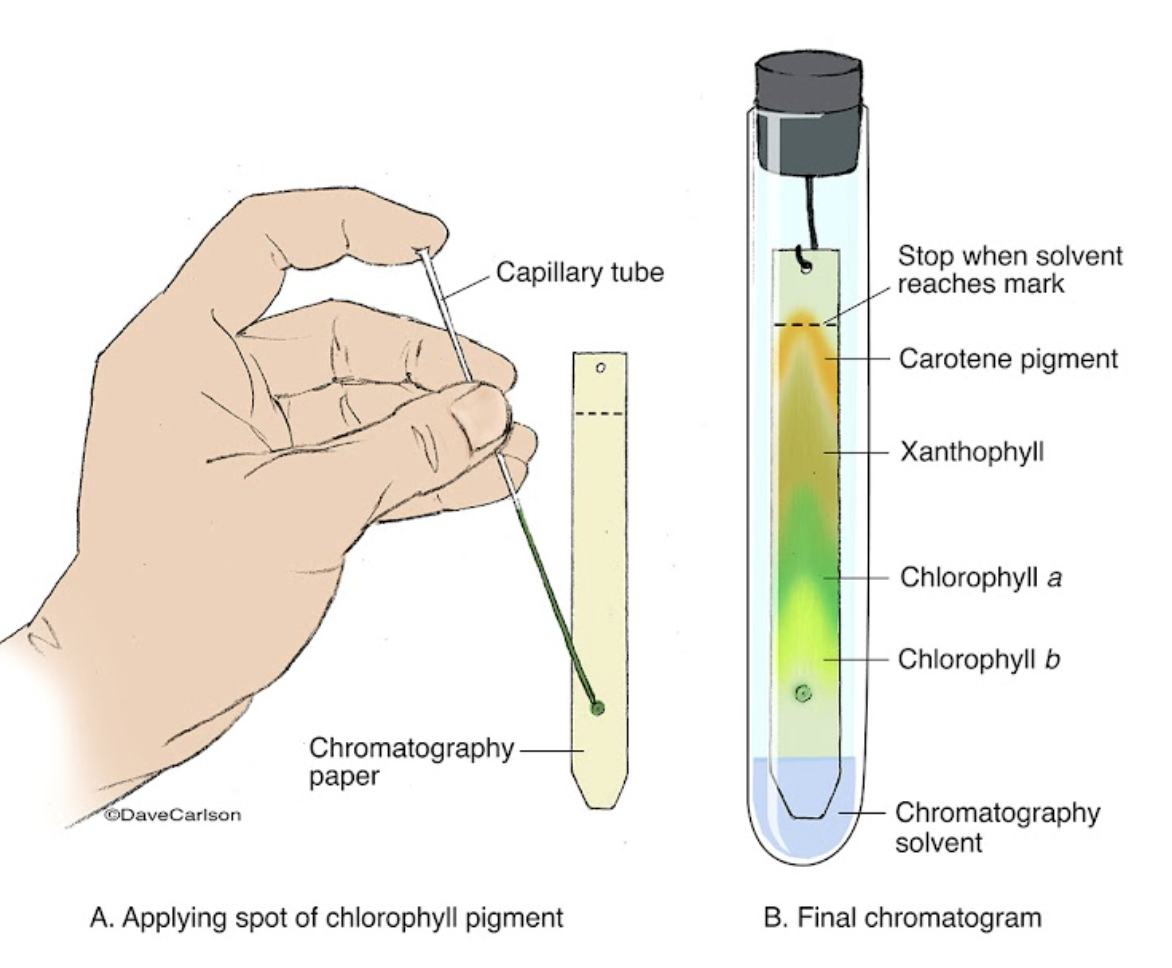
42. When performing paper chromatography on plant pigments, which observation correctly explains the separation of pigments?
A. All pigments remain at the origin because they have the same solubility in the solvent.
B. Pigments separate based on differences in solubility and affinity for the paper, with more soluble pigments traveling farther.
C. Pigments move randomly on the paper, so their position has no relation to chemical properties.
D. Pigments separate only because of gravity pulling heavier molecules downward.
B. Pigments separate based on differences in solubility and affinity for the paper, with more soluble pigments traveling farther.
43. Students set up an experiment to measure the rate of photosynthesis in Elodea plants by counting oxygen bubbles produced over 10 minutes. They place the light source at three distances: 10 cm, 30 cm, and 50 cm from the plant. The results show the highest bubble count at 10 cm and the lowest at 50 cm.
What is the best explanation for these observations?
A. Light intensity decreases as distance increases, reducing the energy available for photosynthesis.
B. Photosynthesis occurs faster at greater distances because plants avoid light stress.
C. Light distance has no effect; bubble count differences are due to random error.
D. Oxygen bubbles are produced by respiration, not photosynthesis.
A. Light intensity decreases as distance increases, reducing the energy available for photosynthesis.
44. Students set up two groups of aquatic plants in sealed containers with CO₂ indicators (phenol red). One group is placed under bright light, and the other is kept in complete darkness for 6 hours. At the end of the experiment, the CO₂ indicator shows a decrease in CO₂ in the light group and an increase in CO₂ in the dark group.
What is the best explanation for these observations?
1/1
A. Light promotes carbon fixation during photosynthesis, reducing CO₂ levels, while darkness prevents carbon fixation and allows respiration to increase CO₂.
B. Darkness accelerates photosynthesis, causing more CO₂ to be consumed.
C. Light has no effect on carbon fixation; the changes are due to temperature differences.
D. Both groups fix carbon equally, but the indicator is faulty.
A. Light promotes carbon fixation during photosynthesis, reducing CO₂ levels, while darkness prevents carbon fixation and allows respiration to increase CO₂.
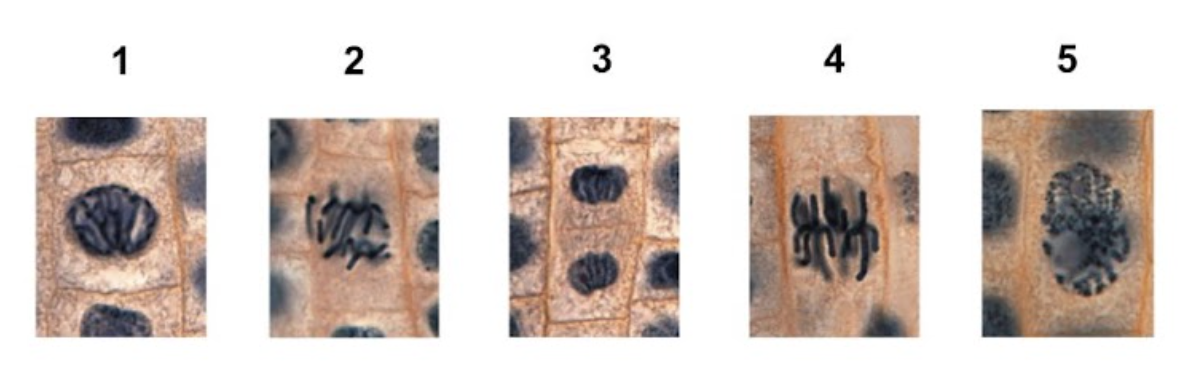
45. Observe the micrographs of the onion root tip below. Which of the following places the images in the correct order of mitosis?
A. 1 = Prophase, 2 = Pro-metaphase, 3 = Metaphase, 4 = Anaphase, 5 = Telophase
B. 1 = Anaphase, 2 = Metaphase, 3 = Pro-metaphase, 4 = Telophase, 5 = Prophase
C. 1 = Pro-metaphase, 2 = Anaphase, 3 = Telophase, 4 = Metaphase, 5 = Prophase
D. 1 = Metaphase, 2 = Pro-metaphase, 3 = Prophase, 4 = Anaphase, 5 = Telophase
C. 1 = Pro-metaphase, 2 = Anaphase, 3 = Telophase, 4 = Metaphase, 5 = Prophase
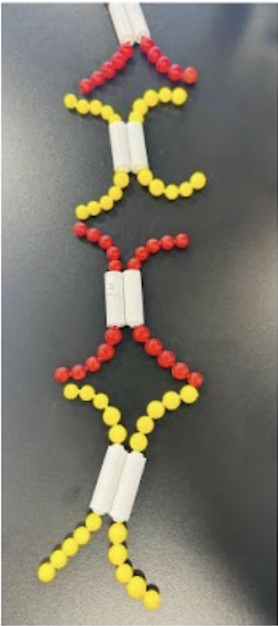
46. A student at Columbus State Community College is using pop-beads to model mitosis. Observe the image below. Which stage of mitosis is being modeled with the pop beads?
A. Prophase
B. Telophase
C. Anaphase
D. Metaphase
D. Metaphase
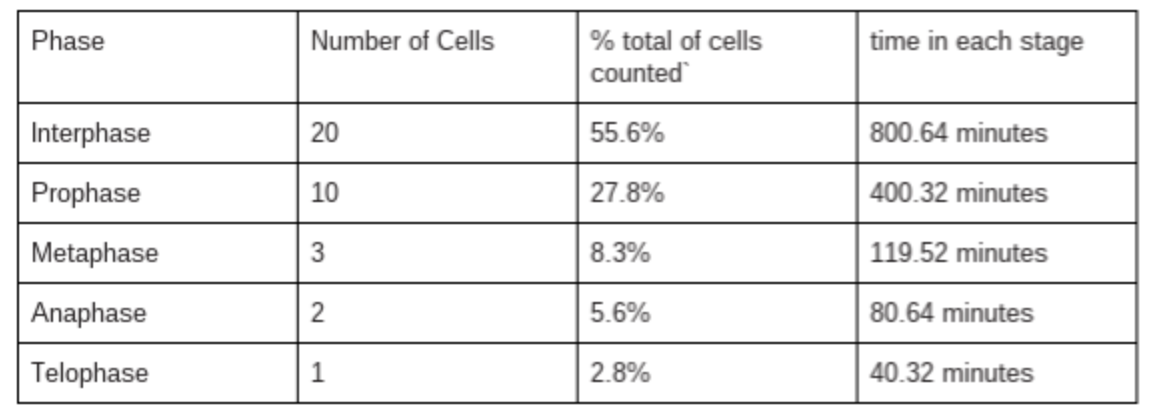
47. Observe the table below. Which of the following is the longest phase of the cell cycle?
A. Interphase
B. Prophase
C. Metaphase
D. Telophase
A. Interphase
48. Why are restriction enzymes essential tools in recombinant DNA technology?
A. They randomly cut DNA into fragments of different sizes for sequencing.
B. They cut DNA at specific recognition sites, allowing scientists to insert or remove genes precisely.
C. They synthesize new DNA strands to replace damaged ones.
D. They join two unrelated DNA molecules without any sequence specificity.
B. They cut DNA at specific recognition sites, allowing scientists to insert or remove genes precisely.
49. What is the primary principle behind DNA separation during gel electrophoresis?
A. DNA fragments move through the gel according to their size, with smaller fragments traveling farther toward the positive electrode.
B. DNA fragments are separated based on their color and chemical composition.
C. DNA fragments are sorted by their ability to replicate during the process.
D. DNA fragments remain stationary while the gel moves around them.
A. DNA fragments move through the gel according to their size, with smaller fragments traveling farther toward the positive electrode.
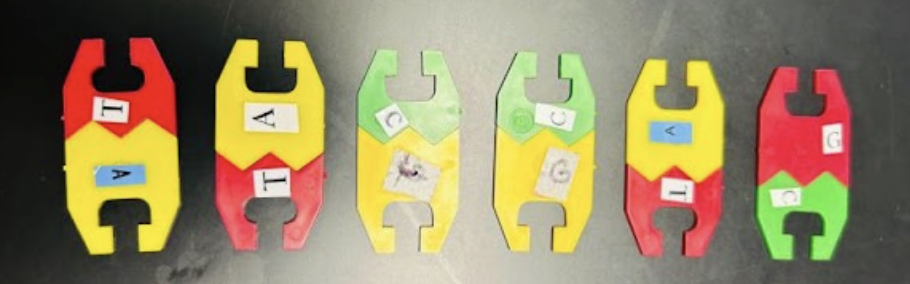
50. A student is using a kit to model DNA replication. Observe the image below. What molecule is responsible for adding complementary base pairs to the template strand, forming the new daughter strand?
A. Helicase
B. Primase
C. DNA polymerase
D. Singl strand binding proteins
C. DNA polymerase
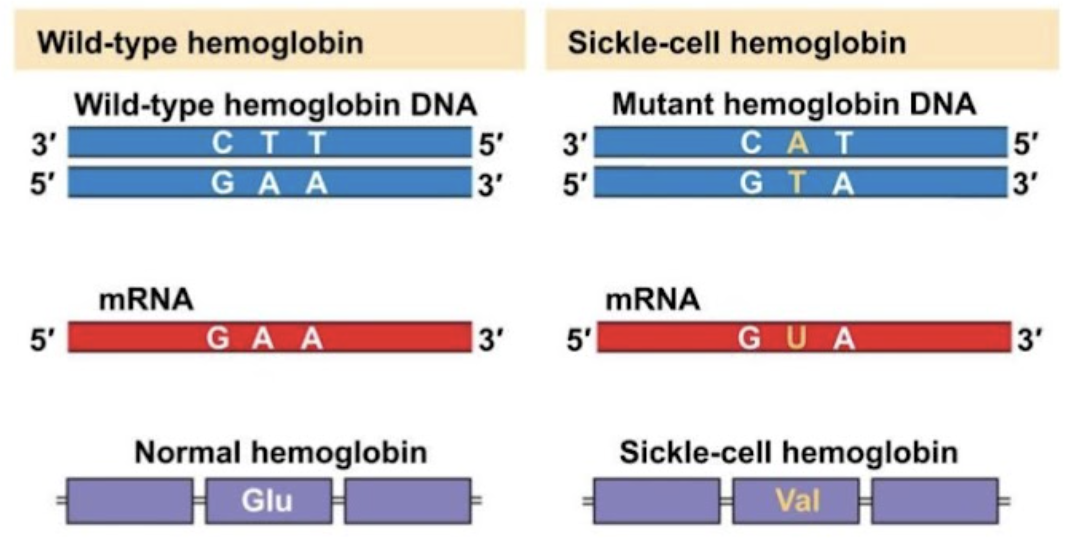
51. Observe the image below. How does the point mutation affect the shape of red blood cells?
A. The red blood cells will be round or bioconcave
B. The red blood cells will be sickled or crescent shaped
C. The red blood cells will be polygonal
D. None of the above are correct
B. The red blood cells will be sickled or crescent shaped
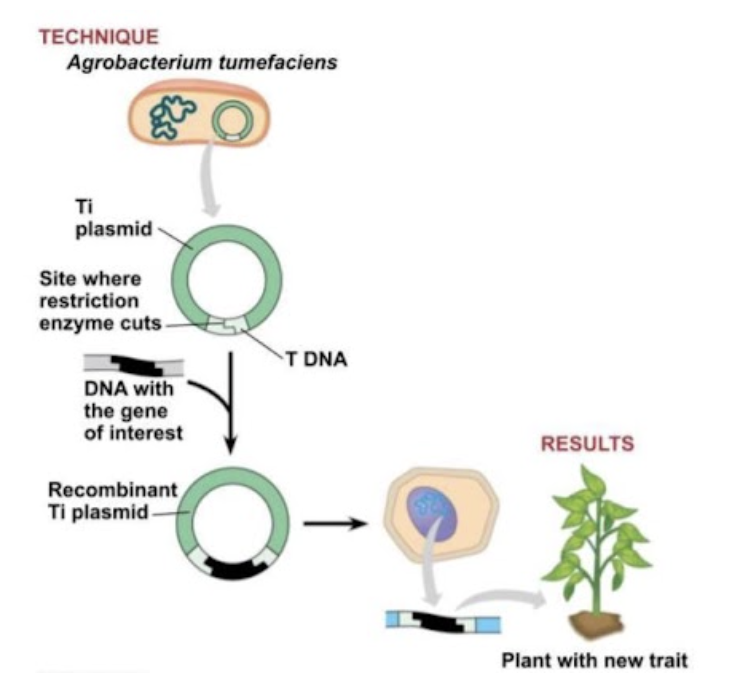
52. Why is the Ti plasmid from Agrobacterium tumefaciens useful in creating genetically modified plants?
A. It naturally transfers a segment of DNA (T-DNA) into plant cells, which scientists can replace with desired genes.
B. It produces proteins that directly change plant traits without altering DNA.
C. It only works in animals, so scientists use it as a model for plant modification.
D. It is used to increase the amount of chlorophyll in plants by adding extra chloroplasts.
A. It naturally transfers a segment of DNA (T-DNA) into plant cells, which scientists can replace with desired genes.
53. Which of the following best describes the correct sequence and technique for preparing and running a gel electrophoresis experiment?
A. Use a micropipette without changing tips between samples, load the gel wells quickly to avoid sample diffusion, and run the gel at high voltage for faster results.
B. Use a micropipette with a fresh tip for each sample, load samples slowly and carefully into the wells to avoid puncturing the gel, and run the gel at recommended voltage to ensure proper separation.
C. Use a micropipette with the same tip for all samples, load the gel wells from the top without inserting the tip into the well, and run the gel at low voltage to prevent overheating.
D. Use a micropipette with a fresh tip only for the first sample, load the gel quickly to minimize time, and run the gel at maximum voltage for sharper bands.
B. Use a micropipette with a fresh tip for each sample, load samples slowly and carefully into the wells to avoid puncturing the gel, and run the gel at recommended voltage to ensure proper separation.
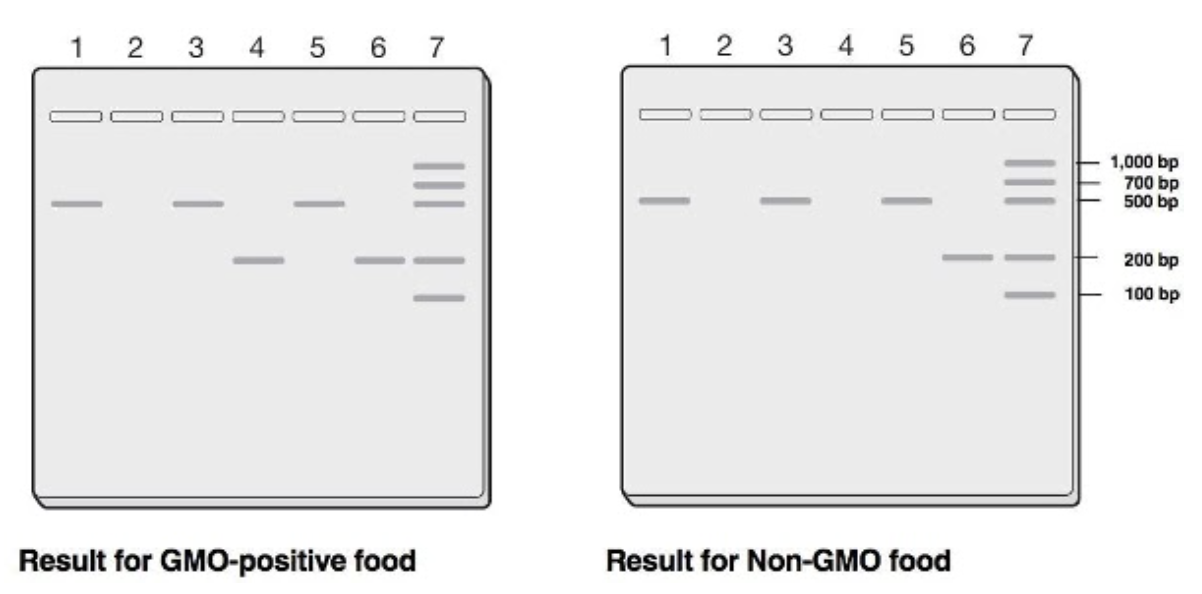
54. A student at Columbus State Community College is using gel electrophoresis to identify genetically modified food products with amplified DNA sequences. Observe their results in the image below.
Which of the following best describe the result of the experiment?
A. Lane 4 contains a GMO sample that is about 200 bps long
B. Lane 6 contains a non-GMO sample that is about 500 bps long
C. Lane 7 contains a GMO sample that is about 1,000 bps long
D. None of the above accurately describes the results of the experiment
A. Lane 4 contains a GMO sample that is about 200 bps long
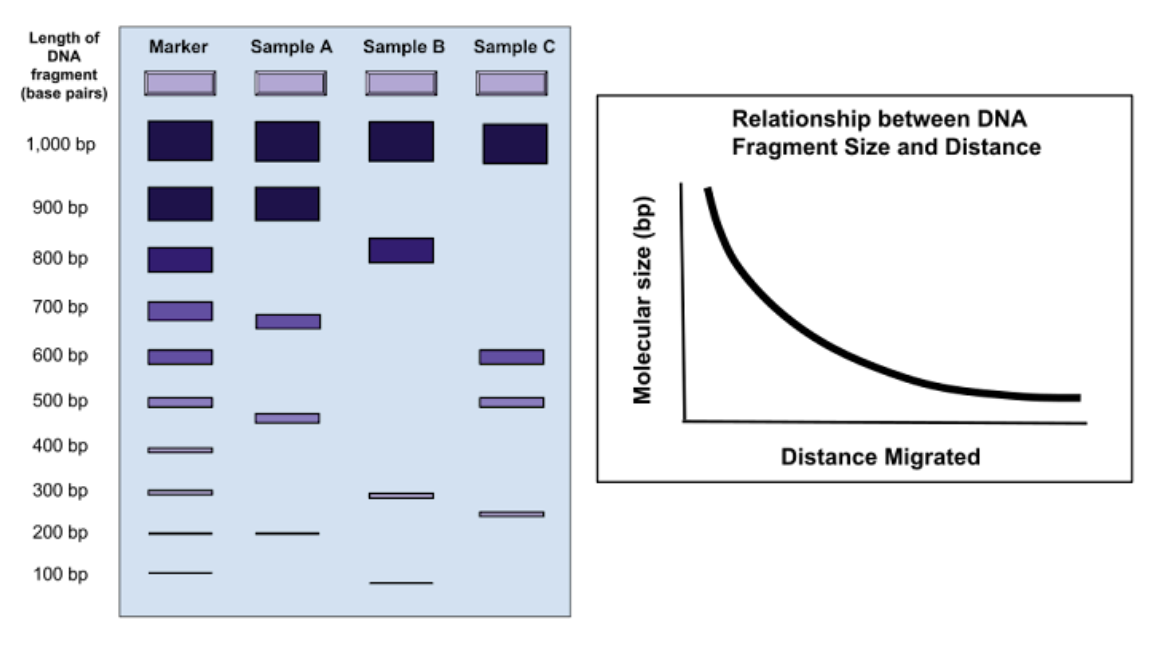
55. A student is analyzing the results of a gel electrophoresis and plots the relationship between DNA fragment size and distance. Observe the image below. What can be inferred from this data?
A. Larger segments of DNA travel shorter distances in the gel
B. Larger segments of DNA travel farther distances in the gel
C. Shorter segments of DNA travel shorter distances in the gel
D. None of the above is correct
A. Larger segments of DNA travel shorter distances in the gel
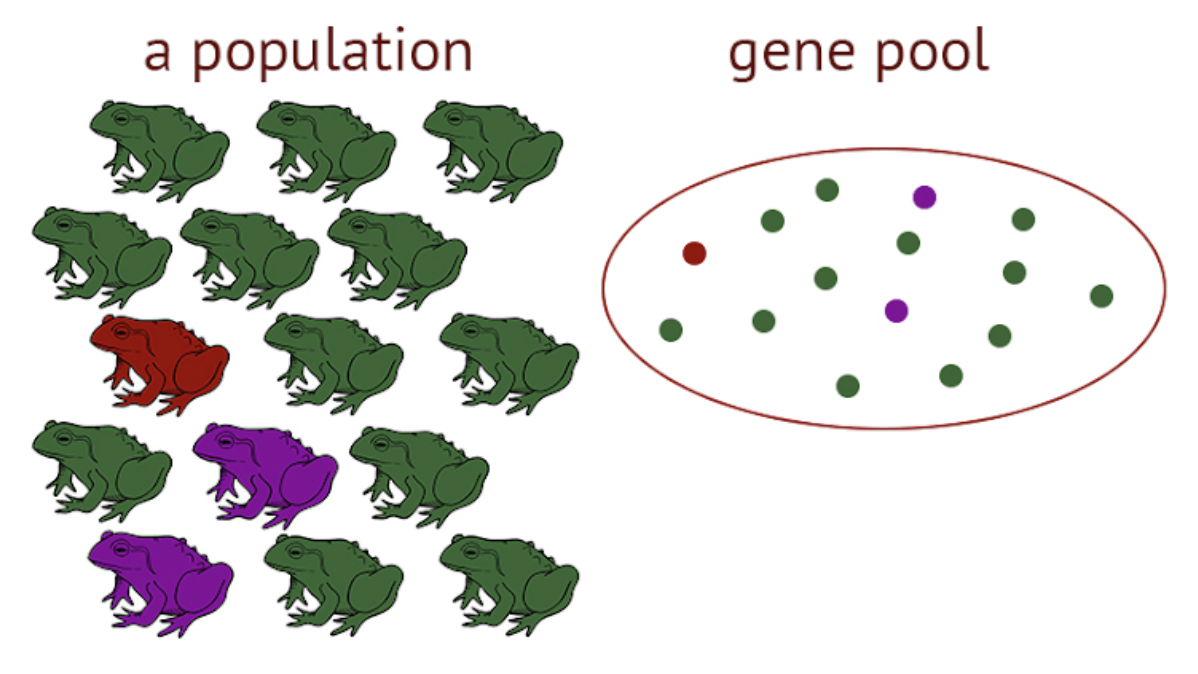
57. Observe the image below. What percentage of the gene pool consists of purple frogs?
A. 1/15
B. 4/15
C. 3/15
D. 2/15
D. 2/15
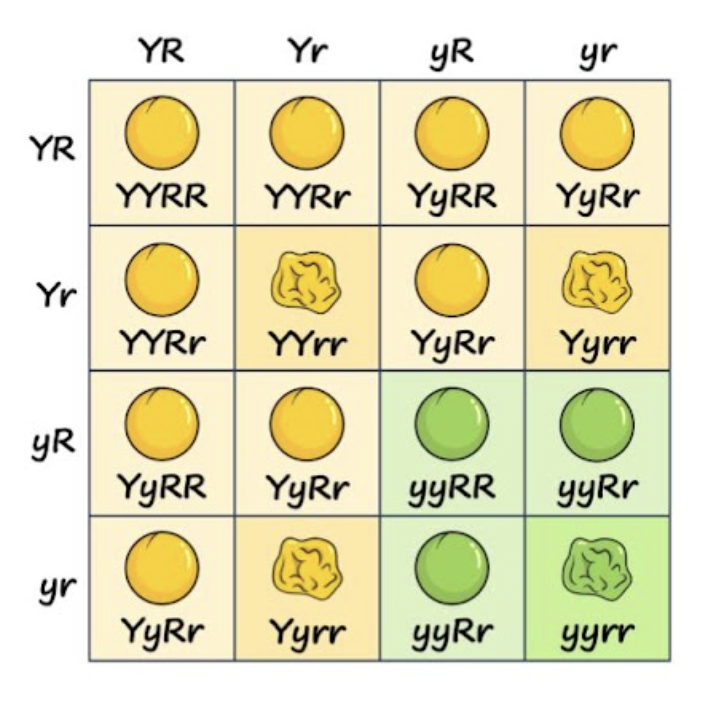
58. What is the phenotypic ratio shown in the dihybrid cross below?
A. 3:1:1:2
B. 9:3:3:1
C. 9:1:1:3
D. 6:9:3:1
B. 9:3:3:1
59. A biology class planted 80 pea plants and expected a 3:1 ratio of green to yellow seeds. They observed 62 green seeds and 18 yellow seeds. Which statement best describes the purpose of the Chi-Square test in this situation?
A. To calculate the average number of seeds per plant
B. To measure the correlation between seed color and plant height
C. To find the probability that green seeds are more nutritious than yellow seeds
D. To determine if the observed ratio is significantly different from the expected ratio
D. To determine if the observed ratio is significantly different from the expected ratio
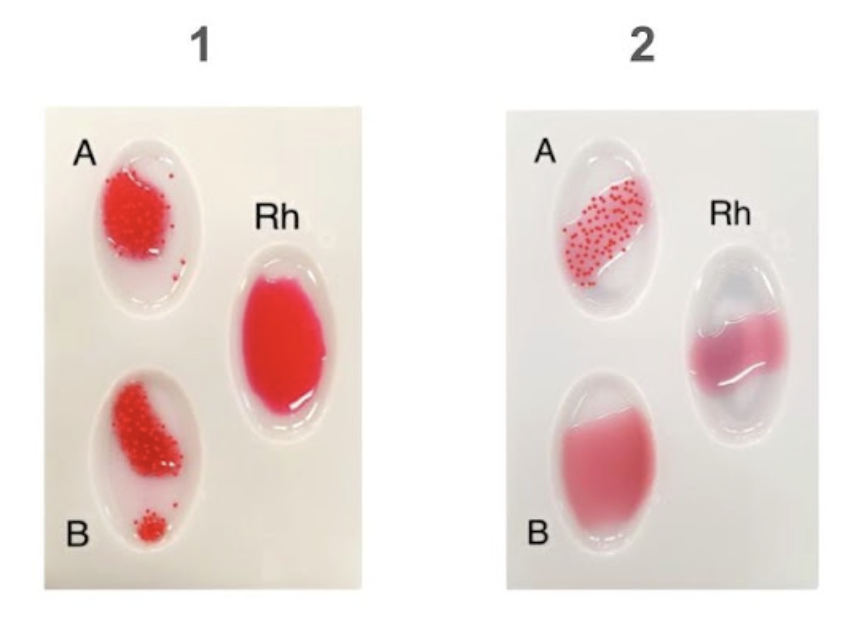
60. Observe the results from a blood typing experiment below. Which of the following statements is correct regarding the samples?
A. 1 = AB negative, 2 = A negative
B. 1 = A negative, 2 = AB positive
C. 1 = O negative, 2 = A positive
D. 1 = O positive, 2 = A negative
A. 1 = AB negative, 2 = A negative
61. In a population of 200 rabbits, the allele for black fur (B) is dominant over the allele for white fur (b). If 32 rabbits have white fur, what is the estimated frequency of the b allele under Hardy-Weinberg equilibrium?
A. 0.20
B. 0.40
C. 0.60
D. 0.80
B. 0.40
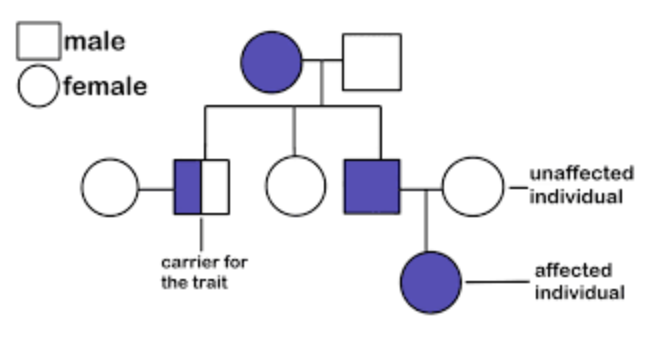
62. In the pedigree below, shaded symbols represent individuals with a genetic disorder. The disorder appears in every generation and affects both males and females equally. What is the most likely mode of inheritance?
A. Autosomal dominant
B. Autosomal recessive
C. X-linked recessive
D. X-linked dominant
A. Autosomal dominant
63. A Student at Columbus State Community College is isolating (extracting) strawberry DNA using the spooling method. During DNA isolation using the spooling method, which observation best indicates the presence of DNA?
A. A clear liquid with no visible strands forms at the top of the solution.
B. Thin, stringy, white fibers spool around a glass rod when gently lifted from the alcohol layer.
C. Bubbles form in the solution, indicating a chemical reaction.
D. The solution turns blue, showing the presence of proteins.
B. Thin, stringy, white fibers spool around a glass rod when gently lifted from the alcohol layer.
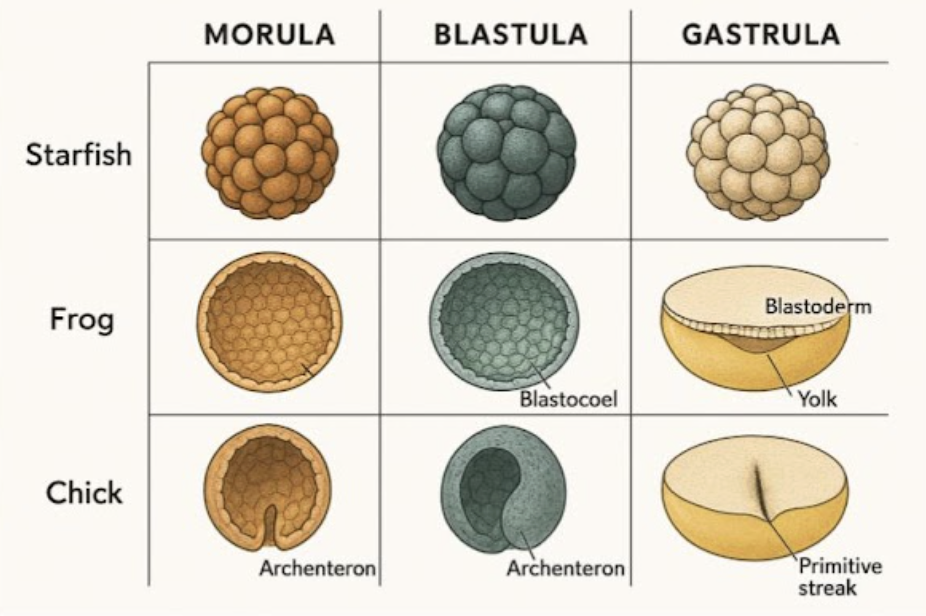
64. Observe the image below. Which statement correctly compares the morula, blastula, and gastrula stages in starfish, frogs, and chicks?
A. The morula stage in all three organisms consists of a solid ball of cells, while the blastula stage introduces a cavity (blastocoel) in starfish and frogs but not in chicks.
B. The gastrula stage in chicks is characterized by the formation of the primitive streak, whereas in starfish and frogs it involves archenteron development.
C. In frogs, the blastula contains a large yolk and no blastocoel, unlike starfish and chicks.
D. Both A and B are correct
D. Both A and B are correct
65. How does the amount of yolk in an egg affect the pattern of embryonic development?
A. Eggs with little yolk (e.g., starfish) undergo complete and equal cleavage, forming a uniform blastula.
B. Eggs with moderate yolk (e.g., frogs) exhibit unequal cleavage, with larger cells near the vegetal pole.
C. Eggs with large yolk (e.g., chicks) show meroblastic cleavage, where only a small disc of cytoplasm divides.
D. All of the above are correct
D. All of the above are correct
66. Which of the following correctly matches an embryonic germ layer with one of its primary derivatives?
A. Ectoderm – Skeletal muscles
B. Mesoderm – Nervous system
C. Endoderm – Lining of the digestive tract
D. Mesoderm – Epidermis of the skin
C. Endoderm – Lining of the digestive tract
67. Instead of a placenta, which is found in mammals, birds rely on what structure for nutrient uptake in embryonic development?
A. Amnion
B. Chorion
C. Allantois
D. Yolk sac
D. Yolk sac
68. Which of the following correctly associates the extra-embryonic tissue with its function?
A. Yolk Sac: The outermost layer that encloses all the other membranes and contributes to the formation of the placenta in mammals.
B. Allantois: Surrounds the yolk, providing nourishment to the embryo.
C. Amnion: Encloses the embryo in a fluid-filled sac that cushions it.
D. Chorion: Stores waste products and assists in gas exchange.
C. Amnion: Encloses the embryo in a fluid-filled sac that cushions it.
69. Which of the following correctly describes the role of somites during later embryonic development?
A) They give rise to the neural tube and brain structures
B) They form segments that develop into vertebrae, skeletal muscles, and dermis
C) They differentiate into the endodermal lining of the gut
D) They contribute to the formation of the placenta
B) They form segments that develop into vertebrae, skeletal muscles, and dermis
70. Observe the micrographs of chicken embryonic development. Which of the following correctly describes a key stage in chick embryonic development?
A. The primitive streak forms during gastrulation, establishing the body axis.
B. The blastoderm develops into the yolk sac, which later becomes the embryo.
C. Organogenesis occurs before gastrulation in the chick embryo.
D. The amnion and chorion are absent in avian embryos because they develop externally.
A. The primitive streak forms during gastrulation, establishing the body axis.