3 p1

0.0(0)
Studied by 0 people
call kaiCall Kai
Locked
learnLearn
examPractice Test
spaced repetitionSpaced Repetition
heart puzzleMatch
flashcardsFlashcards
GameKnowt Play
Card Sorting

1/32

encourage image

There's no tags or description

Looks like no tags are added yet.

Last updated 2:03 PM on 7/1/26
Name
Mastery
Learn
Test
Matching
Spaced
Call with Kai
Chat

No analytics yet

Send a link to your students to track their progress

33 Terms

1
New cards

What is a Chemical Bond?

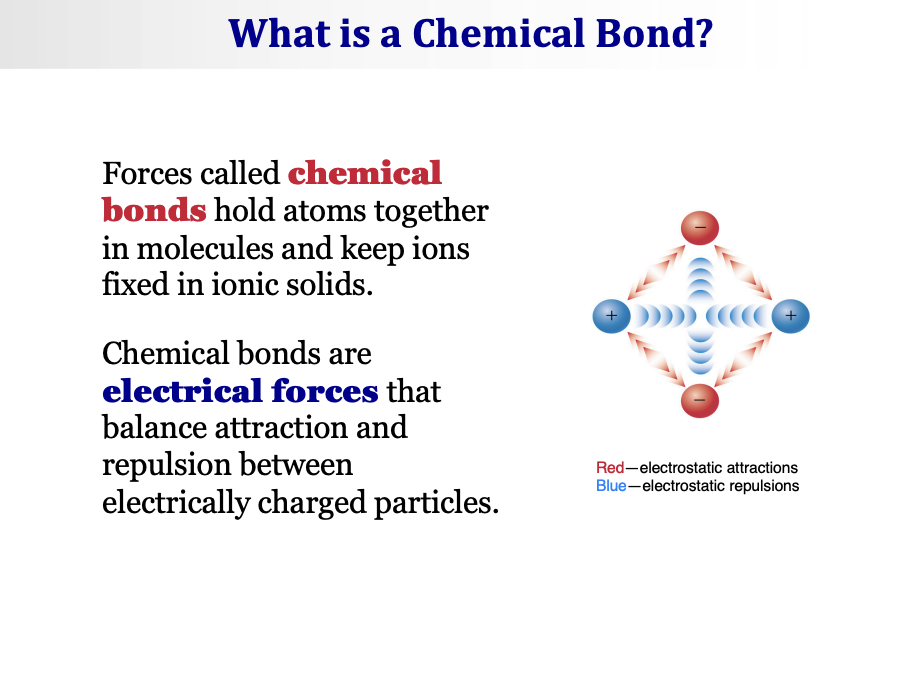
  • Forces called chemical bonds hold atoms together in molecules and keep ions fixed in ionic solids.

  • Chemical bonds are electrical forces that balance attraction and repulsion between electrically charged particles.

  • In a bond diagram:

    • Red = electrostatic attractions (opposite charges pulling toward each other)

    • Blue = electrostatic repulsions (same charges pushing away)


Think of it like magnets — opposite poles attract, same poles repel. A bond forms when attraction wins over repulsion.
<ul><li><p><span><strong>Forces called chemical bonds</strong> hold atoms together in molecules and keep ions fixed in ionic solids.</span></p></li><li><p><span><strong>Chemical bonds are electrical forces</strong> that balance attraction and repulsion between electrically charged particles.</span></p></li><li><p><span>In a bond diagram:</span></p><ul><li><p><span><strong>Red</strong> = electrostatic attractions (opposite charges pulling toward each other)</span></p></li><li><p><span><strong>Blue</strong> = electrostatic repulsions (same charges pushing away)</span></p></li></ul></li></ul><p>&nbsp;</p><p>Think of it like magnets — opposite poles attract, same poles repel. A bond forms when attraction wins over repulsion.</p>
2
New cards

 Chemical Bond Formation

  • The overwhelming majority of elements occur in compounds, that is, in chemical combination with other elements.

  • A chemical bond forms if the energy of the bonded atoms is lower than that of the separate atoms. (Lower energy = more stable = bonds want to form.)

  • If the lowest energy can be achieved by ion formation (transferring electrons between interacting atoms), then the bonding will be ionic.

  • If the lowest energy can be reached by electron sharing, then the bonding will be covalent.

  • We call a compound covalent (or molecular) if it is made up of molecules and ionic if it is made up of oppositely charged ions positioned in a huge lattice.

3
New cards

Molecules Can Be Represented Using…

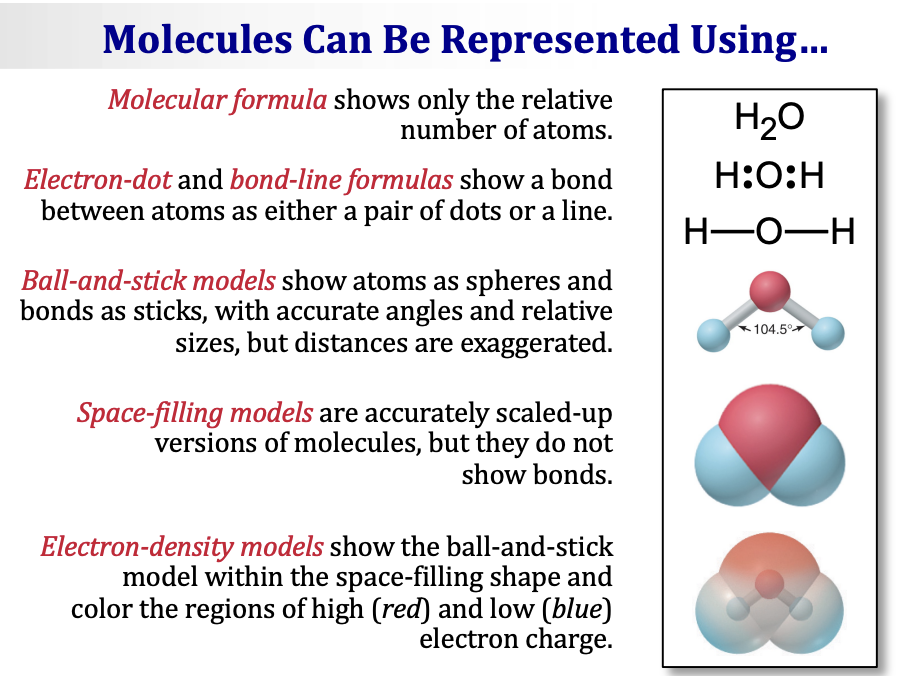
There are 5 ways to represent a molecule (example: water, H₂O):

  • Molecular formula — shows only the relative number of atoms. (H₂O)

  • Electron-dot and bond-line formulas — show a bond between atoms as either a pair of dots or a line. (H:O:H or H—O—H)

  • Ball-and-stick models — show atoms as spheres and bonds as sticks, with accurate angles and relative sizes, but distances are exaggerated.

  • Space-filling models — are accurately scaled-up versions of molecules, but they do not show bonds.

  • Electron-density models — show the ball-and-stick model within the space-filling shape and color the regions of high (red) and low (blue) electron charge.
<p>There are 5 ways to represent a molecule (example: water, H₂O):</p><ul><li><p><span><strong>Molecular formula</strong> — shows only the relative number of atoms. (H₂O)</span></p></li><li><p><span><strong>Electron-dot and bond-line formulas</strong> — show a bond between atoms as either a pair of dots or a line. (H:O:H or H—O—H)</span></p></li><li><p><span><strong>Ball-and-stick models</strong> — show atoms as spheres and bonds as sticks, with accurate angles and relative sizes, but distances are exaggerated.</span></p></li><li><p><span><strong>Space-filling models</strong> — are accurately scaled-up versions of molecules, but they do not show bonds.</span></p></li><li><p><span><strong>Electron-density models</strong> — show the ball-and-stick model within the space-filling shape and color the regions of high (<em>red</em>) and low (<em>blue</em>) electron charge.</span></p></li></ul><p></p>
4
New cards

Covalent Bonding

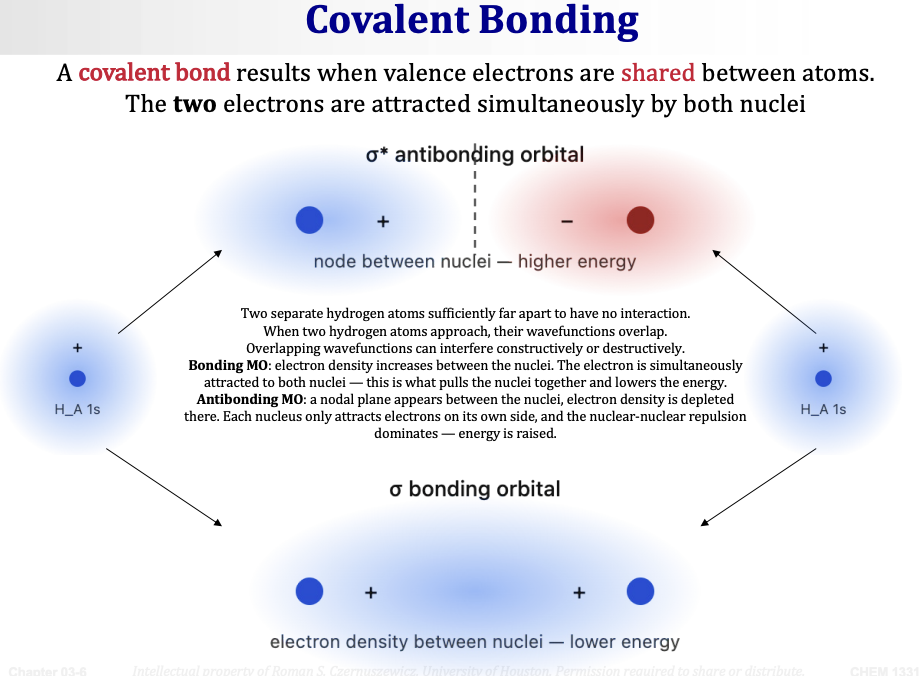
  • A covalent bond results when valence electrons are shared between atoms. The two electrons are attracted simultaneously by both nuclei.


How it works (using two hydrogen atoms as an example):

  • Two separate hydrogen atoms are sufficiently far apart to have no interaction.

  • When two hydrogen atoms approach, their wavefunctions overlap.

  • Overlapping wavefunctions can interfere constructively or destructively.


Two outcomes when orbitals overlap:

Bonding MO (σ bonding orbital): electron density increases between the nuclei. The electron is simultaneously attracted to both nuclei — this is what pulls the nuclei together and lowers the energy. (Good — this is the bond!)


Antibonding MO (σ antibonding orbital):* a nodal plane appears between the nuclei, electron density is depleted there. Each nucleus only attracts electrons on its own side, and the nuclear-nuclear repulsion dominates — energy is raised. (Bad — this destabilizes the bond.)


<ul><li><p><span>A <strong>covalent bond</strong> results when valence electrons are <strong>shared</strong> between atoms. The <strong>two</strong> electrons are attracted simultaneously by both nuclei.</span></p></li></ul><p>&nbsp;</p><p>How it works (using two hydrogen atoms as an example):</p><ul><li><p><span>Two separate hydrogen atoms are sufficiently far apart to have no interaction.</span></p></li><li><p><span>When two hydrogen atoms approach, their <strong>wavefunctions overlap.</strong></span></p></li><li><p><span>Overlapping wavefunctions can interfere <strong>constructively</strong> or <strong>destructively.</strong></span></p></li></ul><p>&nbsp;</p><p>Two outcomes when orbitals overlap:</p><p><span><strong>Bonding MO (σ bonding orbital):</strong></span> electron density <span><strong>increases between the nuclei.</strong></span> The electron is simultaneously attracted to both nuclei — this is what pulls the nuclei together and <span><strong>lowers the energy.</strong></span> (Good — this is the bond!)</p><p>&nbsp;</p><p><span><em>Antibonding MO (σ antibonding orbital):</em></span>* a <span><strong>nodal plane appears between the nuclei</strong></span>, electron density is depleted there. Each nucleus only attracts electrons on its own side, and the nuclear-nuclear repulsion dominates — <span><strong>energy is raised.</strong></span> (Bad — this destabilizes the bond.)</p><p>&nbsp;</p><p>&nbsp;</p>
5
New cards

Stability of Atoms in Covalent Bonding

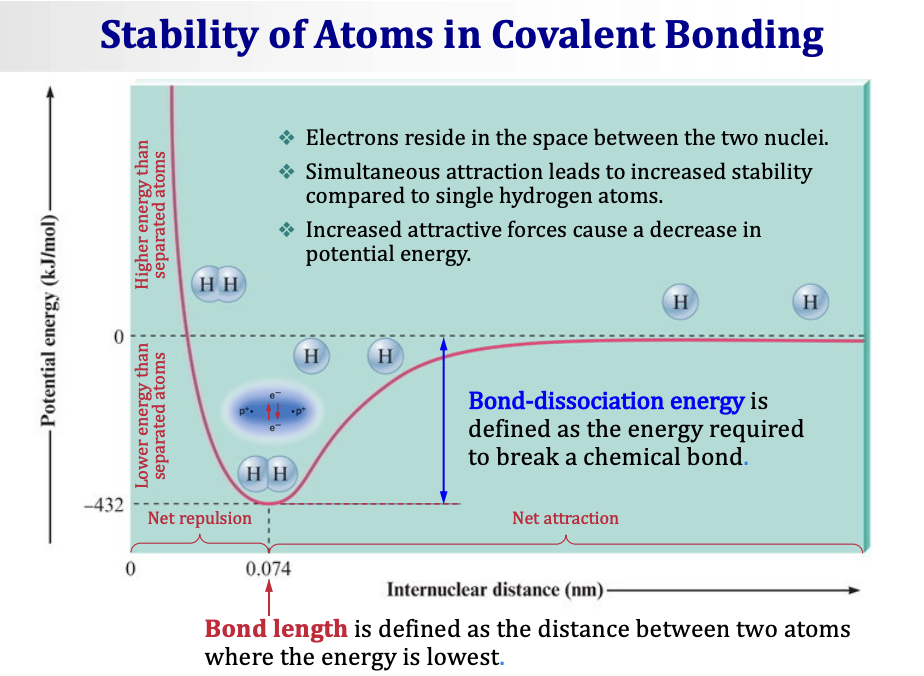
  • Electrons reside in the space between the two nuclei.

  • Simultaneous attraction leads to increased stability compared to single hydrogen atoms.

  • Increased attractive forces cause a decrease in potential energy.


Key definitions from the energy diagram (a curve that dips down to a minimum):

  • Bond length — defined as the distance between two atoms where the energy is lowest. For H₂ this is 0.074 nm.

  • Bond-dissociation energy — defined as the energy required to break a chemical bond. For H₂ this is 432 kJ/mol.


When the atoms are too close together → net repulsion → energy goes up. When the atoms are too far apart → net attraction → energy approaches zero. At the right distance (bond length) → lowest energy → most stable.
<ul><li><p><span>Electrons reside in the <strong>space between the two nuclei.</strong></span></p></li><li><p><span>Simultaneous attraction leads to <strong>increased stability</strong> compared to single hydrogen atoms.</span></p></li><li><p><span>Increased attractive forces cause a <strong>decrease in potential energy.</strong></span></p></li></ul><p>&nbsp;</p><p>Key definitions from the energy diagram (a curve that dips down to a minimum):</p><ul><li><p><span><strong>Bond length</strong> — defined as the <strong>distance between two atoms where the energy is lowest.</strong> For H₂ this is <strong>0.074 nm.</strong></span></p></li><li><p><span><strong>Bond-dissociation energy</strong> — defined as the <strong>energy required to break a chemical bond.</strong> For H₂ this is <strong>432 kJ/mol.</strong></span></p></li></ul><p>&nbsp;</p><p>When the atoms are too close together → net repulsion → energy goes up. When the atoms are too far apart → net attraction → energy approaches zero. At the right distance (bond length) → lowest energy → most stable.</p>
6
New cards

Ionic Bonds

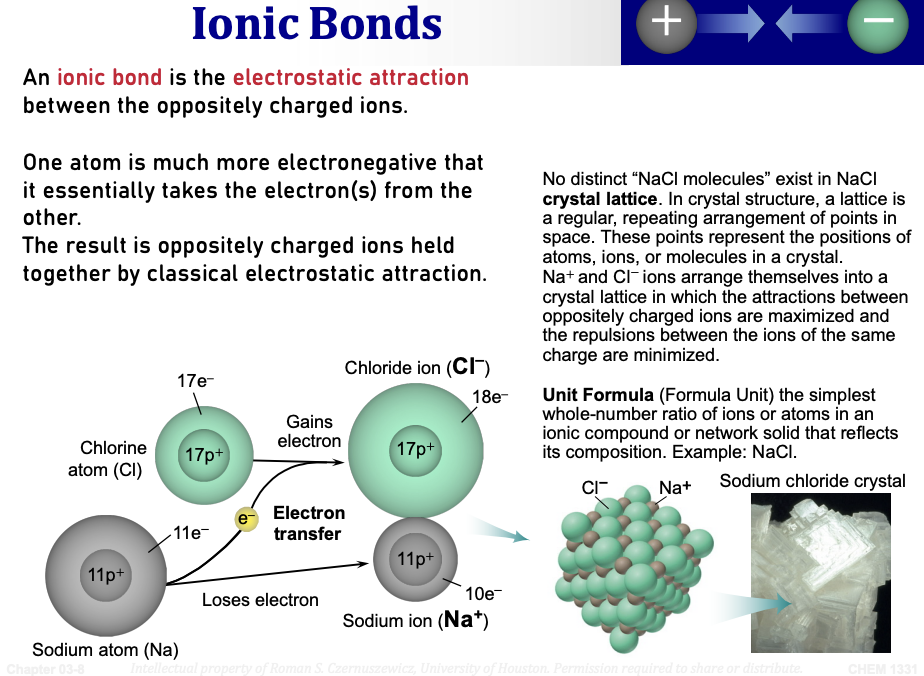
  • An ionic bond is the electrostatic attraction between the oppositely charged ions.

  • One atom is much more electronegative that it essentially takes the electron(s) from the other.

  • The result is oppositely charged ions held together by classical electrostatic attraction.


Example: Sodium chloride (NaCl)

  • Sodium atom (Na): 11p⁺, 11e⁻

  • Chlorine atom (Cl): 17p⁺, 17e⁻

  • Na loses 1 electron → becomes Na⁺ (11p⁺, 10e⁻)

  • Cl gains 1 electron → becomes Cl⁻ (17p⁺, 18e⁻)

  • Na⁺ and Cl⁻ attract each other → ionic bond forms


Crystal lattice: No distinct "NaCl molecules" exist in NaCl crystal lattice. In crystal structure, a lattice is a regular, repeating arrangement of points in space. These points represent the positions of atoms, ions, or molecules in a crystal.


  • Na⁺ and Cl⁻ ions arrange themselves into a crystal lattice in which the attractions between oppositely charged ions are maximized and the repulsions between the ions of the same charge are minimized.


Unit Formula (Formula Unit) — the simplest whole-number ratio of ions or atoms in an ionic compound or network solid that reflects its composition. Example: NaCl.
 

<ul><li><p><span>An <strong>ionic bond</strong> is the <strong>electrostatic attraction</strong> between the oppositely charged ions.</span></p></li><li><p><span>One atom is much more electronegative that it <strong>essentially takes the electron(s) from the other.</strong></span></p></li><li><p><span>The result is oppositely charged ions held together by <strong>classical electrostatic attraction.</strong></span></p></li></ul><p>&nbsp;</p><p><span><strong>Example: Sodium chloride (NaCl)</strong></span></p><ul><li><p><span>Sodium atom (Na): 11p⁺, 11e⁻</span></p></li><li><p><span>Chlorine atom (Cl): 17p⁺, 17e⁻</span></p></li><li><p><span>Na <strong>loses</strong> 1 electron → becomes <strong>Na⁺</strong> (11p⁺, 10e⁻)</span></p></li><li><p><span>Cl <strong>gains</strong> 1 electron → becomes <strong>Cl⁻</strong> (17p⁺, 18e⁻)</span></p></li><li><p><span>Na⁺ and Cl⁻ attract each other → <strong>ionic bond forms</strong></span></p></li></ul><p>&nbsp;</p><p><span><strong>Crystal lattice:</strong></span> No distinct "NaCl molecules" exist in NaCl crystal lattice. In crystal structure, a <span><strong>lattice</strong></span> is a regular, repeating arrangement of points in space. These points represent the positions of atoms, ions, or molecules in a crystal.</p><p>&nbsp;</p><ul><li><p><span>Na⁺ and Cl⁻ ions arrange themselves into a crystal lattice in which the <strong>attractions between oppositely charged ions are maximized</strong> and the <strong>repulsions between the ions of the same charge are minimized.</strong></span></p></li></ul><p>&nbsp;</p><p><span><strong>Unit Formula (Formula Unit)</strong></span> — the simplest whole-number ratio of ions or atoms in an ionic compound or network solid that reflects its composition. Example: NaCl.</p><p>&nbsp;</p>
7
New cards

Ionic Bonding

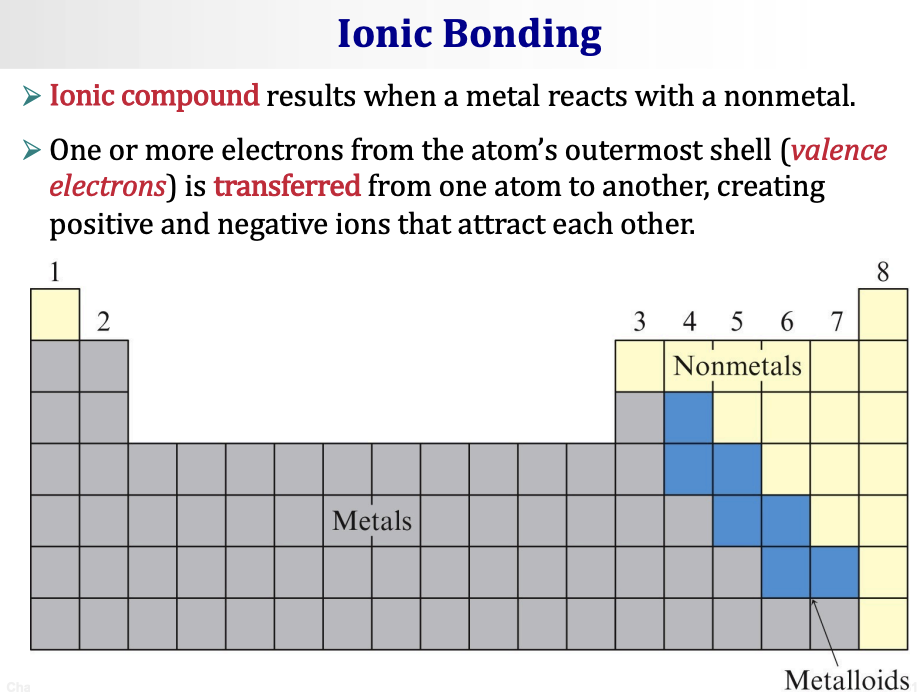
  • Ionic compound results when a metal reacts with a nonmetal.

  • One or more electrons from the atom's outermost shell (valence electrons) is transferred from one atom to another, creating positive and negative ions that attract each other.


On the periodic table:

  • Metals (left and middle) → give away electrons → form cations (positive ions)

  • Nonmetals (upper right) → receive electrons → form anions (negative ions)

  • Metalloids (the staircase border) — in between
<ul><li><p><span><strong>Ionic compound</strong> results when a <strong>metal reacts with a nonmetal.</strong></span></p></li><li><p><span>One or more electrons from the atom's outermost shell (<em>valence electrons</em>) is <strong>transferred</strong> from one atom to another, creating positive and negative ions that attract each other.</span></p></li></ul><p>&nbsp;</p><p>On the periodic table:</p><ul><li><p><span><strong>Metals</strong> (left and middle) → give away electrons → form <strong>cations</strong> (positive ions)</span></p></li><li><p><span><strong>Nonmetals</strong> (upper right) → receive electrons → form <strong>anions</strong> (negative ions)</span></p></li><li><p><span><strong>Metalloids</strong> (the staircase border) — in between</span></p></li></ul><p></p>
8
New cards

Coulomb's Law

Coulomb's Law is used to calculate the energy of interaction between ions:


E = (2.31 × 10⁻¹⁹ J·nm) (Q₁Q₂ / r)

  • E = energy of interaction (in joules)

  • Q₁, Q₂ = numerical charges of the ions (with sign: + or −)

  • r = distance between the ions (in nanometers)

The energy of attraction (or repulsion) between two ions is directly proportional to the product of their numerical charges (Q₁, Q₂) and inversely proportional to the distance between them (r in nm).


Example — Ionic energy per pair of ions in solid NaCl:


E = (2.31 × 10⁻¹⁹ J·nm) × [(1+)(1−) / 0.276 nm]

E = −8.37 × 10⁻¹⁹ J

Note the negative sign — indicating that the ion pair has lower energy than the separated ions. (Negative energy = more stable = bond wants to form.)


<p><span><strong>Coulomb's Law</strong></span> is used to calculate the energy of interaction between ions:</p><p>&nbsp;</p><p><span><strong>E = (2.31 × 10⁻¹⁹ J·nm) (Q₁Q₂ / r)</strong></span></p><ul><li><p><span><strong>E</strong> = energy of interaction (in joules)</span></p></li><li><p><span><strong>Q₁, Q₂</strong> = numerical charges of the ions (with sign: + or −)</span></p></li><li><p><span><strong>r</strong> = distance between the ions (in nanometers)</span></p></li></ul><p>The energy of attraction (or repulsion) between two ions is <span><strong>directly proportional to the product of their numerical charges (Q₁, Q₂)</strong></span> and <span><strong>inversely proportional to the distance between them (r in nm).</strong></span></p><p>&nbsp;</p><p><span><strong>Example — Ionic energy per pair of ions in solid NaCl:</strong></span></p><p>&nbsp;</p><p>E = (2.31 × 10⁻¹⁹ J·nm) × [(1+)(1−) / 0.276 nm]</p><p><span><strong>E = −8.37 × 10⁻¹⁹ J</strong></span></p><p>Note the <span><strong>negative sign</strong></span> — indicating that the ion pair has <span><strong>lower energy than the separated ions.</strong></span> (Negative energy = more stable = bond wants to form.)</p><p>&nbsp;</p>
9
New cards

Electronegativity — Section Goal

Goal: Understand the nature of bonds and their relationship to electronegativity.


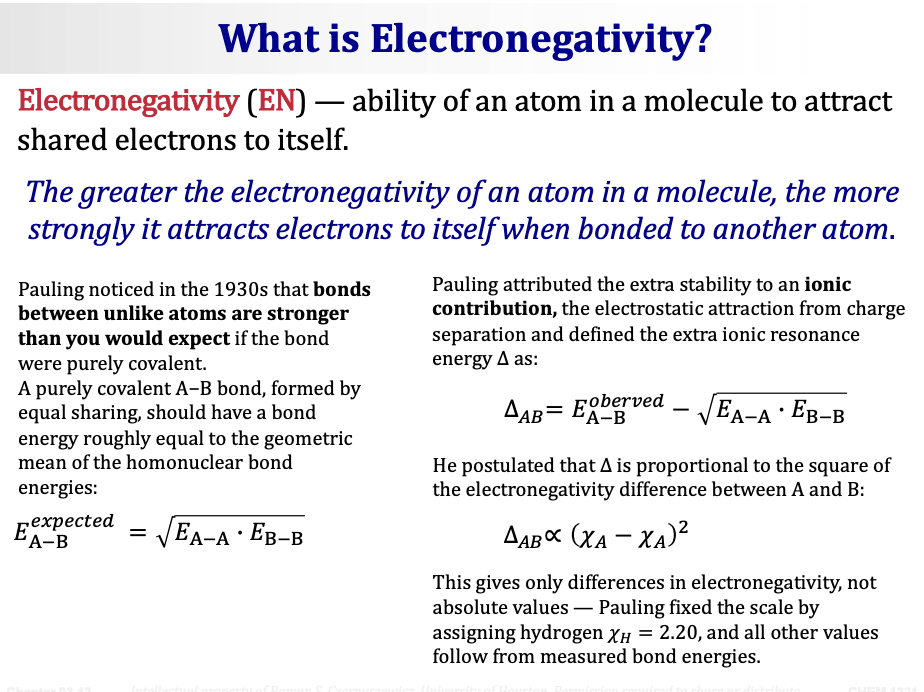
Electronegativity (EN) — ability of an atom in a molecule to attract shared electrons to itself.

The greater the electronegativity of an atom in a molecule, the more strongly it attracts electrons to itself when bonded to another atom.


How Pauling developed the EN scale:

  • Pauling noticed in the 1930s that bonds between unlike atoms are stronger than you would expect if the bond were purely covalent.

  • A purely covalent A−B bond, formed by equal sharing, should have a bond energy roughly equal to the geometric mean of the homonuclear bond energies:


E(expected) A−B = √(E(A−A) · E(B−B))

  • Pauling attributed the extra stability to an ionic contribution — the electrostatic attraction from charge separation — and defined the extra ionic resonance energy Δ as:


Δ(AB) = E(observed) A−B − √(E(A−A) · E(B−B))

  • He postulated that Δ is proportional to the square of the electronegativity difference between A and B:


Δ(AB) ∝ (χ_A − χ_B)²

  • This gives only differences in electronegativity, not absolute values — Pauling fixed the scale by assigning hydrogen χ_H = 2.20, and all other values follow from measured bond energies.
 

<p>Goal: Understand the <span><strong>nature of bonds and their relationship to electronegativity.</strong></span></p><p>&nbsp;</p><p>&nbsp;</p><p><span><strong>Electronegativity (EN)</strong></span> — ability of an atom <span><strong>in a molecule</strong></span> to attract shared electrons to itself.</p><p><span><em>The greater the electronegativity of an atom in a molecule, the more strongly it attracts electrons to itself when bonded to another atom.</em></span></p><p>&nbsp;</p><p><span><strong>How Pauling developed the EN scale:</strong></span></p><ul><li><p><span>Pauling noticed in the 1930s that <strong>bonds between unlike atoms are stronger than you would expect</strong> if the bond were purely covalent.</span></p></li><li><p><span>A purely covalent A−B bond, formed by equal sharing, should have a bond energy roughly equal to the <strong>geometric mean</strong> of the homonuclear bond energies:</span></p></li></ul><p>&nbsp;</p><p><span><strong>E(expected) A−B = √(E(A−A) · E(B−B))</strong></span></p><ul><li><p><span>Pauling attributed the extra stability to an <strong>ionic contribution</strong> — the electrostatic attraction from charge separation — and defined the extra ionic resonance energy Δ as:</span></p></li></ul><p>&nbsp;</p><p><span><strong>Δ(AB) = E(observed) A−B − √(E(A−A) · E(B−B))</strong></span></p><ul><li><p><span>He postulated that Δ is <strong>proportional to the square of the electronegativity difference</strong> between A and B:</span></p></li></ul><p>&nbsp;</p><p><span><strong>Δ(AB) ∝ (χ_A − χ_B)²</strong></span></p><ul><li><p><span>This gives only <strong>differences</strong> in electronegativity, not absolute values — Pauling fixed the scale by assigning hydrogen <strong>χ_H = 2.20</strong>, and all other values follow from measured bond energies.</span></p></li></ul><p>&nbsp;</p>
10
New cards

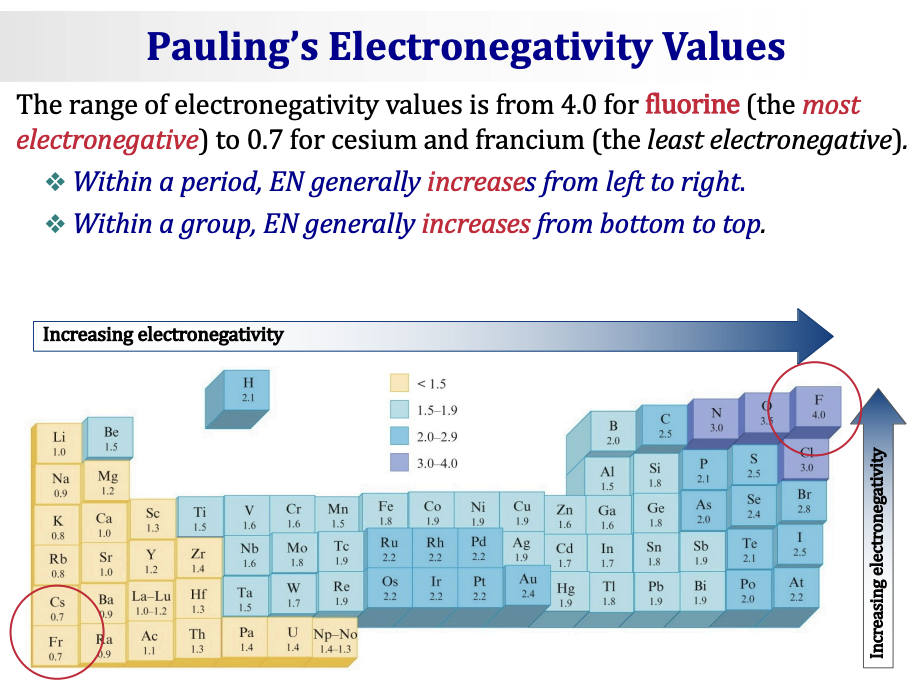
Pauling's Electronegativity Values

  • Atoms of the elements in the upper right of the periodic table — relatively small nonmetal atoms — attract bonding electrons most strongly: They have the greatest electronegativities.

  • Atoms of the elements towards the lower left of the table — relatively large metal atoms — have a weaker hold on electrons: They have the smallest electronegativities.

  • Electronegativities of the noble (inert) gases are zero. Why? Noble gases don't typically form bonds, so EN is not defined/meaningful for them.


Key EN values to know (Pauling scale):


Element

EN

F (fluorine)

4.0

O (oxygen)

3.5

N (nitrogen)

3.0

Cl (chlorine)

3.0

Br (bromine)

2.8

C (carbon)

2.5

S (sulfur)

2.5

H (hydrogen)

2.1

Cs / Fr

0.7

<ul><li><p><span>Atoms of the elements in the <strong>upper right of the periodic table</strong> — relatively small nonmetal atoms — attract bonding electrons most strongly: <em>They have the greatest electronegativities.</em></span></p></li><li><p><span>Atoms of the elements towards the <strong>lower left of the table</strong> — relatively large metal atoms — have a weaker hold on electrons: <em>They have the smallest electronegativities.</em></span></p></li><li><p><span><strong>Electronegativities of the noble (inert) gases are zero.</strong> Why? Noble gases don't typically form bonds, so EN is not defined/meaningful for them.</span></p></li></ul><p>&nbsp;</p><p>Key EN values to know (Pauling scale):</p><p>&nbsp;</p><table style="min-width: 50px;"><colgroup><col style="min-width: 25px;"><col style="min-width: 25px;"></colgroup><tbody><tr><td colspan="1" rowspan="1" style="border-width: 0pt; vertical-align: top; width: 1.0159in; padding: 4pt;"><p><span><strong>Element</strong></span></p></td><td colspan="1" rowspan="1" style="border-width: 0pt; vertical-align: top; width: 0.5548in; padding: 4pt;"><p><span><strong>EN</strong></span></p></td></tr><tr><td colspan="1" rowspan="1" style="border-width: 0pt; vertical-align: top; width: 1.0159in; padding: 4pt;"><p>F (fluorine)</p></td><td colspan="1" rowspan="1" style="border-width: 0pt; vertical-align: top; width: 0.5548in; padding: 4pt;"><p>4.0</p></td></tr><tr><td colspan="1" rowspan="1" style="border-width: 0pt; vertical-align: top; width: 1.0159in; padding: 4pt;"><p>O (oxygen)</p></td><td colspan="1" rowspan="1" style="border-width: 0pt; vertical-align: top; width: 0.5548in; padding: 4pt;"><p>3.5</p></td></tr><tr><td colspan="1" rowspan="1" style="border-width: 0pt; vertical-align: top; width: 1.0159in; padding: 4pt;"><p>N (nitrogen)</p></td><td colspan="1" rowspan="1" style="border-width: 0pt; vertical-align: top; width: 0.5548in; padding: 4pt;"><p>3.0</p></td></tr><tr><td colspan="1" rowspan="1" style="border-width: 0pt; vertical-align: top; width: 1.0159in; padding: 4pt;"><p>Cl (chlorine)</p></td><td colspan="1" rowspan="1" style="border-width: 0pt; vertical-align: top; width: 0.5548in; padding: 4pt;"><p>3.0</p></td></tr><tr><td colspan="1" rowspan="1" style="border-width: 0pt; vertical-align: top; width: 1.0298in; padding: 4pt;"><p>Br (bromine)</p></td><td colspan="1" rowspan="1" style="border-width: 0pt; vertical-align: top; width: 0.5409in; padding: 4pt;"><p>2.8</p></td></tr><tr><td colspan="1" rowspan="1" style="border-width: 0pt; vertical-align: top; width: 1.0159in; padding: 4pt;"><p>C (carbon)</p></td><td colspan="1" rowspan="1" style="border-width: 0pt; vertical-align: top; width: 0.5548in; padding: 4pt;"><p>2.5</p></td></tr><tr><td colspan="1" rowspan="1" style="border-width: 0pt; vertical-align: top; width: 1.0159in; padding: 4pt;"><p>S (sulfur)</p></td><td colspan="1" rowspan="1" style="border-width: 0pt; vertical-align: top; width: 0.5548in; padding: 4pt;"><p>2.5</p></td></tr><tr><td colspan="1" rowspan="1" style="border-width: 0pt; vertical-align: top; width: 1.0354in; padding: 4pt;"><p>H (hydrogen)</p></td><td colspan="1" rowspan="1" style="border-width: 0pt; vertical-align: top; width: 0.5354in; padding: 4pt;"><p>2.1</p></td></tr><tr><td colspan="1" rowspan="1" style="border-width: 0pt; vertical-align: top; width: 1.0159in; padding: 4pt;"><p>Cs / Fr</p></td><td colspan="1" rowspan="1" style="border-width: 0pt; vertical-align: top; width: 0.5548in; padding: 4pt;"><p>0.7</p></td></tr></tbody></table><p></p>
11
New cards

Pauling's Electronegativity Values — Trends

  • The range of electronegativity values is from 4.0 for fluorine (the most electronegative) to 0.7 for cesium and francium (the least electronegative).

  • Within a period, EN generally increases from left to right.

  • Within a group, EN generally increases from bottom to top.

Think of it this way: small atoms at the top right of the periodic table pull electrons hardest. Large atoms at the bottom left barely hold on to their own electrons.


12
New cards

Electronegativity Difference and Bond Type — Nonpolar Covalent

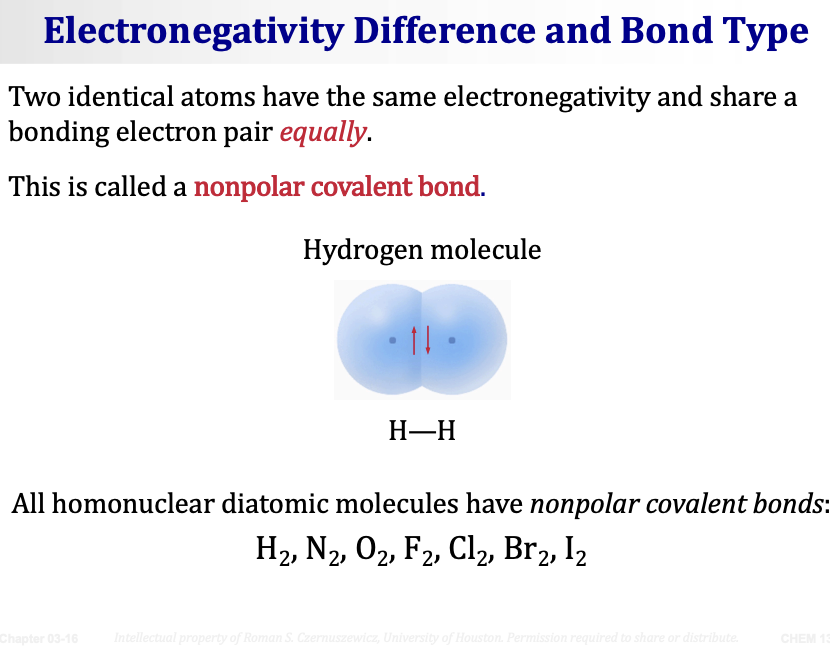
  • Two identical atoms have the same electronegativity and share a bonding electron pair equally.

  • This is called a nonpolar covalent bond.

Example: Hydrogen molecule H—H

  • Both H atoms have EN = 2.1

  • ΔEN = 0 → electrons shared perfectly equally → nonpolar covalent

All homonuclear diatomic molecules have nonpolar covalent bonds: H₂, N₂, O₂, F₂, Cl₂, Br₂, I₂
 

<ul><li><p><span>Two <strong>identical atoms</strong> have the <strong>same electronegativity</strong> and share a bonding electron pair <strong>equally.</strong></span></p></li><li><p><span>This is called a <strong>nonpolar covalent bond.</strong></span></p></li></ul><p>Example: <span><strong>Hydrogen molecule H—H</strong></span></p><ul><li><p><span>Both H atoms have EN = 2.1</span></p></li><li><p><span>ΔEN = 0 → electrons shared perfectly equally → nonpolar covalent</span></p></li></ul><p><span><strong>All homonuclear diatomic molecules have nonpolar covalent bonds:</strong></span> H₂, N₂, O₂, F₂, Cl₂, Br₂, I₂</p><p>&nbsp;</p>
13
New cards

 Electronegativity Difference and Bond Type — Polar Covalent

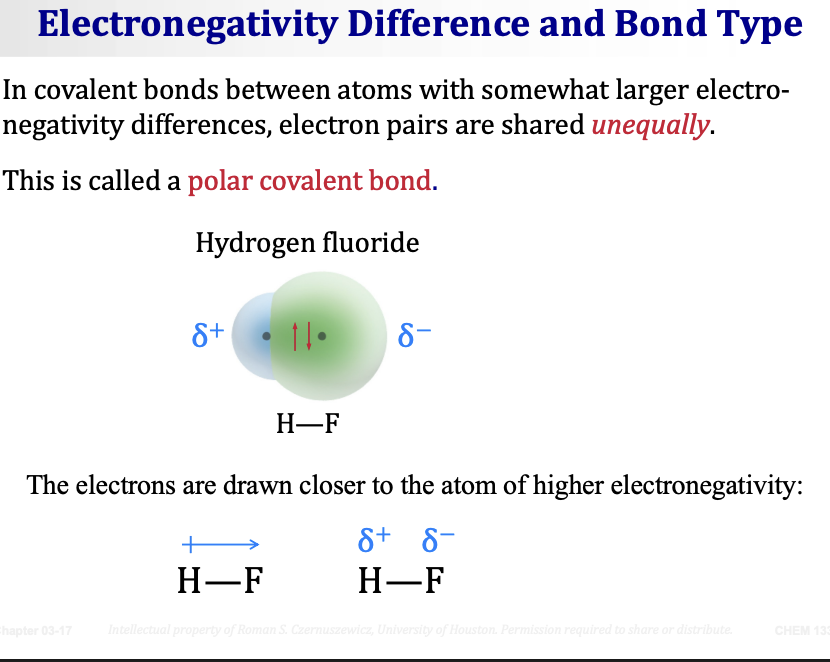
  • In covalent bonds between atoms with somewhat larger electronegativity differences, electron pairs are shared unequally.

  • This is called a polar covalent bond.

  • The electrons are drawn closer to the atom of higher electronegativity.


Example: Hydrogen fluoride H—F

  • H has EN = 2.1, F has EN = 4.0 → ΔEN = 1.9

  • F pulls electrons toward itself → F end is partially negative, H end is partially positive


Notation used:

  • δ+ on the less electronegative atom (H) — slight positive charge

  • δ− on the more electronegative atom (F) — slight negative charge

  • An arrow pointing toward F (the negative end) also shows the direction of polarity

So: δ+ H—F δ−
<ul><li><p><span>In covalent bonds between atoms with <strong>somewhat larger electronegativity differences</strong>, electron pairs are shared <strong>unequally.</strong></span></p></li><li><p><span>This is called a <strong>polar covalent bond.</strong></span></p></li><li><p><span>The electrons are drawn <strong>closer to the atom of higher electronegativity.</strong></span></p></li></ul><p>&nbsp;</p><p><span><strong>Example: Hydrogen fluoride H—F</strong></span></p><ul><li><p><span>H has EN = 2.1, F has EN = 4.0 → ΔEN = 1.9</span></p></li><li><p><span>F pulls electrons toward itself → F end is partially negative, H end is partially positive</span></p></li></ul><p>&nbsp;</p><p>Notation used:</p><ul><li><p><span><strong>δ+</strong> on the less electronegative atom (H) — slight positive charge</span></p></li><li><p><span><strong>δ−</strong> on the more electronegative atom (F) — slight negative charge</span></p></li><li><p><span>An arrow pointing toward F (the negative end) also shows the direction of polarity</span></p></li></ul><p>So: <span><strong>δ+ H—F δ−</strong></span></p>
14
New cards

 The Effect of an Electric Field on H—F Molecules

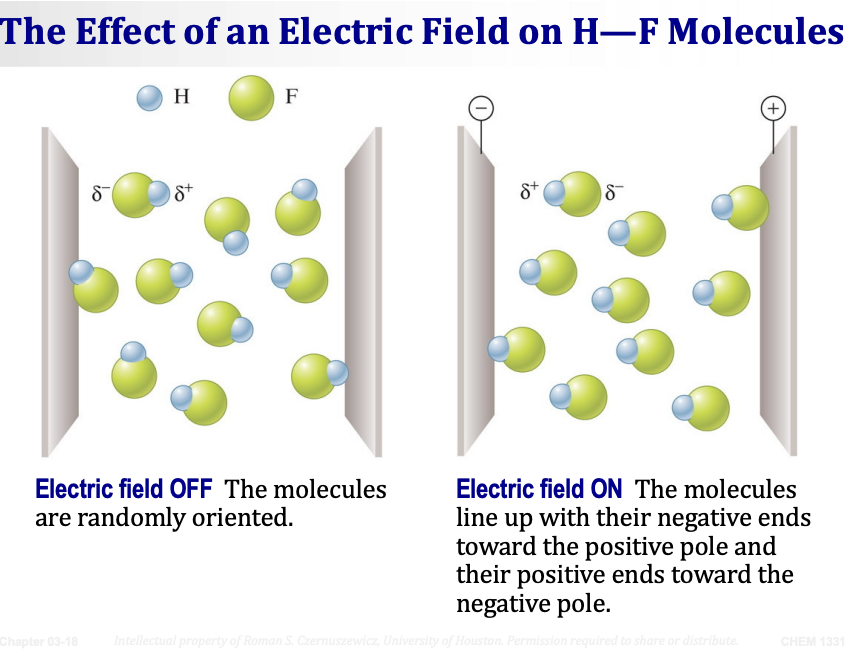
  • Electric field OFF: The H—F molecules are randomly oriented — pointing in all different directions.

  • Electric field ON: The molecules line up with their negative ends (F, δ−) toward the positive pole and their positive ends (H, δ+) toward the negative pole.

This shows that polar molecules behave like tiny magnets — they have a positive end and a negative end, and they respond to electric fields. This is direct proof that H—F is a polar molecule.
 

<ul><li><p><span><strong>Electric field OFF:</strong> The H—F molecules are <strong>randomly oriented</strong> — pointing in all different directions.</span></p></li><li><p><span><strong>Electric field ON:</strong> The molecules <strong>line up</strong> with their <strong>negative ends (F, δ−) toward the positive pole</strong> and their <strong>positive ends (H, δ+) toward the negative pole.</strong></span></p></li></ul><p>This shows that polar molecules behave like tiny magnets — they have a positive end and a negative end, and they respond to electric fields. This is direct proof that H—F is a polar molecule.</p><p>&nbsp;</p><p></p>
15
New cards

Electronegativity Difference and Bond Type — Ionic

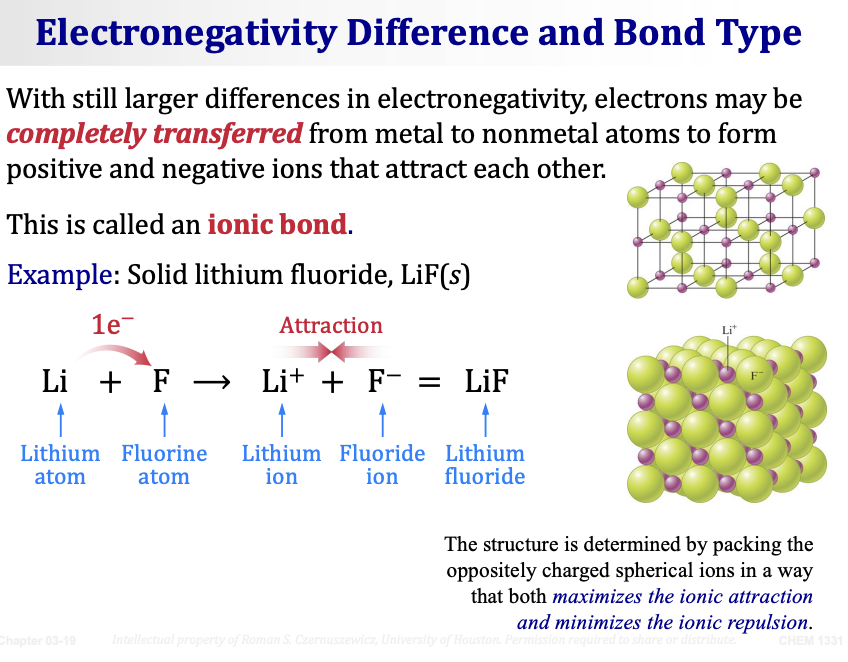
  • With still larger differences in electronegativity, electrons may be completely transferred from metal to nonmetal atoms to form positive and negative ions that attract each other.

  • This is called an ionic bond.


Example: Solid lithium fluoride, LiF(s)

Li + F → Li⁺ + F⁻ = LiF

  • Lithium atom → loses 1 electron → becomes Lithium ion (Li⁺)

  • Fluorine atom → gains 1 electron → becomes Fluoride ion (F⁻)

  • Li⁺ and F⁻ attract each other → LiF


The structure is determined by packing the oppositely charged spherical ions in a way that both maximizes the ionic attraction and minimizes the ionic repulsion.
<ul><li><p><span>With <strong>still larger differences in electronegativity</strong>, electrons may be <strong>completely transferred</strong> from metal to nonmetal atoms to form positive and negative ions that attract each other.</span></p></li><li><p><span>This is called an <strong>ionic bond.</strong></span></p></li></ul><p>&nbsp;</p><p><span><strong>Example: Solid lithium fluoride, LiF(s)</strong></span></p><p>Li + F → Li⁺ + F⁻ = LiF</p><ul><li><p><span>Lithium atom → loses 1 electron → becomes Lithium ion (Li⁺)</span></p></li><li><p><span>Fluorine atom → gains 1 electron → becomes Fluoride ion (F⁻)</span></p></li><li><p><span>Li⁺ and F⁻ attract each other → LiF</span></p></li></ul><p>&nbsp;</p><p><span><strong>The structure is determined by packing the oppositely charged spherical ions in a way that both <em>maximizes the ionic attraction</em> and <em>minimizes the ionic repulsion.</em></strong></span></p>
16
New cards

 The Relationship Between Electronegativity and Bond Type

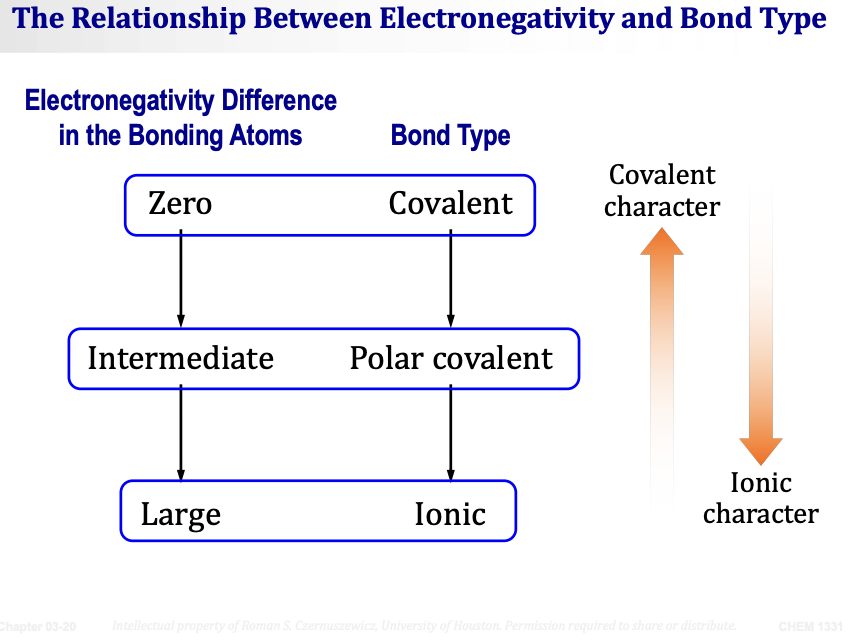
Summary table of how ΔEN (electronegativity difference) determines bond type:


Electronegativity Difference

Bond Type

Zero (ΔEN = 0)

Covalent (nonpolar)

Intermediate (small–moderate ΔEN)

Polar covalent

Large (large ΔEN)

Ionic

  • As ΔEN increases → bond goes from purely covalent (equal sharing) → polar covalent (unequal sharing) → ionic (full transfer)

  • Covalent character decreases as ΔEN increases

  • Ionic character increases as ΔEN increases

There is actually a spectrum from pure covalent to pure ionic — no bond is 100% purely ionic.
 

<p>Summary table of how ΔEN (electronegativity difference) determines bond type:</p><p>&nbsp;</p><table style="min-width: 50px;"><colgroup><col style="min-width: 25px;"><col style="min-width: 25px;"></colgroup><tbody><tr><td colspan="1" rowspan="1" style="border-width: 0pt; vertical-align: top; width: 2.45in; padding: 4pt;"><p><span><strong>Electronegativity Difference</strong></span></p></td><td colspan="1" rowspan="1" style="border-width: 0pt; vertical-align: top; width: 1.327in; padding: 4pt;"><p><span><strong>Bond Type</strong></span></p></td></tr><tr><td colspan="1" rowspan="1" style="border-width: 0pt; vertical-align: top; width: 2.45in; padding: 4pt;"><p>Zero (ΔEN = 0)</p></td><td colspan="1" rowspan="1" style="border-width: 0pt; vertical-align: top; width: 1.3958in; padding: 4pt;"><p>Covalent (nonpolar)</p></td></tr><tr><td colspan="1" rowspan="1" style="border-width: 0pt; vertical-align: top; width: 2.4694in; padding: 4pt;"><p>Intermediate (small–moderate ΔEN)</p></td><td colspan="1" rowspan="1" style="border-width: 0pt; vertical-align: top; width: 1.3076in; padding: 4pt;"><p>Polar covalent</p></td></tr><tr><td colspan="1" rowspan="1" style="border-width: 0pt; vertical-align: top; width: 2.45in; padding: 4pt;"><p>Large (large ΔEN)</p></td><td colspan="1" rowspan="1" style="border-width: 0pt; vertical-align: top; width: 1.327in; padding: 4pt;"><p>Ionic</p></td></tr></tbody></table><ul><li><p><span>As ΔEN increases → bond goes from <strong>purely covalent</strong> (equal sharing) → <strong>polar covalent</strong> (unequal sharing) → <strong>ionic</strong> (full transfer)</span></p></li><li><p><span><strong>Covalent character</strong> decreases as ΔEN increases</span></p></li><li><p><span><strong>Ionic character</strong> increases as ΔEN increases</span></p></li></ul><p>There is actually a <span><strong>spectrum</strong></span> from pure covalent to pure ionic — no bond is 100% purely ionic.</p><p>&nbsp;</p>
17
New cards

EXAMPLE — Using ΔEN to Determine Bond Polarity

PROBLEM: Using the electronegativity values, arrange the following bonds in order of increasing polarity: H—H, O—H, Cl—H, S—H, and F—H


PLAN: The polarity of the bond increases as the ΔEN value increases.


SOLUTION:

Bond

EN Values

ΔEN

Bond Type

H—H

(2.1)(2.1)

2.1 − 2.1 = 0

Covalent

S—H

(2.5)(2.1)

2.5 − 2.1 = 0.4

Polar covalent

Cl—H

(3.0)(2.1)

3.0 − 2.1 = 0.9

Polar covalent

O—H

(3.5)(2.1)

3.5 − 2.1 = 1.4

Polar covalent

F—H

(4.0)(2.1)

4.0 − 2.1 = 1.9

Polar covalent

Increasing polarity: H—H < S—H < Cl—H < O—H < F—H (Least polar → Most polar)
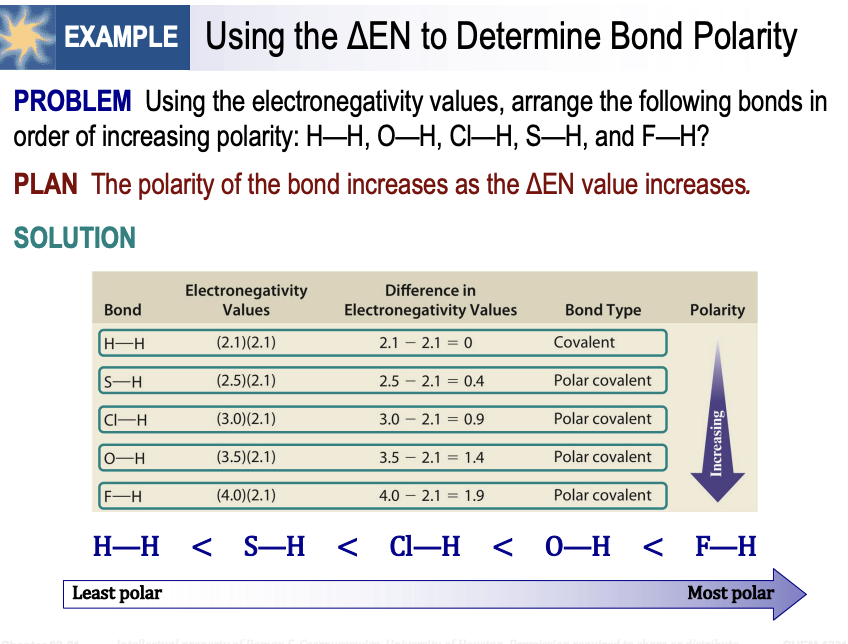
<p><span><strong>PROBLEM:</strong></span> Using the electronegativity values, arrange the following bonds in order of increasing polarity: H—H, O—H, Cl—H, S—H, and F—H</p><p>&nbsp;</p><p><span><strong>PLAN:</strong></span> The polarity of the bond increases as the ΔEN value increases.</p><p>&nbsp;</p><p><span><strong>SOLUTION:</strong></span></p><table style="min-width: 100px;"><colgroup><col style="min-width: 25px;"><col style="min-width: 25px;"><col style="min-width: 25px;"><col style="min-width: 25px;"></colgroup><tbody><tr><td colspan="1" rowspan="1" style="border-width: 0pt; vertical-align: top; width: 0.6673in; padding: 4pt;"><p><span><strong>Bond</strong></span></p></td><td colspan="1" rowspan="1" style="border-width: 0pt; vertical-align: top; width: 0.8201in; padding: 4pt;"><p><span><strong>EN Values</strong></span></p></td><td colspan="1" rowspan="1" style="border-width: 0pt; vertical-align: top; width: 1.0729in; padding: 4pt;"><p><span><strong>ΔEN</strong></span></p></td><td colspan="1" rowspan="1" style="border-width: 0pt; vertical-align: top; width: 0.9194in; padding: 4pt;"><p><span><strong>Bond Type</strong></span></p></td></tr><tr><td colspan="1" rowspan="1" style="border-width: 0pt; vertical-align: top; width: 0.6673in; padding: 4pt;"><p>H—H</p></td><td colspan="1" rowspan="1" style="border-width: 0pt; vertical-align: top; width: 0.8111in; padding: 4pt;"><p>(2.1)(2.1)</p></td><td colspan="1" rowspan="1" style="border-width: 0pt; vertical-align: top; width: 1.0729in; padding: 4pt;"><p>2.1 − 2.1 = 0</p></td><td colspan="1" rowspan="1" style="border-width: 0pt; vertical-align: top; width: 0.9194in; padding: 4pt;"><p>Covalent</p></td></tr><tr><td colspan="1" rowspan="1" style="border-width: 0pt; vertical-align: top; width: 0.6673in; padding: 4pt;"><p>S—H</p></td><td colspan="1" rowspan="1" style="border-width: 0pt; vertical-align: top; width: 0.8111in; padding: 4pt;"><p>(2.5)(2.1)</p></td><td colspan="1" rowspan="1" style="border-width: 0pt; vertical-align: top; width: 1.0923in; padding: 4pt;"><p>2.5 − 2.1 = 0.4</p></td><td colspan="1" rowspan="1" style="border-width: 0pt; vertical-align: top; width: 1.0236in; padding: 4pt;"><p>Polar covalent</p></td></tr><tr><td colspan="1" rowspan="1" style="border-width: 0pt; vertical-align: top; width: 0.6673in; padding: 4pt;"><p>Cl—H</p></td><td colspan="1" rowspan="1" style="border-width: 0pt; vertical-align: top; width: 0.8111in; padding: 4pt;"><p>(3.0)(2.1)</p></td><td colspan="1" rowspan="1" style="border-width: 0pt; vertical-align: top; width: 1.0923in; padding: 4pt;"><p>3.0 − 2.1 = 0.9</p></td><td colspan="1" rowspan="1" style="border-width: 0pt; vertical-align: top; width: 1.0236in; padding: 4pt;"><p>Polar covalent</p></td></tr><tr><td colspan="1" rowspan="1" style="border-width: 0pt; vertical-align: top; width: 0.6673in; padding: 4pt;"><p>O—H</p></td><td colspan="1" rowspan="1" style="border-width: 0pt; vertical-align: top; width: 0.8111in; padding: 4pt;"><p>(3.5)(2.1)</p></td><td colspan="1" rowspan="1" style="border-width: 0pt; vertical-align: top; width: 1.0923in; padding: 4pt;"><p>3.5 − 2.1 = 1.4</p></td><td colspan="1" rowspan="1" style="border-width: 0pt; vertical-align: top; width: 1.0236in; padding: 4pt;"><p>Polar covalent</p></td></tr><tr><td colspan="1" rowspan="1" style="border-width: 0pt; vertical-align: top; width: 0.6673in; padding: 4pt;"><p>F—H</p></td><td colspan="1" rowspan="1" style="border-width: 0pt; vertical-align: top; width: 0.8111in; padding: 4pt;"><p>(4.0)(2.1)</p></td><td colspan="1" rowspan="1" style="border-width: 0pt; vertical-align: top; width: 1.0923in; padding: 4pt;"><p>4.0 − 2.1 = 1.9</p></td><td colspan="1" rowspan="1" style="border-width: 0pt; vertical-align: top; width: 1.0236in; padding: 4pt;"><p>Polar covalent</p></td></tr></tbody></table><p><span><strong>Increasing polarity: H—H &lt; S—H &lt; Cl—H &lt; O—H &lt; F—H</strong></span> (Least polar → Most polar)</p>
18
New cards

Ionic Character of a Bond

  • The percent ionic character of a bond describes how ionic or polar a chemical bond is — essentially, it estimates how much electron transfer (versus sharing) occurs between two atoms in a bond.


Formula: Percent ionic character of a bond = (measured dipole moment of X—Y / calculated dipole moment of X⁺Y⁻) × 100%


Key point from the graph:

  • Na—Cl ionic bond: ΔEN ≈ 2.1 → Percent ionic character ≈ 70–80%, not 100%, because there is still some electron cloud sharing.

  • Compounds with percent ionic character > ~50% are classified as ionic solids.

  • Even so-called "ionic" bonds still have some covalent character.
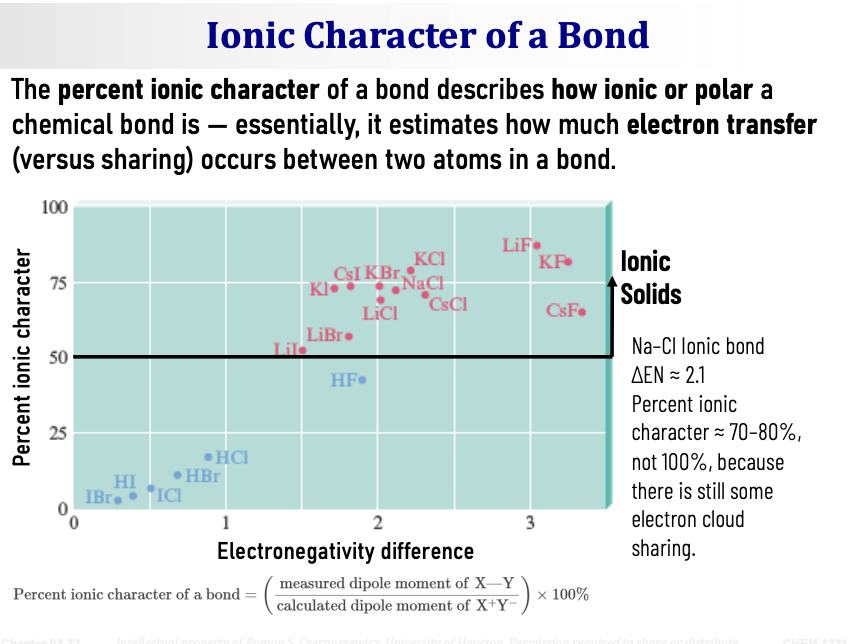
<ul><li><p><span>The <strong>percent ionic character</strong> of a bond describes <strong>how ionic or polar</strong> a chemical bond is — essentially, it estimates <strong>how much electron transfer</strong> (versus sharing) occurs between two atoms in a bond.</span></p></li></ul><p>&nbsp;</p><p><span><strong>Formula:</strong></span> Percent ionic character of a bond = (measured dipole moment of X—Y / calculated dipole moment of X⁺Y⁻) × 100%</p><p>&nbsp;</p><p><span><strong>Key point from the graph:</strong></span></p><ul><li><p><span><strong>Na—Cl ionic bond:</strong> ΔEN ≈ 2.1 → Percent ionic character ≈ <strong>70–80%, not 100%</strong>, because there is still some electron cloud sharing.</span></p></li><li><p><span>Compounds with percent ionic character &gt; ~50% are classified as <strong>ionic solids.</strong></span></p></li><li><p><span>Even so-called "ionic" bonds still have some covalent character.</span></p></li></ul><p></p>
19
New cards

Ionic Compounds: A Closer Look

Problems faced in the identification of ionic compounds:

  • No individual bonds are totally ionic

  • Many substances contain polyatomic ions (a group of atoms bonded together that carry a net charge)


Example: Calcium carbonate (CaCO₃)

  • Contains Ca²⁺ ions and CO₃²⁻ (carbonate) ions

  • The covalent bonds hold the polyatomic ion (CO₃²⁻) together, so it behaves as a unit.


Operational definition of ionic compounds:

  • Any compound that conducts an electric current when melted will be classified as ionic.

  • When NaCl is melted (heated), the ions can move freely and carry current → proves it is ionic.
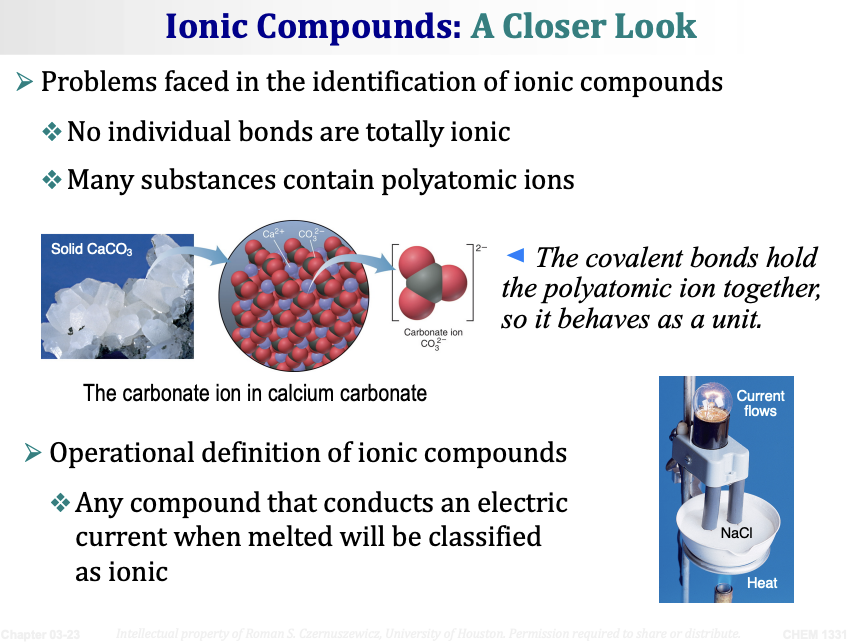
<p><span><strong>Problems faced in the identification of ionic compounds:</strong></span></p><ul><li><p><span>No individual bonds are <strong>totally ionic</strong></span></p></li><li><p><span>Many substances contain <strong>polyatomic ions</strong> (a group of atoms bonded together that carry a net charge)</span></p></li></ul><p>&nbsp;</p><p><span><strong>Example: Calcium carbonate (CaCO₃)</strong></span></p><ul><li><p><span>Contains Ca²⁺ ions and CO₃²⁻ (carbonate) ions</span></p></li><li><p><span><em>The covalent bonds hold the polyatomic ion (CO₃²⁻) together, so it behaves as a unit.</em></span></p></li></ul><p>&nbsp;</p><p><span><strong>Operational definition of ionic compounds:</strong></span></p><ul><li><p><span>Any compound that <strong>conducts an electric current when melted</strong> will be classified as ionic.</span></p></li><li><p><span>When NaCl is melted (heated), the ions can move freely and carry current → proves it is ionic.</span></p></li></ul><p></p>
20
New cards

Ions: Electron Configurations, Charges, and Sizes — Section Goal

Goals:

  • Learn about electron configurations of ions

  • Learn to predict the formulas of ionic compounds


Elements That Form Ions with Predictable Charges


Many elements always form the same charge ion — you can predict this from their group number:

  • Group 1 metals always form (1+) cations: Li⁺, Na⁺, K⁺, Rb⁺, Cs⁺

  • Group 2 metals always form (2+) cations: Be²⁺, Mg²⁺, Ca²⁺, Sr²⁺, Ba²⁺

  • Group 3 metals form (3+) cations: Al³⁺, Ga³⁺, In³⁺

  • Group 5 nonmetals form (3−) anions: N³⁻, P³⁻

  • Group 6 elements always form (2−) anions: O²⁻, S²⁻, Se²⁻, Te²⁻

  • Group 7 nonmetals always form (1−) anions: F⁻, Cl⁻, Br⁻, I⁻


Transition metals form cations with various charges (see Table 3.6) — they don't follow one simple rule.

Why? Atoms gain or lose electrons to achieve the stable electron configuration of the nearest noble gas.
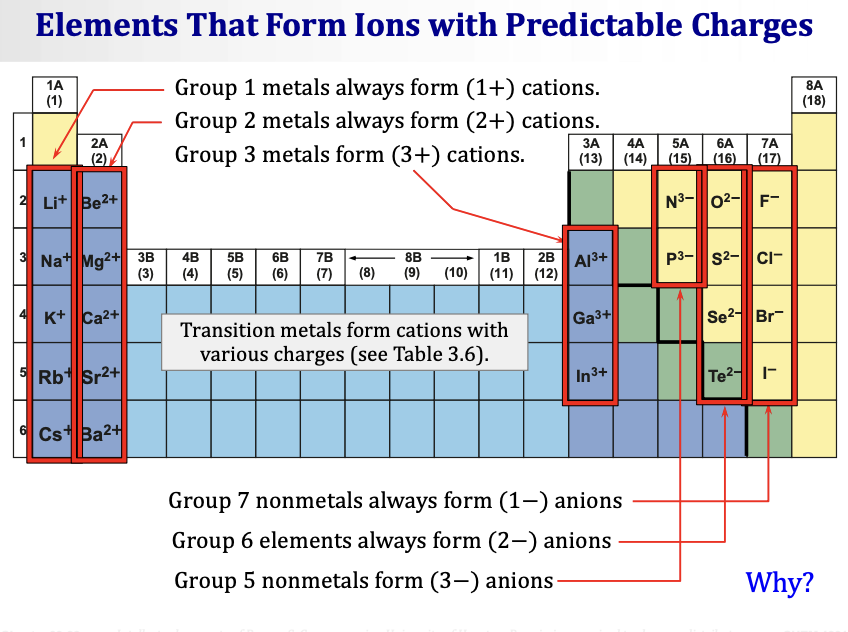
 

<p></p><p>Goals:</p><ul><li><p><span>Learn about <strong>electron configurations of ions</strong></span></p></li><li><p><span>Learn to <strong>predict the formulas of ionic compounds</strong></span></p></li></ul><p>&nbsp;</p><p><span><strong>Elements That Form Ions with Predictable Charges</strong></span></p><p>&nbsp;</p><p>Many elements always form the same charge ion — you can predict this from their group number:</p><ul><li><p><span><strong>Group 1 metals</strong> always form <strong>(1+) cations:</strong> Li⁺, Na⁺, K⁺, Rb⁺, Cs⁺</span></p></li><li><p><span><strong>Group 2 metals</strong> always form <strong>(2+) cations:</strong> Be²⁺, Mg²⁺, Ca²⁺, Sr²⁺, Ba²⁺</span></p></li><li><p><span><strong>Group 3 metals</strong> form <strong>(3+) cations:</strong> Al³⁺, Ga³⁺, In³⁺</span></p></li><li><p><span><strong>Group 5 nonmetals</strong> form <strong>(3−) anions:</strong> N³⁻, P³⁻</span></p></li><li><p><span><strong>Group 6 elements</strong> always form <strong>(2−) anions:</strong> O²⁻, S²⁻, Se²⁻, Te²⁻</span></p></li><li><p><span><strong>Group 7 nonmetals</strong> always form <strong>(1−) anions:</strong> F⁻, Cl⁻, Br⁻, I⁻</span></p></li></ul><p>&nbsp;</p><p><span><strong>Transition metals</strong></span> form cations with <span><strong>various charges</strong></span> (see Table 3.6) — they don't follow one simple rule.</p><p><span><strong>Why?</strong></span> Atoms gain or lose electrons to achieve the stable electron configuration of the nearest noble gas.</p><p>&nbsp;</p>
21
New cards

 Stable Electron Configurations of Ions

Atoms/ions in stable compounds usually have a noble gas electron configuration.

  • The noble gases (Group 18) all have eight valence electrons except for helium, which has two. They have full outer energy levels and are particularly stable and unreactive.


Alkali metals (Group 1): lose one electron in their reactions to reach a noble gas configuration.

  • Example: Li (2s¹) → loses 1e⁻ → Li⁺ = [He] configuration (like He, 2 electrons)

  • Example: Na (3s¹) → loses 1e⁻ → Na⁺ = [Ne] configuration


<p><span><strong>Atoms/ions in stable compounds usually have a noble gas electron configuration.</strong></span></p><ul><li><p><span>The <strong>noble gases</strong> (Group 18) all have <strong>eight valence electrons</strong> except for helium, which has <strong>two.</strong> They have full outer energy levels and are particularly <strong>stable and unreactive.</strong></span></p></li></ul><p>&nbsp;</p><p><span><strong>Alkali metals (Group 1):</strong></span> lose <span><strong>one</strong></span> electron in their reactions to reach a noble gas configuration.</p><ul><li><p><span>Example: Li (2s¹) → loses 1e⁻ → Li⁺ = [He] configuration (like He, 2 electrons)</span></p></li><li><p><span>Example: Na (3s¹) → loses 1e⁻ → Na⁺ = [Ne] configuration</span></p></li></ul><p>&nbsp;</p><p>&nbsp;</p>
22
New cards

Stable Electron Configurations of Ions (continued)

Atoms/ions in stable compounds usually have a noble gas electron configuration.

  • Alkali metals (Group 1): lose one electron in their reactions to reach a noble gas configuration.

  • Alkaline earth metals (Group 2): lose two electrons in their reactions to reach a noble gas configuration.

    • Example: Be (2s²) → loses 2e⁻ → Be²⁺ = [He] configuration

    • Example: Mg (3s²) → loses 2e⁻ → Mg²⁺ = [Ne] configuration

    • Example: Ca (4s²) → loses 2e⁻ → Ca²⁺ = [Ar] configuration

The noble gases all have eight valence electrons except for helium, which has two. They have full outer energy levels and are particularly stable and unreactive.


<p><span><strong>Atoms/ions in stable compounds usually have a noble gas electron configuration.</strong></span></p><ul><li><p><span><strong>Alkali metals (Group 1):</strong> lose <strong>one</strong> electron in their reactions to reach a noble gas configuration.</span></p></li><li><p><span><strong>Alkaline earth metals (Group 2):</strong> lose <strong>two</strong> electrons in their reactions to reach a noble gas configuration.</span></p><ul><li><p><span>Example: Be (2s²) → loses 2e⁻ → Be²⁺ = [He] configuration</span></p></li><li><p><span>Example: Mg (3s²) → loses 2e⁻ → Mg²⁺ = [Ne] configuration</span></p></li><li><p><span>Example: Ca (4s²) → loses 2e⁻ → Ca²⁺ = [Ar] configuration</span></p></li></ul></li></ul><p>The noble gases all have eight valence electrons except for helium, which has two. They have full outer energy levels and are particularly stable and unreactive.</p><p>&nbsp;</p><p></p>
23
New cards

Stable Electron Configurations of Ions

Atoms/ions in stable compounds usually have a noble gas electron configuration.

  • Alkali metals (Group 1): lose one electron in their reactions to reach a noble gas configuration.

  • Alkaline earth metals (Group 2): lose two electrons in their reactions to reach a noble gas configuration.

  • Halogens (Group 17): gain one electron in their reactions to reach a noble gas configuration.

    • Example: F (2s²2p⁵) → gains 1e⁻ → F⁻ = [Ne] configuration

    • Example: Cl (3s²3p⁵) → gains 1e⁻ → Cl⁻ = [Ar] configuration

    • Example: I (5s²5p⁵) → gains 1e⁻ → I⁻ = [Xe] configuration

The noble gases all have eight valence electrons except for helium, which has two. They have full outer energy levels and are particularly stable and unreactive.


<p><span><strong>Atoms/ions in stable compounds usually have a noble gas electron configuration.</strong></span></p><ul><li><p><span><strong>Alkali metals (Group 1):</strong> lose <strong>one</strong> electron in their reactions to reach a noble gas configuration.</span></p></li><li><p><span><strong>Alkaline earth metals (Group 2):</strong> lose <strong>two</strong> electrons in their reactions to reach a noble gas configuration.</span></p></li><li><p><span><strong>Halogens (Group 17):</strong> gain <strong>one</strong> electron in their reactions to reach a noble gas configuration.</span></p><ul><li><p><span>Example: F (2s²2p⁵) → gains 1e⁻ → F⁻ = [Ne] configuration</span></p></li><li><p><span>Example: Cl (3s²3p⁵) → gains 1e⁻ → Cl⁻ = [Ar] configuration</span></p></li><li><p><span>Example: I (5s²5p⁵) → gains 1e⁻ → I⁻ = [Xe] configuration</span></p></li></ul></li></ul><p>The noble gases all have eight valence electrons except for helium, which has two. They have full outer energy levels and are particularly stable and unreactive.</p><p>&nbsp;</p>
24
New cards

Electron Configurations: Ionic Bonding

When a nonmetal and a Group 1, 2, or 3 metal react to form a binary ionic compound, the ions form in such a way that:

  • The valence orbitals of the metal are emptied to achieve the configuration of the previous noble gas

  • The valence-electron configuration of the nonmetal is completed to achieve the configuration of the next noble gas


Example: KCl (potassium chloride)

  • K (Z = 19): 1s²2s²2p⁶3s²3p⁶4s¹ → loses 1e⁻ → K⁺: 1s²2s²2p⁶3s²3p⁶4s⁰ = [Ar] (octet in previous level)

  • Cl (Z = 17): 1s²2s²2p⁶3s²3p⁵ → gains 1e⁻ → Cl⁻: 1s²2s²2p⁶3s²3p⁶ = [Ar] (octet in the same level)


Result: KCl — both ions now have the argon noble gas configuration.


<p>When a nonmetal and a <span><strong>Group 1, 2, or 3 metal react</strong></span> to form a binary ionic compound, the ions form in such a way that:</p><ul><li><p><span>The <strong>valence orbitals of the metal are emptied</strong> to achieve the configuration of the <strong>previous noble gas</strong></span></p></li><li><p><span>The <strong>valence-electron configuration of the nonmetal is completed</strong> to achieve the configuration of the <strong>next noble gas</strong></span></p></li></ul><p>&nbsp;</p><p><span><strong>Example: KCl (potassium chloride)</strong></span></p><ul><li><p><span>K (Z = 19): 1s²2s²2p⁶3s²3p⁶<strong>4s¹</strong> → loses 1e⁻ → <strong>K⁺</strong>: 1s²2s²2p⁶3s²3p⁶4s⁰ = [Ar] (octet in previous level)</span></p></li><li><p><span>Cl (Z = 17): 1s²2s²2p⁶<strong>3s²3p⁵</strong> → gains 1e⁻ → <strong>Cl⁻</strong>: 1s²2s²2p⁶3s²3p⁶ = [Ar] (octet in the same level)</span></p></li></ul><p>&nbsp;</p><p>Result: <span><strong>KCl</strong></span> — both ions now have the argon noble gas configuration.</p><p>&nbsp;</p><p>&nbsp;</p>
25
New cards
<p><span><strong>Predicting Formulas of Ionic Compounds</strong></span></p>

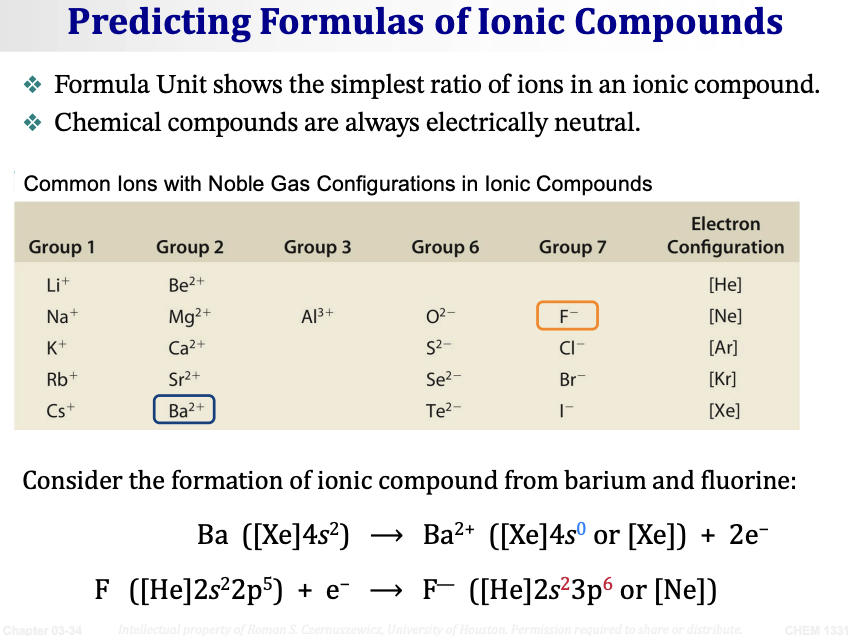
Predicting Formulas of Ionic Compounds

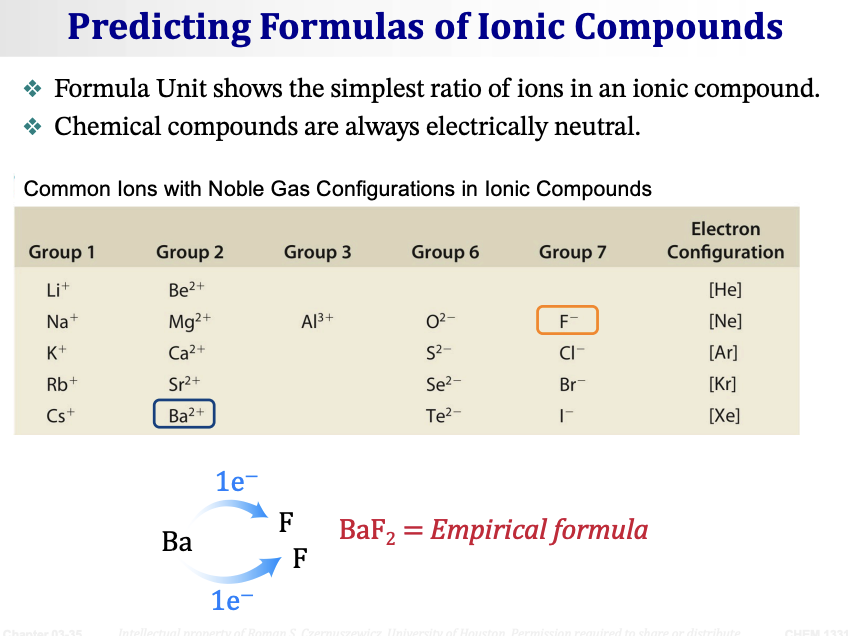
  • Formula Unit shows the simplest ratio of ions in an ionic compound.

  • Chemical compounds are always electrically neutral.

Common Ions with Noble Gas Configurations in Ionic Compounds:

Group 1

Group 2

Group 3

Group 6

Group 7

Electron Configuration

Li⁺

Be²⁺


[He]

Na⁺

Mg²⁺

Al³⁺

O²⁻

F⁻

[Ne]

K⁺

Ca²⁺


S²⁻

Cl⁻

[Ar]

Rb⁺

Sr²⁺


Se²⁻

Br⁻

[Kr]

Cs⁺

Ba²⁺


Te²⁻

I⁻

[Xe]

Example — Formation of ionic compound from barium and fluorine:

  • Ba ([Xe]4s²) → Ba²⁺ ([Xe]4s⁰ or [Xe]) + 2e⁻

  • F ([He]2s²2p⁵) + e⁻ → F⁻ ([He]2s²3p⁶ or [Ne])


26
New cards

Predicting Formulas of Ionic Compounds

  • Formula Unit shows the simplest ratio of ions in an ionic compound.

  • Chemical compounds are always electrically neutral.

Continuing the Ba + F example:

  • Ba forms Ba²⁺ (loses 2 electrons)

  • F forms F⁻ (gains 1 electron)

  • Ba needs to give away 2 electrons total → needs 2 F atoms to each take 1 electron

Ba → gives 1e⁻ to F, and 1e⁻ to another F

BaF₂ = Empirical formula

The formula is BaF₂ because 1 Ba²⁺ is balanced by 2 F⁻ → total charge = (2+) + 2(1−) = 0. Neutral!
 

<ul><li><p><span><strong>Formula Unit</strong> shows the simplest ratio of ions in an ionic compound.</span></p></li><li><p><span><strong>Chemical compounds are always electrically neutral.</strong></span></p></li></ul><p><span><strong>Continuing the Ba + F example:</strong></span></p><ul><li><p><span>Ba forms Ba²⁺ (loses 2 electrons)</span></p></li><li><p><span>F forms F⁻ (gains 1 electron)</span></p></li><li><p><span>Ba needs to give away 2 electrons total → needs <strong>2 F atoms</strong> to each take 1 electron</span></p></li></ul><p>Ba → gives 1e⁻ to F, and 1e⁻ to another F</p><p><span><strong>BaF₂ = Empirical formula</strong></span></p><p>The formula is BaF₂ because 1 Ba²⁺ is balanced by 2 F⁻ → total charge = (2+) + 2(1−) = 0. Neutral!</p><p>&nbsp;</p>
27
New cards

Predicting Formulas of Ionic Compounds — Al and Se

Chemical compounds are always electrically neutral.

Example — Formation of ionic compound from Al and Se:

  • Al → Al³⁺ (loses 3 electrons, Group 3)

  • Se → Se²⁻ (gains 2 electrons, Group 6)

To balance charges:

  • Need the total positive charge = total negative charge

  • 2 Al³⁺ gives +6 total; 3 Se²⁻ gives −6 total

Formula: Al₂Se₃

Check: 2(3+) + 3(2−) = 6+ + 6− = 0. Neutral!

28
New cards

Relative Sizes of Atoms and Their Ions

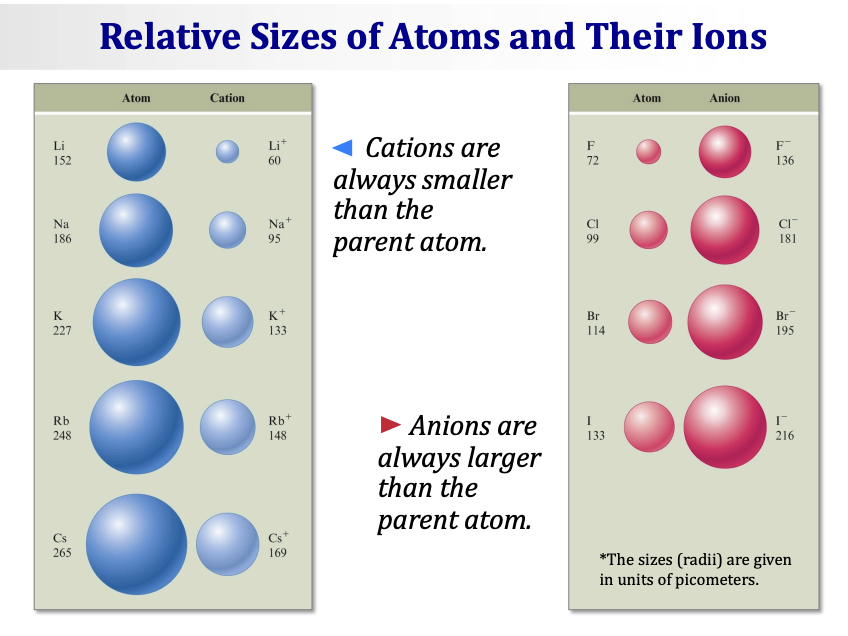
Two important rules about ion size compared to the parent atom:

  • Cations are always SMALLER than the parent atom.

    • Why? When electrons are removed, there are fewer electrons but the same number of protons → protons pull remaining electrons in more tightly → smaller size.

    • Example: Li = 152 pm → Li⁺ = 60 pm (much smaller!)

    • Example: Na = 186 pm → Na⁺ = 95 pm

  • Anions are always LARGER than the parent atom.

    • Why? When electrons are added, there are more electrons competing for the same number of protons → electrons spread out more → larger size.

    • Example: F = 72 pm → F⁻ = 136 pm (much larger!)

    • Example: Cl = 99 pm → Cl⁻ = 181 pm

The sizes (radii) are given in units of picometers.
<p>Two important rules about ion size compared to the parent atom:</p><ul><li><p><span><strong>Cations are always SMALLER than the parent atom.</strong></span></p><ul><li><p><span>Why? When electrons are removed, there are fewer electrons but the same number of protons → protons pull remaining electrons in more tightly → smaller size.</span></p></li><li><p><span>Example: Li = 152 pm → Li⁺ = 60 pm (much smaller!)</span></p></li><li><p><span>Example: Na = 186 pm → Na⁺ = 95 pm</span></p></li></ul></li><li><p><span><strong>Anions are always LARGER than the parent atom.</strong></span></p><ul><li><p><span>Why? When electrons are added, there are more electrons competing for the same number of protons → electrons spread out more → larger size.</span></p></li><li><p><span>Example: F = 72 pm → F⁻ = 136 pm (much larger!)</span></p></li><li><p><span>Example: Cl = 99 pm → Cl⁻ = 181 pm</span></p></li></ul></li></ul><p><span><em>The sizes (radii) are given in units of picometers.</em></span></p>
29
New cards

Trends in Ionic Sizes

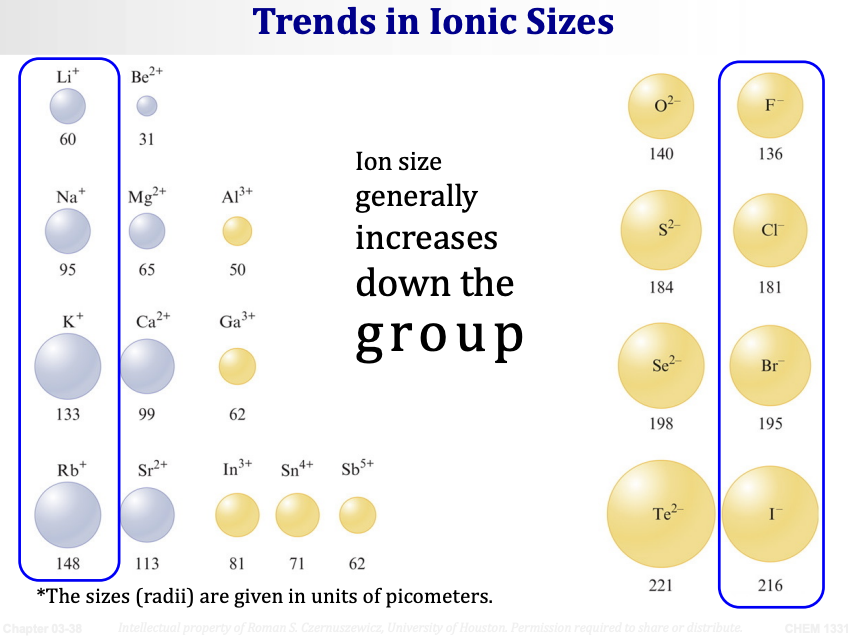
Ion size generally increases down the group.

Just like neutral atoms, as you go down a group, ions get bigger because electrons occupy higher and higher principal energy levels (n), which are farther from the nucleus.


Examples (cations going down Group 1):

  • Li⁺ = 60 pm

  • Na⁺ = 95 pm

  • K⁺ = 133 pm

  • Rb⁺ = 148 pm

Examples (anions going down Group 7):

  • F⁻ = 136 pm

  • Cl⁻ = 181 pm

  • Br⁻ = 195 pm

  • I⁻ = 216 pm


The sizes (radii) are given in units of picometers.
 

<p><span><strong>Ion size generally increases down the group.</strong></span></p><p>Just like neutral atoms, as you go down a group, ions get bigger because electrons occupy higher and higher principal energy levels (n), which are farther from the nucleus.</p><p>&nbsp;</p><p>Examples (cations going down Group 1):</p><ul><li><p><span>Li⁺ = 60 pm</span></p></li><li><p><span>Na⁺ = 95 pm</span></p></li><li><p><span>K⁺ = 133 pm</span></p></li><li><p><span>Rb⁺ = 148 pm</span></p></li></ul><p>Examples (anions going down Group 7):</p><ul><li><p><span>F⁻ = 136 pm</span></p></li><li><p><span>Cl⁻ = 181 pm</span></p></li><li><p><span>Br⁻ = 195 pm</span></p></li><li><p><span>I⁻ = 216 pm</span></p></li></ul><p>&nbsp;</p><p><span><em>The sizes (radii) are given in units of picometers.</em></span></p><p>&nbsp;</p>
30
New cards
<p><span><strong>Trends in Ionic Sizes — Isoelectronic Series</strong></span></p>

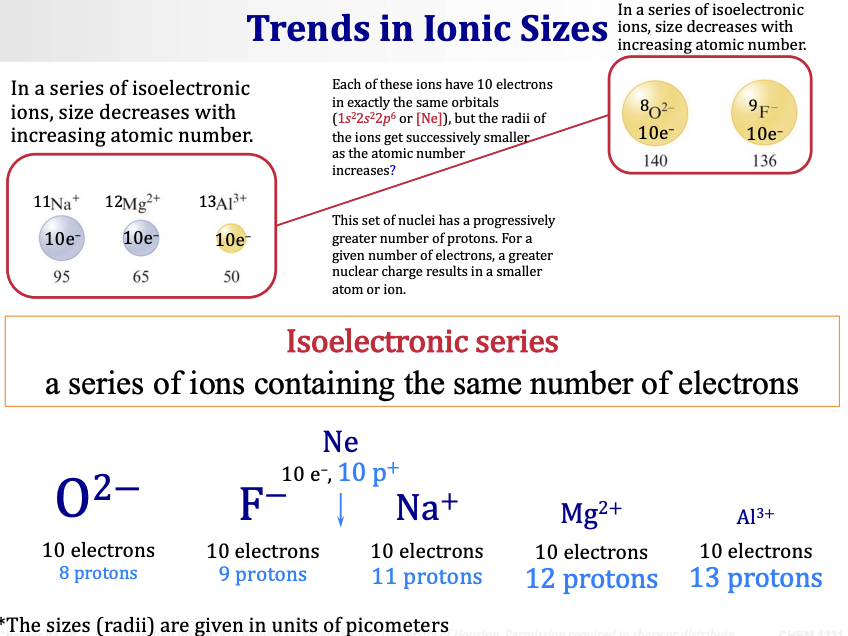
Trends in Ionic Sizes — Isoelectronic Series

Isoelectronic series = a series of ions containing the same number of electrons.

In a series of isoelectronic ions, size DECREASES with increasing atomic number.

Example: All of the following have 10 electrons (same as Ne: 1s²2s²2p⁶):


Ion

Electrons

Protons

Size (pm)

O²⁻

10

8

140

F⁻

10

9

136

Ne

10

10

Na⁺

10

11

95

Mg²⁺

10

12

65

Al³⁺

10

13

50


Each of these ions have 10 electrons in exactly the same orbitals (1s²2s²2p⁶ or [Ne]), but the radii of the ions get successively smaller as the atomic number increases.


Why? This set of nuclei has a progressively greater number of protons. For a given number of electrons, a greater nuclear charge results in a smaller atom or ion. More protons pull the same number of electrons in tighter.


31
New cards

Covalent Bonds — Single Bond

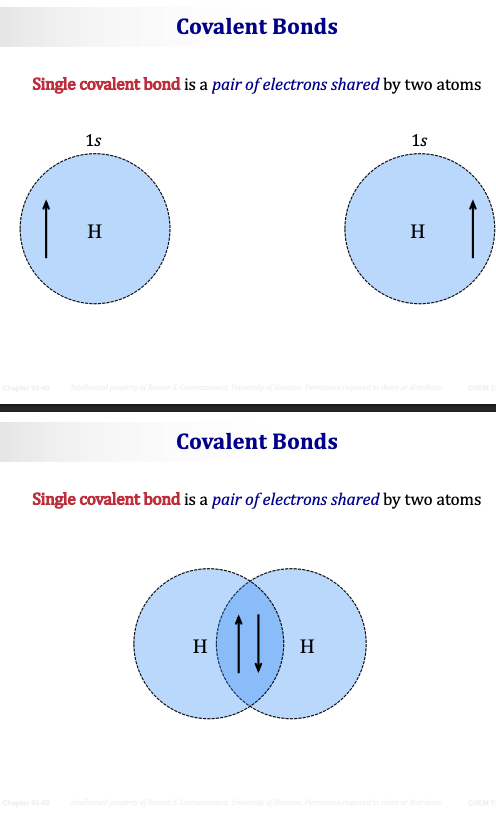
Single covalent bond = a pair of electrons shared by two atoms.


Two hydrogen atoms each contribute 1 electron from their 1s orbitals. When they come together, their orbitals overlap and the two electrons are now shared — each electron belongs to both atoms simultaneously. This shared pair is what holds the two H atoms together.


The overlapping region (shown as the darker area where the two circles overlap) is where the two electrons spend most of their time — pulled equally to both nuclei.
 

<p><span><strong>Single covalent bond</strong></span> = a <span><strong>pair of electrons shared</strong></span> by two atoms.</p><p>&nbsp;</p><p>Two hydrogen atoms each contribute <span><strong>1 electron</strong></span> from their 1s orbitals. When they come together, their orbitals <span><strong>overlap</strong></span> and the two electrons are now shared — each electron belongs to both atoms simultaneously. This shared pair is what holds the two H atoms together.</p><p>&nbsp;</p><p>The overlapping region (shown as the darker area where the two circles overlap) is where the two electrons spend most of their time — pulled equally to both nuclei.</p><p>&nbsp;</p>
32
New cards

Covalent Bonds — Single, Double, and Triple Bonds

Single covalent bond = a pair of electrons shared by two atoms.


Multiple covalent bonds have greater electron density between the nuclei than single bonds, thus, higher bond energies.


Three types of covalent bonds:


Single bond — carbon atoms share one pair of electrons:

  • Example: Ethane, C₂H₆ — bond energy = 347 kJ/mol

  • Written as C—C


Double bond — carbon atoms share two pairs of electrons:

  • Example: Ethylene, C₂H₄ — bond energy = 614 kJ/mol

  • Written as C=C


Triple bond — carbon atoms share three pairs of electrons:

  • Example: Acetylene, C₂H₂ — bond energy = 839 kJ/mol

  • Written as C≡C

More pairs of shared electrons = stronger bond = higher bond energy = shorter bond length.
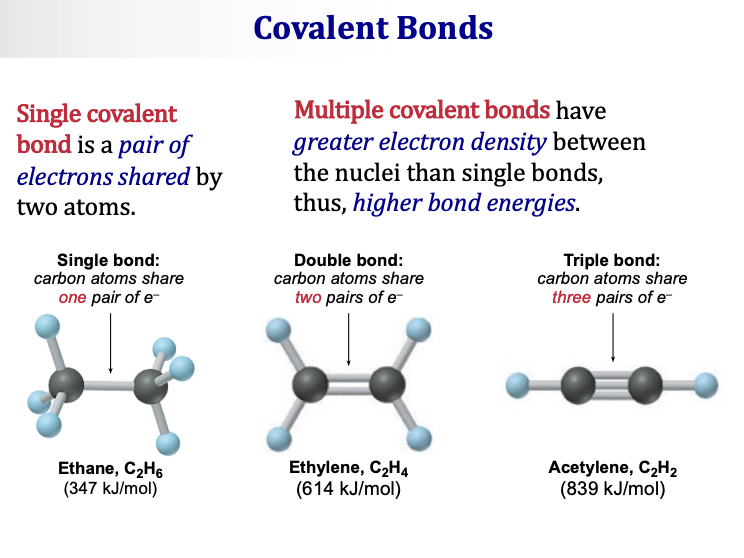
 

<p><span><strong>Single covalent bond</strong></span> = a <span><strong>pair of electrons shared</strong></span> by two atoms.</p><p>&nbsp;</p><p><span><strong>Multiple covalent bonds</strong></span> have <span><strong>greater electron density between the nuclei</strong></span> than single bonds, thus, <span><strong>higher bond energies.</strong></span></p><p>&nbsp;</p><p>Three types of covalent bonds:</p><p>&nbsp;</p><p><span><strong>Single bond</strong></span> — carbon atoms share <span><strong>one pair of electrons:</strong></span></p><ul><li><p><span>Example: Ethane, C₂H₆ — bond energy = <strong>347 kJ/mol</strong></span></p></li><li><p><span>Written as C—C</span></p></li></ul><p>&nbsp;</p><p><span><strong>Double bond</strong></span> — carbon atoms share <span><strong>two pairs of electrons:</strong></span></p><ul><li><p><span>Example: Ethylene, C₂H₄ — bond energy = <strong>614 kJ/mol</strong></span></p></li><li><p><span>Written as C=C</span></p></li></ul><p>&nbsp;</p><p><span><strong>Triple bond</strong></span> — carbon atoms share <span><strong>three pairs of electrons:</strong></span></p><ul><li><p><span>Example: Acetylene, C₂H₂ — bond energy = <strong>839 kJ/mol</strong></span></p></li><li><p><span>Written as C≡C</span></p></li></ul><p>More pairs of shared electrons = stronger bond = higher bond energy = shorter bond length.</p><p>&nbsp;</p>
33
New cards

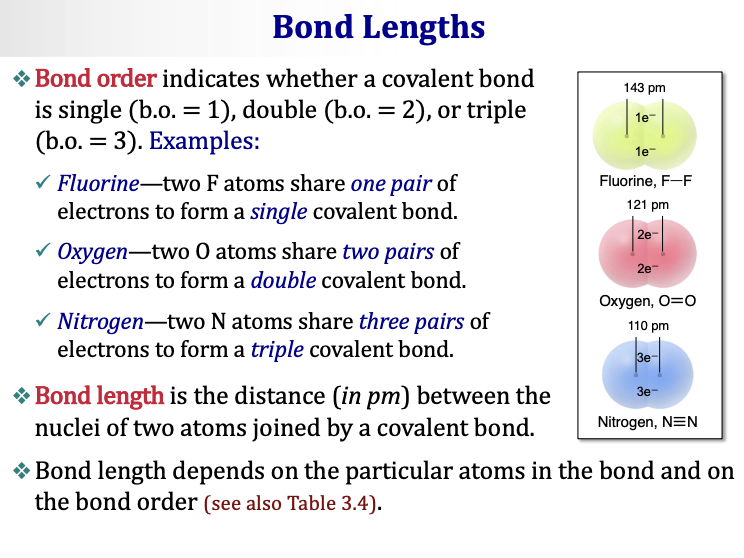
Bond Lengths

  • Bond order indicates whether a covalent bond is single (b.o. = 1), double (b.o. = 2), or triple (b.o. = 3).

Examples:

  • Fluorine (F—F): two F atoms share one pair of electrons → single covalent bond. Bond length = 143 pm

  • Oxygen (O=O): two O atoms share two pairs of electrons → double covalent bond. Bond length = 121 pm

  • Nitrogen (N≡N): two N atoms share three pairs of electrons → triple covalent bond. Bond length = 110 pm

  • Bond length = the distance (in pm) between the nuclei of two atoms joined by a covalent bond.

  • Bond length depends on the particular atoms in the bond and on the bond order (see also Table 3.4).

Key trend: Higher bond order → shorter bond length AND higher bond energy.

  • Single bond: longest, weakest

  • Double bond: medium

  • Triple bond: shortest, strongest

<ul><li><p><span><strong>Bond order</strong> indicates whether a covalent bond is single (b.o. = 1), double (b.o. = 2), or triple (b.o. = 3).</span></p></li></ul><p>Examples:</p><ul><li><p><span><strong>Fluorine (F—F):</strong> two F atoms share <strong>one pair</strong> of electrons → <strong>single</strong> covalent bond. Bond length = <strong>143 pm</strong></span></p></li><li><p><span><strong>Oxygen (O=O):</strong> two O atoms share <strong>two pairs</strong> of electrons → <strong>double</strong> covalent bond. Bond length = <strong>121 pm</strong></span></p></li><li><p><span><strong>Nitrogen (N≡N):</strong> two N atoms share <strong>three pairs</strong> of electrons → <strong>triple</strong> covalent bond. Bond length = <strong>110 pm</strong></span></p></li><li><p><span><strong>Bond length</strong> = the <strong>distance (in pm) between the nuclei</strong> of two atoms joined by a covalent bond.</span></p></li><li><p><span><strong>Bond length depends on the particular atoms in the bond and on the bond order</strong> (see also Table 3.4).</span></p></li></ul><p><span><strong>Key trend:</strong></span> Higher bond order → shorter bond length AND higher bond energy.</p><ul><li><p><span>Single bond: longest, weakest</span></p></li><li><p><span>Double bond: medium</span></p></li><li><p><span>Triple bond: shortest, strongest</span></p></li></ul><p></p>