Week 3 Quiz Review flashcards
 Call Kai
 Learn
Learn Practice Test
 Spaced Repetition
 Match
Match Flashcards
 Knowt Play
1/51

There's no tags or description
Looks like no tags are added yet.
Name | Mastery | Learn | Test | Matching | Spaced | Call with Kai | Chat |
|---|
No analytics yet
Send a link to your students to track their progress
52 Terms
what are the characteristics of muscle cells?
excitability, conductivity, contractility, extensibility, and elasticity
what are the functions of skeletal muscles
body movement, maintaining posture, regulation of body openings, and heat production
what is a skeletal composed of
muscle fibers, connective tissue sheaths, nerves, arteries, and veins
hierarchy of smallest to largest muscle components
myofilament, myfibril, muscle fiber, fascicle, skeletal muscle
whats a myofilament
short contractile which consists of thick and thin proteins
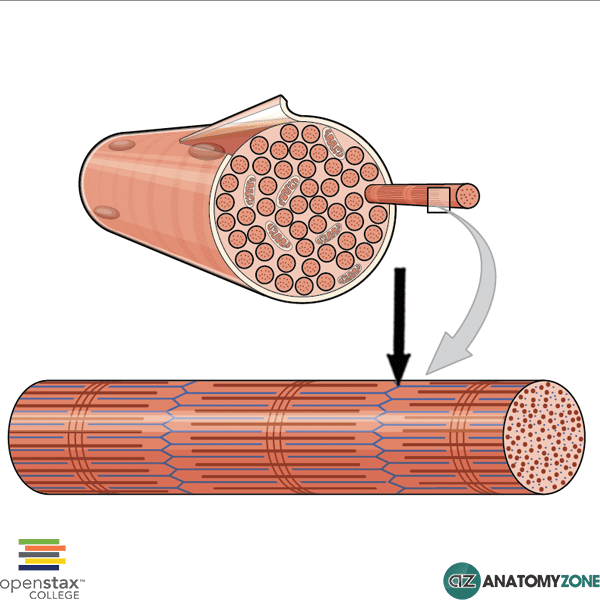
whats a myofibril
cylindrical contractile composed of myofilaments
whats a muscle cell (fiber)
fiber which contains myofibrils
whats a fascicle
group of muscle cells
what is a muscle
multiple fascicles grouped together
connective tissue covering from deep to superficial
endomysium, perimysium, epimysium
what does the endomysium surround
individual muscle fibers
what does perimysium surround
fascicles
what does epimysium surround
entire muscle
what is superficial fascia
the areolar and adipose connective tissue that separates muscle from skin
where does a tendon attach
muscle to bone, skin or another muscle
what is an aponneurosis
a thin flattened sheet some tendons form
what stimulates skeletal muscle contraction
somatic motor neurons
what is the neuromuscular junction
the junction between a motor neuron axon and a muscle fiber
what is a synaptic cleft
the narrow gap between the neuron and muscle fiber
what do synaptic vesicles stores
acetylcholine (ACh), until it’s released
what is acetylcholine
the neurotransmitter that initiates skeletal muscle conntraction
what does acetylcholinestease’s do
break down ACh in the synaptic cleft
what is sacrolemma
the plasma membrane of the skeletal muscle fiber
what is sarcoplasma
the cytoplasm of the skeletal muscle fiber
specialized structures of muscle fibers
t-tubules and the sarcoplasmic reticulum
what do terminal cisternae do
store the calcium needed for contraction
what forms a triad
one t-tubule plus two terminal cisternae
what happens when myoblasts fuse
multiple nuclei in the skeletal muscle fibers
what forms thick filaments
myosin
what forms thin filaments
actin, troponin, and tropomyosin
whats troponin
the protein that binds calcium
what binds to actin during contraction
myosin heads
whats the sarcomere
the functional contractile until of the skeletal muscle
where does the sarcomere extend from
one z-disc to the next z-disc
whats this
z disc

whats #5
i band

whats #1
a band

whats #3
h zone
what does titin/connectin do
helps with muscle elasticity and filament alignment
what are connectins
z-disc proteins that anchor and interconnect thin filament ends
what areas are narrows during contraction
i band and h zone
what areas stay the same during contraction
a band
what areas move closer during contraction
z disc
what is the crossbridge cycle
attach, pivot, detach, return
what does ATP do
provides the energy for myosin movement and cross-bridge cycling
what is passive, not fully active
return of a contracted muscle fiber to resting length
motor neuron recrution helps…
produce more force
distal attachment is
more mobile in appendicular muscles
what are slow oxidative fibers
fatigue resistant and important for posture and endurance
what do fast glycolytic fibers do
produce powerful contractions but fatigue quickly
characteristics of smooth muscles
one nucleus, lacks striations, lacks sarcomeres, and has no z discs
characteristics of cardiac muscles
has striations, usually one nucleus, intercalated discs