Equine Pregnancy
 Call Kai
 Learn
Learn Practice Test
 Spaced Repetition
 Match
Match Flashcards
 Knowt Play
1/45

There's no tags or description
Looks like no tags are added yet.
Name | Mastery | Learn | Test | Matching | Spaced | Call with Kai | Chat |
|---|
No analytics yet
Send a link to your students to track their progress
46 Terms
How long is equine pregnancy of average?
336 days (but very variable).
Are overdue foals problematic?
No.
Are premature foals problematic?
Depends on how early but typically yes, do not fare well.
Where does fertilisation occur in the mare?
Ampulla of oviduct.
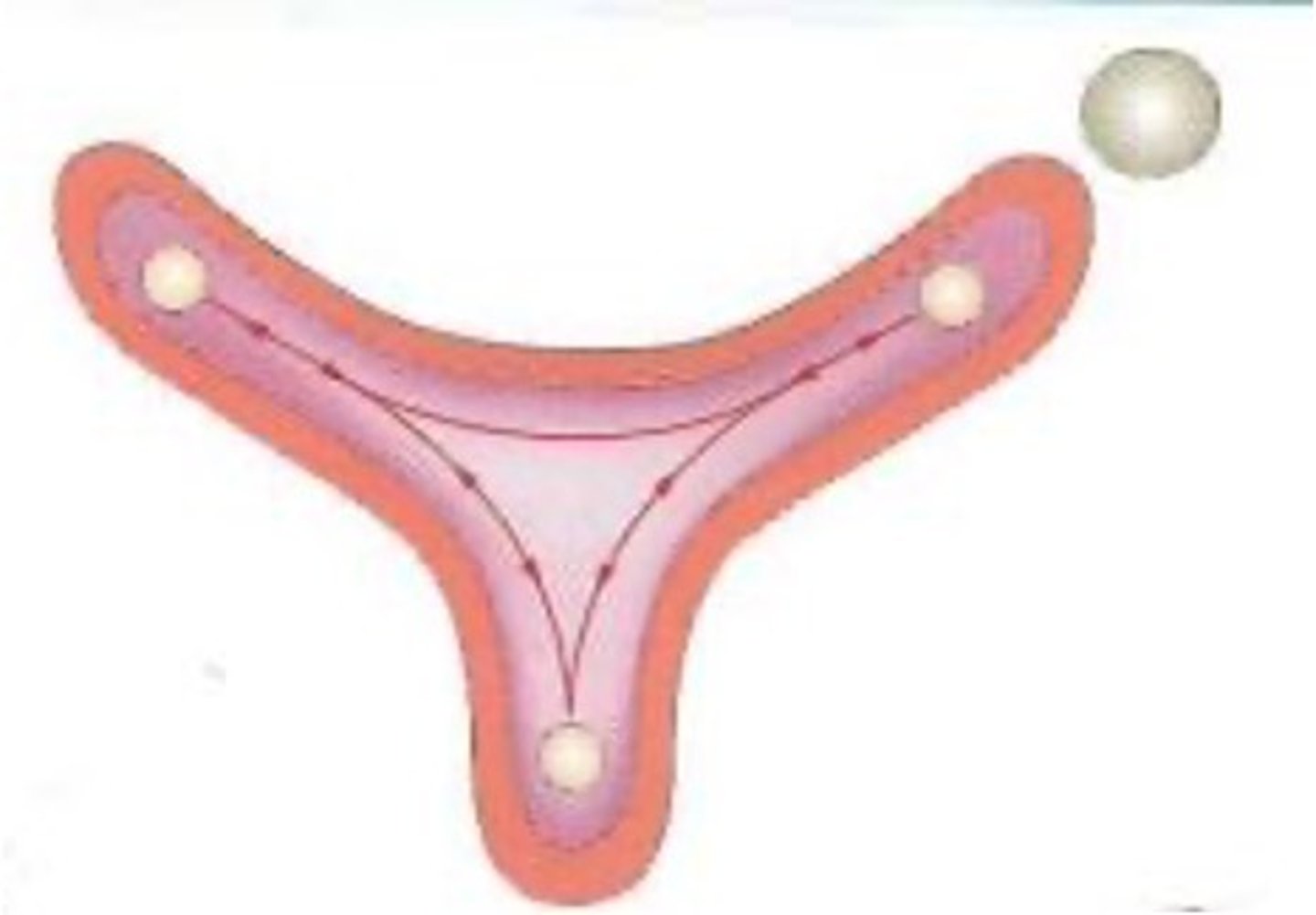
Summarise the general development of the embryo within the mare in early pregnancy
1. Embryo remains in ampulla of oviduct until day 5-6
2. Embryo migrates around uterus up to day 16 (essential for PD & prevention of prostaglandin release by endometrium)
3. Embryo fixes in position on day 16 (usually at the base of one horn).
4. Placental attachment at day 36 + production and attachment of endometrial cups.
5. Foetus grows into uterine body after 70 days.
What produces progesterone in the mare?
CL —> maintains pregnancy
What produces equine chorionic gonadotropin in the mare? When?
Endometrial cups from day 35 —> encourages secondary CL formation
When do the endometrial cups start to degenerate?
After about day 70 —> eCG levels start to fall, followed by progesterone levels
When do the endometrial cups fully regress?
Day 150 gestation.
When does the CL fully regress?
Day 200.
What maintains progesterone in the mare after the CL has regressed?
Foetal-placental production (locally acting).
When do foetal gonads produce oestrogens?
From day 60 onwards
Are the presence of endometrial cups (and hence eCG) a definitive sign of pregnancy? Why?
No —> cups regress by day 150 and cups can remain even if the foal has died.
Any attempt to abort foal must be done BEFORE day 35 if desired to get mare to breed again in same breeding season
How can we tell if a mare has not returned to oestrus and hence is gravid?
Look to see if mare stands for male after mating. If no = pregnant, if yes = not pregnant.
What laboratory test can be used to diagnose pregnancy in mares between days 45-90?
Blood sample for eCG.
What laboratory test can be used to diagnose pregnancy in mares from day 120 onwards?
Blood sample for oestrone sulphate —> indicates foetus alive
At what stage of pregnancy can oestrone sulphate in urine sample be used to diagnose pregnancy in mares?
After day 150.
Is oestrone sulphate in faecal sample a reliable method to diagnose pregnancy in mares?
No, it is not reliable.
How early can we detect equine pregnancy by manual rectal palpation?
40 days or more.
By day 120, may be able to ballot foetus
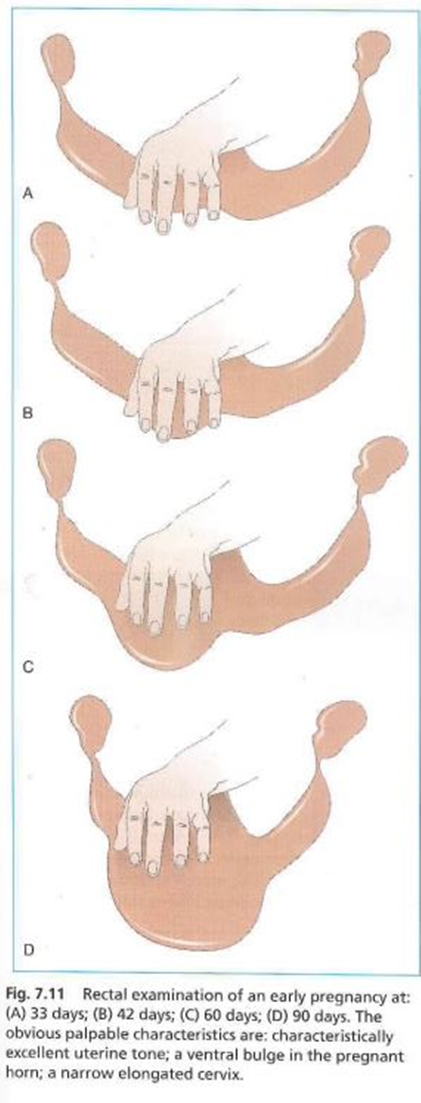
What is a more reliable pregnancy diagnosis method than rectal palpation?
Rectal ultrasonography.
When can ultrasonography be performed for pregnancy diagnosis in mares?
10 days after mating (but embryonic death may still occur later + twins can be missed)
Early embryonic death highest in first 14days
Conceptus motile to day 16 —> useful to distinguish cyst from twin and twin from twin
Outline the typical pregnancy scanning protocol for mares
First scan at day 15 post mating = check for pregnancy or twins
Second scan at day 25-28 = check for heartbeat, twins
before cups established so can terminate pregnancy
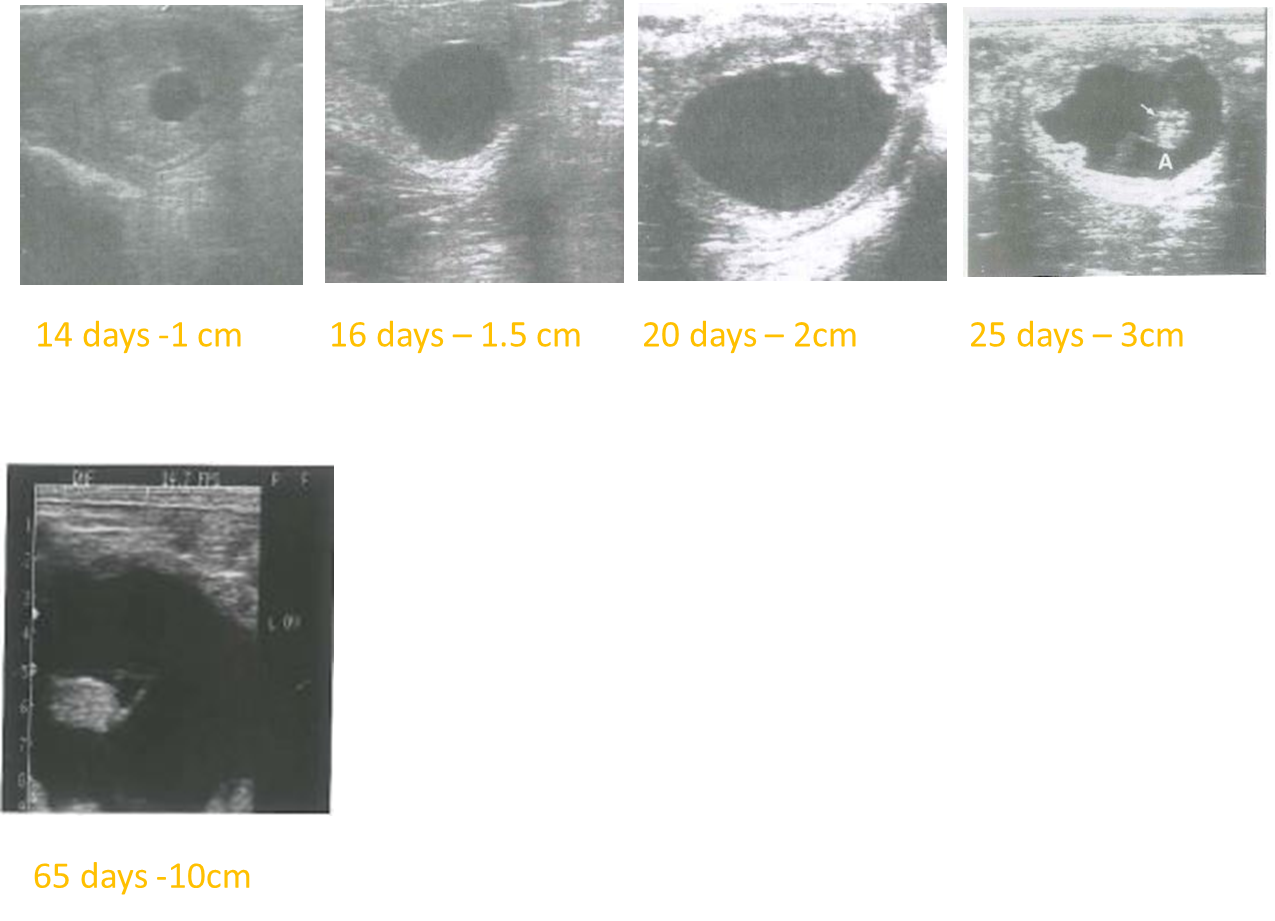
Third scan at 6 weeks (optional) = reassess all the above (embryonic death unlikely now)
Describe transabdominal US
Same technique as abdominal scan —> from 6 months onwards
What is the time range of pregnancy where early embryonic death can occur?
Fertilisation to day 40.
What is the time range of pregnancy where abortion can occur?
40-300 days.
What is the time range of pregnancy where stillbirth can occur?
300 onwards.
Why does early embryonic death generally occur?
Genetics
Breeding on foal heat (may not be as fertile)
Uterine problems (fibrosis, endometritis)
How is failure of pregnancy diagnosed?
Found empty on repeat scan, abnormal size / shape conceptus seen on scan
What is the most common cause of infectious abortion in horses? How is this diagnosed?
Equine herpesvirus 1 —> spread by resp route, membranes, vaginal discharges
Diagnosed by nasopharyngeal swabs for horses w/ resp signs or aborted material (PCR)
How can we prevent EHV-1 infection in mares?
Hard as ubiquitous but can use vaccination at 5, 7, and 9 months of pregnancy with good biosecurity —> reduces risk but doesn’t guarantee.
Separate pregnant mares from young stock (most likely to be clinically affected)
What is a notifiable abortive disease of mares in the UK?
Equine viral arteritis.
notifiable in stallions & mares mated in last 14days —> stallions become persistently infected shedders, mares abort then recover
How can we control equine viral arteritis in the UK?
Vacc (not always available), be aware of PIs.
What are the main bacterial aetiologies which cause abortion?
Streptococcus spp.
E. coli
Salmonella
Leptospires
asc. infection from cervix, haematogenous spread, intro at breeding
How is bacterial abortion treated?
ABs / NSAIDs but often too late
Which fungus causes pregnancy failure?
Aspergillus spp. (rare)
What is the problem with twin pregnancy in mares?
Mare uterus & placenta not well adapted to accommodate for the sustenance of 2 foals at one time → death of both foals in gestation.
Which is more likely to abort both twins: bilateral twins or unilateral twins?
Bilateral —> both will get to a reasonable size before they begin to compete with each other → insufficient placental attachment
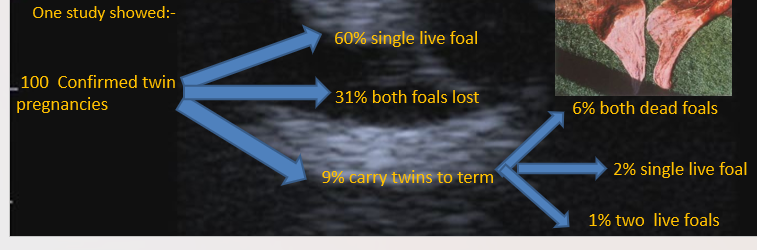
What are the outcomes of both twins carried to term?
6% both dead foals, 2% single live foal, 1% two live foals
What is the standard practice if a mare is identified to have 2 foals?
Use uterine crush method to destroy one twin —> sedatives & hyoscine to relax rectum?
NSAID injection to prevent induced inflam affecting other foetus
Mare scanned again in 24-48hrs to ensure success
What other things can contribute to pregnancy failure?
Systemic illness esp. ones involving endotoxaemia or pyrexia
Torsion of umbilical cord (>13 twists)
Congen defects
Idiopathic
What are signs of abortion?
Off colour —> may be cause of abortion, not due to abortion
Vaginal discharge
Running milk
Colic / foaling signs
How is abortion investigated?
Send whole carcass & placenta off
Examine placenta & cord
Weight of foal, crown-rump length (work out how old foal was), float lungs of foal to see if taken in air (was once alive)
Internal exam
Sample chorion, thymus, liver, lung, spleen —> test for EHV + bacterial culture + histopath
What can we use to induce abortion in mares before 3 months gestation?
Prostaglandin injection.
(if endometrial cups present = mare will not return to oestrus this breeding season)
What can we use to induce abortion in mares after 3 months gestation?
Repeat prostaglandin injections (twice daily).
or dilation of cervix + uterine lavage
or transabdominal injection of KCl into foetal heart
or dislocation of foatal neck per rectum
How can we induce parturition in mares?
1-2 ml oxytocin every 15-20 mins until parturition start.
What are the risks of inducing foaling in a mare?
Uterine rupture
Dystocia
Foal immaturity (matures in last 1% of pregnancy)
Retained membranes