Math Formulas for AFOQT
 Call Kai
 Learn
Learn Practice Test
 Spaced Repetition
 Match
Match Flashcards
 Knowt Play
1/50

There's no tags or description
Looks like no tags are added yet.
Name | Mastery | Learn | Test | Matching | Spaced | Call with Kai | Chat |
|---|
No analytics yet
Send a link to your students to track their progress
51 Terms
Real Numbers
These are all numbers on the number line. These include integers, fractions, decimals, irrational, etc.
Order of Operations
PEDMAS; Division and Multiplication are conducted left to right as are Subtraction and Addition
Ratios
A comparison of two numbers by division
Percentages
Part=(percent/100)×whole
Proportional Ratios
Two ratios are equal
Percent of Change
(New value-old value)/(old value) x 100%
Markup
Selling price - Cost
Markup rate
Markup/Cost
Discount
Multiply the regular price by the rate of discount
Selling price
Original-Discount=?
Tax
Multiply the tax rate by the taxable amount
Distributive Property
A(B+C)=AB+AC
Polynomial

Systems of Equations
Two or more equations working together
Ex. -2x + 2y=3
-2x + y=3
Functions
A rule that goes from one number (x) to another number (y), usually written y=f(x). For any given value of x, there can only be one corresponding value y. If y=kx for some number k (f(x)=0.5x), then y is said to be inversely proportional to x. The graph of y=f(x) + k is the translation of the graph of y= f(x) by (h,k) units in the plane. For example, y= f(x+3) shifts the graph of f(x) by 3 units to the left.
Solving Systems of Equations by Elimination
Ex. x+2y=6 + (-x)+y=3 → [3y =9 → y=3] [x+6=6 → x=0]
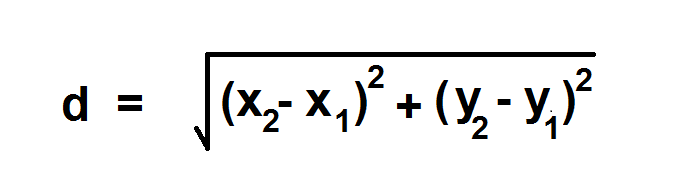
Distance from A to B (Distance Formula)
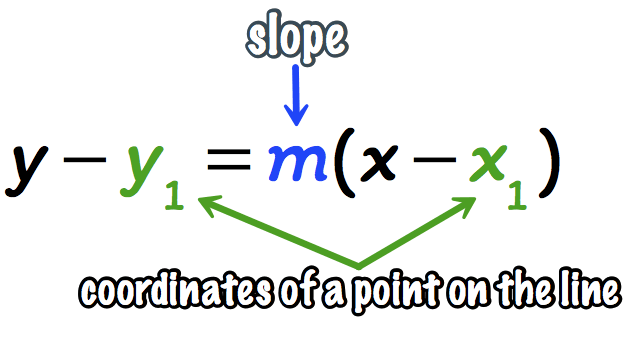
Slope of the Line

Point slope formula
Midpoint of Segment AB

Parabola
Parallel Parabolas to the y-axis are given by y=ax²+bx+c.
If a>0, the parabola opens up
If a<0, the parabola opens down
The y-intercept is C, and the x-coordinate of the vertex is x=-(b/2a)
Triangle (Area)
Area is given by A=(1/2)bh
Triangle (Perimeter)
P=a+b+c
Interior Angles of a Triangle
The sum equals 180°
Right Triangles
A good example is of a=3, b=4, c=5. This is referred to as the 3-4-5 right triangle. These are multiples that when a number is multiple by the we get an equal, larger triangle. Ex. If we multiply by 2 we get 6-8-10, which is also a right triangle.
Equilateral
All sides equal 60°
Isosceles
Has two equal sides, the base angles
Circle (Area)
A=(pi)r²
Circle (circumference)
C=2(pi)r
Full angle/circumference=360°
Circle (Length of Arc)
(n°/360°) × 2(pi)r
Circle (Area of Sector)
A=(n°/360°) × (pi)r²
Circle (Equation of the curve)
(x-h)² + (y-k)² = r²
Rectangle
A=l×w
If square l=w
Parallelogram
Area= l×h
(Rhombus if l=w)
Parallelogram
Regular polygons are n-sided figures with all equal sides and all angles equal. The sum of the inside angles of an n-sided regular polygon is (n-2)×180°
Area of a trapezoid
A=(1/2)h(b+b)
*b=base, the equation calls for the addition of base 1 and base 2
Surface area and volume of a rectangular/right prism
SA=ph+lb, V=bh
Surface Area and Volume of a Cylinder
SA=2(pi)rh + 2(pi)r², v=(pi)r²h
Surface Area and Volume of a Pyramid
SA= (1/2)ps+b, v=(1/3)bh
Surface Area and Volume of a Cone
SA=(pi)rs+(pi)r², v=(1/3)(pi)r²h
Surface Area and Volume of a Sphere
SA=4(pi)r² , v=(4/3)(pi)r³
Solids (Rectangular)
Volume=l×w×h, Area=2(l×w+w×h+l×h)
Solids (Right Cylinder)
V=(pi)r²h, A=2(pi)r(r+h)
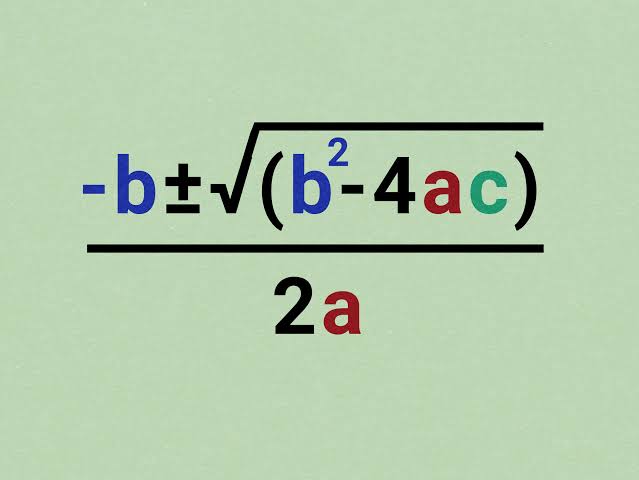
Quadratic formula
Simple interest
I=prt
(I=interest, p=principal, r=rate, t=time)
Probability
Number of desired outcomes/Number of total outcomes
Powers, Exponents, Roots

Interest
Total amount: A=P+I=P(1+rt)
Compound: A=P(1+r/n)^nt
*n is the number of times interest compounds each year
Factorials
The product of a number and all counting numbers below it
Ex. 8 factorial= 8! =8×7×6×5×4×3×2+1
5 factorial= 5! = 5×4×3×2×1
2 factorial= 2! = 2×1
Permutation
When different orderings of the same item are counted separately
Formula: nPr= (n!)/(n-1)!
Combination
Used when selecting objects from a group where the order is not important
Formula: nCr=(n!)/r!(n-1)!