Shoulder Complex — Bony Landmarks & O, I, A, I
 Call Kai
 Learn
Learn Practice Test
 Spaced Repetition
 Match
Match Flashcards
 Knowt Play
1/58

Earn XP
Description and Tags
Bones, bony landmarks, muscles, origins, insertions, actions, and innervations of the muscles & bones in the Shoulder Complex! Based off lecture slides from PTAP-120!
Name | Mastery | Learn | Test | Matching | Spaced | Call with Kai | Chat |
|---|
No analytics yet
Send a link to your students to track their progress
59 Terms

What is the shoulder complex?
A group of 4 interconnected joints, bones, & muscles that connect your upper arm to your torso & allow for a massive range of motion (ROM)
What is the osteology of the shoulder complex? (AKA what are the bones of the shoulder complex?)
Sternum
Clavicle
Scapula
Humerus

What is the arthology of the shoulder complex? (AKA what are the joints that make up the shoulder complex?)
Sternoclavicular Joint (SC Joint)
Acromioclavicular Joint (AC Joint)
Glenohumeral Joint (GH Joint)
Scapulothoracic Joint (ST Joint)


What type of synovial joint is the Sternoclavicular (SC) Joint?
Saddle joint


What type of synovial joint is the Acromioclavicular (AC) Joint?
Plane joint
What type of synovial joint is the Glenohumeral (GH) Joint? How many degrees of freedom does the GH Joint have?
Ball and socket joint; 3 (flex/ext, abd/add, IR/ER)
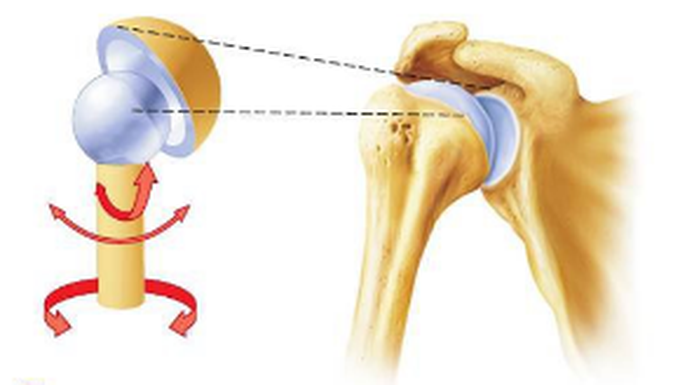

What type of synovial joint is the Scapulothoracic (ST) Joint? Why is it considered this type of joint?
Pseudo-joint
This joint is not a “true joint,” meaning it does not articulate two bones together. Instead, the bones of this joint (scapula & rib cage) are separated by muscles like the serratus anterior & subscapularis.
This separation allows the scapula to float & glide over the posterior thorax (back of the ribcage)
Why is the Scapulothoracic (ST) Joint in the shoulder complex despite it not being a “true joint”?
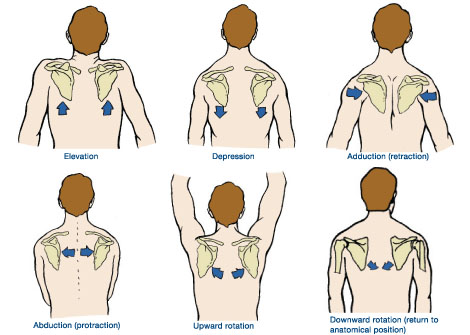
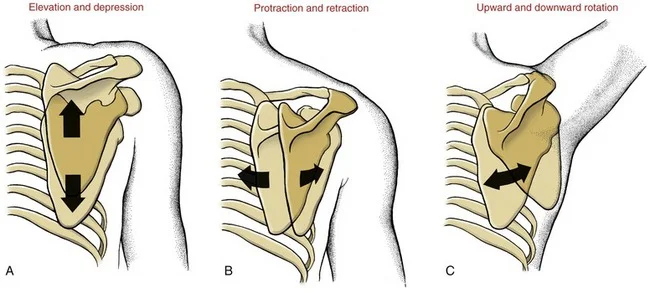
This pseudo-joint allows the scapula (shoulder blades) to:
elevate (shrugging)
depress (shoulders down)
retract (scap squeeze)
protract (push forward)
These movements help raise the arm overhead!
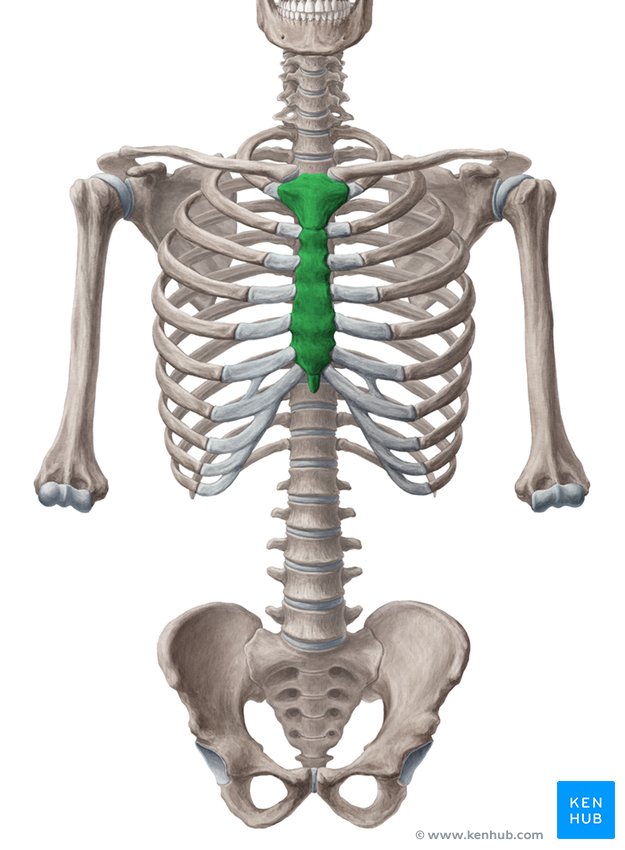
What bone is this?
Sternum
What are the bony landmarks of the sternum?
Clavicular notch (or clavicular facet) — this is where the clavicle sits
Jugular notch (AKA Suprasternal notch) — this is the articulation between the clavicle & the sternum, forming the Sternoclavicular (SC) Joint
Body — articulates with the ribs
Xiphoid process — point at the bottom
Manubrium — tie-knot shape at the top (superior end of the sternum)


What bone is this?
Clavicle

What are the bony landmarks of the clavicle?
Acromial end — (AKA lateral end because it’s pointed towards the outside); articulates with the acromion of the scapula to create the Acromioclavicular (AC) Joint
Sternal end — (AKA medial end because it’s pointed towards the midline of the body); articulates with the manubrium to create the Sternoclavicular (SC) Joint
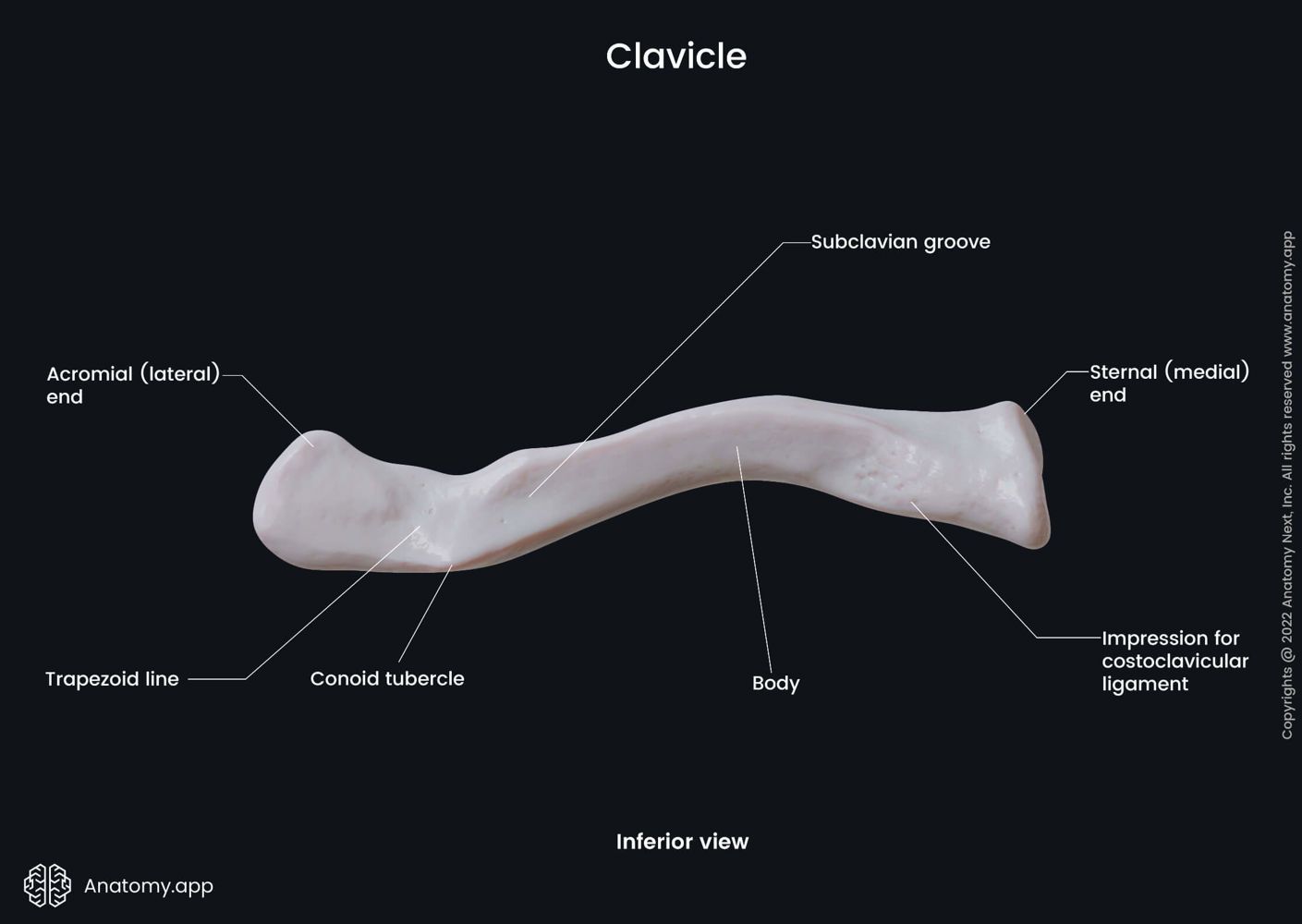
What 2 bones does the clavicle link together?
Scapula to the sternum

What are the components of the Sternoclavicular (SC) Joint?
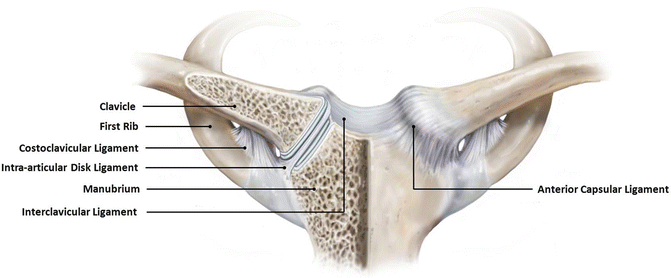
SC Ligament — tightly connects the clavicle with the to the manubrium
Costoclavicular Ligament — connects the clavicle to the 1st rib, specifically the costal cartilage of the 1st rib (AKA strips of hyaline cartilage that connect the front of the ribs to the sternum)
This ligament limits all motion except for depression
This ligament is also more superficial
Interclavicular Ligament — connects both of the clavicles together atop the manubrium
Articular disc — connects the interclavicular ligament to the manubrium
This is deep to the Costcoclavicular Ligament
In what planes does the SC Joint (sternoclavicular) allow movement?
All 3 cardinal planes!
Frontal (coronal)
Sagittal
Transverse
What is a fused joint? How would a fused SC joint affect movement?
This is what we call a joint in which 2 or more bones of that joint have been surgically connected into one bone structure
Fusing this joint would significantly limit the movement of the clavicle, scapula, & the overall movement of the entire shoulder

All movements at the shoulder girdle (scapula & clavicle) originate at the…
SC (sternoclavicular) joint
How might axial rotation occur at the SC joint?
This movement can occur posteriorly (towards the back) during shoulder flexion and shoulder ABduction
Which bones are the convex and concave at the SC joint?
Both the medial end of the clavicle and the clavicular notch of the sternum are concave and convex!
This is because the SC joint is a saddle joint
The reciprocal “C” shape on both the clavicle and the sternum to play both parts depending on the movement being done

When does the medial end of the clavicle become a concave/convex on an SC joint? When does the clavicular notch on the sternum become a concave/convex on the SC joint?
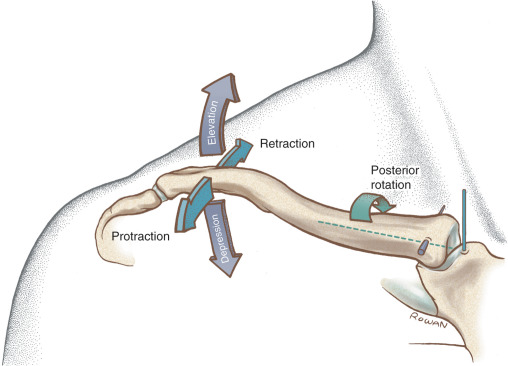
If we’re trying to do movement in the frontal plane (depression & elevation), the clavicle is convex, while the sternum is concave
Elevation — convex clavicle rolls up (superiorly), & glides down (inferiorly) on the concave manubrium
Depression — convex clavicle rolls down (inferiorly), & glides up (superiorly) on the concave manubrium
If we’re trying to do movement in the transverse plane (protraction & retraction), the sternum is convex, while the clavicle is concave
Protraction — concave clavicle rolls & glides anteriorly (towards the front) on the convex manubrium
Retraction — concave clavicle rolls & glides posteriorly (towards the back) on the convex manubrium


What are the bony landmarks of the scapula?
Subscapular fossa — big, flat part on the front (anterior side) of scapula
Glenoid fossa/cavity — where the head of the humerus articulates
Glenoid tubercles
Infraglenoid tubercle — small, rounded projection underneath (inferior to) the glenoid fossa
Supraglenoid — small, rounded projection atop (superior to) the glenoid fossa
Spine of the scapula — big, protruding line on the posterior side of the scapula
Supraspintaus fossa — big, flat part on the posterior side of the scapula, superior to the spine of the scapula
Infraspinatus fossa — big, flat part on the posterior side of the scapula, inferior to the spine of the scapula
Acromion — hook-like shape on the superior, lateral end of the scapula, that wraps around to the front & connects to the clavicle
Coracoid process — protruding hook shape on the anterior side of the scapula
Medial border — the side edge of the scapula that’s closest to the midline of the body
Lateral border — the side edge of the scapula that’s closest to the arm; it’s the hypotenuse!
Inferior angle — bottom tip of the scapula
Superior angle — top tip of the scapula

The Acromioclavicular Joint is the articulating point between what 2 bones?
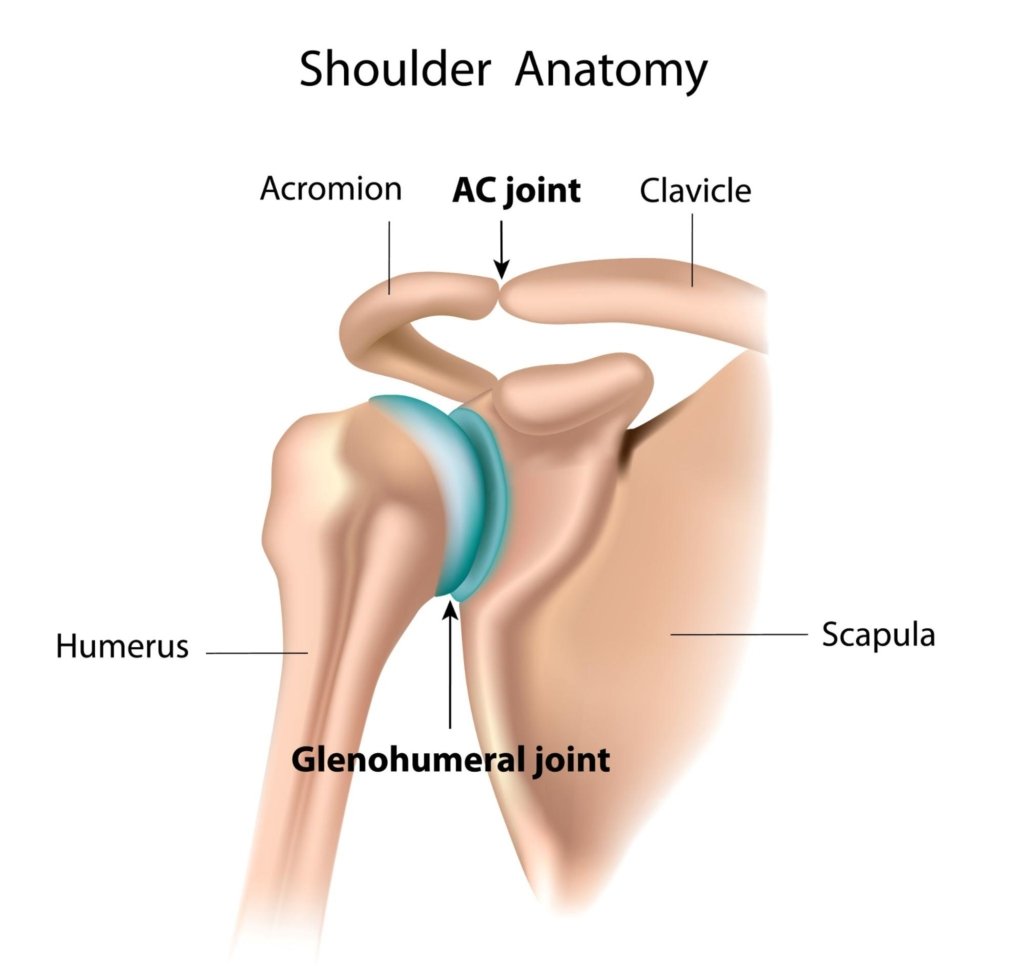
The lateral clavicle with the acromion of the scapula
What are the components that make up the Acromioclavicular Joint (AC Joint)?
Acromioclavicular (AC) Ligament — the ligament that actually connects the acromion to the clavicle; it prevents the scapula from getting dislocated; this is also what links the motions of the scapula (elevation, depression, protraction, retraction) to the clavicle
Coracoacromial Ligament — the ligament that connects the acromion of the scapula to the coracoid process (the hook-like shape) at the anterior portion of the scapula; it is responsible for protecting the head of the humerus!
Coracoclavicular Ligament — the ligament that connects the clavicle to the coracoid process (the hook-like shape) at the anterior portion of the scapula; this is what suspends the scapula from the clavicle & prevents dislocations!
The Glenohumeral (GH) Joint is the articulation between what 2 bones?
The glenoid fossa of the scapula with the head of the humerus

What are the bony landmarks of the humerus for the shoulder complex?
Humeral head — round ball at the top (proximal end) of the humerus that fits into the glenoid fossa
Greater tubercle — small, rounded bump on the proximal, lateral side of the humerus (at the top and away from the midline)
Lesser tubercle — small, rounded bump on the proximal, medial side of the humerus (at the top and towards the midline)
Bicipital groove/intertubercular groove — the space in between the greater & lesser tubercles at the proximal end of the humerus
Deltoid tuberosity — raised, rough, triangular bump on the lateral side of the shaft of the humerus

What is the glenohumeral (GH) labrum? What is the purpose of the GH labrum?
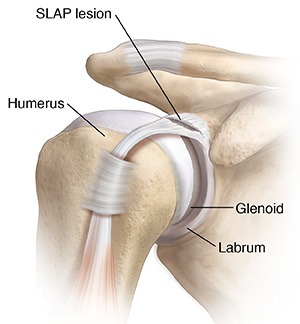
A suction cup-type ring made of fibrocartilage located on the glenoid fossa; it deepens the shallow socket of the glenoid fossa, allowing the humeral head to stay securely inside & not fall out of the socket

What muscle attachment is a direct extension of the superior glenoid labrum (comes from the top of the labrum)?
The long head of the bicep tendon (it runs at the same spot of the bicipital groove/intertubercular groove on the humerus), specifically 50% of the fibers

What is a SLAP tear? What does SLAP stand for, and what are some of the common causes?
This acronym stands for “Superior Labrum From Anterior to Posterior”; it’s an injury to the superior labrum caused by large forces that have partially detached or tore the fibers the labrum is made up of
Common causes include:
falling hard onto an outstretched arm or onto the shoulder
repetitive overhead motions like throwing or pitching
sudden, forceful pulling of the arm or lifting heavy items
gradual wear & tear of the cartilage as you age
What 2 structures are moving against one another at the Scapulothoracic (ST) Joint?
Anterior aspect of the scapula (front of the scapula) glides over the posterior thorax (the back of the ribs)

What are the osteokinematic motions permitted at the Scapulothoracic (ST) joint?
Elevation/depression, protraction/retraction, upward/downward rotation
What is Scapulohumeral Rhythm?
A concept that claims that the GH joint and the ST joint operate on a 2:1 ratio (or rhythm); for every 2 degrees of GH abduction (or flexion), the scapula must upwardly rotate 1 degree
In order to see this on a person, we can pay attention to the inferior angle of their scapula as they perform shoulder abduction
ex. If you were using a goniometer, the axis would be placed on the superior angle of the scapula, with the stationary arm pointed downwards. The moving arm would follow the inferior angle of the scapula as one abducts.
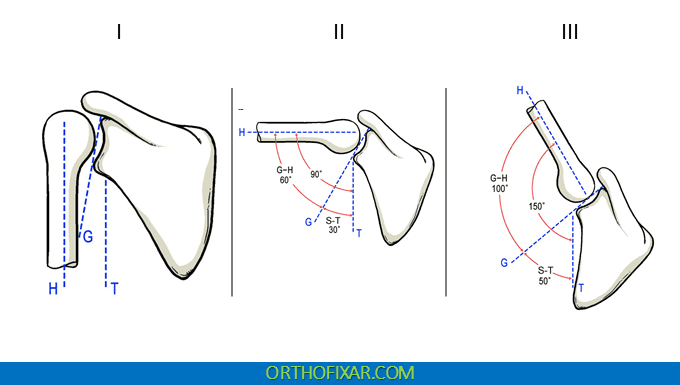
Explain Scapulohumeral Rhythm as it applies to 180 degrees of shoulder abduction
The GH joint does most of the work, contributing 120 degrees to lift the arm all the way up; the ST joint contributes 60 degrees of upward rotation in order to get the arm all the way up

What muscles are needed to perform upward rotation of the scapula? What do we call the use of all of these muscles together? Why do we refer to it as that?
Serratus anterior, Upper trapezius, Lower trapezius
Together, these muscles working together is called a force couple! A force couple is a system where 2 or more muscles pull in different/opposite directions around a joint to produce motion.
When the scapula upwardly rotates, the upper trapezius pulls the scapula superiorly and medially. At the same time, the serratus anterior is pulling the inferior angle of the scapula upwards (superiorly) and around the rib cage. The lower trapezius pulls the scapula downwards (inferiorly), so that the medial border faces the bottom
Think of it like using both of your hands to turn a steering wheel!


What is the convex-concave rule for the shoulder (GH Joint)?
Convex-on-concave, so movement happens in the opposite direction

Explain the arthokinematics of shoulder ABDuction
The convex humeral head rolls superiorly (upward), while also sliding inferiorly (downwards) on the concave glenoid fossa

Explain the arthokinematics of shoulder ADDuction
The convex humeral head rolls inferiorly (downwards), while also sliding superiorly on the concave glenoid fossa
Explain the arthokinematics of internal rotation of the shoulder
Anterior surface of the convex humeral head glides medially (towards the middle of the body) on the concave glenoid fossa

Explain the arthokinematics of external rotation of the shoulder
Anterior surface of the convex humeral head glides laterally (away from the midline of the body) on the concave glenoid fossa

Define a closed-packed position
Joint alignment where the joint surfaces have maximum contact with one another & the surrounding ligaments and joint capsule (AKA the area between joint surfaces) are tightly compressed
ex. knee joint during knee flexion
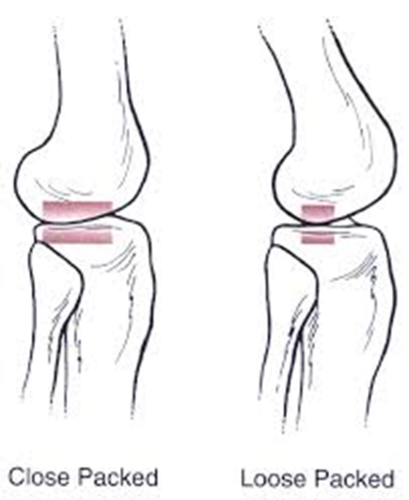
Define an open/loose packed position
Joint alignment where the supporting ligaments and the joint capsule (AKA the area between joint surfaces) are more lax, & the articulating joint surfaces have the least amount of contact
ex. slight knee flexion

Define capsular pattern
A predictable limitation of movement or a pattern of pain at a joint that happens when the entire joint capsule or synovial membrane is inflamed or irritated as a result of lesions (any area of damaged or abnormal tissue caused by injury, infection, or disease)
ex. If someone has frozen shoulder (adhesive capsulitis), ER at the GH joint is likely to be limited first, then abduction, then IR
Define end feel
The type of resistance felt by an examiner at the very of a joint’s passive range of motion (ROM)
Describe the 3 normal end feels
Bony (Hard) — an abrupt, hard stop when bone meets bone (ex. straightening the elbow)
Soft — two muscle masses squash together (ex. flexing the elbow fully so the biceps brachii presses on the forearm)
Firm — a spring-like resistance (ex. full ER of the shoulder)
Describe the 4 abnormal end feels
Empty — patient stops the movement before reaching their end range because of pain, even though no physical block is felt; could be a sign of a fracture, inflammation, or bursitis
Muscle Spasm — suddenly, involuntary tightening of the muscle that stops movement abruptly with a springy-feel; points to joint irritation or acute arthritis
Springy block — a rebound or spring-like block at the end of range; this could mean something’s physically trapped inside the joint
Abnormal Hard/Soft — a hard bony block where a soft or firm feel should be (ex. severe osteoarthritis) OR an uncharacteristic soft feel at a place that should be hard
What is the rotator cuff (RTC)?
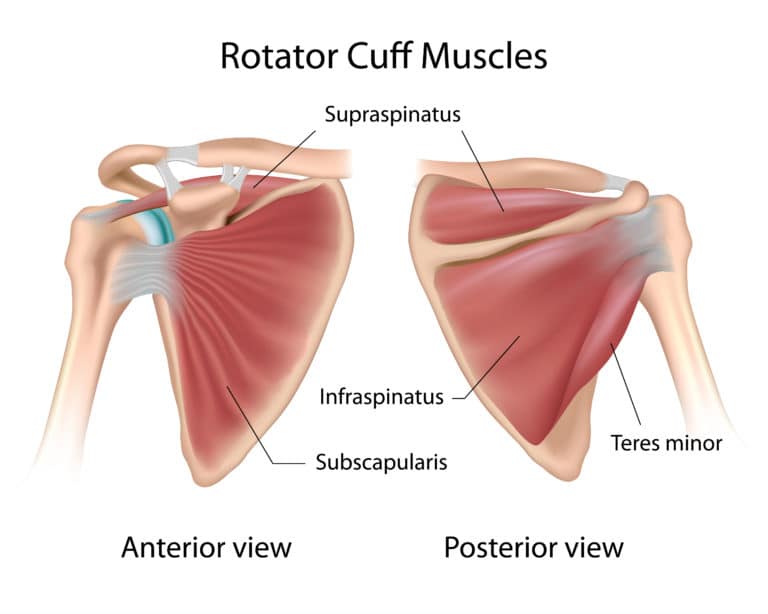
A group of 4 muscles & their tendons that surround the GH joint and connect the scapula to the humerus
What are the 4 muscles of the rotator cuff (RTC)?
Supraspinatus
Infraspinatus
Teres minor
Subscapularis

What are tendons?
Attachments between muscles and bone
How do the RTC muscles work together to produce shoulder ABDuction?
Supraspinatus starts abduction for the first 15°, pushing (compressing) the humeral head into the GH fossa
The deltoid then becomes the primary mover for the rest of abduction
Subscapularis, infraspinatus, & teres minor work together to produce a downward force (inferiorly directed force) to pull humeral head downward and inward to offset deltoid’s superior pull. This prevents the humeral head from hitting the coracromial joint
The infraspinatus and teres minor also externally rotate the humeral head (twist it away from the body) to prevent impingement (tendon becomes trapped or squished in a narrow space between bones when you move) between the greater tuberosity of the humerus and the acromion of the scapula

Explain the arthrokinematics of shoulder flexion and extension.
Both occur in the sagittal plane about a medial-lateral axis of rotation; the convex humeral head spins on the glenoid fossa around a relatively fixed axis
Flexion — the convex humeral head rolls posteriorly (towards the back) & slides inferiorly (down into the glenoid fossa) as the arm elevates
Extension — the convex humeral head rolls anteriorly (towards the front) as the arm moves backward

Explain the arthrokinematics of shoulder internal & external rotation
Both occur in the transverse (horizontal) plane about a vertical (longitudinal) axis of rotation
IR — anterior surface of the humeral head glides medially
ER — anterior surface of the humeral head glides laterally

Explain the arthrokinematics of shoulder abduction & adduction
Both occur in the frontal plane about an anterior-posterior axis of rotation
ABD — the convex humeral head rolls superiorly while simultaneously sliding inferiorly
ADD — the convex humeral head rolls inferiorly while simultaneously sliding superiorly

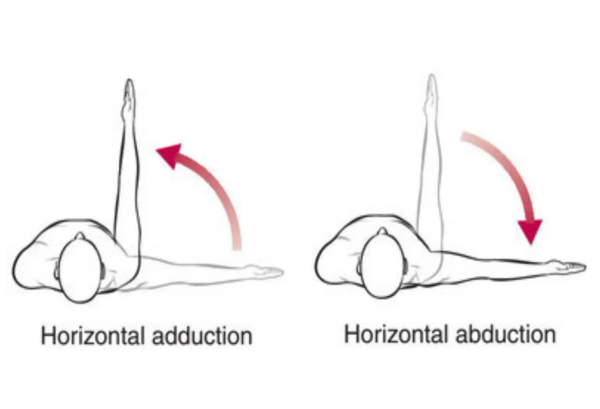
What plane does horizontal abduction and adduction of the GH joint occur in?
Transverse (horizontal) plane
What is the brachial plexus?
A network of nerve roots that spans from spinal nerves C5-T1 that send signals from the spinal cord to the shoulder, arm, & hand
The terminal branches become the 5 peripheral nerves that innervate the muscles of the UE
Muculocutaneous nerve
Axillary nerve
Radial nerve
Median nerve
Ulnar nerve

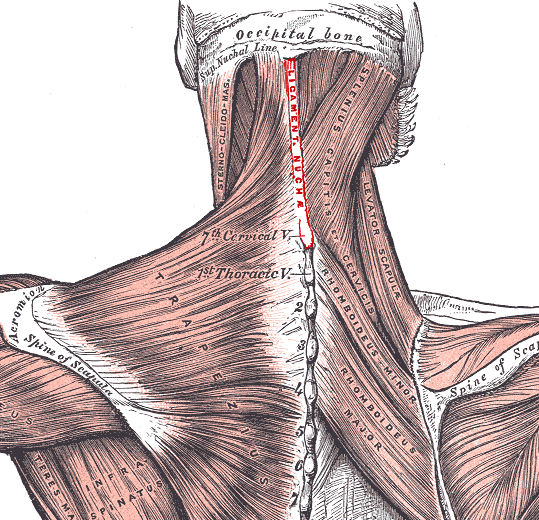
What is the Ligamentum Nuchae? What is its origin and insertion?
A connective tissue that stretches during cervical flexion, allowing the head to come back to an upright position using with the help of its elasticity
O: external occipital protuberances
I: C7 spinous process
What is “scapular winging”? What is a sign of? How can we observe it? How can you improve it?
When the medial border of the scapula is lifting away from the rib cage; can be a sign of weak serratus anterior
We can observe this on someone during resisted shoulder abduction or while they’re doing a standard pushup
Serratus anterior can be strengthen by doing serratus punches (AKA push up plus)

What is a Total Shoulder Arthroplasty?
AKA a standard shoulder replacement; it’s an operation to replace a damaged shoulder joint (AKA arthritic joint surfaces) with artificial parts made of metal & plastic (AKA metal ball attached to a stem, and a plastic socket

Why is a Total Shoulder Arthroplasty done?
To relieve severe pain and restore movement when advanced shoulder arthritis wears away the GH joint’s cartilage, causing painful bone-on-bone friction in the joint

What is a Reverse Total Shoulder?
AKA a reverse shoulder replacement; an operation where the normal ball-and-socket structure of the GH joint is reversed.
An artificial ball is attached to the glenoid fossa of the scapula & an artificial socket is attached to the top of the humerus. This artificial socket relies on the deltoid rather than the rotator cuff to power & position the arm

Why is a Reverse Total Shoulder procedure done?
Patient has severe joint damage or arthritis combined with a badly torn, weak, or missing rotator cuff
