Lecture 4: Sacrum Evaluation and Treatment I
 Call Kai
 Learn
Learn Practice Test
 Spaced Repetition
 Match
Match Flashcards
 Knowt Play
1/39

There's no tags or description
Looks like no tags are added yet.
Name | Mastery | Learn | Test | Matching | Spaced | Call with Kai | Chat |
|---|
No analytics yet
Send a link to your students to track their progress
40 Terms
Superior Transverse Sacral Axis
-axis of the sacrum
-S2 at the anterior aspect of the spinal dura
-Respiratory motion
-pulmonary and cranial rhythmic impulse
Middle Transverse Sacral Axis
-axis of the sacrum
-S2 at the anterior aspect of the sacrum
-sacroiliac motion
Inferior Transverse Sacral Axis
-axis of the sacrum
-S3 at the anterior aspect of the sacrum
-iliosacral motion
Neutral
a forward/anterior torsion is physiologic and ________________
Non-neutral
a backward/posterior torsion is physiologic and ____________________
Left on Right (L on R)
Right on Left (R on L)
options for Backward/Posterior torsions
Left on Left (L on L)
Right on Right (R on R)
options for Forward/Anterior torsions
1. Lateralization Tests
2. Salcral sulci comparison
3. ILA comparison
4. Functional/Motion Testing (Spring/Sphinx)
what are the 4 steps to diagnosing a sacrum?
superior/inferior and anterior/posterior
what are you looking at when evaluating the ILA?
Flexion
Flexion or Extension?
Absence of spring
or
negative sphinx
Extension
Flexion or Extension?
spring present
or
positive sphinx
Oblique
If the sacral sulcus is deep on one side and the ILA is posterior/inferior on the opposite side, there is an _____________ axis.
Unilateral
sacral sulcus is deep on one side and ILA is posterior/inferior on the same side
Opposite
With an oblique axis, the axis is always ____________ the positive seated flexion test.
Extend
inhalation will cause the sacrum to ______________
Flex
exhalation will cause the sacrum to ________________
Physiologic
describes a dysfunction that occurs around an axis
Non-Physiologic
describes a dysfunction that does not occur around an axis. Usually caused by trauma
Superior Transverse Sacral Axis
Respiratory axis
Middle Transverse Sacral Axis
Sacroiliac axis
Inferior Transvers Sacral Axis
Iliosacral axis
Vertical Axis
1

Right Oblique Axis
2
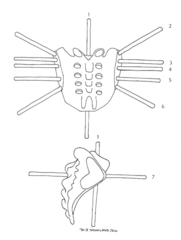
Respiratory axis (superior transverse axis)
3

Sacroiliac axis (middle transverse axis)
4

Iliosacral axis (inferior transverse axis)
5

Left oblique axis
6
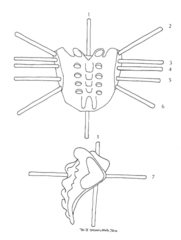
Anteroposterior axis
7

Forward Torsion
• Neutral
• Rotation in same direction
• Left rotation on left oblique axis
• Right rotation on a right oblique axis
Backward Torsion
• Non-neutral
• Rotation in opposite direction
• Right rotation on left oblique axis
• Left rotation on a right oblique axis
Unilateral Sacral Extension
• Rare
• Shallow sulcus & deep ILA on same side
-positive sphinx
Unilateral Sacral Flexion
• Deep sulcus & prominent ILA on same side as positive seated & standing flexion tests
-negative sphinx
Bilaterally Flexed Sacrum
Seated Flexion Test: Positive/Negative Bilaterally
Both sacral sulci: Deep, anterior
Both ILAs: Shallow, posterior
Spring test: Negative
Sacrotuberous ligament tight bilaterally
Bilaterally Extended Sacrum
Seated Flexion Test: Positive/Negative Bilaterally
Both sacral sulci: Shallow, posterior
Both ILAs: Deep, Anterior
Spring test: Positive
Sacrotuberous ligament loose bilaterally
Spring Test and Sphinx Test
Purpose: An indicator of whether you are dealing with a sacral dysfunction which is going forward or going backward.
When dealing with oblique axes it will tell you if it is an Oblique Axis that is a neutral or non-neutral
Spring Test
1. Find sacral base
2. Place heel of hand over Lumbosacral junction
3. Spring in an Anterior motion(always spring in the direction of the joint)
-No springing allowed
-non-neutral condition (backward torsion) or unilateral/bilateral sacral extension
Describe a positive spring test
-Springing allowed
-Neutral condition (forward torsion) or unilateral/bilateral sacral flexion
describe a negative spring test
Sulci become more symmetrical
describe a negative sphinx test
Sulci become more uneven
describe a positive sphinx test