Microbiology - Ch. 6 Microbial Growth - flashcards
 Call Kai
 Learn
Learn Practice Test
 Spaced Repetition
 Match
Match Flashcards
 Knowt Play
1/74

There's no tags or description
Looks like no tags are added yet.
Name | Mastery | Learn | Test | Matching | Spaced | Call with Kai | Chat |
|---|
No analytics yet
Send a link to your students to track their progress
75 Terms
How is microbial growth determined in the lab?
By observation of a culture medium — checking for growth in the culture media (e.g., Nutrient Agar vs. Nutrient Broth).
What do you look for to determine growth on Nutrient Agar vs. in Nutrient Broth?
Nutrient Agar (solid): appearance of colonies
Nutrient Broth (liquid): cloudiness (turbidity)
What is Nutrient Agar (N.A.) and how is it available?
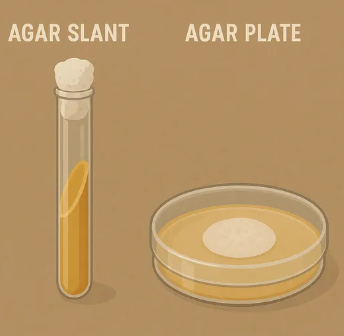
A solid culture medium. Available as a plate or a slant. Check for appearance of colonies (large populations of cells).
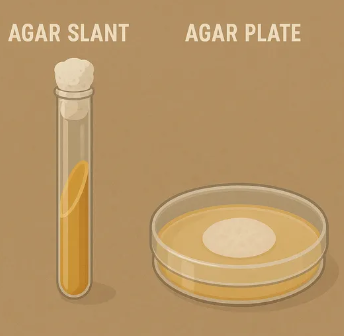
What is a Nutrient Agar (N.A.) slant?
A test tube where the agar solidifies at an angle/slant (rather than flat).
What is Nutrient Broth (N.B.) and how is it available?
A liquid culture medium. Available as a test tube. Check for cloudiness (turbidity).
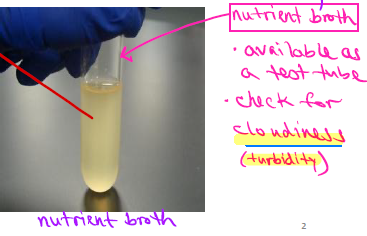
What does turbidity mean in the context of Nutrient Broth?
Turbidity = cloudiness in the liquid broth, indicating bacterial growth.

How does bacteria reproduce?
Bacterial division (binary fission) — one bacterium divides into two, then those divide again, and so on (e.g., 1 bact. → 2 → 4 → 8 bact.).
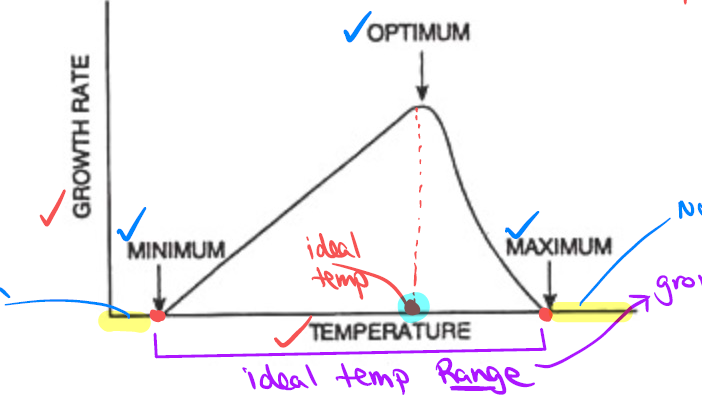
What is minimum growth temperature?
The lowest temperature required for growth. Any temp below this value → no growth.
What is maximum growth temperature?
The highest temperature tolerated for growth. Any temp above this value → no growth.
What is optimum growth temperature?
The best/ideal temperature for growth (where growth rate peaks).
According to the growth rate vs. temperature curve, when does growth occur?
Growth only occurs between the minimum and maximum temperatures — this range is the "ideal temp range." Growth rate rises from minimum, peaks at optimum, then falls back down to zero at maximum.
What are Psychrophiles and where are they found?
Bacteria that prefer to grow at low temperatures. Found growing in the fridge, snow, and deep ocean.
What are Mesophiles and where are they found?
Bacteria that prefer to grow at medium temperatures. Found growing in humans — mesophiles share their temperature range with humans (ideal body temp = 37°C / ~98°F).
What are Thermophiles and where are they found?
Bacteria that prefer to grow at hot/high temperatures. Found growing in hot springs and volcanoes (Ex: Domain Archaea).
What is the human body's ideal temperature, and which microbial category shares this range?
37°C (~98°F) — this range is shared with Mesophiles.
What does pH stand for?
Potential of Hydrogen
What is the pH scale range, and what do the low/mid/high ends represent? (1-14)
Ranges from 1 (acidic) to 14 (alkaline/base), with 7 being neutral.
What is pH a measure of, and how does it relate to H⁺ concentration?
H+ is hydrogen ion more of this = acidity.
OH- is hydroxide more of this = basic/alkaline.
What pH do most bacteria prefer?
Neutral pH, ~pH 7.
What pH do molds and yeasts prefer?
Slightly acidic environment, ~pH 5–6.
What are Acidophiles, and what pH do they prefer?
Microbes that prefer a low pH (acidic) environment, ~pH 1–2.
Ex: H. pylori, present in the G.I. tract (stomach), which has HCl (acid).
What is osmotic pressure comparing, and what is it mainly due to?
Comparing pressure outside the cell (external environment) vs. inside the cell (internal environment). Due mainly to the concentration of particles/solutes — water follows the particles.
How does osmotic pressure affect microbial growth if it's unequal inside vs. outside the cell?
More solutes outside meaning water will exit the cell and cell will shrink and die.
—
More solute inside means water will go into the cell and it’ll swell and blow up.
What is an isotonic solution, and why is it ideal for cell survival?
A solution where osmotic pressure is equal inside and outside the cell → no net water movement → cell survives.
Example: bacteria on skin or in the ocean under normal (non-halophilic) conditions.
What happens to a non-halophile bacterium in a high-salt (high osmotic pressure) external environment, like sea water?
Water leaves the bacterium (moves out toward the high-salt water) → the cell shrinks → the cell dies.
What are Halophiles?
"Salt-loving" bacteria that survive high-salt (high osmotic pressure) external environments.
How do Halophiles survive a high-salt external environment that would normally cause a cell to shrink?
They produce positively-charged solutes/particles inside the cell → this balances out the external osmotic pressure → no net water movement → cell survives (doesn't shrink).
Why do microbes need carbon, and where does it come from?
To produce energy. Carbon is present in carbs, proteins, lipids, and nucleic acids — when broken down, they release energy. Sources:
From CO₂ (for autotrophs) → energy
From organic compounds (for heterotrophs) → energy
Why do microbes need nitrogen, and which organic compounds contain it?
Proteins are made of amino acids (AA's), which have an amino group (–NH₂) that contains N.
—
Nucleic acids are made of nucleotides, which have a nitrogenous (N) base (Ex: A, G, C, U, T).
Why do microbes need sulfur, and which organic compound contains it?
Sulfur is needed to make proteins. Proteins contain 2 sulfur-containing amino acids.
Cysteine and Methionine
Why do microbes need phosphorus, and which organic compounds contain it?
Phosphorus is needed to make nucleic acids and some lipids.
Nucleic acids (nucleotides) contain phosphorus, plus sugar and a nitrogenous (N) base.
Also needed for cell membrane formation.
What is an example of a phosphorus-containing lipid, and what is its structure?
Phospholipid bilayer. Structure = a phosphate (P) head + fatty acid (F.A.) tails (the lipid portion).
What are Micronutrients ("trace elements")?
Chemicals required by microbes in small quantities.
Examples: ions, vitamins.
What are the two functions of micronutrients?
Inorganic enzyme cofactors (Ex: iron, copper, zinc) — ions that help enzymes work better, speeding up chemical reactions.
Organic growth factors (Ex: vitamins A & D, animal extract in lab media) — enhance/improve growth of microbes.
What are Obligate Aerobes?
High O₂ required. Only aerobic growth; oxygen required. Growth occurs only where high concentrations of oxygen have diffused into the medium (high growth at top of tube).
What are Obligate Anaerobes?
No (or low) O₂ required — oxygen is not tolerated. Growth occurs only where there is no oxygen (growth throughout tube, no O₂ present/needed).
What are Facultative Anaerobes? (oxygen requirement, growth pattern)
Very adaptive to different O₂ concentrations. Growth occurs in both O₂ and no O₂, but they prefer O₂ — growth is best/greatest where oxygen is present, but occurs throughout the tube.
What are Microaerophiles? (oxygen requirement, growth pattern)
Growth in small amounts of O₂ only — a low concentration of oxygen is required.
What is culture media, and what are the two preparation types (with examples)?
A solid or liquid preparation for microbial growth in a lab.
Solid (agar) media — in a plate or slant. Ex: Nutrient Agar. What you see: colonies.
Liquid (broth) media — in a test tube. Ex: Nutrient Broth. What you see: cloudiness/turbidity.
What is an Inoculum?
The introduction of microbes into a medium — the microbes being transferred. This becomes a culture (Ex: bacterial colonies grow).
What is a Culture?
Microbes growing in or on a culture medium.
What is a Pure Culture, and how do you recognize one?
A culture that contains only one species, seen on a solid agar plate. All colonies look similar (Ex: all same color) — indicates no contamination present.
What is a Colony, and what is it also called?
A population of cells from a single cell or from a group of attached cells — bacteria divide and the population doubles. Often called a colony-forming unit (CFU). Colonies are only seen on agar.
What is the Streak Plate Method, and what does "streaking" involve?
Used to isolate pure bacterial cultures. Streaking = spreading bacteria across a Nutrient Agar plate, then incubating (Ex: 24 hrs).
What is the goal of the streak plate method?
Spread, separate, and isolate colonies, then transfer a colony to another plate to get a pure culture.

What is an isolated colony (CFU)?
A single, separated colony from streaking — used to obtain a pure culture.
Why does a virus require a host cell, and what happens to the host?
Virus needs a bacterial host cell to multiply. Virus multiplies inside the host → bacteria dies.
What is a viral plaque?
A clearing on a "bacterial lawn" (plate) - virus infected/killed host cells.
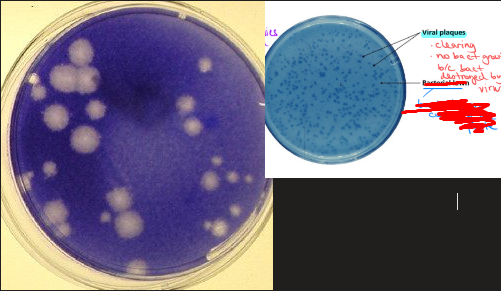
What is a Bacterial lawn?
Bacteria that are covering the plate.

What is a Plaque-forming unit (PFU), and what is it analogous to?
Analogous to a CFU (colony-forming unit) — but for viral growth instead of bacterial growth.
How are bacterial and viral growth quantified in the lab?
Bacteria → grow into colonies, counted as CFU (colony-forming units)
—
Viruses → form plaques, counted as PFU (plaque-forming units)
What is Chemically Defined Media?
Exact chemical composition known — same in every batch.
What is Complex Media?
Composition unknown/varies by batch. Ex: beef extract, peptone.
What is Reducing Media?
Contains chemicals that remove/deplete all O₂ — creates anaerobic environment for obligate anaerobic bacteria growth.
What is an example of Reducing Media?
Anaerobic Jar — removes all O₂ present to create anaerobic environment.

What is Selective Media?
Selects for growth of only 1 type of bacteria; suppresses (inhibits) unwanted microbes.
What is an example of Selective Media, and what does it select for?
EMB (Eosin Methylene Blue) agar — selects for Gram(-) growth… inhibits Gram(+).
Ex: E. coli or other Gram(-) bact.
What is Differential Media?
Allows differentiation between bacteria within the same group.
Ex: Blood agar (differentiates 2 types of Gram(-) or Gram(+) via hemolysis).
What is an example of media that's both Selective AND Differential, and how does it work?
Eosin Methylene Blue (EMB) agar:
Selects first – only Gram(-) bacteria grow.
Differentiates between E. coli and non-E. coli (both are Gram(-).
E. coli → dark, shiny green.
non-E. coli → dark purple.
What is Enrichment Media?
"Rich" in growth factors — non-selective (everything grows).
Stimulates growth of many bacterial species. Usually liquid (nutrient broth).
What are Fastidious bacteria, and why do they need Enrichment Media?
"Picky eaters" — difficult to grow without specific growth factors/nutrients present.
Usually exist as liquid (nutrient broth).
How do bacteria grow (reproduce), and what's the process called?
Asexual reproduction (same cell dividing) — increase in number of cells.
Process = binary fission.
What is Generation Time?
Time required for a cell to divide/double. Ranges from minutes to hours.
What are the 4 phases of the bacterial growth curve?
1) Lag, 2) Log, 3) Stationary, 4) Death.
What happens in the Lag Phase?
No growth — DNA replicating, active state (preparing to divide).
What happens in the Log Phase?
Exponential growth (doubling) — population ↑.
What happens in the Stationary Phase?
Balance/equilibrium — microbial deaths balance production of new cells.
Running out of nutrients.
What happens in the Death Phase?
Metabolic waste (toxic) ↑ → cell death → population ↓.
What are Indirect Measurement methods, and what are the 3 types?
Not directly counting — instead estimate/assume growth.
1) Turbidity (measure cloudiness)
2) Metabolic Activity (waste ↑ proportional to bact. #)
3) Dry weight (bact. filtered, dried, weighed — high weight = ↑ # bact).
What are the 3 steps of Plate Counts?
1) Serial dilutions of sample.
2) Plate out serial dilutions.
3) Colony count.
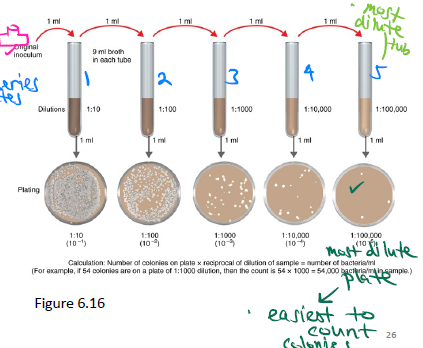
Why must you dilute plates before counting colonies?
Concentrated plates have too many overlapping colonies to count accurately.
Serial dilution brings the count down to a countable range (~30-300 colonies), which is then multiplied by the reciprocal of the dilution factor to find the original concentration.
What is the formula for calculating bacteria/mL from a plate count?
# colonies × reciprocal of dilution = bacteria/mL.
Ex: 54 colonies at 1:1000 dilution = 54 × 1000 = 54,000 bacteria/mL.
How does the Filtration Method work?
Solution passed through filter → collects bacteria (bact. bigger than holes, stay on filter). Filter transferred to Petri dish → grows as colonies.
How does Direct Microscopic Count work?
Bacterial suspension placed on slide → cell counter (has grid for counting) → average # bact./field calculated → math to estimate total # bact.
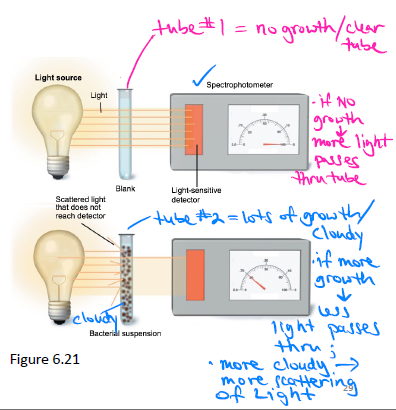
How does Turbidity work with a spectrophotometer as an indirect growth measurement?
Measures cloudiness with a spectrophotometer.
No growth = clear tube, more light passes through.
More growth = cloudy, more light scattered, less light passes through.