BMS2062 - W1: Genomic Variation and Disease
 Call Kai
 Learn
Learn Practice Test
 Spaced Repetition
 Match
Match Flashcards
 Knowt Play
1/20

There's no tags or description
Looks like no tags are added yet.
Name | Mastery | Learn | Test | Matching | Spaced | Call with Kai | Chat |
|---|
No analytics yet
Send a link to your students to track their progress
21 Terms
What is bioinformatics?
any application where computers are used to process, store or analyse biological data
can be used to study gene, gene sequence, RNA
What is a genomics?
DNA bioinformatics
Genome: The complete set of genetic information in an organism that is housed in the chromosomes
What is transcriptomics?
RNA bioinformatics
Transcriptome: The sequence of each RNA transcript present in a cell or group of cells at a point in time.
What is proteomics?
Protein bioinformatics
Proteome: The sequence of each protein present in a cell or group of cells at a point in time.
What is Structural Bioinformatics?
Structural bioinformatics of proteins (primarily) and other macromolecules
Biological network analysis
What interactions are occurring inside a cell - understand the relationship between DNA, RNA, protein, and cellular function
Hutchinson-Gliford Progeria Syndrome (HGPS)
very rare disease caused by point mutations in the LMNA gene which encodes for lamin protein
How can bioinformatics help combat disease?
Identify where genetic variants associated with disease are located
sequence an individual’s genome and compare to find variation
Detect which individuals are susceptible or have a high likelihood of being susceptible to a disease
check if someone has a known variation in their genes based on their genome sequence
Establish how genetic variants actually cause disease
compare healthy and disease tissue
comparative transcriptomics or comparative proteomics
can see consequences of lost/ damaged proteins
Create treatment and management practices for diseases
can see effects of treatments on the transcriptomic/ proteomics profile of disease tissue
precision medicine strategies (by seeing where the variation is, can designing drugs/ treatments to treat the disease)
personalised medicine
requirements of transcription/ translation
DNA needs to be accessible (epigenetic mechanisms)
RNA polymerase binds to promotor region
Separation of template strand and coding strand
mRNA leaves nucleus, goes to ribosome (recognised via 5’ cap)
tRNA recruit specific amino acids
stop codon, mRNA disengages, translation stops
protein fold into 3D shape (via chaperones, interactions with amino acids, etc)
Types of mutations (which affects how it is passed on)
Somatic mutations: are not passed onto the next generation, but is passed onto other cells originating from the altered cell (mitosis)
Hereditary mutations: are those passed from the parent to the child via the sperm & egg cells
Present in all of the parents cells
de novo mutation: Mutations not found in the parents somatic cells but that originate in the child & usually present in all cells
Mutations can arise in the sperm or egg cells or after fertilisation
Mosaicism possible where some cells have mutation & some don’t
Non-hereditary mutations: Environmental & spontaneous mutations
e.g. cigarettes, UV, DNA replication errors
Mutation in how many genes required for proto-oncogenes and tumour suppressor genes to cause cancer?
Single proto-oncogene – mutations cause gain of function – loss of cell cycle control = cancer
Two homologous tumour suppressor genes – loss of cell cycle control = cancer
What can mutations in cis and trans regulatory regions cause?
enhance gene expression
reduce gene expression
have no effect
Can change the amount of protein produce which can cause disease
What can mutations in the untranslated regions (Utrs) cause?
mutations in 5’ UTRs can alter interactions with: (causing these factors to bind more strongly/ weakly)
silences
enhancers
transcription factors
microRNAs
can also alter stability of mRNAs produced
Mutations in 3’ UTRs can alter interactions with microRNAs (increase/ decrease affinity for microRNAs)
What can mutations in the coding regions cause?
Point mutations:
silent (no change in amino acid)
nonsense (stop codon)
missense (change in amino acid)
Frameshift mutations:
insertions
deletions
(if nucleotides are inserted/ deleted in groups of 3, then it will not result in a frameshift mutation)
Can cause protein to be:
non-functional
partially functional
gain a new/ enhanced function
function normally
What is a neutral mutation?
A mutation that has little or no effect on an organism’s reproductive fitness
does not alter a protein’s folding, function or stability
Most likely to be a silent mutation, conservative missense mutation, other mutations that don’t alter folding/ function, mutations in 5’ or 3’ UTRs that do not affect amount of protein produced
can identify a neutral mutation if no individual with the mutation show evidence of disease due to that mutation
What are advantageous mutations?
a mutation that increases the organism’s reproductive fitness
What is a pathogenic mutation?
A mutation where sufficient evidence had been collected to demonstrate the mutation is capable of causing disease
High penetrance = high likelihood of causing disease
Low penetrance = not all people develop the disease/ milder symptoms
in general, higher degree of protein dysfunction/ folding = higher pentrance
pathogenic mutation can be masked (recessive vs dominant)
Which types of mutations can be pathogenic?
frameshift
nonsense
missense
in the UTRs causing upregulation/ downregulation
How to determine which mutations are pathogenic?
If a mutation can be correlated with a certain disease (increase risk for a disease)
Example:
Cystic Fibrosis: deletion of F508 in CTFR gene → CTFR protein become trapped in closed state → chloride cannot pass
In the HEXA gene, the first stop codon in the exon coding sequence occurs at 1588. A mutation 1528 C→T can occur, resulting in CGA → TGA (stop codon).
How many amino acids are lost?
Native: 1587/3 = 529 amino acids
Mutant = 1527/3 = 509 amino acids
Amino acids lost = 20
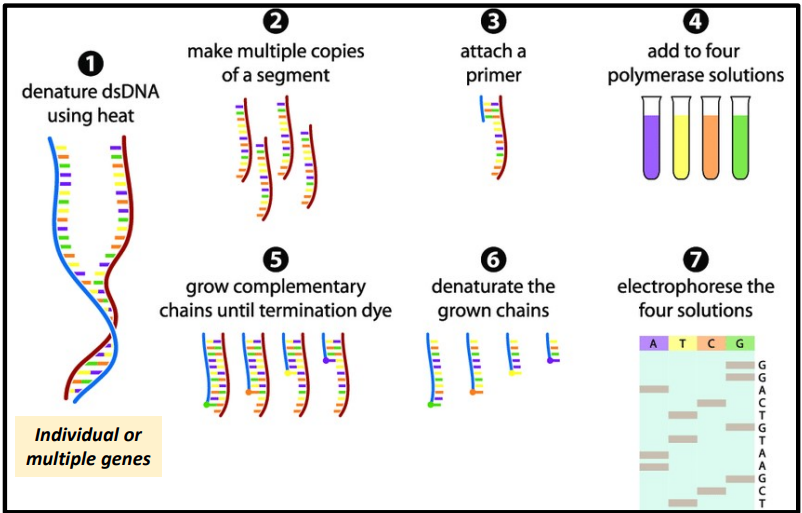
Sangar Sequencing
Better for looking at individual or multiple genes rather than the whole genome
high accuracy (99.99%). The gold standard of DNA sequencing
Steps:
Harvest DNA of interest (usually one or some genes) → create DNA fragments and incorporate chain terminator sequences → use machine to determine which of the 4 nucleotides is positioned at the chain terminator nucleotide for each DNA fragment
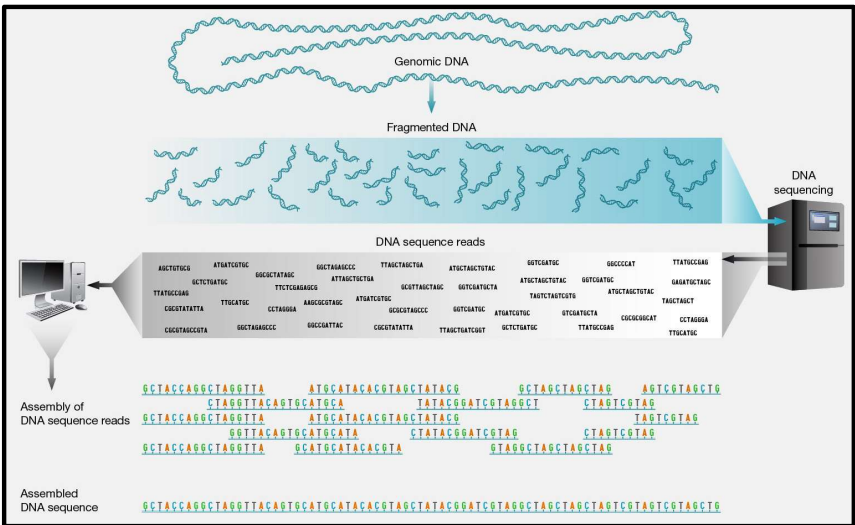
Next generation sequencing
Can be used to look at entire genome or individual/ multiple genes
faster
cheaper
can reveal low frequency DNA variants (mutations in some of the cells but not all of them)
Steps:
Extract genomic DNA → fragment DNA → create many copies of fragmented DNA containing fluorescent nucleotides that can be “read” by sequencing machine → Alignment of sequence reads to create a complete genome sequence
There are more steps, check W1 lecture 2 last video
what is De novo sequencing?
genome sequence determined for the first time (without a reference sequence)
time consuming