Biological Molecules (A)
 Call Kai
 Learn
Learn Practice Test
 Spaced Repetition
 Match
Match Flashcards
 Knowt Play
1/161

There's no tags or description
Looks like no tags are added yet.
Name | Mastery | Learn | Test | Matching | Spaced | Call with Kai | Chat |
|---|
No analytics yet
Send a link to your students to track their progress
162 Terms
Examples of reactions enzymes catalyse
-Respiration
-Digestion
-Production of collagen
Where does enzyme action occur
-Intracellular
-Extracellular
Intracellular
Within cells
Extracellular
Outside cells
What biological molecule are enzymes
Proteins
Activation energy
The amount of energy that needs to be supplied to the chemicals before the reaction will start
What usually provides the activation energy for reactions
Heat
How do enzymes catalyse reactions
They lower the activation energy of a reaction, speeding up the rate of reaction
Explain how enzyme-substrate complexes lower the activation energy for synthesising molecules
Being attached to the enzyme holds the two substrate molecules close together, reducing any repulsion between the molecules so that they bond easier
Explain how enzyme-substrate complexes lower the activation energy for the breakdown of molecules
Fitting into the active site puts strain on the bonds in the substrate, so the substrate molecule breaks up more easily
What are the models for enzyme action
-Lock and Key
-Induced Fit
Lock and key model
The substrate fits into the enzyme the same way a key fits into a lock
Induced fit model
After an enzyme-substrate complex is formed, the active site changes shape slightly fit the substrate
Explain why enzymes are highly specific
The shape of their active site is determined by their tertiary structure which is determined by their primary structure. Each different enzyme has a different tertiary structure and so a different shaped active site, which only one complementary substrate will fit in so only this reaction is catalysed
What happens if the enzyme’s tertiary structure is altered
The active site will change shape so the substrate will no longer fit
What is the primary structure of a protein controlled by
A gene
What happens if a mutation occurs in the gene controlling the primary structure of an enzyme
The tertiary structure changes
Explain how increasing temperature affects enzyme activity
-At first, it increases as molecules have more kinetic energy so the enzymes are more likely to collide with the substrate molecules and with more energy
-If temperature too high, denatures
Explain how a high temperature can cause an enzyme to denature
The vibrations break some of the bonds holding an enzyme in shape, changing the shape of the active site so that the substrate no longer fits
Optimum temperature for most human enzymes
37°C
Explain how pH can affect an enzyme
A pH too low or too high means that the H+ and OH- ions can mess up the ionic and hydrogen bonds that hold the enzymes tertiary structure in place, changing the active site’s shape
Explain how increasing enzyme concentration affects rate of reaction
-The more enzyme molecules, the more likely substrate molecules are to collide and form an enzyme-substrate complex, increasing rate of reaction.
-Rate eventually plateaus when substrate concentration is limiting rate of reaction
Explain how increasing substrate concentration affects rate of reaction
-More substrate molecules means collisions between enzymes and substrates are more likely, increasing rate of reaction until saturation point
-Increasing beyond saturation point has no effect
Saturation point
The point at which all active sites are full
Explain why rate of reaction will not continue to increase as more substrate is added at saturation point
There are no free active sites, so adding them makes no difference
Explain what happens to the rate of reaction of an enzyme-controlled reaction if no variables are changed
Substrates are being used up so the substrate concentration decreases with time, decreasing the rate of reaction
Enzyme inhibitors
Prevent enzyme activity by binding to the enzyme
Competitive inhibition
Inhibitor molecules have a similar shape to the substrate molecules so compete with the substrate to bind with the active site, blocking it
Explain how increasing competitive inhibitor concentration affects rate of reaction
Decreases rate of reaction as the inhibitors fill up the active sites, stopping enzyme-substrate complexes from forming
Non-competitive inhibition
Inhibitor molecules bind to the enzyme away from its active site, causing it to change shape so that substrate molecules will no longer fit in it
Explain what happens if substrate concentration of an competitively inhibited reaction is increased
The substrates have a greater chance of binding to the active site before an inhibitor, increasing the rate of reaction
Explain what happens if substrate concentration of an non-competitively inhibited reaction is increased
The enzymes will still be inhibited, so there is barely any change to reaction rate
Experiment to investigate the effect of temperature on an enzyme-controlled reaction by measuring the speed at which a product is made
1- Set up boiling tubes containing equal volumes and concentrations of hydrogen peroxide. Add an equal volume of buffer solution to each.
2- Place each boiling tube into a water bath of a different temperature. Wait for the tubes to reach the temperature.
3- Add catalase to the boiling tube
4- Attach a delivery tube from the bung of the boiling tube into a trough of water containing an upturned measuring cylinder.
5- Record volume the water rose by in a set length of time.
6- Repeat 3 times for each temperature at different temperatures
7- Calculate an average rate of reaction for each temperature
Explain the use of hydrogen peroxide in the enzyme experiment
Catalase catalyses the breakdown of hydrogen peroxide into water and oxygen. Oxygen displaces water, so the volume risen an upturned measuring cylinder is equal to the volume of oxygen added
What variables should be controlled in the enzyme temperature experiment
-Volume and concentration of hydrogen peroxide
-Volume of buffer (to control pH)
-Volume and concentration of catalase
What is the volume of oxygen produced in the enzyme temperature experiment
The volume the upturned cylinder increased by
What does catalase catalyse the break down of
Hydrogen peroxide
What does catalase catalyse the breakdown of hydrogen peroxide into
Oxygen and water
What does amylase catalyse the breakdown of
Starch
What does amylase catalyse the breakdown of starch into
Maltose
Experiment to investigate the effect of enzyme concentration on the rate if reaction
1- Add a drop of iodine into each well of a spotting tile
2- Mix together a known concentration of amylase and starch in a test tube.
3- Use a pipette to add the mixture into a well at regular intervals
4- Wells remain browny-orange when all starch is broken down
5- Repeat with different amylase concentrations
How to alter the enzyme experiments to measure the effect of pH on enzyme-controlled reactions
Change the independent variable to the pH of the buffer added to each test tube
How to calculate the initial rate of reaction
Draw a tangent to the graph at t=0 and calculate its gradient
Triglycerides
A molecule of glycerol with three fatty acids attached
Describe the structure of a fatty acid
A carboxylic acid group attached to a structurally variable long tail of hydrocarbons
Explain the solubility of lipids in water
Insoluble because the tails of fatty acids are hydrophobic
Hydrophobic
Repel water molecules
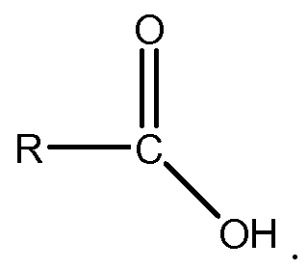
What molecule is this?
Fatty acid
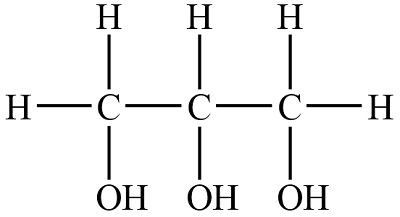
What molecule is this?
Glycerol
Explain how triglycerides form
A condensation reaction between three fatty acids and a glycerol molecule
Ester bond
Chemical bond between a glycerol and fatty acid molecule
Types of fatty acids
-Saturated fatty acid
-Unsaturated fatty acid
Saturated fatty acid
No double bonds between carbon atoms
Unsaturated fatty acid
At least one double bond between carbon atoms
What is the structural difference between a saturated and unsaturated fatty acid (caused by double bonds)
An unsaturated fatty acid has a kink in the chain where a double bond is
Types of lipids
-Triglycerides
-Phospholipids
Type of lipid in cell membranes
Phospholipids
Phospholipid
Two fatty acids and a phosphate group joined to a glycerol
Property of the phosphate group of a phospholipid
Hydrophilic
Hydrophilic
Attracts water
Function of triglycerides
Energy storage molecules
Why are triglycerides good energy storage molecules
They have a long hydrocarbon tail containing lots of chemical energy
Explain whether triglycerides cause the cell to swell up or not
Triglycerides are insoluble in water so do not affect the water potential of the cell so do not cause water to enter by osmosis so do not cause the cell to swell up
What do many triglycerides in a cell form
They clump together as insoluble droplets
Explain why triglycerides clump together as droplets
The fatty acid tails are hydrophobic
Explain the structure of a triglycerides droplet
Hydrocarbon tails face inwards so are furthest from water, glycerol heads face outwards to shield tails from water
Phospholipid function
Make up the bilayer of cell membranes
Explain the structure of the bilayer of cell membranes
Form a double layer of phospholipids with the heads facing outwards and the tails facing inwards
Explain how the cell membrane acts as a barrier to water-soluble substances
The centre of the bilayer is hydrophobic so water-soluble substances can’t easily pass through it
What is the emulsion test for
Lipids
Test for lipids
1- Add ethanol
2- Shake
3- Add to water
4- Lipids will precipitate out as a milky white emulsion
Monomers of proteins
Amino acids
Dipeptite
Two amino acids joined together
Polypeptide
When more than two amino acids join together
Proteins
One or more polypeptides
Amino acid general structure
Carboxyl group, amine group and variable side group
Carboxyl group
COOH
Amine group
NH2
How many different types amino acids are there (that make up proteins)
20
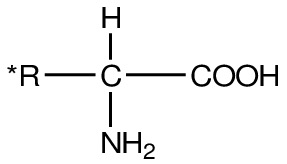
What molecule is this?
Amino acid
Describe how polypeptides are formed
Amino acids are linked together by condensation reactions
What happens to polypeptides during digestion
They are broken down into amino acids
Peptide bond
The chemical bond between amino acids
How many structural levels are there of a protein
4
Primary structure of a protein
The sequence of amino acids in a polypeptide chainrotP
Explain the secondary structure of a protein
Hydrogen bonds form between amino acids which cause it to coil into an alpha helix or a beta pleated sheet
Tertiary structure of a protein
-Coiled/folded chain coils/folds further
-More bonds form between different parts of the polypeptide chain (hydrogen and ionic)
-Disulfide bridges form
How many structural levels are there for proteins mad cup of a single polypeptide chain
3
Explain how disulphide bridge form
When two molecules of cysteine come close together the sulfur atom in one cysteine bonds to the sulfur atom in the other
Quaternary structure of a protein
Several polypeptide chains held together by bonds
Final 3D structure of a protein made up of more than one polypeptide chain
Quaternary Structure
Functions of proteins
-Enzymes
-Antibodies
-Transport proteins
-Structural proteins
Explain the structure of enzymes
Spherical due to the tight folding of polypeptide chains
Solubility of enzymes
Soluble
Antibody structure
-Two light polypeptide chains and two heavy polypeptide chains bonded together
-Has variable regions
Variable regions
Areas where the amino acid sequence varies greatly
Heavy polypeptide chain
Long chain
Light polypeptide chain
Short chain
Explain the structure of channel proteins
Hydrophobic and hydrophilic amino acids in the protein cause it to fold up, so that it can transport molecules and ions across membranes
Structural proteins
Physically strong proteins