Membrane Transport Processes
 Call Kai
 Learn
Learn Practice Test
 Spaced Repetition
 Match
Match Flashcards
 Knowt Play
1/85

There's no tags or description
Looks like no tags are added yet.
Name | Mastery | Learn | Test | Matching | Spaced | Call with Kai | Chat |
|---|
No analytics yet
Send a link to your students to track their progress
86 Terms
What regulates what moves in/out of a cell?
- Its plasma membrane
Plasma Membrane: Composition
- Phospholipid molecules
- Protein molecules scattered throughout
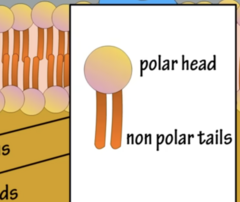
Phospholipid: Structure
- Head: Polar, water loving, face lumens
- Tails: Nonpolar, water hating, faces interior of membrane
Forms lipid bilayer
Interstitial Fluid vs Cytosol
- IF: Outside of cell
- Cytosol: Inside of cell
Membrane Transport
- The movement of ions or molecules across a cell membrane
Membrane Transport: 2 Main Processes
- Passive Transport: Do not require energy
- Active Transport: : Requires energy
Types of Passive Transport
- Simple Diffusion
- Facilitated Diffusion
- Osmosis
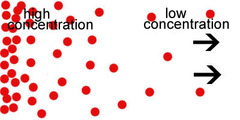
Diffusion
- Movement of a substance from high [c] to low [c]
- Occurs down a [c] gradient
![<p>- Movement of a substance from high [c] to low [c] </p><p>- Occurs down a [c] gradient</p>](https://assets.knowt.com/user-attachments/27ab3991-2867-44ae-9404-849ce0dcc12c.png)
Concentration Gradient
- Difference in the concentration of a substance from one location to another
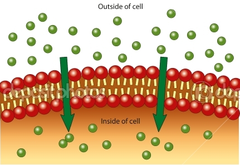
Cellular Diffusion
- Diffusion of a solute (dissolved substance) occurs across a plasma membrane from an area of high [c] to low [c]
![<p>- Diffusion of a solute (dissolved substance) occurs across a plasma membrane from an area of high [c] to low [c]</p>](https://assets.knowt.com/user-attachments/24589228-5488-4541-8f65-0338a2099d30.png)
Types of Diffusion
- Simple
- Facilitated
Simple Diffusion
- Movement of a solute from an area of high concentration to an area of low concentration through the membrane directly
Which solutes use Simple Diffusion?
Small, Non-polar Solutes:
- O2
- CO2
- Steroid Hormones
Can polar or non polar solutes move between the lipids found in the plasma membrane?
- Nonpolar solutes bc/ the interior is nonpolar
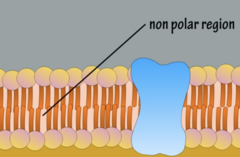
What happens when [O2] is higher outside of a cell?
- Can move down its [c] gradient via simple diffusion and enter cytosol
Facilitated Diffusion
- Movement of specific molecules across cell membranes through protein channels
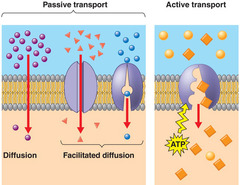
Which solutes use Facilitated Diffusion?
Small, charged/polar solutes
- Glucose → via GLUT transporters
- Na+/K+/Ca2+/Cl- → via ion channels
- Water → via aquaporins
Can polar solutes pass through the lipid bilayer unaided?
- No, the polar heads block them from passing though
- Needs additional aid from membrane proteins
Types of Facilitated Diffusion
- Channel Mediated
- Carrier Mediated
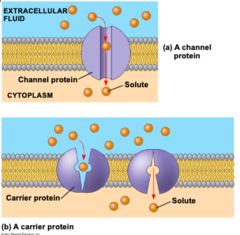
Channel Mediated Diffusion
- The movement of small ions across the plasma membrane through water-filled protein channels
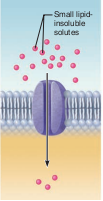
Are protein channels specific or nonspecific?
- Typically specific for one type of ion
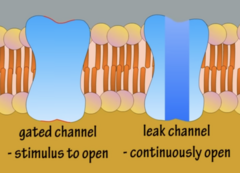
Leak channel vs Voltage Gated Channel
- Leak: Continuously open
- Voltage: Only opens from being stimulated, and only open for a fraction of a second
Carrier Mediated Diffusion
- Movement of small, polar molecules across the membrane
- Simple sugars/carbs (glucose), AAs
Changes shape in the process of transport
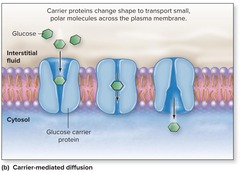
What happens when a glucose molecule binds to a carrier protein?
- Once it binds, the protein changes shape to move the glucose molecule to the other side of membrane
Osmosis
- The passive movement of water through a selectively permeable membrane
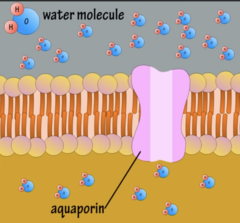
How can water move across a plasma membrane?
- Via simple diffusion
- OR channels called aquaporins
The plasma membrane is not permeable to what solutes?
- Charged
- Polar
- Large
Osmosis: If the interstitial fluid has 3% solutes/97% water, and the cytosol has 1% solutes/99% water- which way will water move?
- Water moves to where there is a HIGHER [c] of solutes → in this case towards IF → achieves equilibrium
Active Membrane Processes
- Energy (ATP) required
- Substance moves up or against its concentration or pressure gradient; utilizes pumps and vesicular transport
Types of Active Processes
- Active Transport
- Vesicular Transport
Active Transport
- Movement of solutes against [c] gradient
![<p>- Movement of solutes against [c] gradient</p>](https://assets.knowt.com/user-attachments/2dda84b6-2a77-46a2-b2f5-520443793515.png)
Vesicular Transport
- Transport of large particles and macromolecules across plasma membranes
- Proteins or large carbohydrate polysaccharides
Types of Active Transport
- °1 Active
- °2 Active
Primary Active Transport
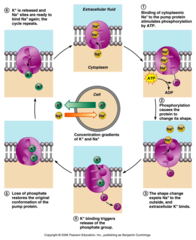
- Active transport that relies directly on the hydrolysis of ATP to move solutes against [c] gradient with an ion pump
Na+K+ Pump
- Uses ATP to maintain higher concentrations of Na+ and K+ on opposite sides of the plasma membrane
3 Na+ out, 2 K+ In
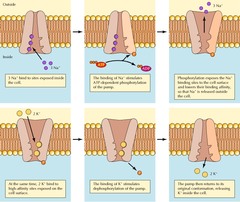
Na+K+ Pump: Steps
1. 3x Na+ and ATP bind to cytosolic side of ionic pump
2. ATP hydrolyzed → ADP + P; P binds to pump, release of energy pushes 3x Na+ out of cell
3. 2x K+ bind to pump, and the P already bound on cytosolic side releases → conformational change brings the K+ inside
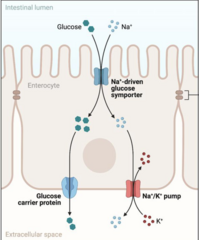
Secondary Active Transport
- Form of active transport a substance is moved against its [c] gradient by COUPLING it with the movement of a 2nd substance DOWN its [c] gradient
![<p>- Form of active transport a substance is moved against its [c] gradient by COUPLING it with the movement of a 2nd substance DOWN its [c] gradient</p>](https://assets.knowt.com/user-attachments/24b1cdd1-7770-4ec2-b88c-384f1215178d.png)
Secondary Active Transport: Types
- Symport
- Antiport
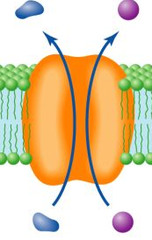
Symport
- A membrane transport process that carries two substances in the same direction across the membrane.
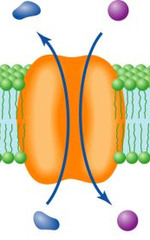
Antiport
- A membrane transport process that carries one substance in one direction and another in the opposite direction.
Vesicular Transport: Types
- Exocytosis
- Endocytosis
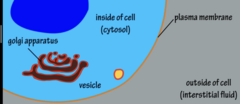
Where do the vesicles form for vesicular transport?
- Membranous vesicles formed from golgi apparatus transport materials to cell membrane
Exocytosis
- Release of substances out a cell by the fusion of a vesicle with the membrane.
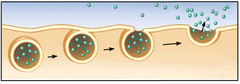
What happens when the vesicle reaches the internal plasma membrane during exocytosis?
- The phospholipid molecules that make up the vesicle fuse w/ plasma membrane → contents of vesicle are released outside the cell
Endocytosis
- Process by which a cell takes material into the cell by infolding of the cell membrane
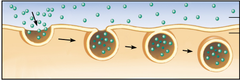
Forms of Endocytosis
- Pinocytosis, phagocytosis, receptor-mediated endocytosis
Phagocytosis
- A type of endocytosis in which a cell engulfs large particles or whole cells → vesicle fuses w/ lysosome for digestion into its components
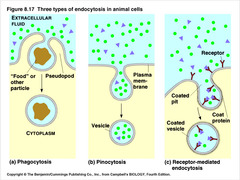
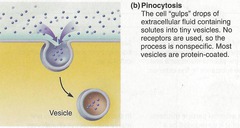
Pinocytosis
- A type of endocytosis in which the cell ingests extracellular fluid and its dissolved solutes.
Cell drinking
Receptor Mediated Endocytosis
- Molecules from interstitial fluid bind to receptors on plasma membrane → membrane folds, enclosing the receptors and bound molecules
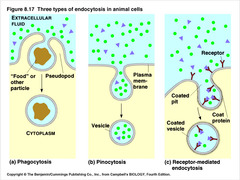
Endocytosis and Exocytosis require what?
- The use of energy (ATP)
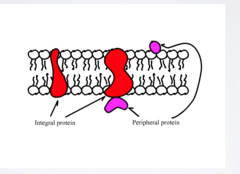
Integral vs Peripheral Proteins
Integral penetrate the hydrophobic interior of the lipid bilayer. Peripheral are loosely bound to the surface of the membrane.
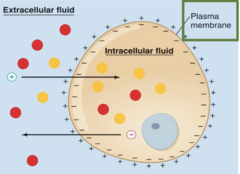
Electrochemical Gradients
- The combined difference in concentration and charge; influences the distribution and direction of diffusion of ions.
What type of transport mechanism do GLUT transporters use?
- Facilitated diffusion
A researcher is studying cellular processes and focuses on how cells internalize extracellular material. They observe that cells are engulfing large particles and fluids from their surroundings, forming vesicles that are brought into the cell. This process is crucial for nutrient uptake and removing debris from the extracellular environment. Which of the following best describes this process?
- Endocytosis (phagocytosis)
Molecules that can cross by simple diffusion
- Fatty acids
- Steroid hormones
- Lipid soluble drugs
- Fat soluble vitamines: A D E K
- Gasses: N2, O2, CO2
Fick's Law of Diffusion
- Diffusion through a membrane is directly proportional to the surface area and concentration gradient and inversely proportional to the thickness of the membrane
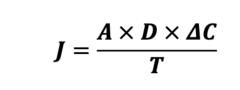
In pulmonary fibrosis, the alveolar membrane becomes thicker due to scar tissue formation, but the surface area of the alveoli remained the same.
What is the most likely affect upon the rate of oxygen uptake into pulmonary capillaries?
- Increase in thickness → ↓ Rate of diffusion
Pore
- Always open, provides continuous pathway for specific molecules or ions to pass through
Aquaporins
- Channel proteins that facilitate the passage of water
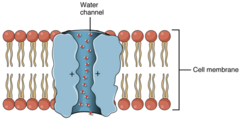
Gated Channels
- A protein channel in a cell membrane that opens or closes in response to a particular stimulus.
Types of Gated Channels:
- Voltage: Membrane potential (neurons, muscle cells)
- Ligand Gated: Ach, GABA, Glu, Ca, ATP, cAMP
- Mechanosenstive: Deformation opens plasma membrane
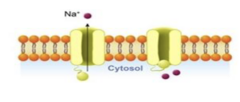
Voltage Gated Channels
- Open and close in response to changes in membrane potential
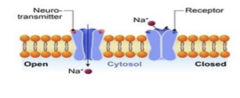
Ligand Gated Channels
- Open in the presence of a specific binding substance, usually a hormone or neurotransmitter
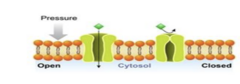
Mechanically Gated Channels
- Open and close in response to physical deformation of receptors
Myasthenia Gravise
- Antibodies block postsynaptic Ach receptors → impairs ability of muscle to respond and release Ca2+ → muscle weakness
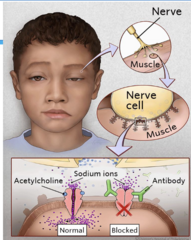
Mechanically gated channels allow for what when opened? What are they crucial for?
- Allows: Ion flow
- Crucial: Touch sensation, pain perception, hearing
Which GLUT Transporters are insulin independent?
- GLUT-1: Brain, RBCs
- GLUT-2: Liver, Kidney, Intestines pancreas
Which GLUT Transporters are insulin dependent?
- GLUT-4: Fat tissue, skeletal muscle
Needs insulin to translocate to the membrane
Antidiuretic hormone (ADH) regulates water balance by increasing water reabsorption in the kidneys through aquaporin channels. How do aquaporins
facilitate the action of ADH in the kidneys?
- Aquaporins create pores for passive water diffusion
A patient with type 2 diabetes is found to have reduced activity of GLUT-4
transporters. This affects which type of transport mechanism?
- Carrier-mediated transport
Is ATP required for passive transport?
- No
The Na⁺/ K⁺ ATPase extrudes three Na⁺ ions from the cell in exchange for bringing
two K⁺ ions into the cell. It requires energy in the form of ATP. What type of
transporter is this?
- Primary active transporter
- Moving them each against their [c] gradient
Examples of Primary Active Transport
1. Na+/K+ ATPase: Moves Na+ out and K+ in
2. H+/K+ ATPase
3. Ca2+ ATPase
4. H+ ATPase
What do Ca²⁺-ATPase +SERCA pumps do in cardiac muscle?
- They lower cytosolic Ca²⁺ using ATP, allowing the muscle to relax
SERCA → pumps Ca²⁺ from cytosol back into the sarcoplasmic reticulum
Cell membrane Ca²⁺-ATPase → pumps Ca²⁺ out of the cell
Digoxin can be used to treat congestive heart failure. It inhibits the Na⁺/K⁺ ATPase
present on cardiac muscle cells. This inhibition results in reduced function of the
Na⁺/Ca²⁺ antiporters, leading to increased Ca²⁺ levels in the cardiac muscle cells
and improved cardiac contractility.
Based on this information, do Na⁺/Ca²⁺ antiporters function via:
- Secondary active transport (Symport, both moving into cell)
What drives water flux?
- Ion flux sets up a solute [c] gradient
- Water moves towards higher [c]
Hypertonic Solution
- Solute [c] is higher outside of cell → water moves out of cell → cell shrinks
![<p>- Solute [c] is higher outside of cell → water moves out of cell → cell shrinks</p>](https://assets.knowt.com/user-attachments/b12ff2bf-f93a-4fa5-9fd7-28fc876b5eb4.png)
Isotonic Solution
- [Solute] is equal inside/outside cell, no net water movement
![<p>- [Solute] is equal inside/outside cell, no net water movement</p>](https://assets.knowt.com/user-attachments/a8cec2f8-70ba-4320-aea9-75a20b79b9b4.png)
Hypotonic Solution
- [Solute] higher inside cell → water moves inside → cell swells
![<p>- [Solute] higher inside cell → water moves inside → cell swells</p>](https://assets.knowt.com/user-attachments/90760cca-3969-4b0c-959f-b765af9d022c.png)
Steps of Exocytosis
1. Vesicle Transport: Vesicles containing cellular products (hormones, neurotransmitters) are transported to plasma membrane
2. Vesicle Docking: Vesicles dock at plasma membrane. SNAREs facilitate docking and fusion
3. Fusion and Release: Vesicle fuses with PM → contents expelled into extracellular splace
SNARE Proteins
- Promote fusion of vesicles at the correct target membranes
- Basically pulls the vesicle and PM together → fuses
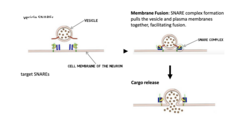
What do the toxins of Clostridium Botulinum and C. Tetani target? Its effect?
- The toxins target/cleave SNARE proteins → BLOCKS neurotransmitter release
Patient injures hand on rusty nail and develops muscle weakness/difficulty swallowing. Dx is tetanus. Toxin prevents normal release of NT at nerve endings. What cellular process is disrupted by this neurotoxin?
- Fusion of vesicles with target membranes
Oxygen is a small, nonpolar molecule that needs to enter muscle cells to support
their metabolic processes. How does oxygen primarily move across the cell
membrane of muscle cells?
- O2 diffuses directly through cell membrane following its [c] gradient
Small, nonpolar molecules can squeeze through phospholipid heads and pass through bc/ interior of plasma membrane is nonpolar
A cell is taking up a specific nutrient from its environment through a process that
involves binding of the nutrient to specific receptors on the cell surface, followed
by the internalization of the receptor-nutrient complex into the cell.
What process best describes this mechanism?
- Receptor-mediated endocytosis
A transport mechanism in the intestine moves glucose into cells against its
concentration gradient by simultaneously transporting sodium ions into the cells.
This process utilizes the sodium gradient established by the sodium-potassium
pump and does not directly use ATP.
What type of transport mechanism is this?
- Secondary Active transport (Symporter)