FSA M4 - Cash Flow Statements

0.0(0)
Studied by 0 people
call kaiCall Kai
Locked
learnLearn
examPractice Test
spaced repetitionSpaced Repetition
heart puzzleMatch
flashcardsFlashcards
GameKnowt Play
Card Sorting

1/36

encourage image

There's no tags or description

Looks like no tags are added yet.

Last updated 2:01 PM on 8/25/26
Name
Mastery
Learn
Test
Matching
Spaced
Call with Kai
Chat

No analytics yet

Send a link to your students to track their progress

37 Terms
1
New cards
The four primary financial statements
Balance Sheet: financial position at a point in time, reporting "stock" accounts (assets and how they're financed). Income Statement: a "flow" statement covering the period between two balance sheet dates, made up of revenue/expense/gain/loss accounts; based on accrual accounting, so it doesn't necessarily reflect cash inflows/outflows. Statement of Cash Flows: reports the change in cash, cash equivalents, and restricted cash between balance sheet dates, classified as operating, investing, or financing activities — also a flow statement. Statement of Shareholders' Equity: a flow statement showing how equity components (e.g., common stock, retained earnings) changed between balance sheet dates due to activities like share issuance, net income/loss, and dividends.
2
New cards
How the statements link together
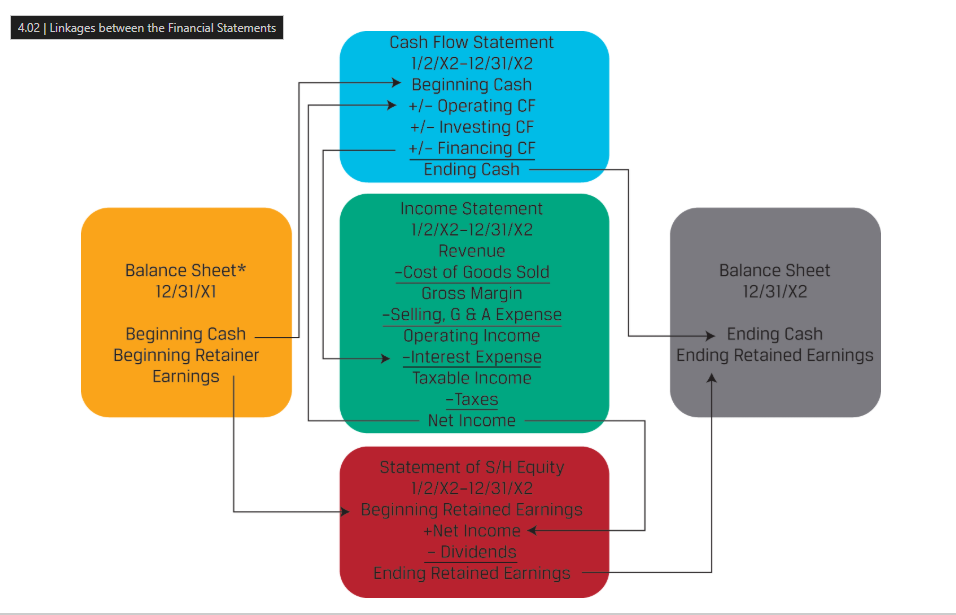
The income statement, cash flow statement, and statement of shareholders' equity link the balance sheet from one period-end to the next. Cash linkage: the cash flow statement for the period reconciles beginning cash (from the prior balance sheet) to ending cash (on the current balance sheet) via operating/investing/financing inflows and outflows. Retained earnings linkage: net income from the income statement flows into the statement of shareholders' equity (added to beginning retained earnings, less dividends), and the resulting ending retained earnings flows onto the ending balance sheet. The statement of shareholders' equity itself reconciles beginning to ending equity balances, incorporating net income/loss and dividends paid (dividends paid in cash also appear on the cash flow statement).
3
New cards
Linkages between current assets/liabilities and the income statement/cash flow statement
Differences between accrual and cash timing for operating activities show up as changes in current balance sheet accounts: accrual revenue in excess of cash collected increases accounts receivable; accrual expenses lower than cash actually paid typically decreases accounts payable or another accrued liability; cash received before delivering goods/services is recognized as an asset but paired with a deferred revenue liability for the delivery obligation, which is derecognized once revenue is recognized (performance obligations satisfied). Formula: Ending accounts receivable = Beginning accounts receivable + Revenues − Cash collected from customers.
4
New cards
Using statement linkages to evaluate health and detect irregularities
Understanding how the balance sheet, income statement, and cash flow statement interrelate helps assess financial health and can also flag accounting irregularities — e.g., a company reporting healthy sales and income (from sales made on account, without regard to future collections) that isn't accompanied by corresponding cash inflow can be a red flag for improperly recognized revenue
5
New cards
Transaction treatment principles across the three flow statements
Credit purchase/sale cycle: a purchase or sale on credit affects the balance sheet (and, for a sale, the income statement) but has no cash flow statement impact until cash actually changes hands (payment to supplier or collection from customer) — the cash flow statement is affected only when cash is actually paid or received, unlike the accrual-basis income statement. Equipment purchase and depreciation: the cash purchase of equipment is an investing outflow with no income statement impact at the time; the later depreciation expense reduces net income and increases accumulated depreciation but has no cash flow statement impact, since depreciation is non-cash. Borrowing and repayment: taking a loan is a financing inflow with no income statement impact; at repayment, principal repayment is a financing outflow, while interest expense hits the income statement and the interest payment can be classified as either an operating or a financing cash outflow. Deferred revenue: an advance payment received before delivery increases cash and a deferred-revenue liability (an operating inflow) with no income statement impact yet; upon delivery, the deferred revenue liability is derecognized, the full contract revenue is recognized on the income statement, and any newly collected cash is a further operating inflow.
6
New cards
Direct vs. indirect method — overview
Operating cash flows can be presented via the direct method (major categories of gross cash receipts and payments) or the indirect method (reconciles net income to net cash flow). Investing and financing cash flows are identical regardless of which method is used for the operating section. Since companies often disclose only the indirect method, understanding the direct-method logic lets an analyst approximate a direct cash flow statement from indirect disclosures — not perfectly accurate, but useful. Each direct-method line item is derived by adjusting the related income statement (accrual) amount for the net change in the associated balance sheet account(s).
7
New cards
Cash received from customers
Cash received from customers = Revenue − Increase in accounts receivable (or + Decrease in accounts receivable). An AR increase means accrual revenue exceeds cash receipts, and vice versa. If the company has deferred/unearned revenue, further adjust: a decrease in deferred revenue is a negative adjustment to cash received, an increase is a positive adjustment.
8
New cards
Cash paid to suppliers
Two-step calculation. Step 1 (purchases from suppliers) = Cost of goods sold + Increase in inventory (or − Decrease in inventory) — an inventory increase means purchases exceeded COGS. Step 2 (cash paid to suppliers) = Purchases from suppliers − Increase in accounts payable (or + Decrease in accounts payable) — an AP increase means the company purchased more on credit than it paid in cash.
9
New cards
Cash paid to employees
Cash paid to employees = Salary and wage expense − Increase in salary and wages payable (or + Decrease in salary and wages payable). An increase in wages payable means accrual-basis expense exceeds actual cash paid.
10
New cards
Cash paid for other operating expenses
Adjust other operating expenses for both prepaid expenses and accrued liabilities: an increase in prepaid expenses makes cash-basis expenses higher than accrual (cash paid out ahead of expense recognition), while an increase in accrued expense liabilities makes cash-basis expenses lower than accrual (expense recognized before cash is paid). Formula: Other operating expenses − increase in accrued liabilities (or + decrease) − decrease in prepaid expenses (or + increase in prepaid expenses).
11
New cards
Cash paid for interest
Cash paid for interest is included in operating cash flows under US GAAP, and may be classified as either operating or financing under IFRS. Cash paid for interest = Interest expense − Increase in interest payable (or + Decrease in interest payable). An interest payable increase means accrual interest expense exceeds cash actually paid.
12
New cards
Cash paid for income taxes
Cash paid for income taxes = Income tax expense − Increase in income tax payable/deferred tax liabilities (or + Decrease) + Increase in taxes receivable/deferred tax assets (or − Decrease). An increase in taxes receivable or deferred tax assets means cash-basis taxes exceed accrual; an increase in taxes payable or deferred tax liabilities means cash-basis taxes are lower than accrual.
13
New cards
Indirect method — overview and adjustment logic
The indirect method reconciles net income to operating cash flow (vs. the direct method's gross receipts/payments); investing and financing sections are identical either way. Net income is adjusted for three things: (1) non-operating activities — e.g., a gain on sale of equipment is removed, since its cash effect appears in investing instead; (2) non-cash expenses — e.g., depreciation is added back since it was a non-cash deduction in net income; (3) changes in operating working capital, arising from accrual accounting recognizing revenue/expense timing differently from cash timing. Working capital rule: for current operating ASSET accounts (AR, inventory, prepaid expenses), an increase is subtracted from net income and a decrease is added back (an asset increase means accrual revenue/spending outran actual cash). For current operating LIABILITY accounts (AP, accrued expense liabilities), an increase is added to net income and a decrease is subtracted (a liability increase means accrual expenses outran actual cash paid).
14
New cards
Full additions/subtractions list under the indirect method
Additions: non-cash items (depreciation, amortization of intangibles, depletion, amortization of bond discount); non-operating losses (loss on sale/write-down of assets, loss on retirement of debt, loss on equity-method investments); an increase in deferred income tax liability; and working capital changes from accruing higher expenses or lower revenues than actual cash flows (a decrease in current operating assets, or an increase in current operating liabilities). Subtractions are the mirror image: amortization of bond premium; non-operating gains (gain on sale of assets, gain on retirement of debt, income on equity-method investments); a decrease in deferred income tax liability; and working capital changes from accruing lower expenses or higher revenues than actual cash flows (an increase in current operating assets, or a decrease in current operating liabilities).
15
New cards
Converting indirect to direct method — purpose and 3-step process
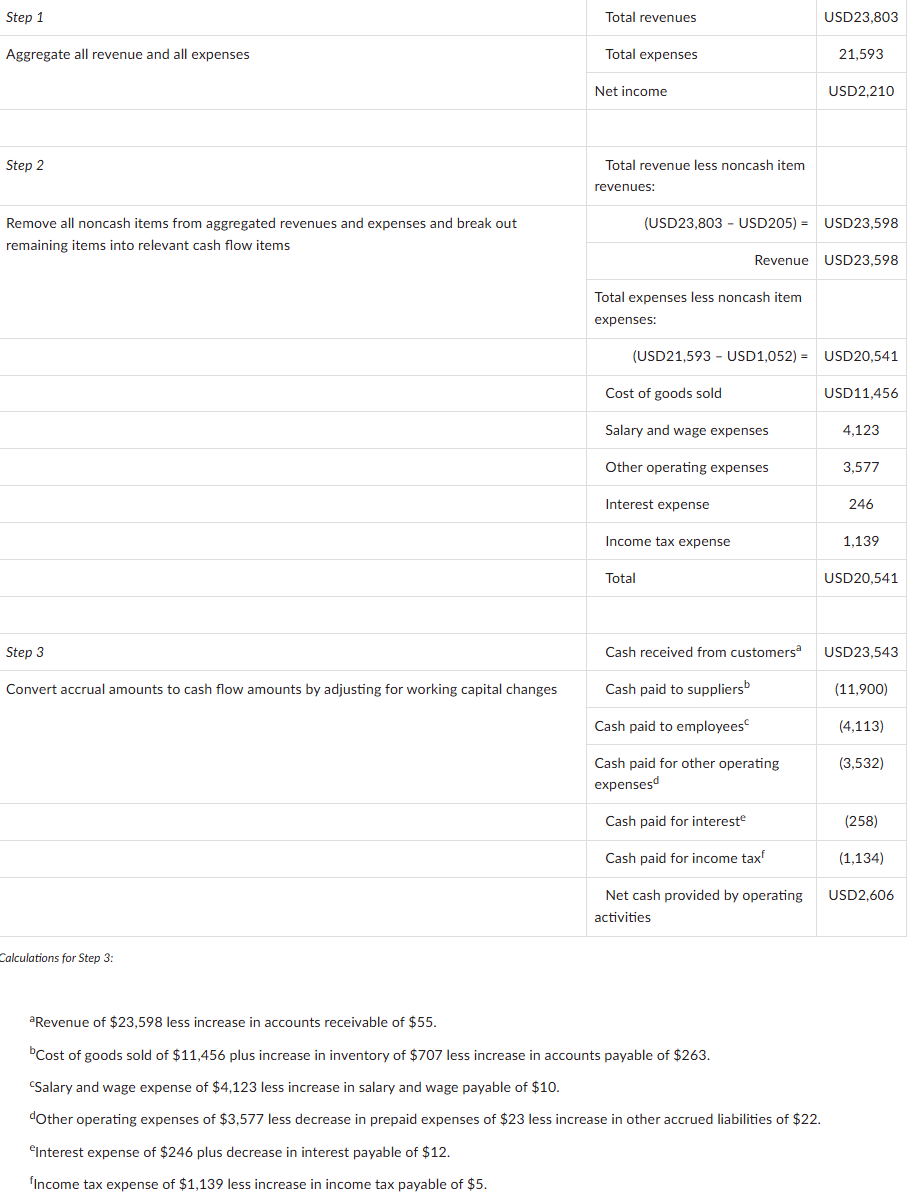
When a company only discloses the indirect method, an analyst wanting to review trends in direct-format cash receipts/payments can convert indirect-method operating cash flow to direct-format; accuracy depends on the adjustment data available in published reports, but the method is sufficiently accurate for most analytical purposes. Three steps: (1) disaggregate net income back into total revenues and total expenses; (2) remove non-operating items (e.g., a gain on asset sale) from revenues and non-cash items (e.g., depreciation) from expenses, then break the remaining expenses into their individual categories (COGS, salary/wages, other operating expenses, interest, income tax); (3) convert each accrual-basis revenue/expense category into a cash flow amount by adjusting for the change in its associated working capital account — the same accrual-to-cash adjustment logic used for cash received from customers, cash paid to suppliers, employees, other operating expenses, interest, and income taxes. The Step 3 results are the direct-format line items, which sum to the same net cash from operating activities as the indirect method.
16
New cards
Investing cash flows — overview and identifying disposals
Investing and financing cash flow sections are presented identically regardless of whether the direct or indirect method is used for operating cash flows. Investing activities are identified from changes in long-term asset accounts on the comparative balance sheet, often paired with informational notes on purchases made during the year. Key check: if the net change in a long-term asset account doesn't match the disclosed purchases for the year, the company must have also sold or disposed of some of that asset — the difference implies a disposal occurred.
17
New cards
Three-step method to determine cash received from an asset sale
Step 1 — Historical cost of asset sold = Beginning balance of the asset account + Asset purchased during the year − Ending balance of the asset account. Step 2 — Accumulated depreciation on the asset sold = Beginning balance of accumulated depreciation + Depreciation expense for the year (from the income statement) − Ending balance of accumulated depreciation. Step 3 — Book value of asset sold = Historical cost of asset sold (Step 1) − Accumulated depreciation on asset sold (Step 2); then Cash received from sale = Book value of asset sold + Gain on sale (or − Loss on sale, from the income statement). This method assumes all accumulated depreciation on the balance sheet relates to the specific asset category being analyzed.
18
New cards
Financing cash flows — debt/stock changes and dividends paid
Investing and financing sections are presented identically regardless of the operating method used (direct vs. indirect). Absent other information: a decrease in long-term debt indicates the company retired debt (a financing cash outflow); a decrease in common stock indicates a share repurchase (also a financing cash outflow) — increases in either would instead indicate new issuance (cash inflows). Dividends paid can be derived from the retained earnings relationship: Beginning retained earnings + Net income − Dividends = Ending retained earnings, rearranged to Dividends paid = Beginning retained earnings + Net income − Ending retained earnings (assuming no other items affected retained earnings). Dividends paid are also presented directly in the statement of changes in equity.
19
New cards
IFRS vs. US GAAP — cash flow classification differences
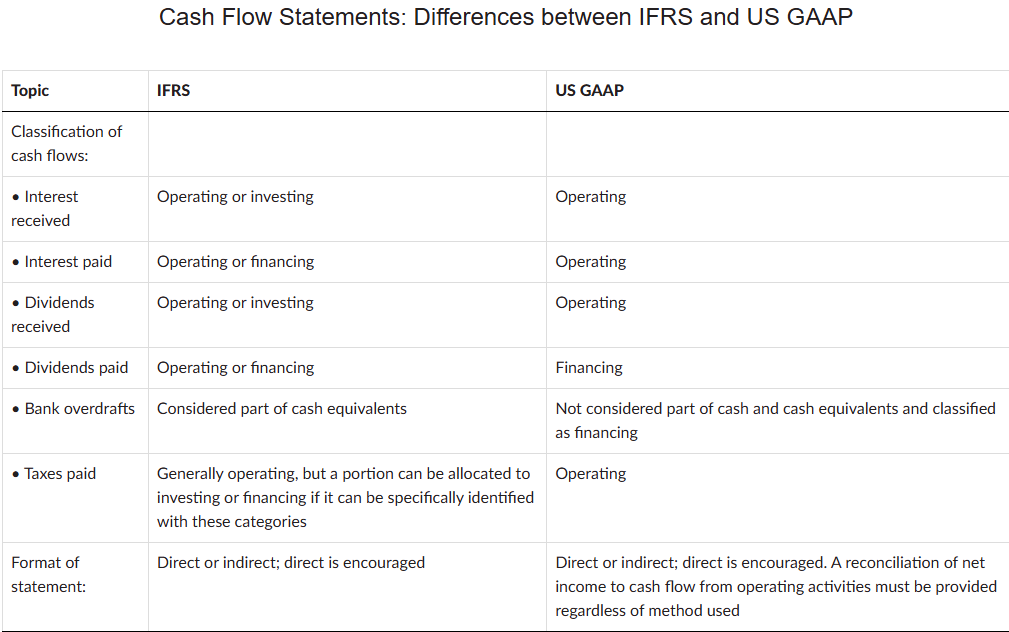
IFRS allow more flexibility than US GAAP for interest, dividends, and income tax classification on the cash flow statement. Interest/dividends received: US GAAP = operating only; IFRS = operating or investing. Interest paid: US GAAP = operating only (even though the related debt principal is a financing item); IFRS = operating or financing. Dividends paid: US GAAP = financing only; IFRS = operating or financing. Bank overdrafts: IFRS treats them as part of cash and cash equivalents; US GAAP does not — they're classified as financing. Taxes paid: US GAAP classifies all income tax expense as operating; IFRS also generally treats it as operating, but allows a portion to be allocated to investing or financing if specifically identifiable with those activities (e.g., tax effect of selling a discontinued operation could be investing). Statement format: both frameworks permit direct or indirect presentation and encourage the direct method; US GAAP specifically requires a reconciliation of net income to operating cash flow regardless of method used.
20
New cards
Step 1 — Major sources and uses of cash flow
Cash flow statement evaluation follows a 4-step framework; Step 1 looks at overall sources/uses across operating, investing, and financing. For a mature company, operating activities should be the primary and expected source of cash — sustained negative operating cash flow forces borrowing/stock issuance, and those capital providers eventually need repayment from operations or they'll stop funding. Cash generated from operations should go to investing (if value-creative opportunities exist) or be returned to capital providers via financing (if not). A new/growth-stage company may run negative operating cash flow for a period while investing in inventory and receivables to grow — not sustainable long-term, so cash must eventually shift to being generated primarily by operations. Desirable outcome: operating cash flow is positive and sufficient to cover capital expenditures (positive free cash flow). Key questions: what are the major sources/uses of cash flow, and is operating cash flow positive and sufficient to cover capex?
21
New cards
Step 2 — Primary determinants of operating cash flow
Examine the most significant drivers: cash used to hold receivables/inventory and pay employees/suppliers, cash received from customer payments. Changes in receivables, inventory, and payables reveal whether the company is using or generating cash in operations, and why. Compare operating cash flow to net income: for a mature company, since net income includes non-cash expenses (D&A), it's expected and desirable that operating cash flow exceeds net income — the relationship is also an earnings-quality indicator, since large net income with poor operating cash flow can signal aggressive accounting choices that inflate income without generating real cash. Also examine the variability of earnings and cash flow, and its implications for risk and for forecasting future cash flows. Key questions: what are the major determinants of operating cash flow, is it higher or lower than net income and why, and how consistent are operating cash flows?
22
New cards
Step 3 — Primary determinants of investing cash flow
Evaluate each investing line item as a source or use of cash to see where cash is being spent or received: how much is invested in PP&E, how much is used to acquire whole companies, how much goes into liquid investments (stocks/bonds), and how much cash is raised by selling these types of assets. For major capital investments, consider whether the funding comes from excess operating cash flow or from financing activities. If assets are sold, determine why and assess the effects on the company.
23
New cards
Step 4 — Primary determinants of financing cash flow
Examine each financing line item to understand whether the company is raising or repaying capital and the nature of its capital sources. If the company borrows every year, consider when repayment may be required. The financing section also shows dividend payments and stock repurchases, which are alternative ways of returning capital to owners. It's important to assess why capital is being raised or repaid.
24
New cards
<p>Free cash flow — general concept and FCFF formulas</p>

Free cash flow — general concept and FCFF formulas

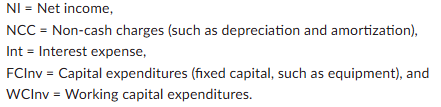
Free cash flow (generic) = operating cash flow − capital expenditures; used for valuing a company or its equity. FCFF (free cash flow to the firm) = cash flow available to both debt and equity investors after all operating expenses (incl. taxes) and necessary working/fixed capital investments. From net income: FCFF = NI + NCC + Int(1 − Tax rate) − FCInv − WCInv (NCC = non-cash charges like D&A; interest is added back after-tax because FCFF is available to debt suppliers too). From CFO: FCFF = CFO + Int(1 − Tax rate) − FCInv, where CFO reflects interest paid included in operating activities (as under US GAAP or one IFRS option).

25
New cards
FCFF — adjustments for classification choices
If interest paid was instead classified in financing activities (an IFRS option), CFO does not need the Int(1 − Tax rate) add-back, since interest was never subtracted from CFO to begin with. Under IFRS, if interest and dividends received were placed in investing activities, add them back to CFO to determine FCFF. If dividends paid were subtracted within the operating section (an IFRS option), add them back in to compute FCFF.
26
New cards
Free cash flow to equity (FCFE)
FCFE = cash flow available to common stockholders after all operating expenses and borrowing costs (principal and interest) are paid and necessary working/fixed capital investments are made. FCFE = CFO − FCInv + Net borrowing. When net borrowing is negative (debt repayments exceed new borrowing), FCFE = CFO − FCInv − Net debt repayment. Positive FCFE means operating cash flow exceeds what's needed for capex and debt repayment — the excess is available for distribution to owners.
27
New cards
Cash flow to revenue
CFO ÷ Net revenue. Measures operating cash generated per dollar of revenue.
28
New cards
Cash return on assets
CFO ÷ Average total assets. Measures operating cash generated per dollar of asset investment.
29
New cards
Cash return on equity
CFO ÷ Average shareholders' equity. Measures operating cash generated per dollar of owner investment.
30
New cards
Cash to income
CFO ÷ Operating income. Measures the cash-generating ability of operations.
31
New cards
Cash flow per share
(CFO − Preferred dividends) ÷ Number of common shares outstanding. Measures operating cash flow on a per-share basis. IFRS adjustment: if total dividends paid were included as a use of cash in the operating section, add total dividends back to CFO as reported, then subtract preferred dividends.
32
New cards
Debt coverage ratio
CFO ÷ Total debt. Measures financial risk and financial leverage.
33
New cards
Interest coverage ratio (cash flow basis)
(CFO + Interest paid + Taxes paid) ÷ Interest paid. Measures ability to meet interest obligations. IFRS adjustment: if interest paid was included as a use of cash in the financing section (not operating), do not add it back to the numerator.
34
New cards
Reinvestment ratio
CFO ÷ Cash paid for long-term assets. Measures ability to acquire assets with operating cash flows.
35
New cards
Debt payment ratio
CFO ÷ Cash paid for long-term debt repayment. Measures ability to pay debts with operating cash flows.
36
New cards
Dividend payment ratio
CFO ÷ Dividends paid. Measures ability to pay dividends with operating cash flows.
37
New cards
Investing and financing ratio
CFO ÷ Cash outflows for investing and financing activities. Measures ability to acquire assets, pay debts, and make distributions to owners.