posterior superior alveolar (PSA) nerve block
 Call Kai
 Learn
Learn Practice Test
 Spaced Repetition
 Match
Match Flashcards
 Knowt Play
1/11

There's no tags or description
Looks like no tags are added yet.
Name | Mastery | Learn | Test | Matching | Spaced | Call with Kai | Chat |
|---|
No analytics yet
Send a link to your students to track their progress
12 Terms
what is the PSA nerve block?
anesthetizes the posterior superior alveolar nerve before it enters the mx (V2 injection)
used when multiple mx molars require treatment
other common names: tuberosity block, zygomatic block
what areas are anesthetized by the PSA nerve block?
pulps of: mx third molar, mx second molar, mx first molar (except for the MB root in some patients)
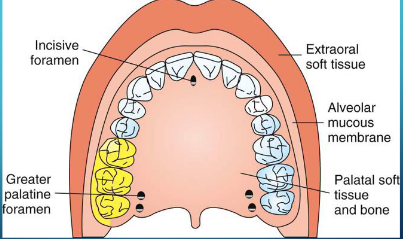
buccal bone and buccal periodontium over these teeth (NOT the palatal tissue)
why isn’t the MB root of the mx first molar always anesthetized with a PSA block
in approx 28% of patients, the MB root of the mx first premolar receives innervation from the MSA nerve, not PSA
when is a PSA nerve block indicated
when one or more mx molars require treatment
a supraperiosteal injection cannot be used due to inflammation or infection
a supraperiosteal injection has failed
when is a PSA nerve block contraindicated?
when the pt has a high risk of bleeding (hemophilia or other bleeding disorrders)
^ bc of greater risk of hematoma
alternative: supraperiosteal injection, PDL injection
advantages of the PSA nerve block
very little discomfort
high success rate (> 95%)
one injection anesthetizes multiple molars
uses less anesthetic than multiple infiltrations
disadvantages of the PSA nerve block
risk of hematoma
few bony landmarks during insertion
may require another injection for the MB root of the first molar
PSA technique
27-gauge short
insertion point: height of the mucobuccal fold above the mx second molar
target area: PSA nerve- posterior, superior, and medial to the posterior border of the mx
operator position for a PSA nerve block
for a right-handed clinician:
left PSA- 10 o’clock
right PSA- 8 o’clock
always prep the tissues at the mucobuccal fold before inserting the needle
most common complication of a PSA nerve block
hematoma caused by accidental puncture of the pterygoid venous plexus or the posterior superior alveolar artery
signs: rapid swelling, bruising, or discoloration
management: firm pressure, ice, reassurance
why does the PSA nerve block have a higher hematoma risk than many other injections
bc needle passes close to: pterygoid venous plexus and posterior superior alveolar artery
these vessels lie behind the mx tuberosity, making accidental puncture possible
what tissue does the PSA block not anesthetize
palatal soft tissue (if this is needed, administer a greater palatine block)