508: Lecture 5 - Pregnancy and Lactation 1
 Call Kai
 Learn
Learn Practice Test
 Spaced Repetition
 Match
Match Flashcards
 Knowt Play
1/39

There's no tags or description
Looks like no tags are added yet.
Name | Mastery | Learn | Test | Matching | Spaced | Call with Kai | Chat |
|---|
No analytics yet
Send a link to your students to track their progress
40 Terms
Learning Objectives for this lecture:
Understand the variations during pregnancy trimesters, and how this may impact effect of drug exposure
Explain the factors influencing teratogenicity of a drug
Summarize which pts require preconception planning and why this is important
Evaluate general epidemiological and medical needs for management of pregnancy termination/loss
Given a patient case, evaluate medical management of pregnancy loss/induced termination
Understand the changes in ADME that occur in pregnant patients and how these changes may impact drug pharmacokinetics
Review the current and new FDA pregnancy risk categories and 5 lactation categories and be able to apply this information for justifying drug therapy in patient cases
Given drug information and characteristics, evaluate a medication for use during acute/chronic illness in pregnancy
Given a patient case, be able assess, select and recommend, and educate on the appropriate pharmacologic, and non-pharmacologic treatments for common acute/chronic conditions during pregnancy
Briefly describe the pathophysiology of pregnancy:
Fertilization
Day 1-2: usually occurs in the fallopian tube
Day 3: the fertilized egg reaches the uterus.
Cell division continues for another 2 to 3 days in the uterine cavity before implantation.
Implantation – occurs by day 10 post fertilization
How is pregnancy diagnosed? Which hormone is used?
hCG (human chorionic gonadotropin)
Produced by the placenta (usually by D6 post fertilization)
hCG concentration doubles every 2-3 days and peaks at 8-12 weeks
Comprised of two subunits: α and β
α subunit has cross-reactivity with LH, TSH, FSH and may produce false positive results
β subunit unique to hCG; what pregnancy tests are evaluating
What about using home pregnancy tests (HPT)?
Detects urine hCG
97+% accurate, most false negatives are the result of patients testing too soon
only 25% are false negatives
False positives are incredibly rare
What is the general duration of pregnancy?
267 days from conception
280 days from the first day of the last menstrual period (LMP)
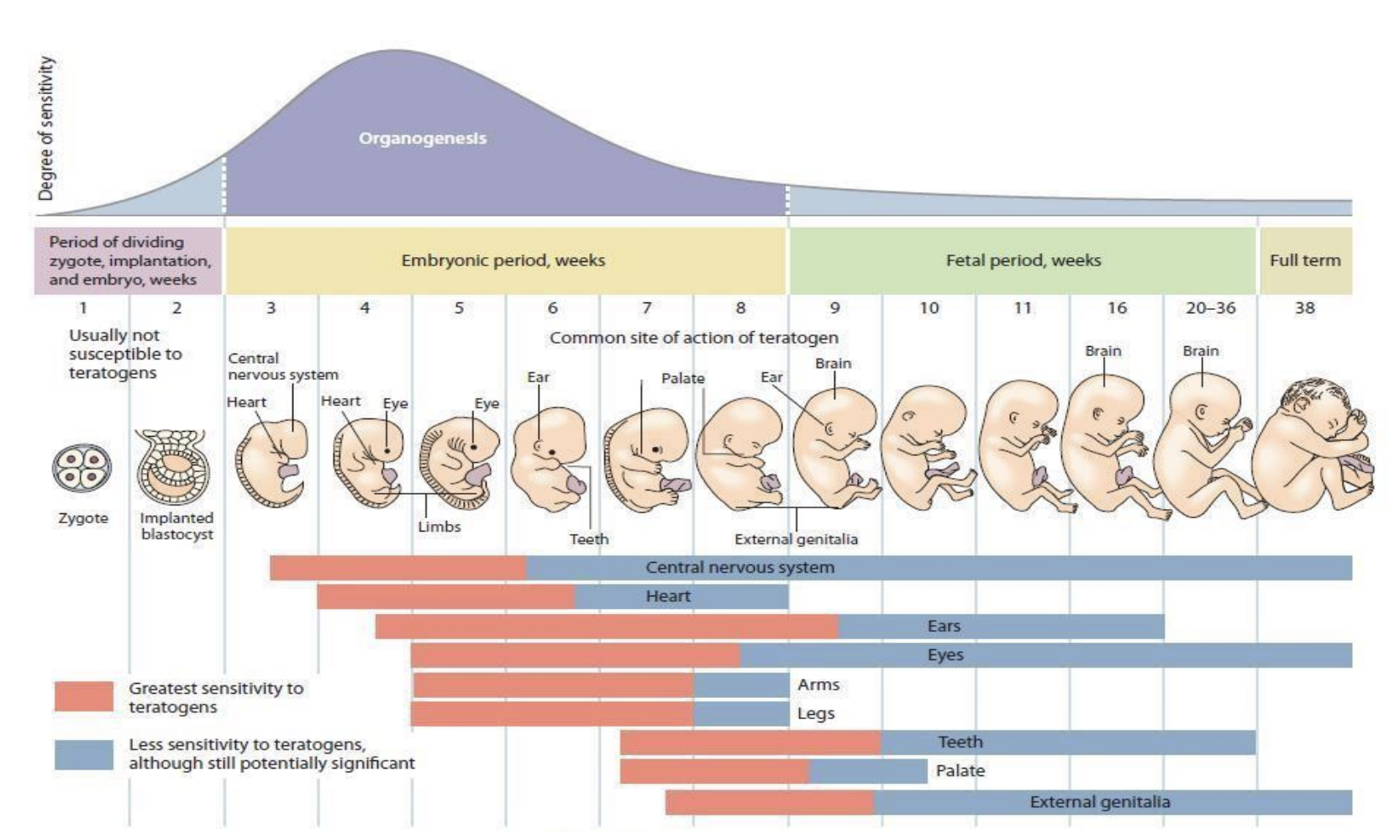
What’s the gestational age? At what point during pregnancy is the risk of drug exposure greatest?
Number of completed weeks of pregnancy since the first day of the last menstrual period (LMP)
Embryo is < 8 weeks of gestational age (wga)
Fetus is >8 wga
1st Trimester has the greatest drug exposure risk.
What is gravidity? What is parity? What is the acronym TPAL?
Gravidity (G) = the total number of pregnancies a patient has experienced, including active pregnancies
Parity (P) = number of deliveries
Term (T) = any deliveries after 37 wga
Prepterm (P) = any delivery of live infant 20-37 week gestational age
Aborted/ectopic (A)
Living children
What physiologic changes occur during pregnancy? What are the effects of this?
Metabolic changes: hepatic metabolism can be increased or decreased →
Leads to increased/decreased drug metabolism →
Increased/decreased drug concentrations
Placental changes: thinning of fetal-maternal blood barrier →
Leads to increased drug distribution →
Increased fetal drug concentrations
Decreased maternal concentrations
Renal changes: Increased renal blood flow →
Increased GFR and drug elimination →
Decreased drug concentrations for the mother
Volume of distribution changes: normal blood volume, decreased albumin, increased body fat →
Leads to Increased drug distribution, increased distribution for lipophilic medications, Decreased protein binding →
Decreased concentration of lipophilic drugs,
Increased concentrations of free drug
GI changes: Decreased motility and increased intestinal blood flow →
Increased drug absorption →
Increased drug concentration
When thinking of the placental-fetal compartment, what should we consider?
Considerations:
Amount of drug crossing placenta
Placental metabolism
Fetal distribution
Placental drug transfer (simple diffusion is most common):
Molecular weight of drug (400-600 Daltons cross easily)
Lipid solubility
Ionization
Protein binding
Exchange area
Blood flow
What is teratogenicity?
Teratogenicity – capability to produce congenital abnormalities; can be major or minor
Major – incompatible with life / requiring corrective surgery
Minor – most are cosmetic (extra digits / skin tags)
Normal rate of birth defects: 3-6%
<10% of FDA approved drugs have information regarding use in pregnancy
What are preconception risk factors to counsel/discuss?
Use of teratogenic drugs
Uncontrolled chronic conditions
HTN, DM, Asthma, mood disorders
Lifestyle modifications
Etoh
Tobacco use
Illicit drug use
Nutritional supplementation
What are some examples of teratogenic drugs and how do we manage?
Antiepileptic Drugs (carbamazepine / valproic acid) • Lowest dose to control condition vs transitioning to alternative agent
Isotretinoin
REMS program for use requires 2 methods of pregnancy prevention
Known severe teratogen: CNS, craniofacial, cardiac
Warfarin ➔ change to alternative anticoagulant (LMWH preferred)
How do we manage chronic disease states in pregnancy?
Objective control of primary disease state
Achieve BP or DM goals
Seizure free periods
Prevent asthma exacerbations
Transition to low-risk regimen for pregnancy
How do we manage alcohol and recreational drug use in pregnancy?
Discontinue use as soon as possible; consider entrance into treatment program if assistance needed.
Etoh: no amount considered safe
Increased risk for FAS (fetal alcohol syndrome)
Tobacco: offer cessation counseling and pharmacotherapy if needed
Increased risk for LBW, SAB (spontaneous abortion), PTB, premature placental detachment, SIDS, and fetal deformities
NRT or bupropion preferred
Best if before 16 wga
Marijuana
low birth weight (LBW) and preterm delivery (PTD)
Cocaine
intrauterine growth restriction (IUGR), PTD, LBW, malformations, functional/behavioral deficits, fetal/neonatal death
Amphetamines
IURG, LBW, PTD, fetal/neonatal death
Heroin
IURG, LBW, PTD, cardiac malformations (1st trimester), neonatal abstinence syndrome (NAS), fetal/neonatal death
What supplementation is recommended for preconception?
Iron supplementation: required for maternal/fetal erythropoiesis
2nd + 3rd trimesters require ~30mg of iron daily
Folate supplementation: reduces incidence of neural tube defects
Most critically during 1 month prior to conception and 1st trimester
For all childbearing pts → 0.4 - 0.8mg (400-800mcg) daily
If history of neural tube defects or epilepsy meds → 4mg/daily
Calcium supplementation: benefits maternal and fetal bone development
1000-1200 mg/day
What is the epidemiology of spontaneous abortion?
Early pregnancy loss occurs in approximately 10% of clinically recognized pregnancies, with 80% of losses occurring in the 1st trimester
Most occur due to fetal chromosomal abnormalities
Risk Factors: advancing maternal age (>35yo) and previous early pregnancy losses
Spontaneous abortion is the most common adverse pregnancy outcome worldwide
What are the three different kinds of management of early pregnancy loss (spontaneous abortion)?
1) Expectant Management - Limited to 1st trimester losses, results in pregnancy evacuation in about 80% of cases
2) Medical Management
3) Surgical Management
What does medical management of early pregnancy loss include?
Medication used to induce evacuation of pregnancy tissue; Recommended for those up to 10 wga
Misoprostol regimen: 800mcg inserted vaginally, may repeat within the 7 days if no response after 1st dose
Mifepristone/misoprostol regimens can be used if available
What does surgical management of early pregnancy involve?
Indicated for patients not good candidates for expectant/medical management (i.e hemodynamic instability, bleeding disorders, signs of infection)
Provides an immediate resolution for patients for those desiring/requiring this and an intervention with less follow-up
What are our medical abortion agents?
Mifepristone
Norethindrone derivative
Causes progesterone blockade; Binds with more affinity to progesterone receptors & therefore acts as a antagonist
Starts the detachment process of products of conception
Misoprostol
Prostaglandin E1 analogue
Causes uterine cramping and expulsion
What is the dosing protocol for Mifepristone/Misoprostol?
Mifepristone: 200mg orally (in office or home)
Misoprostol: 800mcg buccally (4 tablets) 24-48 hours after Mifepristone
Follow up 7-14 after mifepristone
What is the maximum gestational age to take mifepristone/misoprostol?
70 days since last menstrual period
What are adverse effects of Mifepristone?
Nausea, weakness, fever/chills, vomiting, headache, diarrhea, dizziness
What drugs interactions dose Mifepristone have?
CYP3A4 inducers/inhibitors
What adverse effects does Misoprostol have?
>10%: diarrhea, abdominal pain
<10%: headache, constipation, dyspepsia, flatulence, nausea, vomiting
What drug interactions does Misoprostol have?
Antacids may enhance diarrhea, enhnces carbetocin and oxytocin
What do we us manage acute pain in pregnancy?
Non-Pharmacologic management preferred, however, can use us pharmacological agents
Pharmacologic Agents:
Acetaminophen (APAP) is drug of choice
Fioricet
Narcotics + APAP (short term use)
NSAIDs, Aspirin, Fiorinal → trimester implications
Triptans (for migraines) – use in pregnancy is limited
What is the time course for N/V in pregnancy? What are our concerns?
Time course: 1st trimester most common
Starts weeks 4 and 6 of gestation and usually resolves by weeks 16 to 20
Peak symptoms occur between weeks 8 and 12
Concerns: severe n/v (hyperemesis gravidarum) ➔ dehydration
Symptom severity will guide therapy
How do we manage mild N/V in pregnancy?
Pyridoxine [vitamin B6] (A)
Doxylamine (A)
Or Diclegis (A) – (which is a combo of doxylamine/pyridoxine) $$$
How do we manage moderate N/V in pregnancy?
Metoclopramide (B)
Use >12 weeks leads to inc risk of tardative dyskinesia
Promethazine (C)
Suppository available
Prochlorperazine (C)
Suppository available
How do we manage severe N/V in pregnancy?
Ondansetron
**only use in 2nd & 3rd trimester because of cardiac risk/oral clefts**
What are non-pharm ways to manage N/V?
Light snack 15-20 minutes before getting out of bed
Small, dry, more frequent meals
Avoid spicy or fatty foods and strong odors
High protein and high carbohydrate intake
Ginger
Colder foods
Acupressure
What is the time course for GERD in pregnancy? What are non-pharm ways to manage GERD?
Time course: occurs in 2nd half of pregnancy
Caused by relaxation of esophageal sphincter and increased abdominal pressure from the uterus
Non-pharmacological:
Trigger avoidance
Avoid caffeine and nicotine
Elevate head of bed if nighttime sx
Avoid tight clothing
Smaller, more frequent meals
What meds do we use for GERD in pregnancy?
1st line – Al/Mg/Ca antacids (B)
Caution with Mg in late pregnancy
2nd line – H2RA: famotidine and ranitidine (B) or metoclopramide (B)
3rd line – PPI (most are B; omeprazole is C)
Large trials have demonstrated efficacy
What should we AVOID using to treat GERD in pregnancy?
Sodium bicarb antacids → Increased risk of fluid/electrolyte imbalance in other + fetus
What are non-pharmacologic ways to manage constipation/diarrhea in pregnancy?
Constipation
High fiber foods
Increase fluid intake
Decrease caffeine
Moderate exercise as allowed
Diarrhea
Keep patient hydrated
Correct electrolyte issues
What agents do we use for constipation in pregnancy? What should we AVOID?
1st line (C)
Bulk forming laxatives:
Polyethylene glycol (PEG)
Docusate
2nd line (C)
Senna
Bisacodyl
Lactulose
Avoid: castor oil; mineral oil
What agents do we use for diarrhea in pregnancy? What should we AVOID?
1st Line:
Bulk forming laxatives (C)
Loperamide (B)
AVOID: bismuth subsalicylate, diphenoxylate/atropine
What agents do we use to manage cough/cold/allergy in pregnancy?
Cough
1st line – guaifenesin +/- dextromethorphan (C)
Decongestant
1st line – saline nasal spray or topical decongestant
Topical products with limited date but also limited bioavailability
Not recommended – pseudoephedrine or phenylephrine***
Allergy
1st line – topical nasal steroids (B budesonide; C others); oral 2nd generation antihistamine (B)
2nd line – diphenhydramine (B); fexofenadine (C)