L3 - Ti-V Oxide Magmatic Ore Deposits
 Call Kai
 Learn
Learn Practice Test
 Spaced Repetition
 Match
Match Flashcards
 Knowt Play
1/45

There's no tags or description
Looks like no tags are added yet.
Name | Mastery | Learn | Test | Matching | Spaced | Call with Kai | Chat |
|---|
No analytics yet
Send a link to your students to track their progress
46 Terms
What criteria must a mineral meet to be considered a critical mineral in Canada?
The supply chain is threatened
There is a reasonable chance of the mineral being produced by Canada
And one of the following:
Be essential to Canada’s economic or national security
Be required for the national transition to a sustainable low-carbon and digital economy
Position Canada as a sustainable and strategic partner within global supply chains
Define a Magmatic Ore Deposit
Masses of igneous rock enriched in useful chemical elements to such an extent that it is feasible to mine them at a profit.
What is the source of most magmatic ore deposits?
Most of these types of ore-forming magmas originate from the melting of mantle peridotite during regional extension

What minerals does peridotite contain?
Ol + Opx + Cpx ± pl/sp/gt
pl = plagioclase
sp = spinel
gt = garnet
Provide 2 examples of regional extension processes
Rifting
Mantle plumes
Where are metals extracted from in most magmatic ore deposits?
Metals are extracted from the source during the partial melting of mantle peridotite
How do most magmatic ore deposits form? What processes concentrate that element of interest?
Ore deposits form when Magma is transported through the crust to a new site and undergoes phase separation and mechanical sorting into small volumes that concentrate the element of interest.
What collects the element of interest?
A mineral (oxide)
An immiscible melt (sulphide liquid) with high enough concentration to separate from the melt
What is the transport system of Magmatic deposits?
Magma
can transport minerals/elements of interest through crust to a new site

What is the trap of a Magmatic Ore Deposit?
Layer
Irregularity in the magma chamber floor/conduit (settling crystals)

What are the main Ti - bearing Ore minerals? (2)
Ilmenite (FeTiO3)
Rutile (TiO2)
What are the main V - bearing Ore mineral? (1)
Magnetite (Fe3O4)
What are some uses for Titanium?
TiO2 White pigment
Paint
Plastics
Paper
Food (white candies and coffee mate)
cosmetics (cream, UV protection)
Ti Metal
Aerospace industry
automobile industry
medicine
sports equipment
jewellery
What are some uses for Vanadium?
V metal
steel additive (80%)
bonding agents
ceramics
magnet
What are some variables that may affect metal prices?
Supply-and-demand
societal demands
new technologies
political instability
What is the general relationship between price and crustal abundance?
Inverse relationship between Price and Crustal abundance
What are the two main Ti-V oxide ore deposit types?
Layered intrusion-hosted magnetite (V) deposits
Proterozoic anorthosite-hosted ilmenite (Ti) deposits
What are two examples of a layered intrusion-hosted magnetite (V) deposits? Where is the magnetite located in both of these intrusions?
2.05 Ga Bushveld Complex, South Africa
Magnetite layers at the top of the intrusion
260 Ma Panzhihua intrusion China
Magnetite layers near base of intrusion (unusual)
What are some characteristics of a layered intrusion-hosted magnetite (V) deposit?
Stratiform sequence of cumulate rocks
V-rich layers deposited on floor of magma chamber during fractional crystallization (FC) following the saturation of titanomagnetite (~1000’C) in evolved basaltic magma (Low MgO, High FeO)
What does FC stand for?
Fractional Crystallization
At what temperature is there saturation of titanomagnetite?
~ 1000 degrees Celsius
How can we tell if basaltic magma is evolved using it’s content?
Low MgO - leaves during the crystallization of Olivine since it’s incorporated in forsterite (Mg2SiO4)
High FeO - a reducing (low-oxygen) environment does not allow oxides to form right away
What are two examples of Proterozoic anorthosite-hosted ilmenite (Ti) deposits?
1.03 Ga Lac Tio deposit, Lac Allard anorthosite, Quebec
0.93 Ga Tellnes deposit, Rogaland anorthosite, Norway
What are the earliest and latest ages of Proterozoic anorthosite-hosted ilmenite (Ti) deposits?
Earliest = Neoproterozoic
Latest = Mesoproterozoic
How thick is the Bushveld Complex deposit in South Africa?
6-8 km thick
Was the Bushveld Complex made from one or more magmatic inputs?
100s of magmatic inputs over several million years

Why is there an increasing abundance of tabular plagioclase upsection? Name the process that creates this.
Phase separation and density segregation
Magnetite has a large density compared to basaltic magma
Plagioclase has a similar density to basaltic magma
While both minerals are crystallizing, the density differences of these crystals will cause both crystal phases to separate from the basaltic melt

What mineral does Vanadium (V) prefer to be incorporated into?
Magnetite
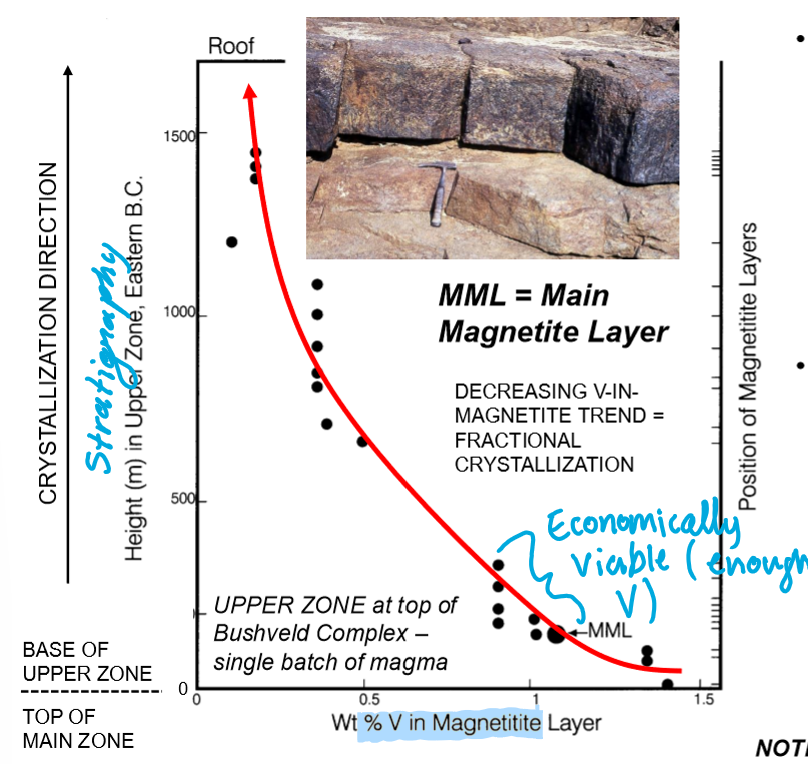
How does the V content of the remaining magma change during progressive fractional crystallization?
The first magnetite layers to crystallize have the highest V content
The remaining magma become progressively depleted in V during fractional crystallization of upper zone magma
What is the percent of plagioclase present in anorthosite?
>90% plagioclase
Why do the magnetite layers repeat (not one big magnetite layer) in the Bushveld Complex?
May be due to small pressure fluctuations in the magma chamber, which change the relative stability during crystallization
How much of the world’s vanadium production comes from the bushveld complex?
50% of the world vanadium production
How much ilmenite is present to name a rock Ilmenitite?
>50 modal%
What minerals are in Nelsonite?
ilmenite and apatite
What is this ore called and what are its mineral components?
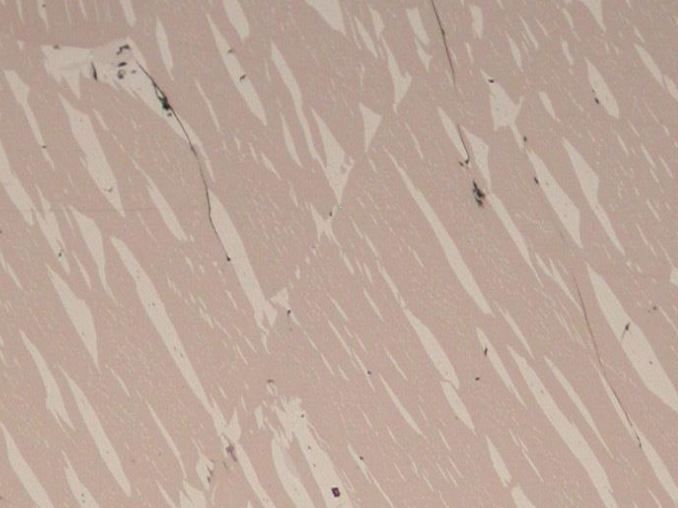
Hemo-ilmenite with lamellae (exsolution) texture
Pinkish-grey ilmentite (FeTiO3)
Light grey hematite (Fe2O3)
Note: the exsolution is caused by the two different Fe states (3+ and 2+)
What is Mangerite?
Opx-bearing monzonite
What is Charnockite?
Opx-bearing granite
What does AMCG stand for?
AMCG = anorthosite-mangerite-charnockite-granite plutonic suite
What ages do most Anorthosites range? answer should contain both in Ga and time period
1.43-0.93 Ga Mesoproterozoic
What structures are in the Lac Tio Deposit in Quebec?
Composite (granite-rich) plutons with many intrusions crystallized over several million years
How much of the world’s ilmenite production is from the Lac Tio “supergiant“ deposit?
12-17% of world ilmenite production
What were the average grades of hemo-ilmenite pre-mining?
Grades of 66% hemo-ilmenite

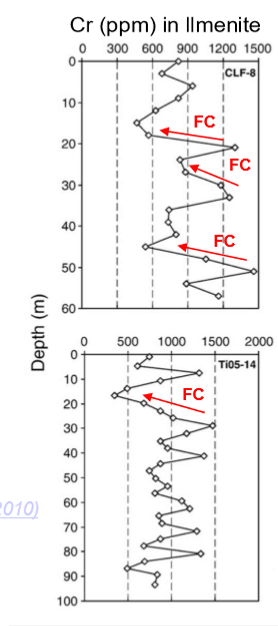
What do these geochemistry graphs provide evidence for?
Evidence for multiple mixing (replenishment/magma injections) after periods of fractional crystallization (FC)
FC = decreasing Cr-in-ilmenite
Mixing = increasing Cr-in-ilmenite
How did scientists interpret the Lac Tio deposit?
Interpreted as the “keel“ of a dike where dense ilmenite accumulated
Source of Ti is mantle-derived melt
crystallization of plagioclase/anorthosites leaves Fe + Ti rich residual magma
Fe-Ti-rich residual magma is transported and injected into syn-magmatic intrusions/dikes
ilmenite begins to crystallize at ~1000’c as the Fe-Ti enriched residual melt cools and segregates (by density) to the bottom/keel of the dikes where it is trapped
What is the source, transport, and trap of the Lac Tio (Ti) Deposit?
Source = Ti mantle-derived melt
Transport = Fe-Ti-enriched residual magma intrusions/dikes
Trap = keel/bottom of residual magma dike

What is the source, transport, and trap of the Bushveld (V) Deposit?
Source = mantle source to a V-rich basaltic magma
Transport = Metals are dissolved in magma until saturation/crystallization at ~1000’c
Trap = phase separation and density segregation - accumulation by gravity on the floor of a large magma chamber
