RNSG 1115 Chapter 34 Activity
 Call Kai
 Learn
Learn Practice Test
 Spaced Repetition
 Match
Match Flashcards
 Knowt Play
1/71

There's no tags or description
Looks like no tags are added yet.
Name | Mastery | Learn | Test | Matching | Spaced | Call with Kai | Chat |
|---|
No analytics yet
Send a link to your students to track their progress
72 Terms
Physiology of Movement/Activity
human body is designed to be mobile
mobility is essential to activities of daily living (ADL’s)
mobility is necessary for healthy function
mobility is vital part of independence and well-being
Role of the Skeletal System in Movement
supports the soft tissues of the body
protects crucial components (organs) of the body
furnishes surfaces for the attachment of muscles, tendons, and ligaments
provides storage areas for minerals and fat
produces blood cells (hematopoiesis)
Skeletal System Features:
bones
joints
connective tissues
Bones:
rigid, structured, specific and distinct form
long, short, flat irregular
Joints:
where bones articulate
allow for movement, flexibility, protection, and padding where bone meets bone or articulate
Connective Tissues:
connect bones and muscles
Ligaments:
bone to bone
Tendons:
muscle to bone
Cartilage:
hard, non-vascular
Bones Classified by Shape:
long bones
short bones
flat bones
irregular bones
Long Bones:
upper and lower extremities
Short Bones:
wrist and ankle
Flat Bones:
ribs and skull bones
Irregular Bones:
spinal column and jaw
Types of Joints:
ball-and-socket
condyloid
gliding
hinge
pivot
saddle
3 types of muscles in the muscular system:
cardiac
skeletal
smooth
Role of the Muscular System:
produces heat (energy) for movement
soft protection, flexibility, and equilibrium for posture
coordination of gross and fine motor movements
synchronize pump action and mobility
provides for volitional, automatic, and reflexive responses
Role of Nervous System:
the skeletal and muscular systems rely upon a functioning nervous system
the afferent nervous system conveys information from receptors to the CNS
neurons conduct impulses from one part of the body to another
information is processed by the CNS leading to a response
the efferent system conveys a response from the CNS to skeletal muscles via the somatic nervous system
Skeletal System:
support, form, structure, joint movement, protection, mineral storage, blood cell production
Muscular System:
heat production and maintenance (energy), gross and fine movement, efficiency, coordination and flexibility
Nervous System:
communication of all senses between different parts of the body (position, balance, visual, auditory, spatial, proprioception)
Body Alignment or Posture:
alignment of body parts that permits optimal musculoskeletal balance and optimal that means NO undue strain on the joints, muscles, tendons or ligaments while balance is maintained
Balance:
body is in correct alignment
balance occurs when the center of gravity is close to its base of support, and the object has a wide base of support
Coordinated Body Movement:
the ability of muscles to work together for purposeful movement
using stronger muscle groups rather than weaker ones, and taking advantage of the body’s natural levers and fulcrums facilities the action of lifting, carrying, pushing, pulling and moving objects
Postural Reflexes:
a group of reflexes (automatic) that maintain body position and equilibrium, whether at rest or during movement
Factors Affecting Movement:
developmental considerations
physical health
mental health
lifestyle
attitude and values
fatigue and stress
external factors
Developmental Considerations:
knowing variations of activities based on developmental levels/age
Physical Health:
problems with/in any body system involved in movement will impact patients ability to move
Mental Health:
body processes, such as, posture, energy level, emotionless behavior can be affected by depression
Lifestyle:
choice of being active or sedentary based on type of work, leisure choices, and culture
Attitude and values:
what’s taught growing up continues into adulthood
Fatigue and Stress:
chronic stress can deplete the body’s energy
External Factors:
weather conditions, fiscal resources, living in high crime areas
Types of Exercise: Muscle Contraction
isotonic
isometric
isokinetic
Types of Exercise: Body Movement
aerobic exercise
stretching exercise
strength and endurance exercises
Effects of Exercise: Benefits
cardiovascular
respiratory
musculoskeletal
metabolic
gastrointestinal
urinary
skin
psychosocial
Effects of Exercise: Risks
precipitation of a cardiac event
orthopedic discomfort
Effects of Exercise: Cardiovascular Benefit
helps to meet oxygen demands
Effects of Exercise: Respiratory Benefit
leads to improved pulmonary function
Effects of Exercise: Musculoskeletal Benefit
improves efficiency of metabolism
Effects of Exercise: Gastrointestinal Benefit
improves digestion and elimination
Effects of Exercise: Urinary Benefit
increases blood circulation with improved blood flow to kidneys
Effects of Exercise: Skin Benefit
nourishes the skin
Effects of Exercise: Psychosocial Benefit
increased energy, appearance, improves sleep, self-concept and health behaviors
Effects of Exercise: Precipitation of a Cardiac Event Risk
more prevalent for people with known risk (diabetics, renal disease, or cardiovascular disease)
Effects of Exercise: Orthopedic Discomfort and Disability Risk
irritation in bones, tendons, ligaments
If the patient isn’t experiencing any mobility or activity problems:
identify personal benefits of regular exercise
list support systems that will reinforce exercise efforts
follow a program or regular physical exercise that improves cardiovascular function, endurance, flexibility and strength
If the patient is at risk for mobility or activity problems:
demonstrate correct body alignment
demonstrate full ROM in joints
demonstrate adequate muscle mass, tone and strength to perform ADLs
For patients who are immobile:
be free from alterations in skin integrity
show signs of adequate circulation
maintain muscle mass, tone and strength
Ergonomics:
includes proper body movement in daily activities, the prevention and correction of problems associated with posture, and the enhancement or coordination and endurance
Body Mechanics:
use of the body as a machine; the use of the body in an efficient way to avoid injury, particularly as it relates to lifting, repositioning, and movement
Variables leading to back injury:
uncoordinated lifts
manual lifting and transferring of patients without assistive devices
lifting when fatigued or after recent back injury recovery
repetitive movements such as lifting, transferring, and repositioning of patients
standing for long periods of time
transferring/repositioning cooperative/uncooperative or confused patients
Equipment and Assistive Devices:
gait belts
stand-assist and repositioning aids
lateral-assist devices
friction reducing sheets
mechanical-lateral assist devices
transfer chairs
powered stand assist and repositioning lifts
powered full-body lifts
Fowler’s Position:
head of the bed elevated to a 45-60 degree angle
this position promotes cardiac and respiratory functioning

Supine or Dorsal Recumbent:
the patient is lying flat on their back and their head and shoulder slightly elevated with a pillow

Side-Lying or Lateral Position
the patient lies on their side and the main weight of the body is on the lateral aspect of the lower scapula and lower ilium. This position relieves pressure on the scapula, sacrum, and heels

Prone Position
patient lies on the abdomen with the head turned to the side

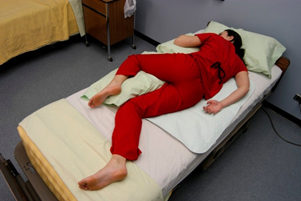
Sim’s Position:
patient is again side-lying but the lower arm is behind the patient and the upper arm is flexed at the shoulder and the elbow
body weight is on the anterior aspects of the humerus, clavicle, and ileum
Graduated Compression Stockings:
available in knee high or thigh-high lengths that requires measuring the leg for proper fit
Pneumatic Compression Devices:
also known as SCD (sequential compression devices) that are composed of an air pump, connecting tubes, and extremity sleeves
Turning the Patient in Bed:
nurses must use knowledge about correct alignment and move patient from back onto side, back onto abdomen, and from abdomen onto the back
Moving a Patient Up in Bed:
nurses should assess whether patient can assist or if equipment is needed to move patient
some of the friction-reducing devices, trapezes, draw sheets, are all possible solutions to assistance
Active Range of Motion:
patient independently moves joints
Passive Range of Motion:
nurse moves joints for patients who are unable
Quadriceps and Gluteal Setting Drills:
isometric
extension and flexion of legs
Pushups:
strengthens the shoulder and arms
can be done sitting in bed by pushing hands down on the mattress in order to lift hips off the bed, if the mattress is not too soft
can also be done in prone position
Dangling:
when the patient sits on the edge of the bed with legs and feet over the side of the bed for a few minutes
this helps prepare patient for getting out of the bed as well
helps with lightheadedness and hypotension
Mechanical Aids for Walking
walkers
canes
braces
crutches
Walkers and Canes:
walkers offer security and support
improve patient balance
increases the base of support
canes widen the base of support
increase balance
Axillary Crutches:
temporary restrictions on ambulation
Forearm Crutches:
long-term restrictions on ambulation
Braces support…
weakened leg muscles