PRAXIS Music Theory
 Call Kai
 Learn
Learn Practice Test
 Spaced Repetition
 Match
Match Flashcards
 Knowt Play
1/48

Earn XP
Description and Tags
Name | Mastery | Learn | Test | Matching | Spaced | Call with Kai | Chat |
|---|
No analytics yet
Send a link to your students to track their progress
49 Terms
Passing Tone
Approached by step then continues by step in same direction.
Retrograde
A melodic line that is the reverse of a previously or simultaneously stated line is said to be its retrograde or cancrizans. An exact retrograde includes both the pitches and rhythms in reverse.
Accented Passing Tone
Passing tone occurs with second chord (instead of middle two chords)
Anticipation
Approached by step then remains the same (note in second chord played early)
Escape Tone
Approached by step and then skips in opposite direction
Appoggiatura
Approached by skip then and then steps in opposite direction
Suspension
Keeps a note the same then steps downward
Retardation
Keeps a note the same then steps upward
Polyphony
A texture of music in which all voices or parts hold similar musical prominence or interest.
Monophony
Also centers on a single melodic line but does not have supplemental accompaniment.
Homophony
Melodic interest is reduced to a single line. Other voices or parts support the main melody as accompaniment and move together in rhythmic likeness.
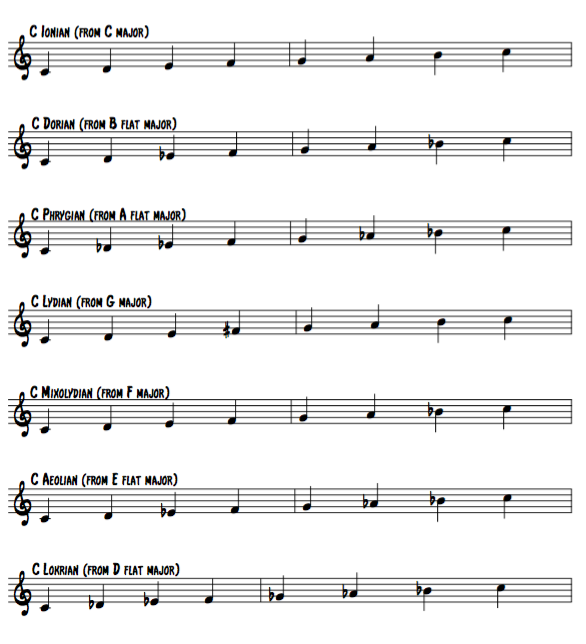
Modes
Perfect Authentic Cadence (PAC)
Has both the roots of the V and I chords sounding in the bass and the tonic is the highest sounding notes.
Imperfect Authentic Cadence (IAC)
Does NOT have roots in BOTH V and I and the tonic is not the highest sounding pitch of the final chord. May have inverted chords.
I
Tonic
viio
Leading tone or subtonic
vi
Submediant
V
Dominant
IV
Subdominant
iii
Mediant
ii
Supertonic
Natural Minor
WhWWhWW
Aeolian mode
Harmonic Minor
The natural minor with a raised 7th scale degree
Melodic minor
Raised seventh and sixth ascending, natural minor descending
Whole tone scale
Scale where every pitch is separated by a whole step
Chromatic scale
Scale where every pitch is separated by a half step
Tone cluster
Only neighboring notes in the diatonic key are used.
Chromatic tone clusters
Notes that are separated by a half step are used
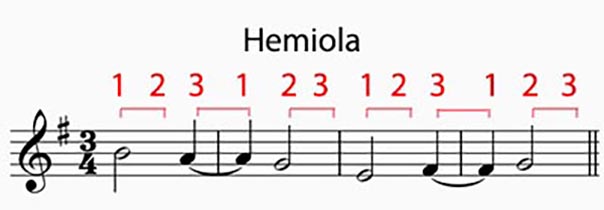
Horizontal Hemiola
Hemiola in succession, refers to a change in note values, where for example, three half notes follow a mature of two dotted half note in a 6/4 meter.
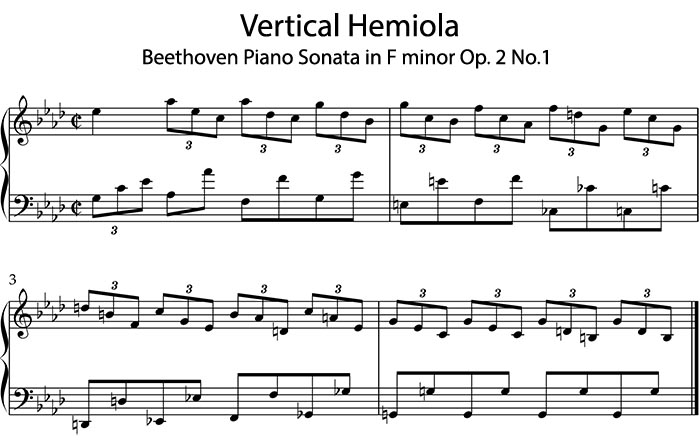
Vertical Hemiola
Hemiola that occurs simultaneously, refers to a rhythmic syncopation. Three against two rhythm.
Binary Form
Consists of two main sections, both repeated. Labeled A A' (B).
Rounded binary form
Form in which there is a return to the original thematic material of A. ABA or AA'A. The initial A section as well as the A' (B) are both repeated as in simple binary form. (Open form - doesn’t have to end on tonic)
Ternary form
This form consists of three main sections in which the first and third sections are nearly identical with a contrasting second section. The middle section is distinctly B. (Closed form - has to end on tonic)
Contrary motion
The motion of two musical lines that move in opposite directions.
Parallel motion
The motion of two musical lines that move in the same direction whether upwards or downwards which maintaining the same interval between lines.
Similar motion
The motion of two musical lines that move in similar directions whether upwards or downwards but without maintaining the same interval between the lines.
Oblique motion
The motion of two musical lines in which one line stays stationary while the other musical line moves in an upward or downward direction.
Phrase Structure
Antecedent (inconclusive phrases) and consequent (conclusive phrases) altogether create musical periods
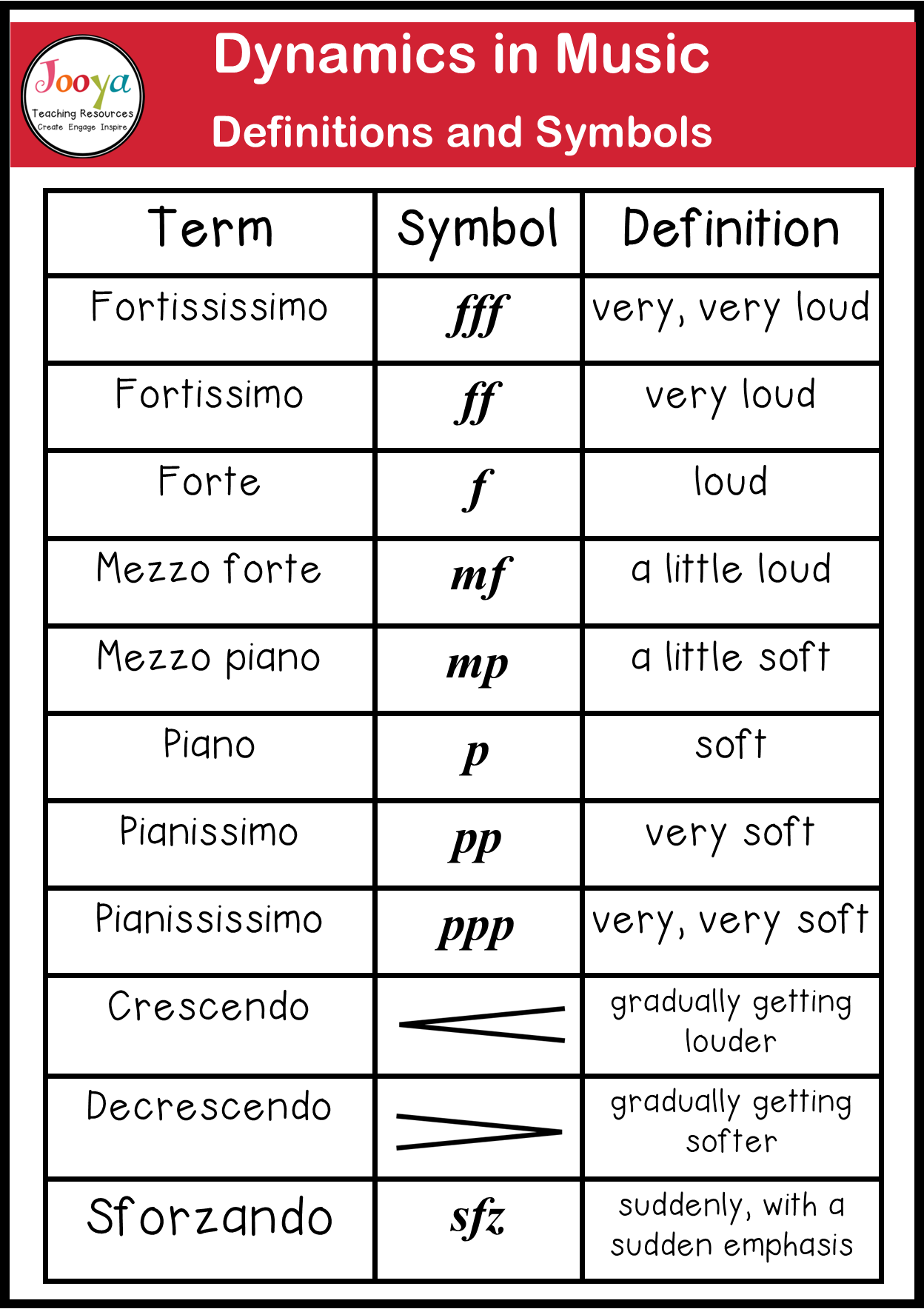
Dynamic Range
Counterpoint
A combination of 2 or more melodic lines and the way they fit together to create sounds
Etude
Short instrumental music designed for practicing a particular skill
Glissando
A glide from one note to the next
Tocatta
A composition for a keyboard instrument in a free style, solo
Portamento
A slide from one note to another, especially in singing or playing a bowed string instrument.
Through Composed
Non-repetitive, non-sectional, continuous
Picardy 3rd
Raising the m3 to make a major triad, composition is in minor key and song ends on the major triad
Strophic Form
Song structure in which the same music is repeated with every stanza (strophe) of the poem.
Bar Form
Three-part A-A-B form, frequently used in music and poetry, particularly in Germany.
A section- Stollen
B section-Abgesang-section typically longer than A and may end with all or latter part of A's melody
Octatonic Scale
A scale that consists of whole steps and half steps
W H W...