OMFPR 1: Radiation Physics - X-Rays, Their Nature, Production, and Interactions
 Call Kai
 Learn
Learn Practice Test
 Spaced Repetition
 Match
Match Flashcards
 Knowt Play
1/99

There's no tags or description
Looks like no tags are added yet.
Name | Mastery | Learn | Test | Matching | Spaced | Call with Kai | Chat |
|---|
No analytics yet
Send a link to your students to track their progress
100 Terms
Radiation
Energy in transit
Ionization
Removal of electrons from an atom resulting in the formation of an "ion pair"
Z-number (atomic #)
Atomic # = # of protons
Electrons
Z-number is same as number of _______ in neutral atom.
A-number (atomic mass #)
# of P + N
Electron binding energy
Attractive force that keeps electrons bound to the nucleus in their orbitals
Increased
Increased Z # = _________ binding energy
Electromagnetic radiation
Movement of energy through space as a combination of electric and magnetic fields
Quantum theory
Energy transfer in the form of "bundles" (or packets) of energy called photons (or "quanta")
Light; energy
EM radiation occurs at the speed of _____ and with specific amount of ______.
No
Do x-rays have mass or electric charge?
Waves; frequency
X-rays travel in _____ with a specific _________.
Speed of light
Specific frequency of x-rays
True
T/F: X-rays travel in straight lines.
Affect photographic film
Able to produce biological and chemical changes
How are x-rays able to ionize?
0.1A to 0.5A
Range of wavelengths for x-rays
Bremsstrahlung
Characteristic radiation
Two mechanisms of x-ray production
Bremsstrahlung
Electron to nucleus interaction
Characteristic radiation
Electron to electron interaction
Bremsstrahlung mechanism
High velocity electrons are suddenly decelerated when they pass close to the nuclei of high Z # absorbing material
In the Bremsstrahlung mechanism, x-rays are produced when...
X-ray tube
Primary source of radiation is generated by what in the Bremsstrahlung mechanism?
X-ray photons with varying energy levels (within a specific range)
What is produced from the Bremsstrahlung mechanism?
Characteristic mechanism
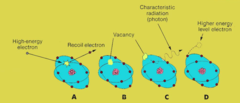
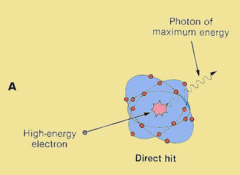
High velocity electrons interact with an inner shell electron and knocks it out of its orbit
In the characteristic mechanism, x-rays are produced when...
Outer shell electron
In the characteristic mechanism, the vacancy is filled by an...
Released; x-ray photon
In the characteristic mechanism, the difference in the energy levels is _________ and an _____ _______.
Small
Characteristic mechanism contributes a small or large fraction of photons in the beam?
True
T/F: In characteristic mechanism, x-ray photons with specific energy level that is characteristic of the atom is produced.
Cathode
Electron source
Focusing cup
Concentration of electrons
Potential difference or tube voltage kVp
Mechanism to accelerate electrons
Anode
Suitable target to stop electrons
Current heats cathode
Emission of electrons (thermionic)
Formation of electron cloud
Describe thermionic emission
99; 1
The x-ray tube allows conversion of kinetic energy with __% as heat and _% x-radiation.
High atomic number
High melting point
Low vapor pressure
High thermal conductivity
Why tungsten target?
Tungsten; copper
Anode has ________ target and _______ stem.
Good thermal conductor
Why is copper stem used?
Tube voltage (kVp)
Exposure time (S)
Tube current (mA)
Filtration
Collimation
Distance of x-ray tube from patient/receptor
Factors controlling x-ray beam
Tube voltage (kVp)
To accelerate the electrons from cathode to anode
Exposure time
Tube current
Heating the cathode to produce electrons
Filtration
To remove lower energy x-ray photons
Collimation
Adjust the shape/size of x-ray beam
# photons increases
Max energy in beam increases
Mean energy increases
What is the difference between 80 kVP and 90 kVP?
Filtration
Removal of low energy photons from the x-ray beam while allowing passage of high energy photons
Glass, oil
Inherent filtration in x-ray tube
Aluminum disk
Added filtration in x-ray tube
Total filtration in x-ray tube
Aluminum + inherent filtration
1.5mm
Total filtration of 50-70 kVp: ___ mm Aluminum equivalent
2.5mm
Total filtration above 70 kVP: ___ mm Aluminum equivalent
Increase; decrease
When filtration is increased, there is _______ in exposure time and ________ in patient skin exposure.
Reduces; 80%
Although filtration requires an increase in exposure time up to 50% to compensate for loss of intensity, it _______ patient skin exposure by as much as __%.
HVL
Useful way to characterize the penetrating quality of an x-ray beam
Quality
Mean energy of an x-ray beam
HVL (half value layer)
Defined as the thickness of an absorber that reduces the quantity of photons by 1/2
Increases
As average energy of beam (kVp) increases, HVL ________.
Reduces size and modifies shape of beam
Reduces volume of tissue irradiated
Improves image quality
Collimator is a metallic barrier with an aperture that:
Inversely proportional ( I = 1/D^2)
For a given beam, the intensity is ________ ___________ to the square of the distance from the source.
Changing the distance between the x-ray tube and patient has marked effect on beam intensity, so position the cone of x-ray as close to the patient (not touching) as possible
Clinical significance of inverse square law
4m
2m
1m
0.25 Gy at _m
1 Gy at _m
4Gy at _m
1. No interaction (9%)
2. Coherent scattering (7%)
3. Photoelectric effect (27%)
4. Compton scattering (57%)
4 types of interactions possible
Coherent
Only 7% of total interactions are ________ scattering.
Photoelectric effect
27% of all interactions in a dental x-ray beam
Higher
Z (atomic #) of bone is ______ than Z of soft tissue.
Z bone > Z soft tissue
Differential photoelectric absorption within different types of tissues makes production of a radiographic image possible!
What is the clinical significance of photoelectric effect?
Compton scattering
57% of all interactions in a dental x-ray beam
Outer orbital
In Compton scattering, an incident photon interacts with an ____ ______ electron.
Fogging (darkening) of the film/receptor while carrying no useful information due to altered path
In Compton scattering, the scattered photon travels in all directions with a lower energy, causing...
Bones = radiopaque
Sinuses = radiolucent
Are bones radiopaque or radiolucent?
Differential
Making a radiographic image requires ___________ absorption.
Equivalent dose
A measure of comparison of biological effectiveness of different types of radiation
Sievert (Sv)
SI unit of equivalent dose
Effective dose
Used to estimate risk in humans by comparing different exposure types (panoramic vs. chest radiograph)
Volume/radiosensitivity of tissue irradiated
Biologic effectiveness of radiation
Effective dose takes into account...
Radiation biology
The study of effects of ionizing radiation on living systems
X ray, y ray
Uncharged, non-particulate (EM)
n
Uncharged, particulate
Beta particles
Alpha particle
Proton
Heavy ions
Charged, particulate
Direct effect
Ionization of biologic macromolecules directly by a photon of ionizing radiation
Direct
1/3 of all radiation-induced biologic effects caused by x-rays is ______ effect.
Indirect
Majority of all radiation-induced biologic effects caused by x-rays is _______ effect.
Photon absorbed by water (in living tissues), causing ionization of some water molecules to form free radicals (radiolysis of water)
Free radicals interact with macromolecules to produce biologic changes
2 steps of the indirect effect
Indirect
2/3 of all radiation-induced biologic damage caused by x-ray exposure is by ________ effects.
DNA
Primary target for cell damage from ionizing radiation
Cell death
Genetic mutations
Carcinogenesis
What can a DNA double-strand break cause?
Tissue reactions (or deterministic effects)
Radiation injury to organisms resulting from killing of large number of cells (e.g. erythema, cataract formation)
Stochastic effects
Sublethal damage by radiation to individual cells leading to carcinogenesis or heritable mutation
Deterministic
Examples: mucositis, cataract formation post radiation therapy
Stochastic
Examples: radiation-induced cancer, genetic effects
Deterministic
Caused by killing of a large number of cells
Stochastic
Caused by sublethal damage to DNA
Deterministic
Is there a safe threshold dose for deterministic or stochastic effects?
Deterministic
Severity of clinical effects and dose are proportional to dose
Stochastic
Severity of clinical effects and dose are independent of dose
Deterministic
Probability of having effect and dose = effect definitely seen ONLY above threshold dose
Stochastic
Probability of having effect and dose = greater the dose, greater chance for having effect
True
T/F: Even the smallest doses of radiation as those associated with dental x-rays have the potential for cancer formation.
Linear
Radiation carcinogenesis has a ______ non-threshold response.
Radiosensitivity of cell/tissue
Stage in cell cycle
Reproductive capability
Age
O2 and temperature (higher = more damage)
Volume of tissue
Host factors influencing radiation damage
Type of radiation / LET
Dose
Dose rate
Radiation factors influencing radiation damage