Week 3 L1 - Introduction to the Peripheral Nervous System and Neuromuscular Junction
 Call Kai
 Learn
Learn Practice Test
 Spaced Repetition
 Match
Match Flashcards
 Knowt Play
1/29

There's no tags or description
Looks like no tags are added yet.
Name | Mastery | Learn | Test | Matching | Spaced | Call with Kai | Chat |
|---|
No analytics yet
Send a link to your students to track their progress
30 Terms
what does the somatic nervous system do?
regulates voluntary movement by skeletal muscle
focus for drugs targets; neuromuscular junction
what does the autonomic nervous system do?
regulates unconscious, involuntary, essential functions by a range of different effector tissues
focus for drug targets: junctions between postganglionic nerve terminal and effector tissue
What is the specific synaptic region on the muscle cell membrane where a motor neuron meets skeletal muscle tissue?
neuromuscular junction (NMJ)
Which neurotransmitter is synthesised in the motor neuron nerve terminal upon arrival of action potential, and what specific type of receptor does it target on the muscle cell membrane?
Neurotransmitter: Acetylcholine (ACh)
Receptor: Nicotinic acetylcholine receptor (AChR)
What enzyme is present in the synaptic cleft to degrade acetylcholine, and what is its abbreviation in the provided diagram?
Acetylcholinesterase (AChE).
What specialised glial cells cover the nerve terminal at the NMJ
Terminal Schwann cells
what are the key stages in synaptic transmission at the NMJ
choline uptake to nerve terminal
synthesis of acetylcholine (ACh)
packaging of ACh into vesicles
arrival of action potential from motor neuron axon
depolarisation of nerve terminal and opening of calcium channels
destabilisation of vesicles and fusion with nerve terminal membrane
ACh release and reversible binding to nicotinic acetylcholine receptors
membrane depolarisation leading to muscle action potential
acetylcholinesterase cleaves ACh and terminates signal
What are non-depolarising blocking agents (e.g., tubocurarine)
Act as competitive antagonists at postsynaptic nicotinic ACh receptors, preventing ACh binding and blocking membrane depolarisation.
why are non-depolarising blocking agents (e.g., tubocurarine) used clinically
During major surgical procedures or mechanical ventilation, doctors need to prevent involuntary muscle movements and reflexes. By using non-depolarising blocking agents (like tubocurarine) or depolarising blocking agents (like suxamethonium), you block postsynaptic nicotinic receptors. This induces temporary, controlled skeletal muscle paralysis, making surgeries safer and intubation easier.
what are depolarising blocking agents (e.g., suxamethonium)
Act as agonists at postsynaptic nicotinic ACh receptors, causing prolonged depolarisation and desensitisation of the motor endplate.
stimulates the muscle so hard and for so long that it completely exhausts the electrical system, locking it in a state of unresponsiveness.
Suxamethonium cannot be degraded by acetylcholinesterase, meaning it remains in the synaptic cleft to continuously activate nicotinic receptors and lock voltage-gated sodium channels in an inactivated state.
what does nicotinic acetylcholine receptor influence
membrane permeability
depolarisation (agonist or antagonist)
what do acetylcholinesterase inhibitors do
reduce acetylcholine breakdown which prolongs signal
what are common drug targets
receptors and enzymes
what is vesamicol
an experimental drug primarily used in pharmacological research to study the presynaptic mechanisms of cholinergic neurons
Inhibits the ACh carrier (vesicular acetylcholine transporter), preventing the transport and storage of acetylcholine into presynaptic empty vesicles.
what disease can affect the NMJ
Myasthenia gravis
what is myasthenia gravis
muscle weakness and fatigue, resulting from impaired NM transmission
ACh release normal, but level of receptor activation insufficient to cause muscle cell contraction
due to circulating anti-nACh receptor antibody and receptor population is depleted
MG = autoimmune disease
humans most evident drooping eyelids, dogs = mouth
85% of MG patients the body produces pathogenic autoantibodies against the postsynaptic AChR.
no longer enough receptors, and not activating enough so total collective activation is too weak
How do drugs used to treat Myasthenia Gravis selectively improve neuromuscular transmission?
They selectively target and inhibit acetylcholinesterase, increasing the concentration of acetylcholine in the synapse and increasing the chances of the transmitter reaching the remaining postsynaptic receptors.
What are two drugs of choice (acetylcholinesterase inhibitors) used for treating Myasthenia Gravis as noted in the lecture?
Neostigmine and physostigmine (anticholinesterases).
Why is increasing the synaptic concentration of ACh effective if Myasthenia Gravis is a postsynaptic receptor problem?
By flooding the synaptic cleft with more ACh and keeping it there longer, it compensates for the depleted receptor population by ensuring the few remaining receptors are maximally activated to trigger muscle contraction.
What is the clinical purpose of using muscle relaxants like tubocurarine in anaesthesia?
they are used to improve post-surgical recovery and outcomes
reduces contraction of muscle in surgery which can cause future recovery issues
What is "tube curare" (tubocurarine) chemically derived from, and how was it historically used?
Source: An alkaloid extract from the plant Chondrodendron tomentosum.
History: Used by indigenous populations in the Amazon on the tips of arrows in blowguns, nicknamed "The flying death" by 20th-century explorers.
Why can prey hunted with tubocurarine-tipped arrows be safely eaten by humans?
Tubocurarine causes paralysis only if it enters the bloodstream directly; it is completely harmless if ingested orally.
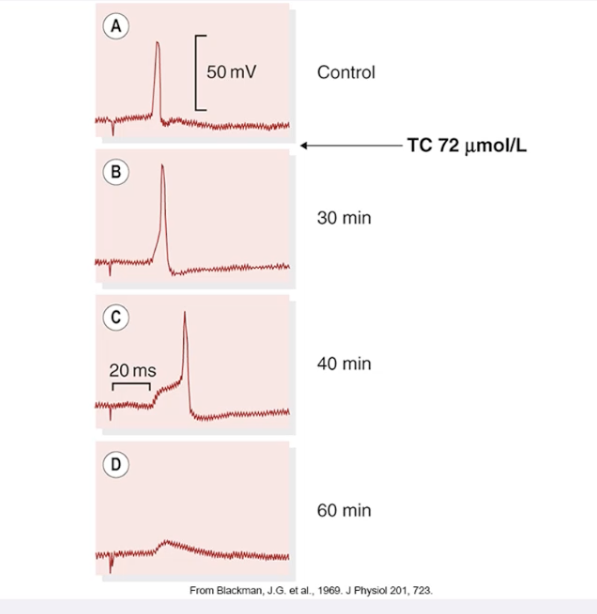
Describe the experimental model, tissue source, and recording method used to generate the "Tubocurarine in action" traces.
Method: Intracellular microelectrode recording.
Tissue Source: Guinea pig parasympathetic ganglion cell (autonomic ganglion cell).
Action: Measuring cholinergic transmission following preganglionic nerve stimulation.
What does the sharp spike/artefact at the very beginning of each voltage trace represent?
It marks the exact moment of stimulation of the preganglionic nerve.
What specific electrical signal does tubocurarine (TC) cause to become progressively smaller over time, and what is its receptor classification here?
Signal: The excitatory postsynaptic potential (EPSP).
Classification: Tubocurarine acts as an acetylcholine antagonist.
Based on the experimental timeline, contrast what is happening to transmission in trace C (40 min) versus trace D (60 min) at a TC dose
Trace C (40 min): The EPSP only just succeeds in reaching threshold to trigger an action potential.
Trace D (60 min): The EPSP has fallen completely below the threshold, failing to trigger an action potential entirely.
What cellular process does botulinum toxin block, and which specific membranes are prevented from interacting?
It blocks the fusion of vesicular and terminal membranes, directly halting the exocytosis of acetylcholine into the synaptic cleft.
What is the exact molecular mechanism by which botulinum toxin reduces acetylcholine release?
The toxin binds to and cleaves a number of synaptic proteins (SNARE proteins) that are fundamentally involved in presynaptic exocytosis.
What organism produces botulinum toxin, how does it propagate, and what severe medical condition does it cause?
Organism: Produced as a neurotoxin by the bacterium Clostridium botulinum.
Propagation: Can propagate inside preserved foods.
Condition: Causes botulism, which is a severe and dangerous form of food poisoning.
List the specific clinical and cosmetic applications of botulinum toxin
Clinical Relief: Used to treat muscle spasms of the neck, limbs, or eyelids, as well as managing urinary incontinence.
MS
Cosmetic Use: Administered via local injection to reduce wrinkles by relaxing targeted muscles.