Protostomes (L15+16)
 Call Kai
 Learn
Learn Practice Test
 Spaced Repetition
 Match
Match Flashcards
 Knowt Play
1/77

There's no tags or description
Looks like no tags are added yet.
Name | Mastery | Learn | Test | Matching | Spaced | Call with Kai | Chat |
|---|
No analytics yet
Send a link to your students to track their progress
78 Terms
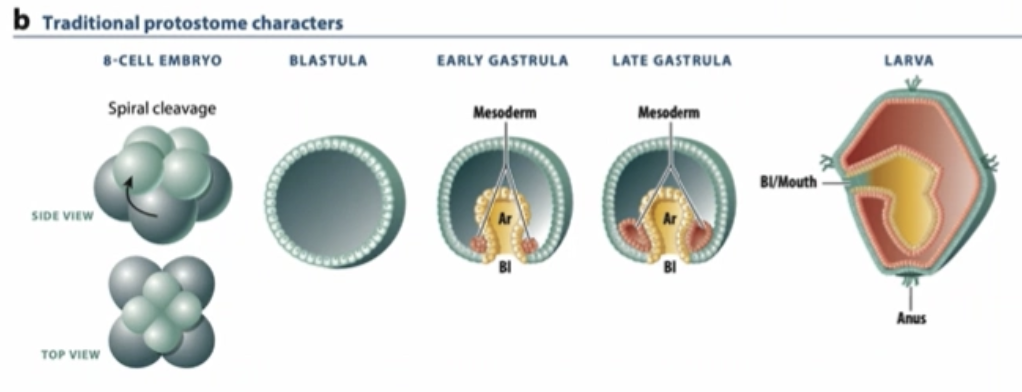
Protostome synapomorphies
schizocoely
Protostomes
Ecdysozoa and Lophotrochozoa
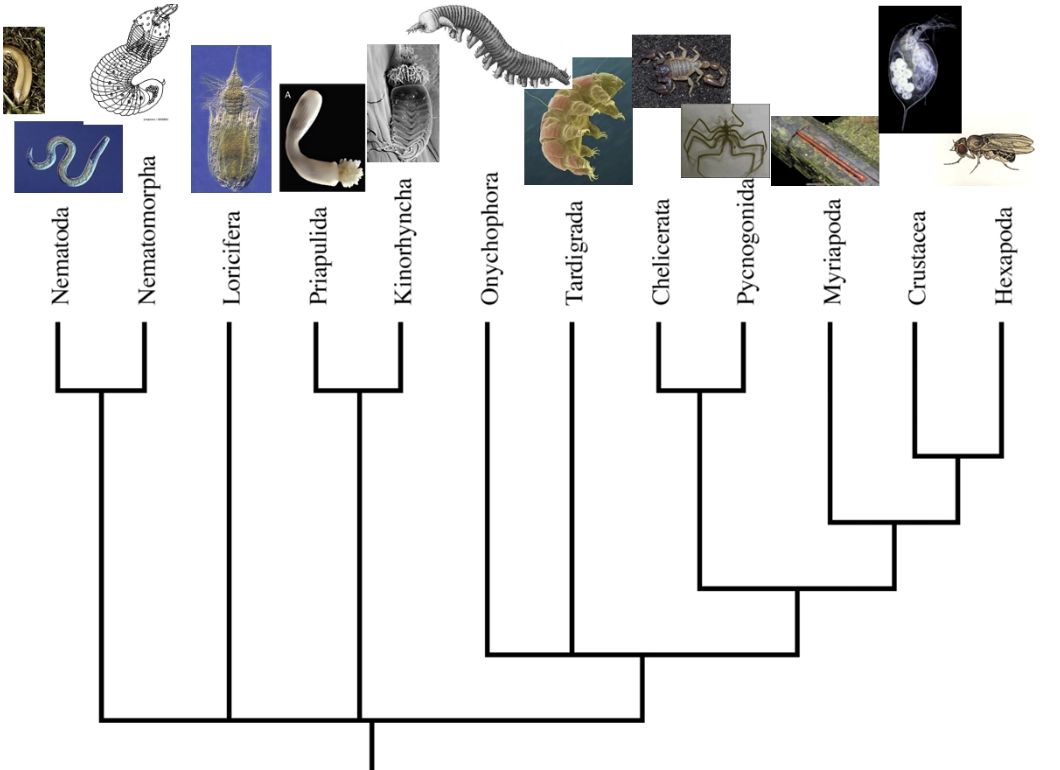
Ecdysozoa
Arthropoda, Nematoda, Nematomorpha, Priapulida
Ecdysis
moulting of cuticle; homologous character that defines Ecdysozoa
Many molecular synapomorphies
between Ecdysozoa and Lophotrochozoa
Segementation in Ecdysozoa may be
a shared character that was lost in some classes
(In Ecdysozoa) Dense mass of
mesoderm forming near the archenteron
Panarthropods
Onycophorans (velvet worms), Tardigrades, Euarthropods
Arthropods are
the biggest group of animals
Euarthropods
Chelicerates, Crustaceans, Insects (Hexapods), Myriapods
Chelicerates
sea spiders, horseshoe crabs, arachnids, sea scorpion (extinct)
Sea spider
(Chelicerate) Pycnogonid
Horseshoe crabs
(Chelicerate) Xiphosuran
Crustaceans
Copepods, Barnacles, Maxillopod crustacea
Barnacles
Cirripedes
Myriapods
Chilopoda, Diplopoda, Symphylan, Pauropoda
Chilopoda
centipedes, one pair of legs per segment
Diplopoda
millipedes, two pairs of legs per segment
Onycophorans
velvet worms
Pancrustacea
group consisting of insects and crustacea
Insects and crustaceans are closely related shown by
changes in mitochondrial gene order
Velvet worms have
poisonous, gluey spit used to catch prey
Tardigrades/Water bears
segmented (1 pair of legs per segment), extremophile
Panarthropod synapomorphies
jointed legs with claws, legs in parasegmental register
Euarthropod and Onycophoran synapomorphies
dorsal ostiate heart, haemocoel
Haemocoel
haemolymph-containing cavity
Haemolymph
blood-like fluid in arthropods
Insect segmentation
head, abdomen, thorax
Chelicerate segmentation
prosoma (head), opisthosoma (legless end)
Tagmatization
segment specialization
Prosoma
head end in Chelicerates
Opisthosoma
legless end in Chelicerates
Introvertan worms
Nematodes, Nematomorphs, Priapulids, Kinorhynchs, Loriciferans
Introvert
spiny retractable proboscis that utilises fluid-filled cavities for motion
Proboscis
elongated sucking mouthpart
Introvert movement
compresses and forces fluid to front (extension)
muscles in introvert pull it back into body
body propelled forward
Properties of Priapulids
radial cleavage, deuterostomy, signs of segmentation (in some groups)
Priapulid larvae
have a tunic/carapace (found in Loriciferan and Kinorhynchs)
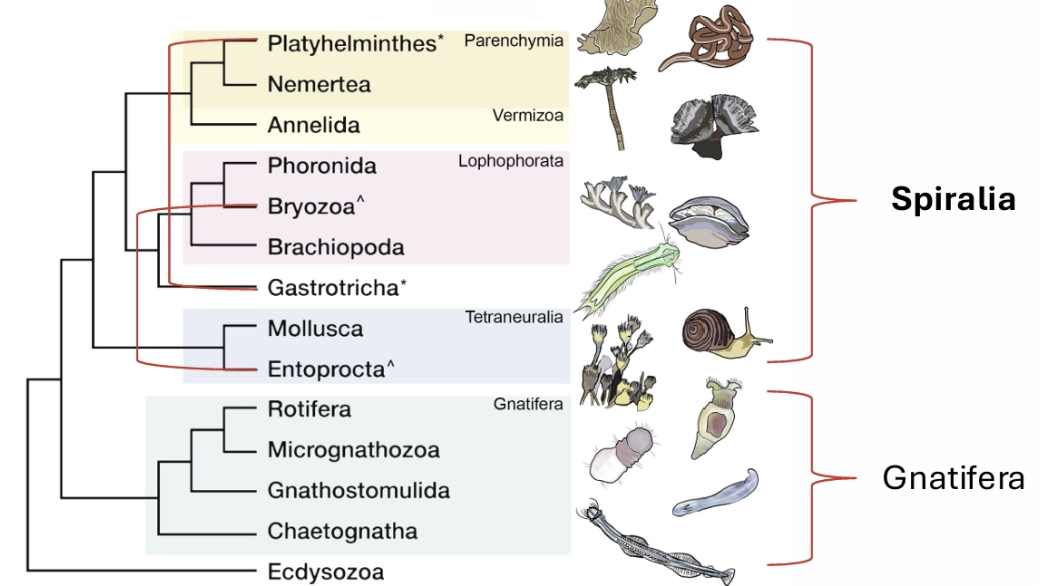
Lophotrochozoa
Spiralia and Gnatifera
Bootlace worm
Nemertea (Ribbon worm), Lineus longissimus, longest known animal
Lophophore
extension of the front of the body with ciliated fingers of tissue that catch particles
Trochophore larvae
prototroch around the equator of the body in the larval stage (molluscs and annelids)
Prototroch
wheel of cilia
Lophotrochozoa (Fundamental characters)
Spiral cleavage, Larval stages, Molecular characters
Lophotrochozoa - larval stage
ciliated larva that look similar across species
In Lophotrochozoa larvae the prototroch is
used for motility coordinated by apical organ
Lophotrochozoa larvae have a ciliary tuft
used to sense environment
Spatial colinearity
(Hox genes) order on the chromosome reflects the order of expression
Genes only found in Lophotrochozoa
Lox5 Lox8 Lox4
Spiralia
Molluscs, Annelids, Platyhelminthes, Nemertea
Gnatifera
Chaetognaths, Rotifers, Micrognathozoa, Gnathostomulida
Molluscs
cephalopods, bivalves, snails, gastropods
Mollusc synapomorphies
radula, mantle, anus and genitalia opening in mantle cavity
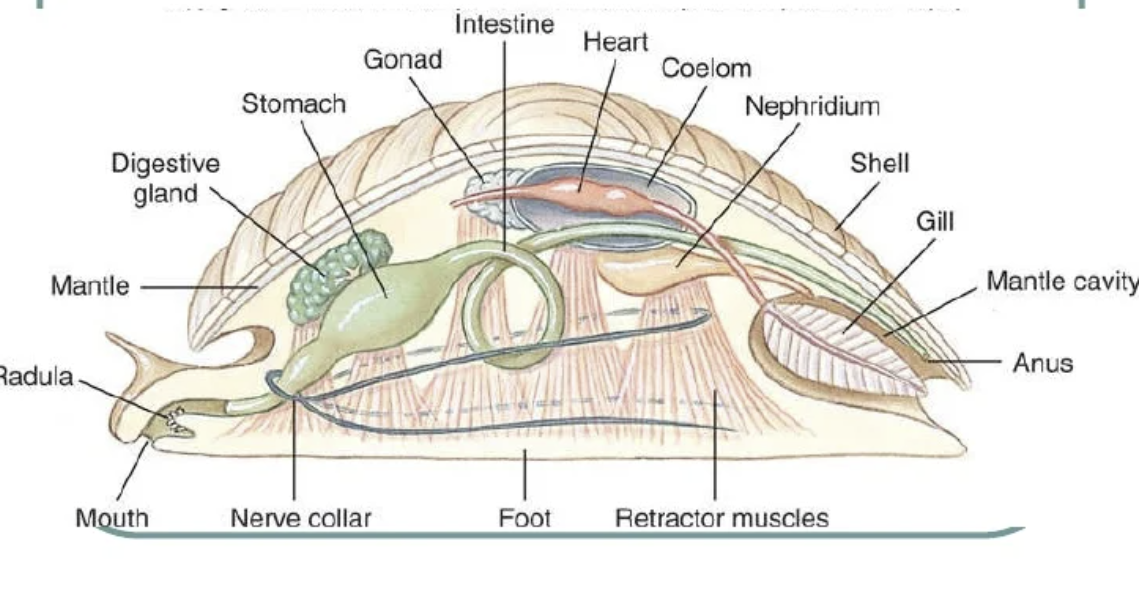
Radula
chitinous band with rows of teeth
Radula is used
to scrape food off rocks
Radula is located
on top of odontophore
Radula is moved by
radula muscles
Radula is renewed
continuously
Mantle
dorsal layer, responsible for secreting the shell/plate
Shell field cells
evolve rapidly in molluscs
Annelid synapomorphies
closed blood vessel system (only protostome to have one), fundamental metamerism
Metamerism
linear series of body segments fundamentally similar in structure
Annelid metamerism
anatomical units contain nephridium, ganglion of ventral nerve chord, muscles around gut
Nephridium
excretory organ (in Annelid metamer)
Platyhelminthes
flatworms; complex digestive system, single intestinal opening, lack coelom, regenerative abilities
Only group of flatworm to have spiral cleavage and larval stage
Polycladida
Polycladida
only group of flatworm to have spiral cleavage and larval stage
Majority of flatworms are
parasitic
Nemertean synapomorphies
reversible proboscis, rhynchocoel, multiple sensory organs (catch prey)
Reversible proboscis in Nemertea is used to
catch prey
Rhynchocoel
fluid-filled cavity which houses the proboscis
Lophophorata
subgroup of Spiralia containing Brachiozoa and Bryozoa
Lophophorata lack
spiral cleavage
Brachiopods
(Brachiozoa) similar shell to bivalves, deuterostomy
Gnatifera synapomorphies
lack larval stage, pharyngeal hard parts (jaws), may have spiral cleavage
Chaetognaths
tripartite body, grasping spines (jaws), coelomates, hermaphrodites, deuterostomy
Chaetognaths linked to Rotifers in Gnathifera by
MedPost Hox gene
Chaetognaths tripartite body organisation
head, trunk, tail