Week: 5 Lecture 1 Development of Decision Making and Risk Taking – How do children deal with risk and uncertainty?
 Call Kai
 Learn
Learn Practice Test
 Spaced Repetition
 Match
Match Flashcards
 Knowt Play
1/12

There's no tags or description
Looks like no tags are added yet.
Name | Mastery | Learn | Test | Matching | Spaced | Call with Kai | Chat |
|---|
No analytics yet
Send a link to your students to track their progress
13 Terms
- Explain what a decision under risk is.
What is decision making under risk?
A choice between options that have some probability of being rewarding or damaging, the larger the variance in outcomes, the greater the risk.
What psychological functions are involved in decision making?
: Numerical representation
Concept of probability
Information search
Comparison
Information integration ;
Number sense and the Approximate Number System
Describe how they study Number sense and the Approximate Number System in infants and young children?
Asking individuals the amount of dots are blue or yellow in a ‘quick flash’. Can change the ratio and size of the dots to gauge the difficulties across tasks In infants → uses tests of habituation in order to figure if children recognise the different amount of numbers.
Babies are exposed to a different amount of dots → in the test phase, infants time spent looking at a novel number is longer – hence if infants correctly look longer at a novel stimuli, then an understanding of numbers is inferred.
What are the trends associated with number sense and the approximate number system in children?
Results of 10,000 people aged 11-85 years show that the precision of the approximate number system changes across a lifespan
. → imprecise in young children, improvement in the teens, and optimal around age 30, with a gradual decline in late adulthood.
The precision of a person’s approximate number system predicts how good they are in formal school mathematics.
What are the trends associated with number sense and the approximate number system in infants ?
Infants numerical discrimination is imprecise but it applies to a broad number of entities, the process of developing these skills occurs in parallel, infants don’t count, they create evidence to support the number over time – it is not about the area/number of dots, it is about the differences between dots. Infants can engage in probabilistic reasoning and inferences.
Describe the development of a number sense to an exact numerical concept.
2 years - rote count recited
2.5-4 years Subset knower
4 years - understanding of cardinal principals - that is, children can understand that the last word = the total number
Probabilistic inferences in Infants How are probabilistic inferences in infants tested?
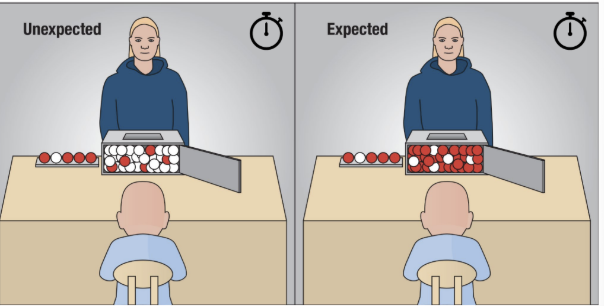
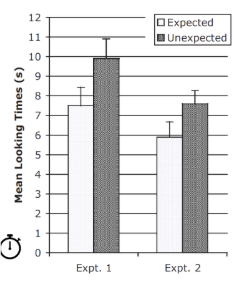
Creates a ratio of different balls in and outside the box, if the box is surprising then the child will look at it for longer, if it isn’t the child won’t – implies understanding of probabilistic inferences. (sample to population inferences).
Describe the trends associated with infant understanding of probabilistic inferences?
infants draw inferences from samples to populations (and vice versa) TO
Integrate physical information about objects when making statistical inferences
Take into account information about the intentions of sampling agents
Use statistical sampling information to guide their choices → whether or not children will choose the ‘more rewarding number’ vs. not.
What is the phylogenetic origin of probability inferences?
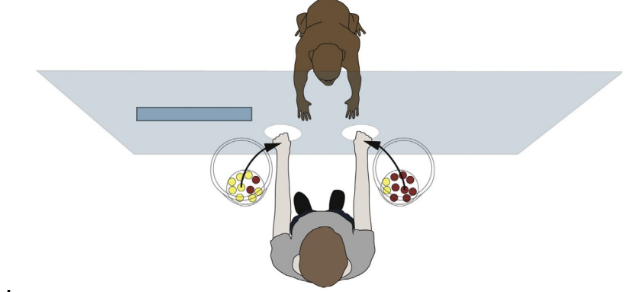
Paradigm, wherein humans test a chimp’s understanding of probability inferences.
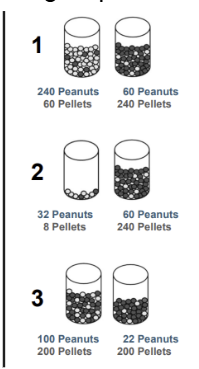
3 x groups- wherein the ratio between the peanuts vs. pellets are different.
Humans draw one item from the buckets, buckets have different ratios of preferred and non-preffered items, chimp watches and make a choice between either hand. They found that chimps have an understanding of ratio and chance.
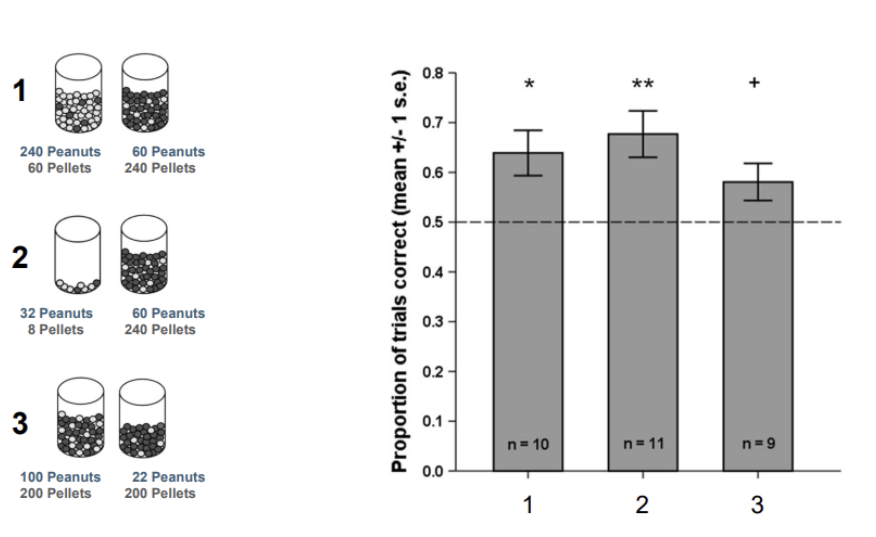
2- quantitative vs. probabilistic understanding of peanuts 3 - harder, tests understanding of amount vs. probability.
Information search Describe trends associated with information search?
Young children are excellent explorers and can outperform adults on learning problems that require wide exploration.
Comparison + Integration What to note about comparison?
Have to have this ability in most previous numerical tasks described - information search, probabilistic understanding and numerical understanding. For example -
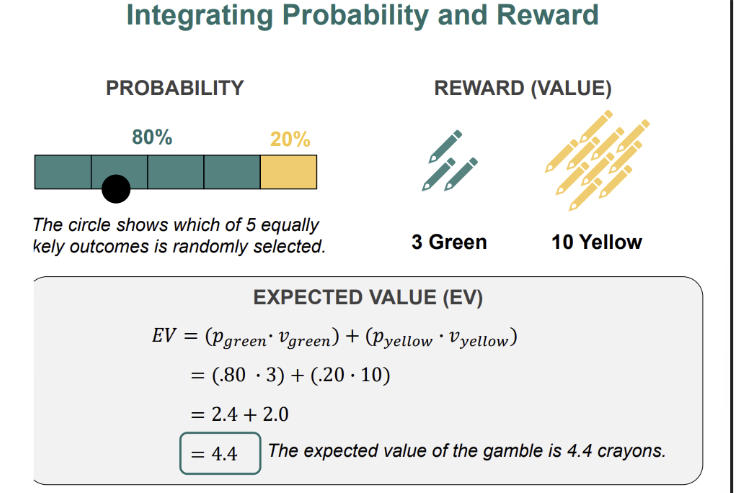
Coloured tube with green or yellow sessions, there is a marble. Chooses which ‘reward’ There are different levels of reward → with green and yellow. - The objective response is to calculate the expected value of either choice.
How do they study this in children?
Model of a tube that is green and yellow that indicate higher or lower probability. Child can have a large (10 pencils) reward or a small reward (3 pencils) EV - ‘expected value’ gamble → the sum of the probability, weighted as a function of the different gambles
Manipulated the expected value – and tested the children's judgement
Manipulated the expected value by changing the probability of green or yellow outcomes
Manipulated the expected value by changing the amount of comparative reward.
They found that children are able to calculate the expected value and change their behaviour adaptatively at 6-year (that is they have the capacity to multiplicatively integrate probability and value.
Main points of this lecture?
Children encounter risks and uncertainty in many domains of their daily lives. • Infants and young children can discriminate numbers, albeit imprecisely (“number sense”) (Spelke, 2022)
Infants use their numerical ability to make probabilistic inferences and have adequate statistical intuitions (Denison & Xu, 2019)
Young children are excellent “explorers,” and can outperform adults on learning problems that require wide exploration (Liquin & Gopnik, 2022)
Children multiplicatively integrate probability and value in line with normative predictions (Schlottmann, 2001) . ; - MORE ELABORATION ON THURSDAY. ;