3.0 The effective therapist
 Call Kai
 Learn
Learn Practice Test
 Spaced Repetition
 Match
Match Flashcards
 Knowt Play
1/38

Earn XP
Description and Tags
The effective therapist
Name | Mastery | Learn | Test | Matching | Spaced | Call with Kai | Chat |
|---|
No analytics yet
Send a link to your students to track their progress
39 Terms
Does it matter which therapy?”
no → treatment modality explains roughly 1-2% of the variation in outcome
Does it matter which therapist?
therapist differences explain around 5%
Clients seen by therapists in the top quartile are on average likely to benefit
about twice as much as those seen by therapists in the bottom quartile.
Personal characteristics → of a therapist
Has a sense of identity → respects & appreciates others, is open to change.
Makes life-oriented choices → is authentic, sincere & honest.
Has a sense of humour → makes mistakes and is willing to admit them.
Lives in the present → is deeply involved in their work.
Appreciates the influence of culture → maintains healthy boundaries

Issues experienced by beginning therapists → IN THE ROOM
Anxiety, being yourself, & self-disclosure.
Avoiding perfectionism → being honest about your limitations.
Understanding silence.
Dealing with demands from clients, & with clients who lack commitment.
Declining to give advice.
Issues experienced by beginning therapists → IN YOURSELF
Tolerating ambiguity.
Developing a sense of humour.
Defining your role as a therapist.
Learning to use techniques properly & developing your own style.
Maintaining your own vitality.
Why is it difficult to determine what makes an effective therapist?
Many different therapeutic approaches can be effective for the same disorder, despite having incompatible theories
Knowing that a treatment package works does not tell us which components make it work
“Effective therapist” → has no single definition
Effectiveness may refer to client compliance, therapeutic alliance, or successful outcomes.
Therefore, different research programs may study different meanings of therapist effectiveness.
Outcome research
Research that asks whether a treatment PRODUCES CHANGE
by measuring clients before & after, & comparing one condition against another.
names the package

What is the difference between outcome research & process research in psychotherapy?
Outcome research = DOES therapy work? → examines the results of treatment, such as symptom improvement, remission & dropout.
Process research = HOW does therapy work? → examines what happens during therapy & which therapist/client processes produce change, e.g. therapeutic alliance and therapist responses.
The main limitations found in what is the difference between outcome research & process research in psychotherapy
Outcome research → tells us whether treatment worked, but not what happened inside the sessions that made it work
Process research → identifies processes associated with change, but this does not automatically prove that the process caused the outcome
Process research
Research that asks WHAT HAPPENS INSIDE the sessions, & which of it produces the change
by observing & coding recorded therapy moment by moment.
describes the interaction

Two perspectives of the therapist´s instrument
The behavioural perspective
The experiential perspective
The behavioural perspective
The instrument: your behaviour — what you actually do & say, moment by moment.
What you develop: a repertoire of effective behaviours & the ability to recognise their function & impact on the client.
The focus: What did my response do to the client’s behaviour? Did it evoke, reinforce, or inhibit the behaviour I was aiming for?
Core principle: interpersonal contact always changes behaviour. The therapist’s task is to make that influence intentional & goal-directed.
The experiential perspective
The instrument: your person — your capacity to use yourself in the service of emotional change.
What you develop: the ability to recognise the client’s active emotion, its level of arousal & productivity, & what the client needs next to move forward.
The focus: What is happening in the client’s emotional process, moment by moment?
Core principle: emotional change follows identifiable processes & sequences. The therapist’s task is to facilitate the next step in that process.
Similarities found in Behavioural perspective & experiential perspective
Both rely on recorded sessions, deliberate practice, & observer-rated coding.
Your behaviour matters in both
The key difference is what is being observed & trained:
Behavioural: the function & impact of the therapist’s behaviour.
Experiential: the client’s emotional process & the therapist’s ability to facilitate change
difference is whether the primary target of training is what the therapist does or what the client is experiencing & how it changes
Classical — the stimulus comes first & ELICITS
BEFORE:
US (the assault) → UR (fear).
NS (the lift) → nothing
PAIRING: the neutral stimulus occurs together with the unconditioned one.
AFTER:
CS (the lift) → CR (fear).
The lift did nothing to her before. Now her heart races at the sight of one, & nothing about her decided to learn it — the pairing did it.
Classical conditioning is a form of
Associative learning in which an organism learns to associate two stimuli, such that a previously neutral stimulus comes to elicit a response after being repeatedly paired with a stimulus that naturally produces that response
Explains phobias & trauma reactions.
Explains why a client can react to your tone of voice for reasons that have nothing to do with you.
Operant Conditioning
Response → Consequence

Operant Conditioning: Response → Consequence
The response is the behaviour the person emits (e.g., leaving the supermarket).
The consequence is what follows (e.g., the panic drops).
Unlike classical conditioning, the behaviour in Operant Conditioning is
Emitted rather than elicited.
The consequence does not trigger the behaviour; it changes how likely it is to occur again.
Operant conditioning is a form of
associative learning in which the likelihood of a behaviour changes as a result of its consequences, particularly through reinforcement or punishment
Behaviour INCREASES →Reinforcement
Positive reinforcement (R+) → Something is ADDED
Negative Reinforcement (R-) → Something is REMOVED
Behaviour DECREASES → Punishment
Positive punishment (P+) → Something is ADDED
Negative punishment (P-) → Something is REMOVED

Behaviour analytic ABC model
A → B → C
A = Antecedent: what happens before the behaviour.
B = Behaviour: what the person does. (For Ellis B is beliefs).
C = Consequence: what happens after the behaviour.

Behaviour-analytic notation → Three term contingency
Sᴰ → R → Sᴿ

Sᴰ
discriminative stimulus → a cue that signals that reinforcement is available for a particular response
(Situation where the behaviour will be reinforces if it occurs)
R
Response of behaviour of interest (target of intervention)
Sᴿ
Reinforcing stimulus → the consequence that increases the future probability of that behaviour.
The role a consequence
plays in maintaining or changing a behaviour
A consequence is not necessarily a reinforcer simply because it follows a behaviour
It functions as reinforcement if it increases the future probability of that behaviour.
Functional analysis → Example

Functional analysis: How consequences shape behaviour → Example

Functional Analysis → example of a table

Clinical Time Course → example of a table
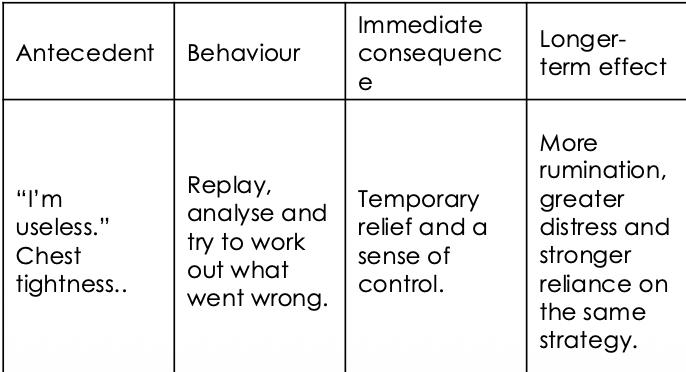
Functional analysis helps us understand
what maintains a pattern
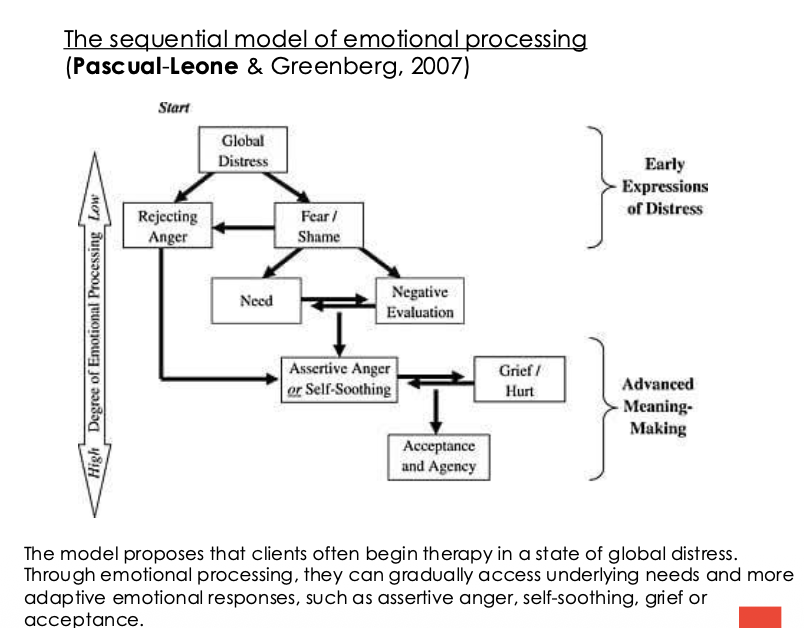
Emotional change in Emotion-Focused Therapy
How emotional experience can change & transform
From an EFT perspective, emotional change involves moving from
problematic emotional states towards new emotional experiences, meanings & responses.

Antonio Pascual-Leone's model describing Emotional change in Emotion-Focused Therapy
An initial emotional state is accessed & processed until a new, more adaptive emotional response becomes possible
The goal is therefore not simply to reduce the emotion, but to transform the emotional process.