brain and behavior exam 1
 Call Kai
 Learn
Learn Practice Test
 Spaced Repetition
 Match
Match Flashcards
 Knowt Play
1/89

There's no tags or description
Looks like no tags are added yet.
Name | Mastery | Learn | Test | Matching | Spaced | Call with Kai | Chat |
|---|
No analytics yet
Send a link to your students to track their progress
90 Terms
in what two ways are neurons similar to other cells?
plasma membrane, and organelles (nucleus etc)
name 3 ways that neurons are different from other cells
morphology (shape), theyre postmitotic( no more cell division), they communicate over long distances

name the parts of the neuron
a- dendrites, b-cell body (soma), c-nucleus, d- axon hillock, e-axon, f- myelin sheath, g-signal direction, h synaptic terminals, i- synapse, j- postsynaptic cell, k- presynaptic cell

name the parts of the synapse
axon terminal, vesicle, nueurotransmitters

what is this image of and what are the top and bottom pieces?
synapse; top- dendrite/ spine (presynaptic cell) bottom- (postsynaptic cell) terminals (can see vesicles and neurotransmitters)
whats a presynaptic and post synaptic cell?
presynaptic is the before the change; postsynaptic is the cell thats recieving

define a multipolar neuron
has more than two projections coming off the soma
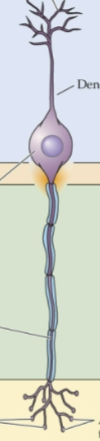
define a bipolar neuron
has two projections coming off the soma
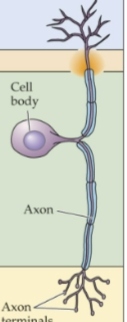
define a unipolar neuron
has one projection coming off the soma
whats the ganglion?
nerve clusters that help control movements
what is gray matter?
neuronal cell bodies that handle thinking and memory
what is white matter?
tissue in the brain made of a deep network of nerve fibers that connects different regions of the brain and spinal cord to let them communicate
define a nerve
axons that transmit electrical and chemical signals between the brain and body
define a nucleus
nerve cell clusters that process and relay information
define a tract
axons that connect different parts of the central nervous system
what makes up the central nervous system?
the brain and spinal cord (menigies, cerebrospinal fluid)
named the 4 lobes and what they do
frontal: movement and motor skills; executive functions (planning, problem solving)
parietal: sensory information (pain, touch, temp); spatial awareness; helps to identify objects through size, shape
occipital: visual processing center; interprets visual things like color, shape; collects visual cues to stored memories
temporary: auditory info; long term memories,
what does the corpus callosum do
it connects the left and right hemispheres
what does the central sulcus do
separates the frontal and parietal lobes
what does the cerebrum do
it deals with movement and coordination
what does the medulla do?
deals with the vital reflexes and functions
what does the pons do?
deals with REM sleep
what does the midbrain do?
knows things about where i stand in perspective
what does the thalamus do?
sends sensory (visual, audio) information to the cortex
what does the hypothalamus do?
deals with the circadian rhythm & sleep
what does the pineal gland do?
makes & release melatonin
what structures make up the brainstem?
medulla, pons, midbrain
what structures make up the hindbrain?
medulla, pons, midbrain, cerebellum
describe where the longitudinal fissure would be
on the top half of the brain splitting hemispheres
do parts of the brain with functional specificity achieve complex functions independently or through connections with other parts of the brain?
connections with other parts of the brain
define neurogenesis
cell division occurs in the walls of the developing ventricles, producing neural and glial precursor cells
define migration
new cells leave the ventricular zone to build the various parts of the brain
define differentiation
based on chemical signals and gene expression, cells become specific types of neurons of glia
define synaptogenesis
neurons begin to form connections with each other
define pruning
some neurons (especially those not well connected) go through a programmed cell death
define synapse rearrangement
some synapses are lost and others develop altering the connectivity between neurons and brain regions
define myelination
oligodendrocytes and schwann cells produce a fatty proteins around axons
what are the three layers of the meningies?
dura mater, arachnoid mater, pia, mater
what fluid is in the ventricles? where else is this fluid?
cerebral spinal fuid (CSF); the subarachnoid space
what is the meninges
protective layer that covers and cushions the brain and spinal cord
what two structures are a part of the limbic system?
hippocampus and amygalda
what should be thought of when hearing “memory and emotion”?
limbic system
where is brocas area located (what lobe)
frontal; left hemi.
where is wernikes area located (what lobe)
temporal; left hemi
wheres the prefrontal cortex? what does it do?
frontal lobe; executive functions
define the basal ganglia
interconnected structures for movement, cognition, and emotion
what is the hippocampus responsible for
memory formation
what is the amygdala responsible for
emotion
what does the lateral fissure do?
separates the frontal and parietal from the temporal lobe
whats the difference between the pituitary and pineal glands
pituitary- production and release of hormones; pineal- melatonin creation
whats the medulla responsible for?
vital reflexes and functions
what are the subdivisions of the nervous system
peripheral nervous system (PNS) central nervous system (CNS)
what is the cell membrane made of?
phospholipid bilayer
how do ions pass through the membrane
protein channels
what numbers on the peak graph represent the absolute refractory period
4-6NOT SURE
what numbers on the peak graph represent the absolute refractory period
1-3NOT SURE
what value is the axon hillock at when introduced to the excitatory input during the action potential
-40mv
what value is the axon hillock at during the action potential
-65mv
whats the action potential motto?
sodium in, potassium out over and over at the nodes
What were the contributions of Camillo Golgi and Santiago Ramon y Cajal to our understanding of neurons?
golgi created the golgi stain; cajal found that neurons are separate cells and not continuous
out of unipolar, multipolar and bipolar neurons, which is a somatosensory neuron and what is a motor neuron
somatosensory neurons are typically unipolar and motor neurons are multipolar
what is a ganglion?
aka the basal ganglia: group of nerve cell clusters responsible for movement, cognition and emotion
what are the two diseases that can happen when theres a loss of neruons in the basal ganglia
huntingtons and parkinsons
what are the types of glial cells and their functions
schwann cells: form the myelin sheath around nerve fibers in the PNS to regenerate damaged nerves
oligodendrocytes: wrap around CNS axons to form the myelin sheath
what does the brain barrier keep out
toxins, pathogens, chemicals etc
what does the brain barrier protect
the CNS
what are the stages of neural development needed for brain development?
neurogenesis, migration, differentiation, synaptogenesis, myelination, pruning
(making neurons, moving neurons, becoming a type of neuron, forming synapses, insulate, deleting the weak ones)
what are the 3 primary divisions of the brain
hindbrain, midbrain, forebrain
what major division of the brain are the cranial nerves associated with?
the brainstem
what lobes are brocas area and wernikes area in
broca: frontal werk.: temporal
what is the difference between brocas area and wernikes area
Broca's area handles speech production, while Wernicke's area handles language comprehension
what are the different layers of the meninges
dura, arachnoid, pia mater (out to in)
what does the meninges do?
it protects and supports the CNS
When the cell is at rest, which ions are most highly concentrated inside of the cell, and which ones are most highly concentrated outside of the cell?
inside: A-, K+; outside: Na+, Cl-
How is the membrane potential maintained?
sodium potassium pump- moves sodium out and potassium in the cell
define the forces working on the ions (electrical gradient and concentration gradient)
concen. gradient: diffusion ( ions move from high to low concentration)
elect. gradient: opposite charges attract
explain what a voltage-gated channel does
when the electrical charge inside a cell changes (called depolarization), parts of the protein shift. This shift opens a tiny pore, letting specific ions flow quickly down their gradient to create electrical signal
When the action potential reaches the terminal, _________ enters through voltage gated channels, triggering _________.
a. calcium ; another action potential
b. calcium; neurotransmitter release
c. sodium ; another action potential
d. sodium ; neurotransmitter release
b. calcium; neurotransmitter release
What aspects of an axon increase the conduction velocity of the action potential?
a. narrow diameter
b. wide diameter
c. lots of myelin
d. little to no myelin
b. wide diameter
c. lots of myelin
What would you find at the nodes of Ranvier?
a. VG sodium channels
b. VG potassium channels
c. sodium-potassium pumps
VG sodium channels
b. VG potassium channels
c. sodium-potassium pumps
EPSPs and IPSPs are
a. all or none
b. graded
graded (their size and strength vary depending on the amount of neurotransmitter bound to the receptors and the number of ion channels that open.)
Multiple synapses are active on the same neuron at the same time. Their postsynaptic potentials add together. This is called
a. spatial summation
b. temporal summation
a. spatial summation
define temporal summation
occurs when a single synapse fires rapidly in quick succession, causing the potentials to pile on top of each other over time.
what does ISPS stand for
inhibitory input
what does ESPS stand for
excitatory input
.Action potentials begin at the _____________ and end at the _______________.
a. dendrites ; axon
b. axon hillock; axon terminal
c. axon terminal ; soma
d. axon hillock ; dendrites
b. axon hillock; axon terminal
what is a Ionotropic Receptor
a shapshifting channel

find the medulla, pons, cerebellum, midbrain, thalamus, hypothalamus, pituitary gland, pineal gland, corpus callosum

What major division of the brain are the cranial nerves associated with?
brainstem
whats the difference between the lateral fissure, central sulcus, and longitudinal fissure
central separates frontal from parietal, lateral separates temporal from parietal and frontal, longi. separates hemispheres