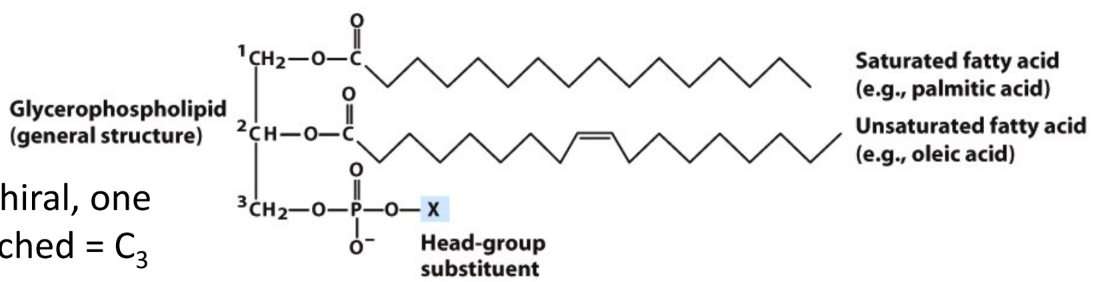
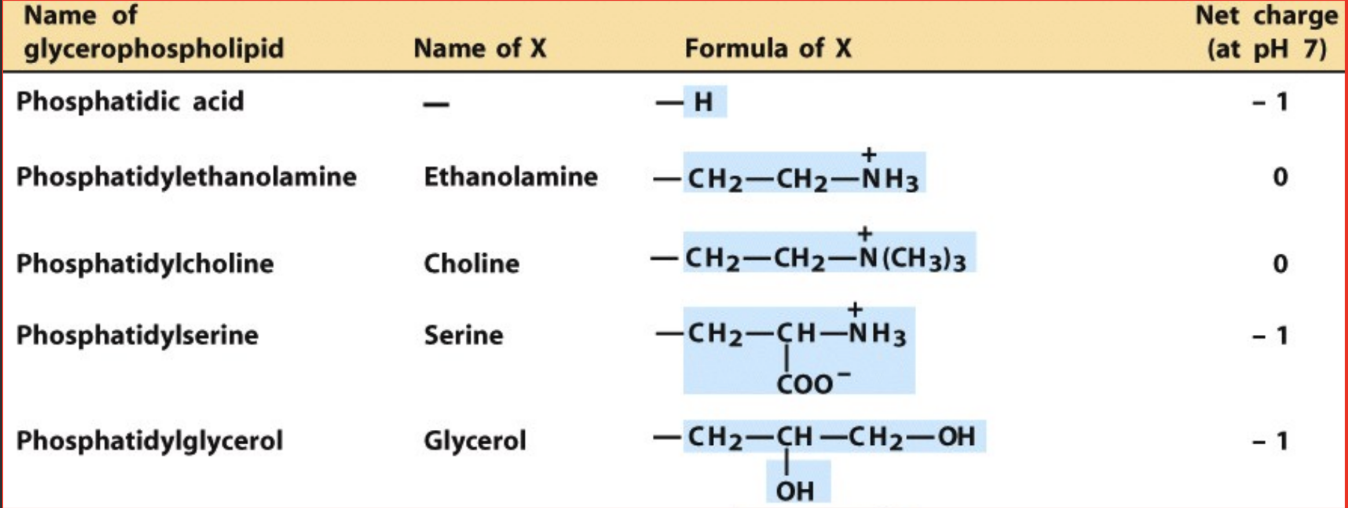
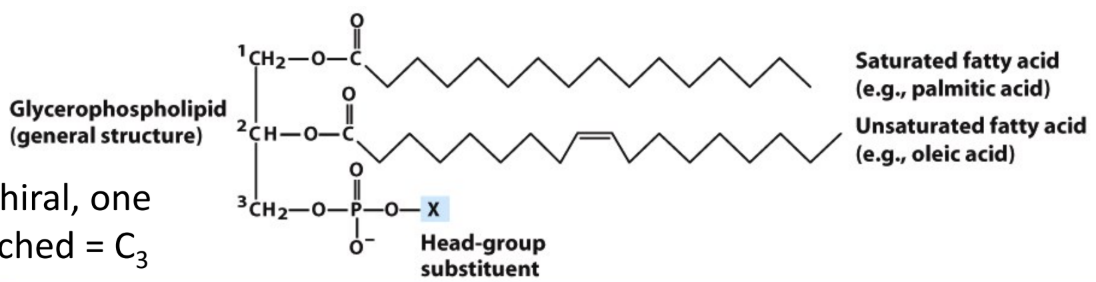
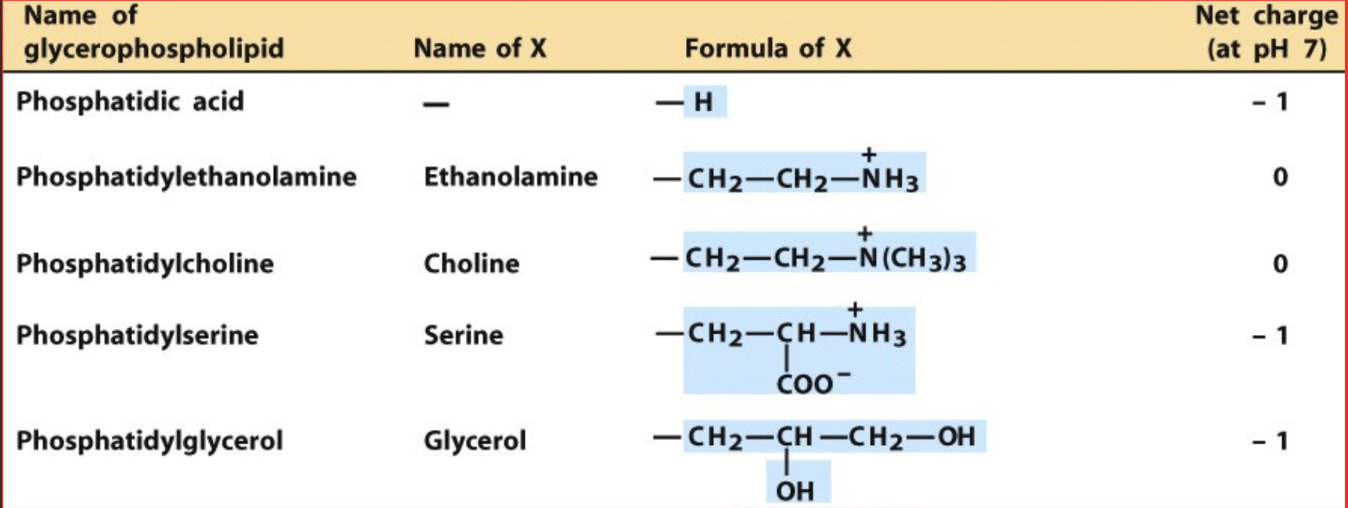
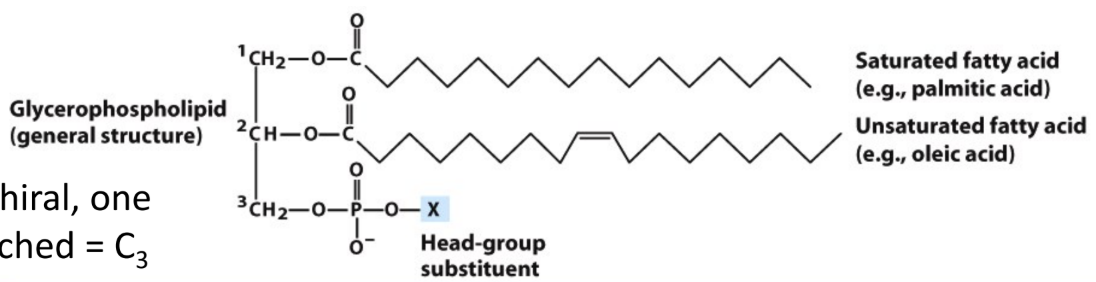
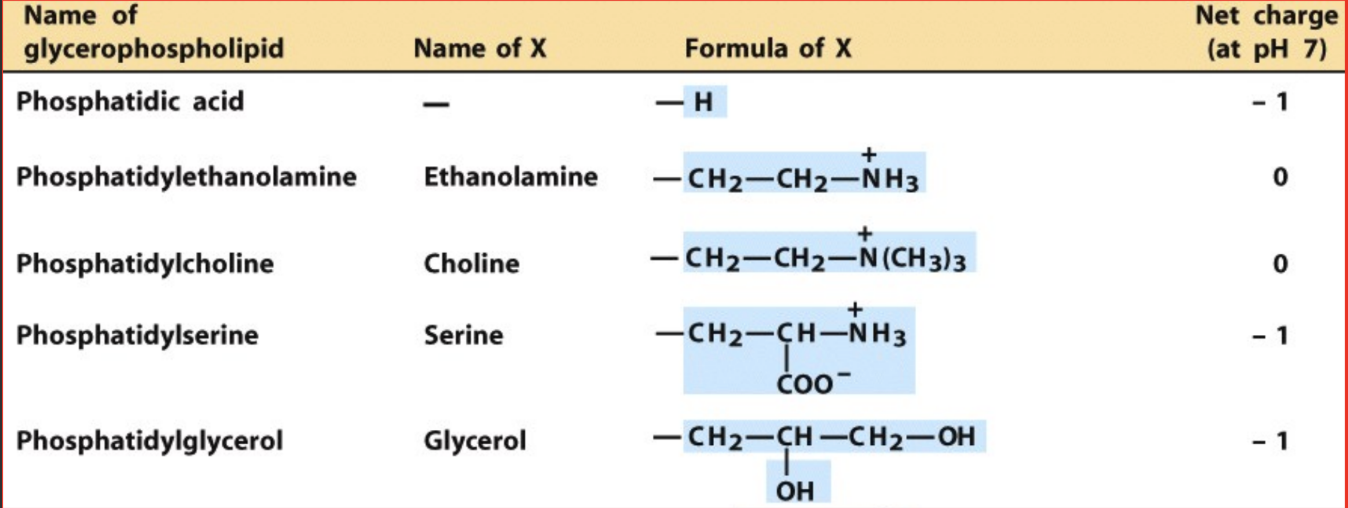
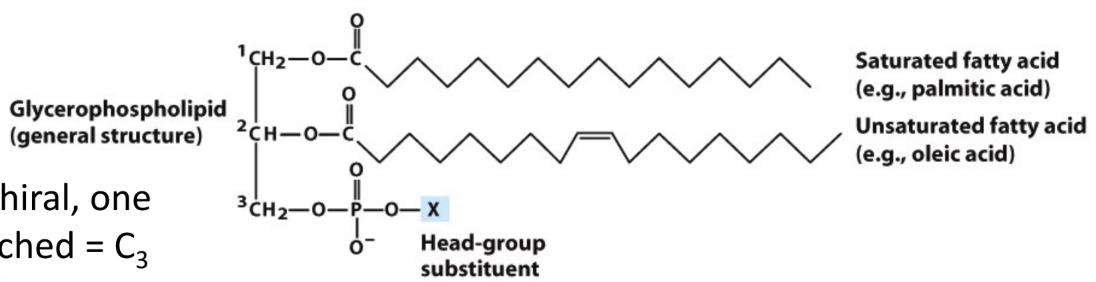
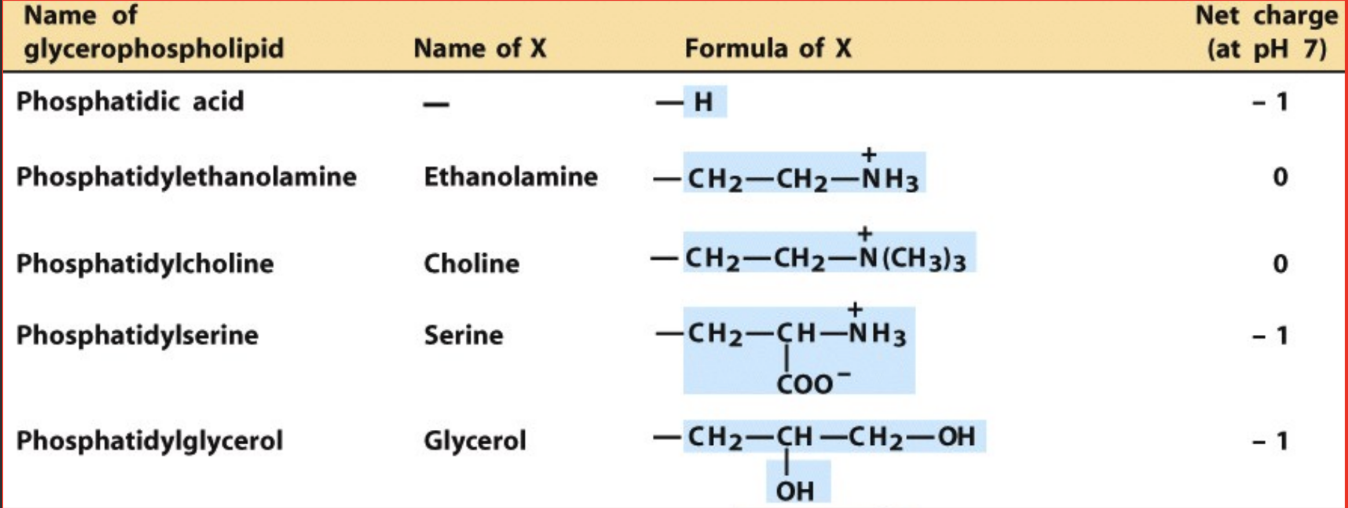
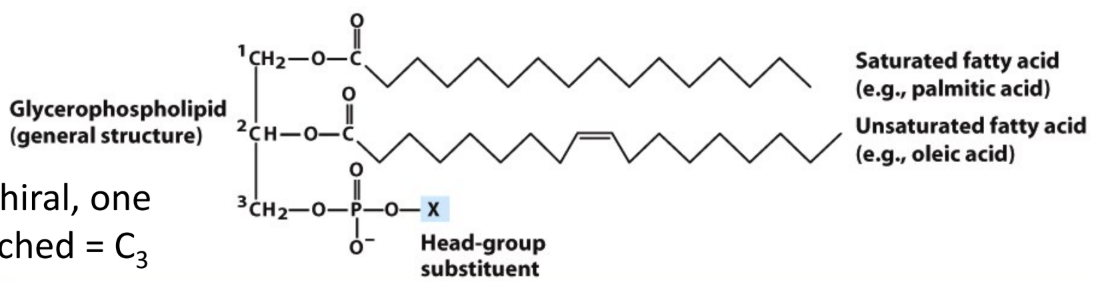
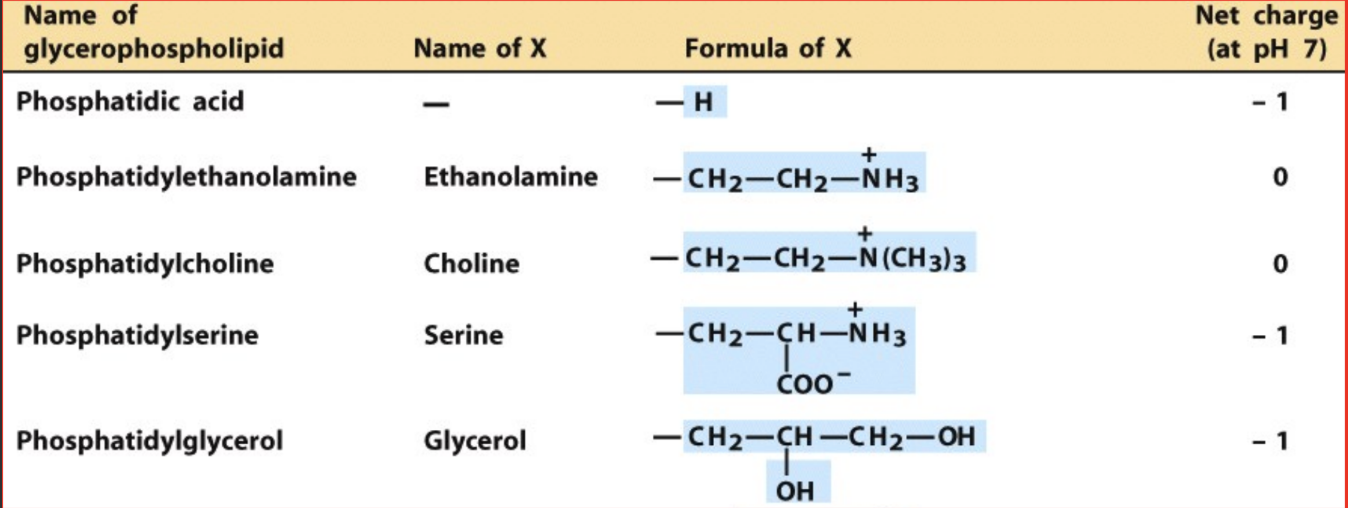
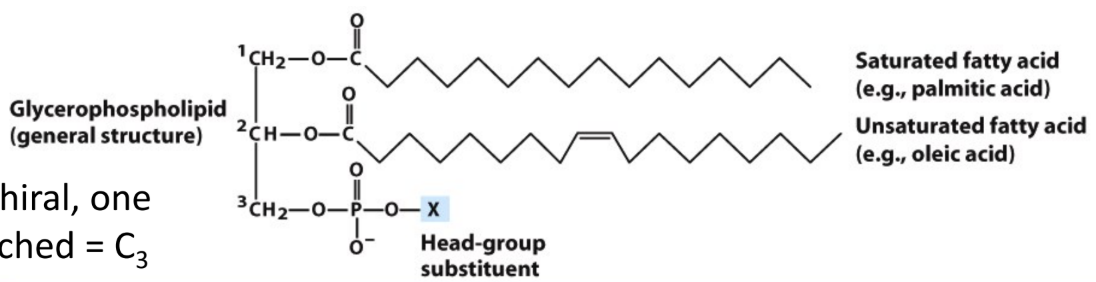
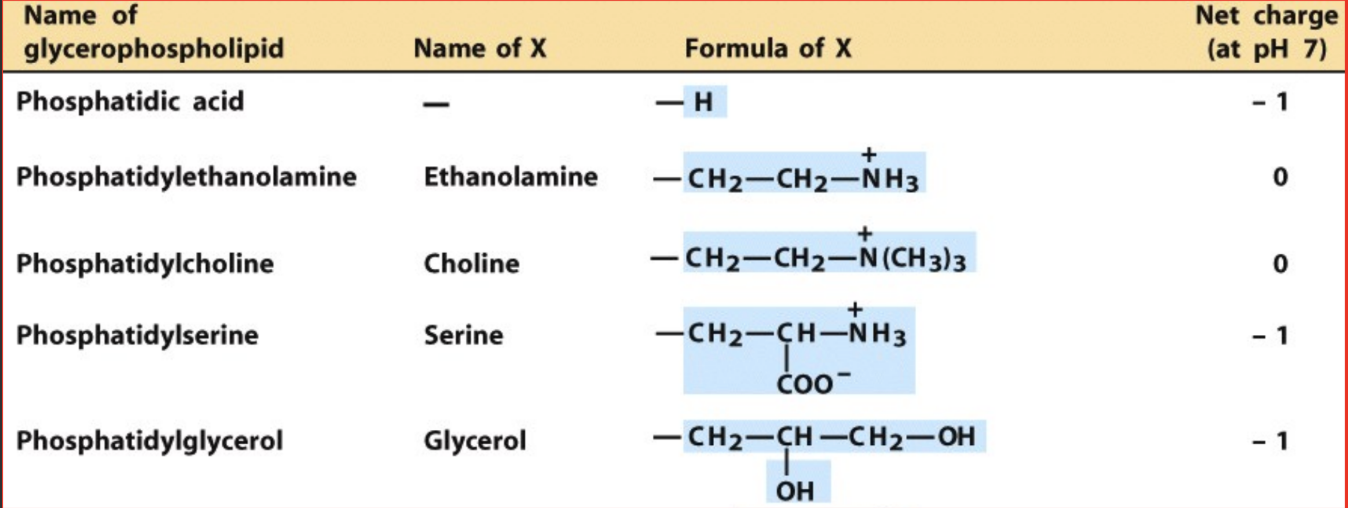
Glycerophospholipids (Head Groups & Charge) and Fatty Acids (Naming System)

0.0(0)
Studied by 0 people
call kaiCall Kai
learnLearn
examPractice Test
spaced repetitionSpaced Repetition
heart puzzleMatch
flashcardsFlashcards
GameKnowt Play
Card Sorting

1/37

encourage image

There's no tags or description

Looks like no tags are added yet.

Last updated 5:28 AM on 4/16/26
Name
Mastery
Learn
Test
Matching
Spaced
Call with Kai

No analytics yet

Send a link to your students to track their progress

38 Terms

1
New cards
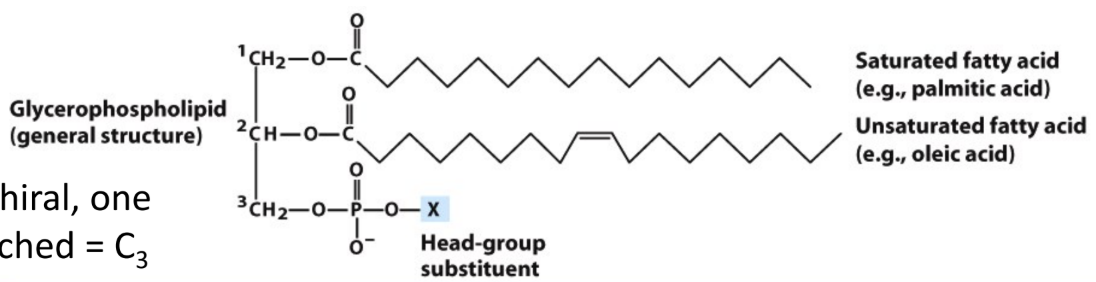
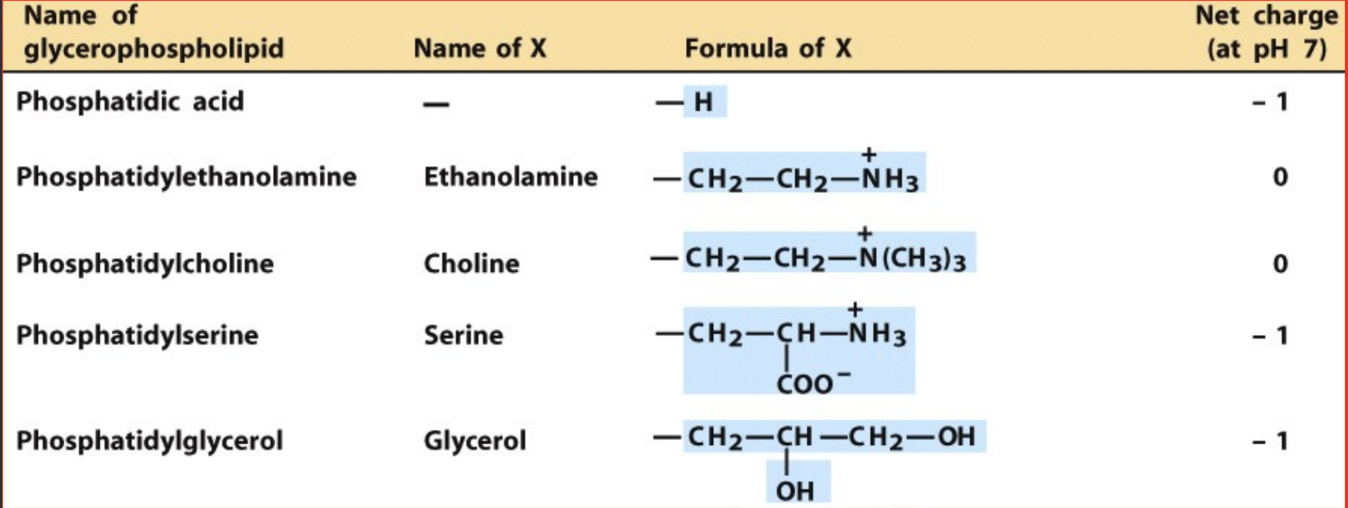
<p>What is the simplest glycerophospholipid (no head group)?</p>

What is the simplest glycerophospholipid (no head group)?

  • Phosphatidic acid

  • X = H

  • Net charge at pH 7 = -1

<ul><li><p><strong>Phosphatidic acid</strong></p></li><li><p>X = <strong>H</strong></p></li><li><p>Net charge at pH 7 = <strong>-1</strong></p></li></ul><p></p>
2
New cards
<p>What head group is in phosphatidylethanolamine (PE)?</p>

What head group is in phosphatidylethanolamine (PE)?

  • Ethanolamine

  • Structure: —CH2—CH2+NH3

  • Net charge at pH 7 = 0

<ul><li><p><strong>Ethanolamine</strong></p></li><li><p>Structure: <strong>—CH<sub>2</sub>—CH<sub>2</sub>—<sup>+</sup>NH<sub>3</sub></strong></p></li><li><p>Net charge at pH 7 = <strong>0</strong></p></li></ul><p></p>
3
New cards
<p>What head group is in phosphatidylcholine (PC)?</p>

What head group is in phosphatidylcholine (PC)?

  • Choline

  • Structure: —CH2—CH2—N+(CH3)3

  • Net charge at pH 7 = 0

<ul><li><p><strong>Choline</strong></p></li><li><p>Structure: <strong>—CH<sub>2</sub>—CH<sub>2</sub>—N<sup>+</sup>(CH<sub>3</sub>)<sub>3</sub></strong></p></li><li><p>Net charge at pH 7 = <strong>0</strong></p></li></ul><p></p>
4
New cards
<p>What head group is in phosphatidylserine (PS)?</p>

What head group is in phosphatidylserine (PS)?

  • Serine

  • Has +NH3 and COO-

  • Net charge at pH 7 = -1

<ul><li><p><strong>Serine</strong></p></li><li><p>Has<strong> <sup>+</sup>NH<sub>3</sub> </strong>and<strong> COO<sup>-</sup></strong></p></li><li><p>Net charge at pH 7 =<strong> -1</strong></p></li></ul><p></p>
5
New cards
<p>What head group is in phosphatidylglycerol (PG)?</p>

What head group is in phosphatidylglycerol (PG)?

  • Glycerol

  • Has two —OH groups

  • Net charge at pH 7 = -1

<ul><li><p><strong>Glycerol</strong></p></li><li><p>Has two<strong> —OH </strong>groups</p></li><li><p>Net charge at pH 7 =<strong> -1</strong></p></li></ul><p></p>
6
New cards
<p>Which glycerophospholipids are neutral at pH 7?</p>

Which glycerophospholipids are neutral at pH 7?

  • Phosphatidylcholine (PC)

  • Phosphatidylethanolamine (PE)

<ul><li><p><strong>Phosphatidylcholine</strong> (PC) </p></li><li><p><strong>Phosphatidylethanolamine</strong> (PE)</p></li></ul><p></p>
7
New cards
<p>Which glycerophospholipids are negatively charged at pH 7?</p>

Which glycerophospholipids are negatively charged at pH 7?

  • Phosphatidic acid

  • Phosphatidylserine

  • Phosphatidylglycerol

<ul><li><p><strong>Phosphatidic acid</strong></p></li><li><p><strong>Phosphatidylserine</strong></p></li><li><p><strong>Phosphatidylglycerol</strong></p></li></ul><p></p>
8
New cards
<p>What is the master rule for glycerophospholipid charge?</p>

What is the master rule for glycerophospholipid charge?

  • Phosphate contributes -1

  • Adding a +1 amine can make the molecule neutral

  • An extra COO- gives more negative charge
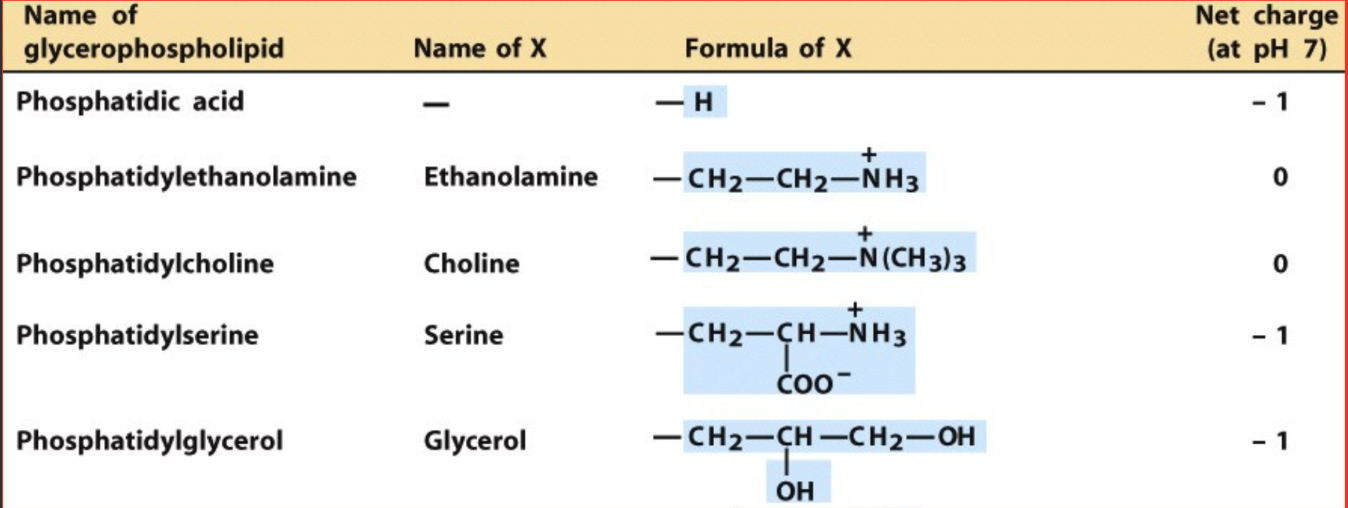
<ul><li><p><strong>Phosphate contributes -1</strong></p></li><li><p>Adding a <strong>+1 amine</strong> can make the molecule <strong>neutral</strong></p></li><li><p>An extra <strong>COO- </strong>gives <strong>more negative</strong> charge</p></li></ul><p></p>
9
New cards
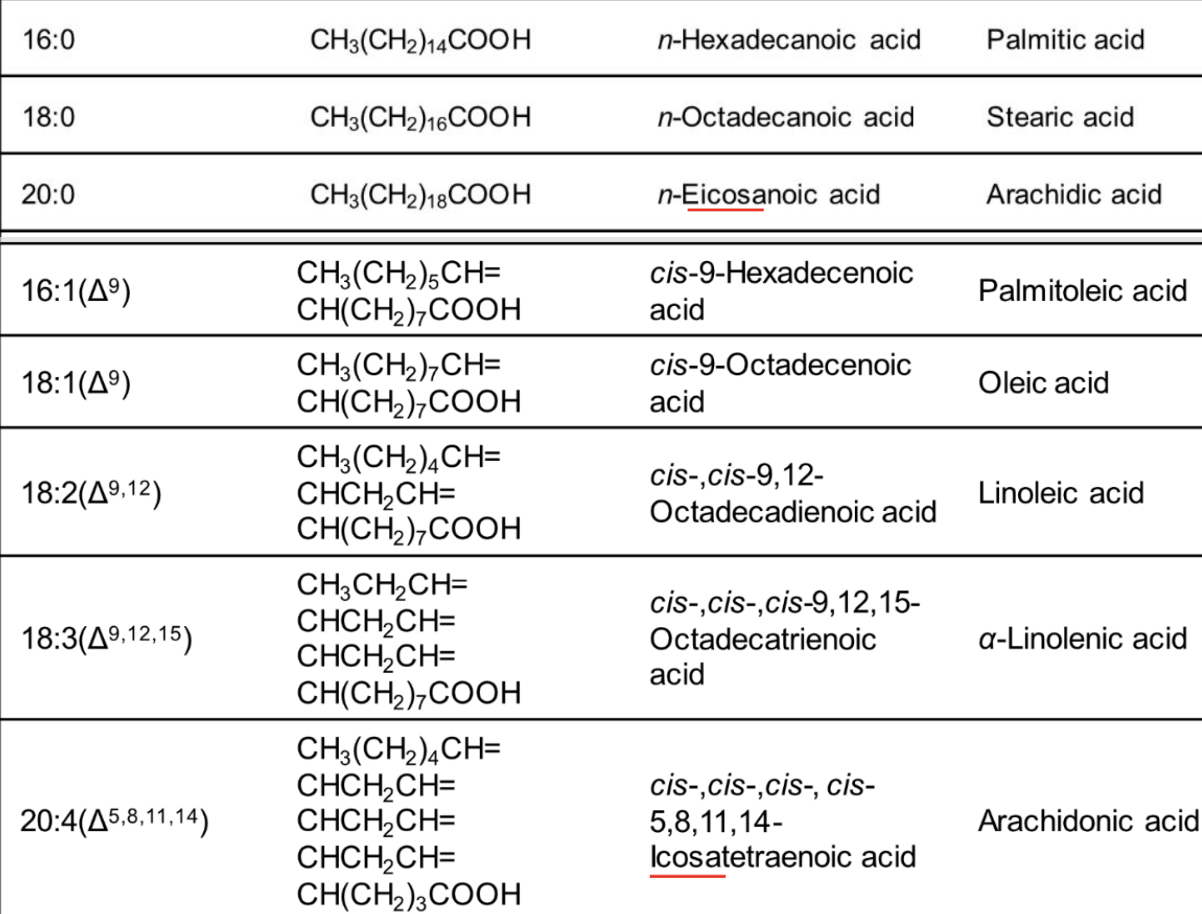
<p>What does 16:0 mean?</p>

What does 16:0 mean?

  • 16 carbons and 0 double bonds

  • Saturated fatty acid

10
New cards
<p>What does 18:1 (Δ9) mean?</p>

What does 18:1 (Δ9) mean?

  • 18 carbons, 1 double bond, with the double bond at C9 from the carboxyl end

11
New cards
<p>What does Δ (delta) indicate in fatty acid notation?</p>

What does Δ (delta) indicate in fatty acid notation?

The position of the double bond counted from the carboxyl (COOH) end

12
New cards
<p>What is the general formula for a saturated fatty acid?</p>

What is the general formula for a saturated fatty acid?

CH3—(CH2)n—COOH

13
New cards
<p>What is the common and systematic name for 16:0?</p>

What is the common and systematic name for 16:0?

  • Common: Palmitic acid

  • Systematic: n-Hexadecanoic acid

14
New cards
<p>What is the common and systematic name for 18:0?</p>

What is the common and systematic name for 18:0?

  • Common: Stearic acid

  • Systematic: n-Octadecanoic acid

15
New cards
<p>What is the common and systematic name for 20:0?</p>

What is the common and systematic name for 20:0?

  • Common: Arachidic acid

  • Systematic: Eicosanoic acid

16
New cards
<p>What is the common and systematic name for 16:1 (Δ9)?</p>

What is the common and systematic name for 16:1 (Δ9)?

  • Common: Palmitoleic acid

  • Systematic: Cis-9-hexadecenoic acid

17
New cards
<p>What is the common and systematic name for 18:1 (Δ9)?</p>

What is the common and systematic name for 18:1 (Δ9)?

Common: Oleic acid

Systematic: Cis-9-octadecenoic acid

18
New cards
<p>What is the common and systematic name for 18:2 (Δ9,12)?</p>

What is the common and systematic name for 18:2 (Δ9,12)?

  • Common: Linoleic acid

  • Systematic: Cis-,cis-9,12-Octadecadienoic

19
New cards
<p>What is the common and systematic name for 18:3 (Δ9,12,15)?</p>

What is the common and systematic name for 18:3 (Δ9,12,15)?

  • Common: Alpha-linolenic acid

  • Systematic: Cis-,cis-,cis-9,12,15-Octadecatrienoic

20
New cards
<p>What is the common and systematic name for 20:4 (Δ5,8,11,14)?</p>

What is the common and systematic name for 20:4 (Δ5,8,11,14)?

  • Common: Arachidonic acid

  • Systematic: Cis-,cis-,cis-,cis-5,8,11,14-Icosatetraenoic acid

21
New cards
<p>What is the pattern for 18-carbon unsaturated fatty acids?</p>

What is the pattern for 18-carbon unsaturated fatty acids?

  • 18:1 = oleic acid

  • 18:2 = linoleic acid

  • 18:3 = alpha-linolenic acid

22
New cards

What does cis mean in fatty acids?

The hydrogens are on the same side of the double bond, causing a kink

23
New cards

What does n- mean in names like n-octadecanoic acid?

Normal, unbranched chain

24
New cards

What do eicosa and icosa mean?

Both mean 20 carbons

25
New cards

What are the must-memorize fatty acids from this slide?

16:0 palmitic; 18:0 stearic; 16:1 palmitoleic; 18:1 oleic; 18:2 linoleic; 18:3 alpha-linolenic; 20:4 arachidonic; 20:0 arachidic

26
New cards

Which phospholipids are neutral and which are negative?

Neutral: PC and PE; Negative: phosphatidic acid, PS, PG

27
New cards

What is the head group in phosphatidic acid?

No additional head group; X = H

28
New cards

Why is phosphatidylserine negatively charged at pH 7?

It contains phosphate (-1) and an extra carboxylate (COO-) balanced partly by NH3+, giving net -1

29
New cards

Why are phosphatidylcholine and phosphatidylethanolamine neutral at pH 7?

Their positive amine balances the negative phosphate, giving net 0

30
New cards

What is special about choline compared with ethanolamine?

Choline has a quaternary ammonium group, N+(CH3)3, with a permanent positive charge

31
New cards

What is special about glycerol as a phospholipid head group?

Glycerol has hydroxyl groups and does not add a positive charge, so phosphatidylglycerol remains net -1

32
New cards

How do you interpret fatty acid notation X:Y?

X = number of carbons; Y = number of double bonds

33
New cards

How do you interpret 20:4 (Δ5,8,11,14)?

20 carbons and 4 double bonds at carbons 5, 8, 11, and 14 from the carboxyl end

34
New cards

What is the systematic name pattern for a saturated 16-carbon fatty acid?

Hexadecanoic acid

35
New cards

What is the systematic name pattern for a saturated 18-carbon fatty acid?

Octadecanoic acid

36
New cards

What is the systematic name pattern for a saturated 20-carbon fatty acid?

Eicosanoic acid

37
New cards

What is the systematic name for oleic acid?

cis-9-octadecenoic acid

38
New cards

What is the systematic name for palmitoleic acid?

cis-9-hexadecenoic acid