All of Chemistry
 Call Kai
 Learn
Learn Practice Test
 Spaced Repetition
 Match
Match Flashcards
 Knowt Play
1/228

There's no tags or description
Looks like no tags are added yet.
Name | Mastery | Learn | Test | Matching | Spaced | Call with Kai | Chat |
|---|
No analytics yet
Send a link to your students to track their progress
229 Terms
Formula for Sulfuric acid and Hydrochloric acid
H2SO4
HCl
Formula for Nitric acid and Phosphoric acid
HNO3
H3PO4
Acid + Base-->
Salt + Water
What is an acid
A substance that acts as a proton donor in a solution
What is a base
A substance that acts a a proton reciever in a solution
What is a neutralisation reaction?
The reaction between an acid and a base which always involves a proton transfer from the acid to the base
Ionic Dissociation of HCl
HCl--> H+ + Cl-
What is the ionic equation for neutralisation
H+ (aq) + OH- (aq) --> H2O (l)
In Ionic equations which substances can be split into sepeate ions and which can be cancelled out.
Every substance that is dissolved in water (aq)
Spectator ions can be cancelled out where the ions appear on both sides
Steps to produce an insoluble salt from two soluble salts
Mix- the two soluble salts
Filter- with filter paper
Wash- with distilled water
Dry- By patting dry with filter paper or leaving in a dry oven
Why is the wash step necessary in insoluble salt prep?
Why use distilled not tap water?
Removes Soluble Impurities
Tap contains dissolved ions, distilled prevents unwanted contamination, and side reactions
What colour does Universal indicator turn in an acid, neutral and base solution
Red
Green
Purple
What colour does Litmus turn in an acid, neutral and base solution
Acid: Red
Neutral: Purple
Base: Blue
What colour does Methyl Orange turn in an acid, neutral and base solution
Red
Orange
Yellow
What colour does Phenolphthalein turn in an acid, neutral and base solution
Colourless
Pale pink
Deep pink
What are alkalis
Bases that are soluble in water
experiment for a soluble salt
Heat- the acid
Excess- add the insoluble reactant in excess
Filter- To remove the excess
Evaporate- 1/2 solution
Dry- Pat dry with filter paper/ warm dry oven
Metal+Acid-->
Salt+hydrogen
Metal+Carbonate-->
Salt + Carbon Dioxide + Water
Metal + Hydrogencarbonate -->
Salt + Carbon dioxide + Water
Can Hydroxides oxides and ammonia act as bases
Yes
What is a mole?
Amount of a substance
What is Avogadro's number
6.022 x 10^23
What is relative atomic mass (Ar)
The mass of an atom of an element when compared to 1/12 of the mass of a carbon-12 atom. No units
What is relative formula mass (Mr)
The mass of a molecule or compount when compared to 1/12 the mass of a carbon-12 atom. No units
What is Molar Mass (M)
The mass of one mole of a substance. Units g/mol
How to calculate the Molar Mass of H2O
H20= 1*2+16=18g/mol
Formula for Moles

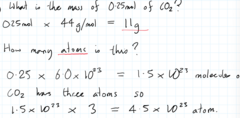
How to calculate how many atoms of 1mol of CO2
Describe the experiment to determine the empirical formula of copper(II) oxide via reduction
Weigh: Record mass of empty test tube with hole + bung.
Add & Weigh: Add copper(II) oxide, re-weigh to find initial mass of CuO
Purge & Ignite: Pass methane gas to flush out air; light the excess methane emerging from the hole.
Heat: Heat strongly until black powder turns fully pink/brown (copper metal).
Cool: Turn off heat, keep methane flowing until cool.
Final Weight: Re-weigh tube, bung, and remaining copper.
What physical observation indicates that copper(II) oxide has been reduced?
Black solid (CuO) turns to Orange (Cu)
Why is it necessary to continue the flow of methane until the apparatus is cool?
To cool the tube and to stop O2 getting back into the test tube, preventing the formation of CuO
Why might this experiment result in a formula with:
a) Too much oxygen?
b) Too much copper ?
Too much O: Incomplete reduction (black CuO) wasn't heated long enough to fully react).
b) Too much Cu: Copper solid blown out of the tube.
What is empirical formula
the simplest whole number ration between the number of atoms of each element in its chemical formula
What are the two ways you can calculate empirical formula
With masses of each element of percentages of each element
If the empirical formula is not a whole number ratio what must you do
Find a multiple that makes both numbers whole numbers
Describe the experiment to find the empirical formula of magnesium oxide via combustion.
Weigh: Record the mass of a crucible with its lid.
Prep & Weigh: Clean 10g magnesium ribbon, coil it into the crucible, and re-weigh with the lid.
Heat & Lift: Heat strongly with a roaring flame. Periodically lift the lid briefly to allow oxygen in while preventing white smoke from escaping.
Constant Mass: Heat to constant mass, then allow to cool.
Final Weight: Re-weigh mass of crucible
What is observed when magnesium burns, and what key safety precaution must be taken during finding the EP for MgO?
White gas
Red Glow
Why is it necessary to lift the lid of the crucible when heating MgO for the EP experiment
So Oxygen can get in
Why do we wish to prevent the white smoke leaving the crucible?
To try not to let any MgO out, as losing it leads to a lower mass skewing the EP
Explain why the MgO combustion experiment rarely produces the right EP, why may it produce a formula with too much Mg
As the lid wasn't lifted for long enough
Stopped heating too early
Experiment to calculate the formula of hydrated Copper Sulfate
Weigh: Record mass of empty crucible or evaporating dish.
Add & Weigh: Add blue hydrated copper sulfate crystals, re-weigh to find mass of hydrate.
Heat Gently: Heat gently with a Bunsen burner until the blue crystals turn completely into white anhydrous powder.
Constant Mass: Cool and re-weigh; repeat heating and weighing until mass remains constant.
Final Mass: Record the final mass of the crucible + white anhydrous Copper Sulfate
What is the molecular formula
The Real Chemical formula of a substance
How to convert EF to MF
Then times the empirical formula compound by the multiple

What two pieces of info are needed to calculate water of hydration
The mass of the anhydrous salt
The mass of the water
What is the formula for % by mass

steps to find mass of a substance from the mass of another substance
Balanced equation
Convert mass to moles of known mass
Convert between moles using the molar ratio in the balanced equation
Convert moles to mass
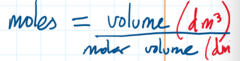
Formula for moles of a gas
How many cm3 if one dm3
1000
Formula for percentage yield

Formula for Molar Concentration

What is the molar volume of a gas
24 dm3 or 24000cm3
How are elements arranged in the periodic table
In order of atomic number
What are the vertical columns on the periodic table called?
Groups.
What is common about elements in the same group
They have the same number of electrons in their outer shell, so often react in a similar way.
What re the horizontal rows on the periodic table called
Periods
What does the period number indicate
The number of shells of electrons
Observations, inferences and other info
Lithium reacting with Water
What colour does UI go
Fizzing- Gas produced- H2
Moves on surface- Density less than water
Metal gets smaller- Reacting away
Other info: UI goes purple- OH- ions in water- LiOH formed
Observations, inferences and other info
Sodium reacting with Water
What colour does UI go
Fizzing- Gas produced- H2
Moves on surface- Density less than water
Metal gets smaller- Reacting away
Melts into a ball- low melting point
Other info: UI goes purple- But makes NaOH
Observations, inferences and other info
Potassium reacting with Water
What colour does UI go
Fizzing- Gas produced- H2
Moves on surface- Density less than water
Metal gets smaller- Reacting away
Melts into a ball- low melting point
Lilac flame- H2 is burning
Other info: Ui goes purple-
How are the atoms in Group 1 metals bonded
Atoms lose their outer electron
Regular lattice of positive ions held together by delocalised electrons
Hardness and strength
Melting points
Density
Of G1 metals
Soft/Weak
Low
Low
Reactivity
Formation of ions
Of G1 metals
High
+1
What is the state of all the halogens at room temp
Flourine: Gas
Chlorine: Gas
Bromine: Liquid
Iodine: Solid
Astetane:Solid
What is the colour of Flourine normally and in water
Pale yellow
In water: Colourless
What is the colour of Chlorine normally and in water
Yellowish green
In Water: Very pale yellow
What is the colour of Bromine normally and in water
Red-brown
In water: Orange
What is the colour of Iodine normally and in water
Grey
In water: Brown
What is the colour of Ascetene
Black
How to determine the order of reactivity using displacement reactions with halogens
A more reactive halogen will displace a less reactive halogen from an aqueous solution of its halide
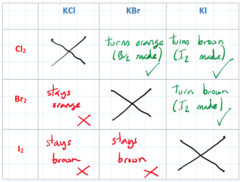
How does the reaction of Chlorine with Potassium bromide and potassium iodide show that Chlorine is more reactive
with Bromide the solution turns orange so Br2 is made (displaced)
With Iodide the solution turns brown so I2 made (displaced)
Trend in reactivity descending group 1 and 7
1: Increases
7: Decreases
Explain the trend in reactivity descending group 1
Reactivity increases
Atoms get bigger descending the group
Outer electron becomes further away from the nucleus
The force of attration is weaker between the outermost electron and the nucleus
Becomes easier to loce the outer electron
Explain the trend in reactivity descending group 7
Reactivity decreases
Atoms get bigger
Outer electron is further away from the nucleus
Force of attraction is weaker between outermost electrons and nucleus
Harder to gain an electron
Common uses of Halogens
To kill bacteria
Large Scale diinfection of water sources (chlorine)
Iodine is antiseptic
Key properties of Noble Gases
They exist as single atoms not molecules
Virtually no bonding between the atoms of a noble gas so they have v low melting and boiling points
What happens to the strength between the atoms as the atoms get bigger in the noble gases
Interatomic forces increase, due to increasing number of electrons.
So melting and boiling points increase descending the group
How reactive are the noble gases and why
Very unreactive as they already contain a full outer-shell of electrons so they don't need to gain, lose, or share electrons in chemical reactions
General physical properties for transition metals
Shiny, grey
High Melting Point
Strong
Hard
High malleability
Important uses of transition metals
As catalysts to speed up the rate of chemical reactions in industrial processes.
Used to make alloys
Where is the Non-Metal zig zag line
Above Al
What is an allotrope
Different forms of the same element dur to different bonding and structure
What is a covalent bond
The electrostatic forces of attraction between a shared pair of electrons and the atoms nuclei
How strong are Covalent bonds
Very strong
Diamond
Structure
Bonding
Key property
Structure: giant covalent lattice
Each C connected to 4 others
Bonding: Covalent in 3D- V strong
Key Property: Very hard and strong, high melting point
3D network of v strong bonds requires lots of energy to break
Graphite
Structure
Bonding
Key property
Giant covalnet lattice
Each C atom connected to 3 others
Bonding: Covalent bonds in 2D layers. Weaker bonding between layers
Key property: can conduct electricity- as has delocalised electrons that can move and carry charge
Soft- layers can slide over each other
C60
Structure
Bonding
Key property
Structure: Molecular
Bonding: Covalent bonds in each molecule
Weak intermolecular forces between molecules.
Key property: Low melting point: weak intermolecular forces require little energy to break
Experiment for thermal decomposition of limestone and observations
Heating marble chips CaCO3 strongly to break them down into calcium oxide and carbon dioxide gas
Marble chip glows with bright white light (limelight)
Reaction of Calcium Oxide with Water and observations
dding water to quicklime CaO to produce calcium hydroxide Ca(OH)2, creating an alkaline solution.
Steam produced (highly exothermic); Universal Indicator turns purple (basic)
Limewater and Carbon Dioxide Test
Bubbling carbon dioxide gas CO2 through limewater Ca(OH)2 to form an insoluble solid precipitate.
Limewater turns cloudy/milky
What do increasing amounts of CO2 in the atmosphere may contribute to
Climate Change (as it is a greenhouse gas)
Green powder CuCO3 turns into a black powder CuO; gas produced turns limewater cloudy CO2.
What is a hydrocarbon
A molecule containing only carbon and hydrogen atoms
If an alkane molecule gets lager and heavier what happens to the melting and boiling point
Increases. As the intermolecular forces between the molecules become stronger as the molecules become larger so more energy is required to separate the molecules
Are larger lakanes more or less volatile than smaller ones
Less volatile
General formula for the alkanes
CnH2n+2
What is an isomer
A compound with the same molecular formula but a different structural formula
Properties of a homologous series
Same general formula
Similar chemical properties (react similarly)
Each member differes from the next by a CH2 unit
Same functional group
Trend in physical properties eg boiling points
What differens alkanes from alkenes
Alkenes have a double bond
General formula for the alkenes
CnH2n