Heart Failures | NURS230
 Call Kai
 Learn
Learn Practice Test
 Spaced Repetition
 Match
Match Flashcards
 Knowt Play
1/97

There's no tags or description
Looks like no tags are added yet.
Name | Mastery | Learn | Test | Matching | Spaced | Call with Kai | Chat |
|---|
No analytics yet
Send a link to your students to track their progress
98 Terms
what does an elevated BNP or NT-proBNP level indicate in heart failure?
Ventricular stretching and fluid overload → helps confirm HF and assess its severity as the higher the level, the worse HF is
BNP - normal level should be below 100 pg/mL
NT-proBNP - normal level should be below 300 pg/mL but can increase normally with age so that should be taken in mine when assessing patient and reviewing their chart
what does an echocardiogram measure in a heart failure patient?
ejection fraction (EF), ventricular wall motion, and overall cardiac function
what heart conditions related to heart failure can be detected by ECG?
arrhythmias
myocardial ischemia or infarction
left ventricular hypertrophy
what is the role of cardiac MRI or CT in heart failure patient?
provides detailed imaging of cardiac structure and function, helps identify scarring and fibrosis
why might a stress test or cardiac catherization be performed in suspected heart failure
to evaulate for ischemic heart disease as a potential underlying cause of H
what lab values are important when assesing a patient with heart failure?
BUN/creatinine: assess renal function - elevated levels = worsening kidney function
electrolytes: detect imbalances (especially K+, Na+)
liver function tests (LFTs): evaluate hepatic congestion
CBC: detect anemia or infection
thyroid levels: identify thyroid disorders contributing to HF
what are the two factors the HF treatment should reduce to reduce the overall cardiac workload presented in HF?
preload
afterload
what nursing action helps reduce preload in a patient with HF and pulmonary congestion?
administer diuretics as ordered and position the patient in high Fowler’s to reduce venous return (preload) to the heart and improve oxygenation
why are ACE inhibitors prescribed for heart fialure, and what is the key nursing consideration?
they reduce afterload and prevent cardiac remodeling
monitor blood pressure and potassium
watch for dry cough or angioedema → the nurse should watch out for dry cough because it is a common side effects caused by the buildup of bradykinin, a substance that can cause airway to tighten
what is a priority nursing assessment before administering digoxin?
check the apical pulse for 1 full minutes
hold if HR less than 60 bpm
monitor for signs of toxicity, N/V, blurred vision, and yellow-green halos in the eyes
what early signs suggest worsening left-sides heart failure?
increasing, crackles, dyspnea, orthopnea, and pink frothy sputum (a sign of pulmonary edema emergency)
what assessment finding is most characteristic of right-sided heart failure?
systemic congestion → JVD, heptomegaly, ascites, and dependent edema
which assessment should the nurse perform daily to evaulate fluid balance?
daily weights - the most accurate indicator of fluid retention
a patient with heart failure has gained 3 lbs in 2 days - what should the nurse do first?
notify the provider as this may indicate fluid overload or worsening HF
what is the first nursing action when a heart failure patient develops acute shortness of breath and O2 sat of 88%?
place patient in high Fowler’s position and apply oxygen → administered prescribed medication → then notify the provider
what are the key side effects of ACE inhibitors taht require immediate attention?
angioedema
hypotension
hyperkalemia
facial or airway swelling
which electrolytes imbalance increases risk of digoxin toxicity?
hypokalemia as low potassium enahnces digoxin binding to myocardial tissues, increasing toxicity risk
what effects do beta-blockers have in chronic heart failure, and when should they be held?
reduce myocardial O2 demand and improve EF long-term - hold if HR is less than 50 bpm or BP less than 90/60 mmHg
what should the nurse teach about recognizing worsening heart failure?
report weight gain more than 2 lbs/day or more than 5 lbs/week, new edema, increased SOB, or fatigue
what dietary instructions should HF patients follow?
low sodium (less than or equal to 2g/day)
→ emphasizes fresh fruits, vegetables, and whole grains
possible fluid restriction (less than or equal to 2L/day)
avoid processed food, high-fat, and alcohol
read the label CAREFULLY
how should HFpatients monitor themselves at home?
weight daily at the same time, track symptoms, and take medications exactly as prescribed
why is it important for HF patients to receive flu and pneumococcal vaccines?
to prevent respiratory infections that can exacerbate heart failure symptoms due to increased inflammation which can increase stress on the heart
what should be included in discharge teaching about activity for a stable HF patient?
gradually increase activity, stop if dyspnea occurs, rest between activities, and enroll in cardiac rehab if available
what psychosocial issue is common among chronic HF patients, and how should nurses responses?
depression and anxiety - provide support, involve family, and refer to counseling or support groups
which heart failure patient should the nurse see first?
A. Crackles, pink frothy sputum, O₂ sat 86%
B. Mild pedal edema
C. Fatigue
D. Weight gain of 1 lb overnight
A. because pink frothy sputum is a respiratory emergency due to pulmonary edema → airway and oxygenation take PRECEDENCE!
an HF patient on digoxin reports seeing yellow halos around lights, what is the nurse’s next action?
hold digoxin and notify the provider
what is cardiac output (CO), and what is the normal range?
normal range = 4-8 L/min - reflects how much blood the heart pumps per minutes
what is preload in relation to cardiac function?
the volume of blood returning to the heart (end-diastolic volume) that stretches the ventricles before contraction
what is afterload?
the resistance the left ventricle must overcome to eject
a patient receiving IV furosemide for HF complains of dizziness and has BP 84/60. What should the nurse do first?
stop the infusion, place the patient supine, and notify the provider — may indicate excessive diuresis or hypovolemia.
what are the causes of left-sided heart failure?
long-term hypertension (increased afterload)
coronary artery disease or myocardial infarction
aortic or mitral valve disorder
cardiomyopathy
what are the key symptoms of left-sided heart failure?
pulmonary congestion/edema
dyspnea (difficulty breathing)
orthopnea (can’t breathe lying flat)
crackles in the lungs
pink frothy sputum (late sign - pulmonary edema)
tachypnea
cough
fatigue, weakness, decreased urinary output (more generalized symptoms due to lower perfusion)
what are the differences between systolic and diastolic left-side HF?
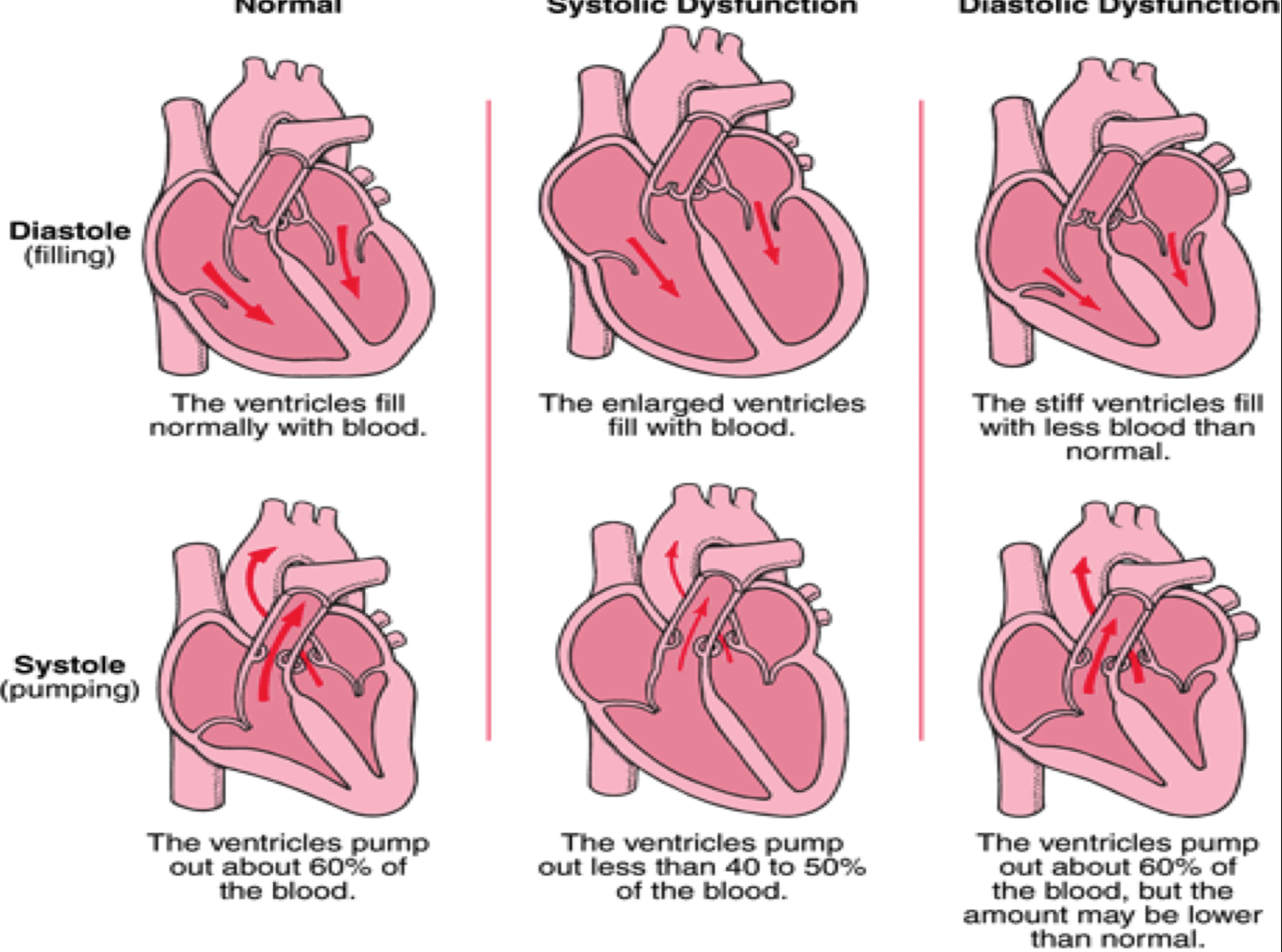
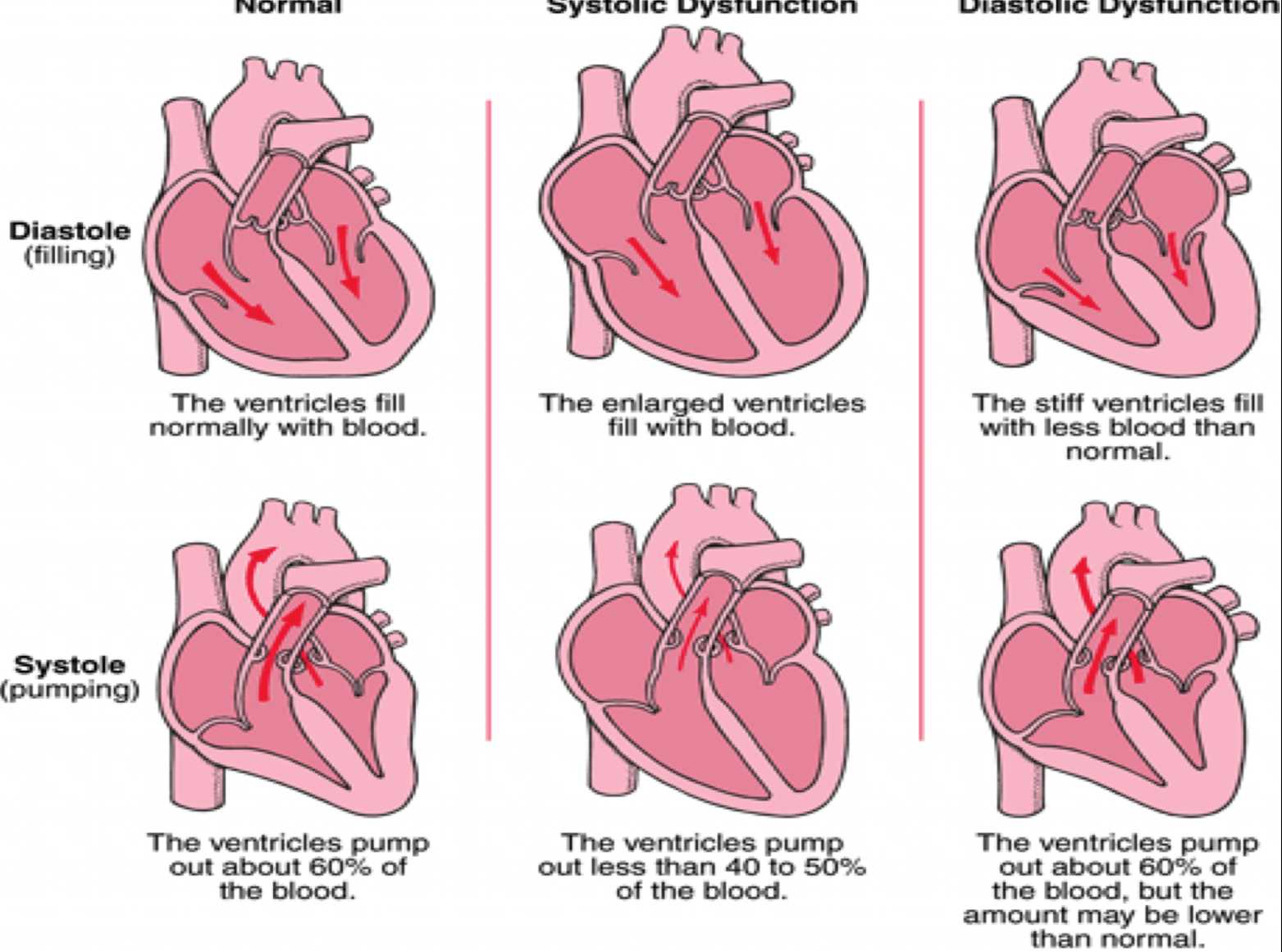
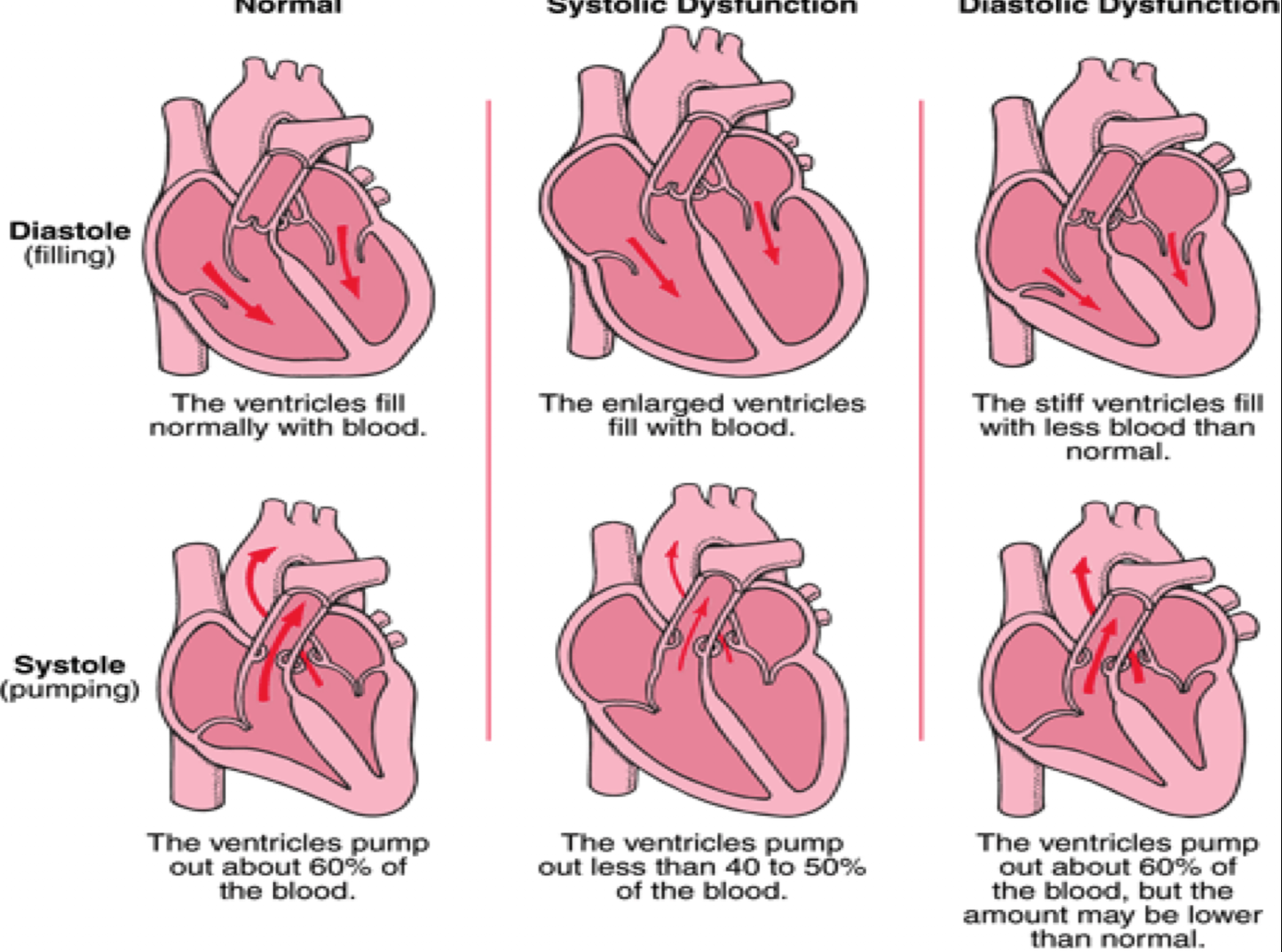
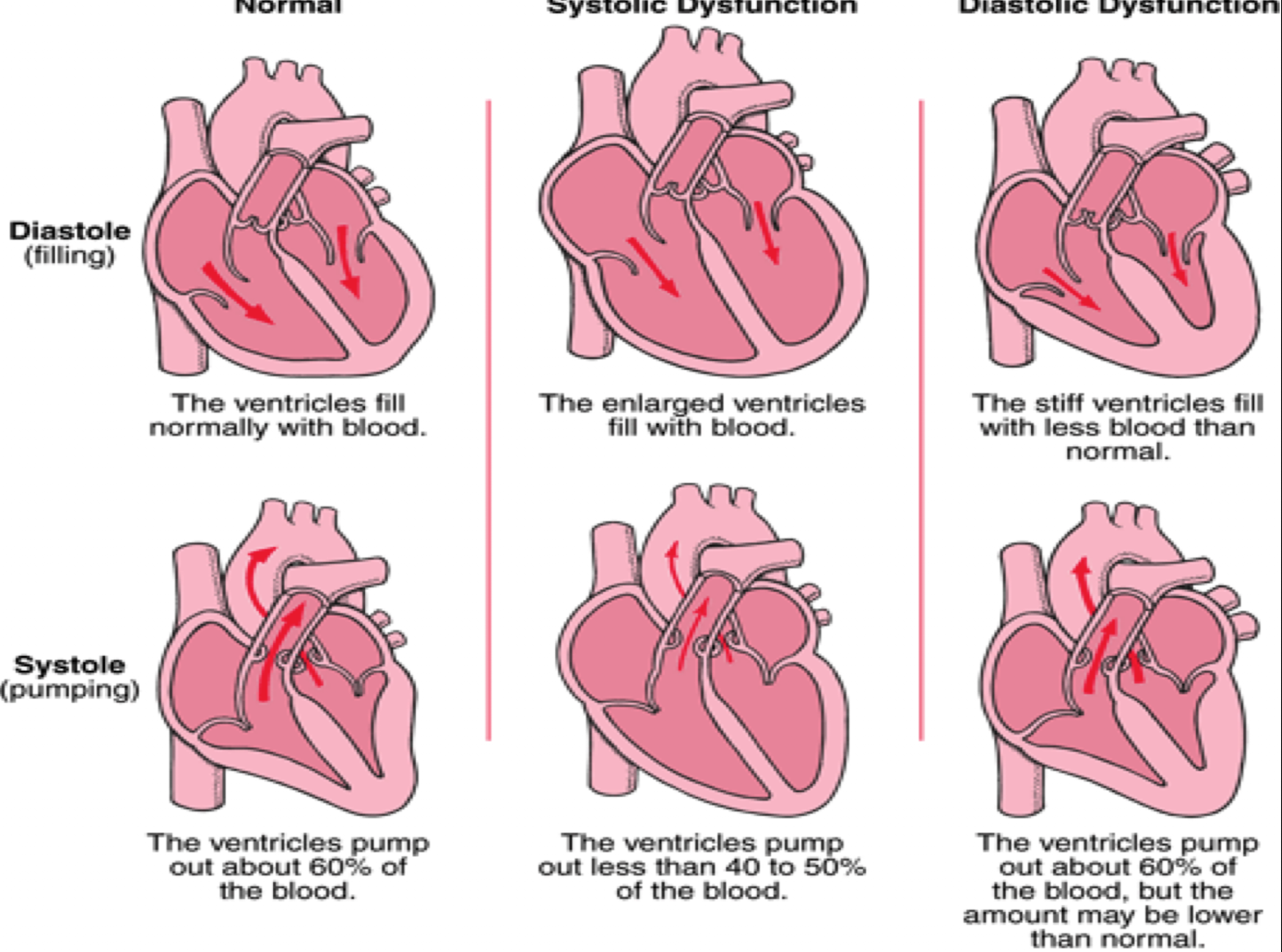
systolic
problems: heart can’t pump
decreased ejection fraction of less than 40%
the heart muscle is weak with thin wall
diastolic
problems: heart can’t fill
normal ejection fraction
the heart muscle is thick with stiff wall
what happens in right-sided heart failure?
right ventricles fails to pump blood into the lungs → blood backs up into the body and systemic veins
what are the causes of right-sides HF?
left-sided HF (most common cause as left side heart failure is much more common and often happen first before patient develop HF
pulmonary hypertension / COPD / pulmonary embolism because these conditions make it harder for the right ventricle to pump blood into the lungs which over time weakens the right side of the heart, leading to right-sided heart failure
right ventricular myocardial infarction which damages the heart tissues making it pump less efficiently
what are the key symptoms of right-sided heart failure?
peripheral edema
jugular vein distention (JVD)
ascites (fluid in the abdomen)
hepatomegaly (enlarged liver) → right upper quadrant pain
weight gain → increased abdominal girth
fatigue
weakness
what are the symptoms of worsening heart failure that patients should report immediately?
sudden weight gain (more than 2-3 lbs/day or more than 5 lbs/week)
increased swelling in legs/abdomen
shortness of breath at rest or lying down
new/worsening cough or pink frothy sputum
decreased urine output
what causes the preload to increase and what are the treatments available?
cause: fluid overload and renal failure
treatment: diuretics and nitrates
what causes the afterload to increased and what are the treatments?
cause: hypertension & vasoconstriction
treatment: ACEI, ARBs, and vasodilators
how do ACEI and ARBs help in HF?
Action: ↓Afterload, ↓BP, ↑CO by vasodilation
Examples:
ACEI: Lisinopril, Enalapril
ARB: Losartan, Valsartan
Side Effects: Dry cough (ACEI), hyperkalemia, hypotension, angioedema
Nursing: Check BP, K+ levels, renal function, avoid in pregnancy
why are beta blockers used in patients with heart failure?
to decrease the heart rate, which decreases the workload on the heart and improves the ejection fraction over time
examples: metoprolol, carvedilol
is calcium channel blocker a first line treatment for heart failure?
no!
how can diabetes causes heart failure?
damage to blood vessels: high blood sugar levels damage the lining of blood vessels, leading to atherosclerosis (plaque buildup) - this narrows and stiffen the arteries, reducing the blood flow to the heart
oxidative stress: diabetes causes an imbalance between free radicals and antioxidants , resulting in oxidative stress of the heart tissues
insulin resistance: the increased used of fatty acids for energy due to inability to effectively use glocuse lead to damaged heart muscles
high blood pressures
what are the common comorbidities with heart failure?
hypertension
diabetes
coronary artery disease
chronic kidney disease
chronic obstructive pulmonary disease
what are the three factors that affects cardiac output?
preload
afterload
contractility
true or false: too much stretching of the heart every time due to increased preload can and will cause the ventricle to lose its contractility, causing less blood to be pump since the strength of each contraction will be wimpier and wimpier
true
what determines left ventricular afterload?
systemic vascular resistance and aortic pressure
what determines right ventricular afterload?
pulmonary vascular resistance and pulmonary artery pressure
which ventricle normally faces higher afterload?
the left ventricle (systemic circulation = high pressure)
why is the right ventricle more sensitive to increased afterload?
it have thin wall
it pumps into low-pressure pulmonary circulation
it cannot adapt well to high resistance because its strength were not designed for high resistance
what happens to the RV when afteload suddenly increases?
rapid dilation
decreased stroke volume
reduced ejection fraction
possible acute right-sided heart failure
concentric hypertrophy if long-term
what happens when the LV with chronic increased afterload?
concentric hypetrophy (thicker heart muscle wall) if long-term
decreased stroke volume
reduced ejection fraction
possible acute right-sided heart failure
name the 3 causes of increased LV afterload…
systemic hypertension
aortic stenosis
decreased aortic compliance (aging)
name the 3 causes of increased RV afterload…
pulmonary hypertension
pulmonary embolism
hypoxia causing pulmonary vasoconstriction
how does ventricular interdependence affect afterload?
RV overload can push the septum into the LV, reducing LV filling and output and vice versa
what is a common compensation for increased LV afterload?
LV myocardial hypertrophy
what is a common result of sustained RV afterload increase?
RV dilation and failure (it cannot hypertrophy as efficiently as the LV
what are the key treatment goal for RV afterload?
reduced pulmonary vascular resistance (oxygenation, pulmonary vasodilators, avoid high PEEP)
what are the key treatment goal for LV afterload?
lower systemic vascular resistance (antihypertension, vasodilators)
what is inotropic in term of the heart?
force of contraction (contractility) - the strength or force of the heart’s contraction - higher inotropy- stronger squeeze = more blood pumped per beat
what is chronotropy in term of the heart?
heart rate (time) - the rate or timing of the heart’s contractions - how fast the heart beats per minutes
what is the normal ejection fraction of a healthy heart?
50-70%
how are ejection fraction calculated?
amount of blood pumped out / amount of blood in the chamber
what is the borderline ejection fraction?
41-49% (symptoms mostly become noticeable during activity but otherwise asymptomatic at rest)
what is the reduced ejection fraction?
less than 40% (symptoms may become noticeable even during rest)
what activates the Renin-Angiotension (RAS)?
low blood pressure, low kidney perfusion, low sodium in the distal tubule, or sympathetic stimulation
what does renin do?
convert angiotensinogen from the liver into angiotensin I
what are the main actions of angiotensin II?
vasoconstriction
stimulates aldosterone release
increased ADH secretion
increased thirst
increased sympathetic activity
how does RAS affect afterload?
since angiotensin II causes vasoconstriction, that will increase the systemic vascular resistance which increases the afterload
what causes the sympathetic stimulation that activate the RAS complex?
decreased cardiac output and systemic blood pressure activate baroreceptors which releases neurotransmitter that stimulate the release of angiotensin II to vasoconstrict and retain sodium and fluid to raise the blood pressure
true or false: compensatory mechanism help maintain cardiac function early on, but eventually may contribute to eventual failure
true
what is the differences between heart failure with reduced ejection fraction (HFrEF) and heart failure with preserved ejection fraction (HFpEF)?
what is the ejection fraction in HFpEF (heart failure with preserved ejection fraction?
equal to or more than 40%
what is the ejection fraction in HFrEF (heart failure with reduced ejection fraction)?
equal to or more than 40%
what is the main problem in HFrEF?
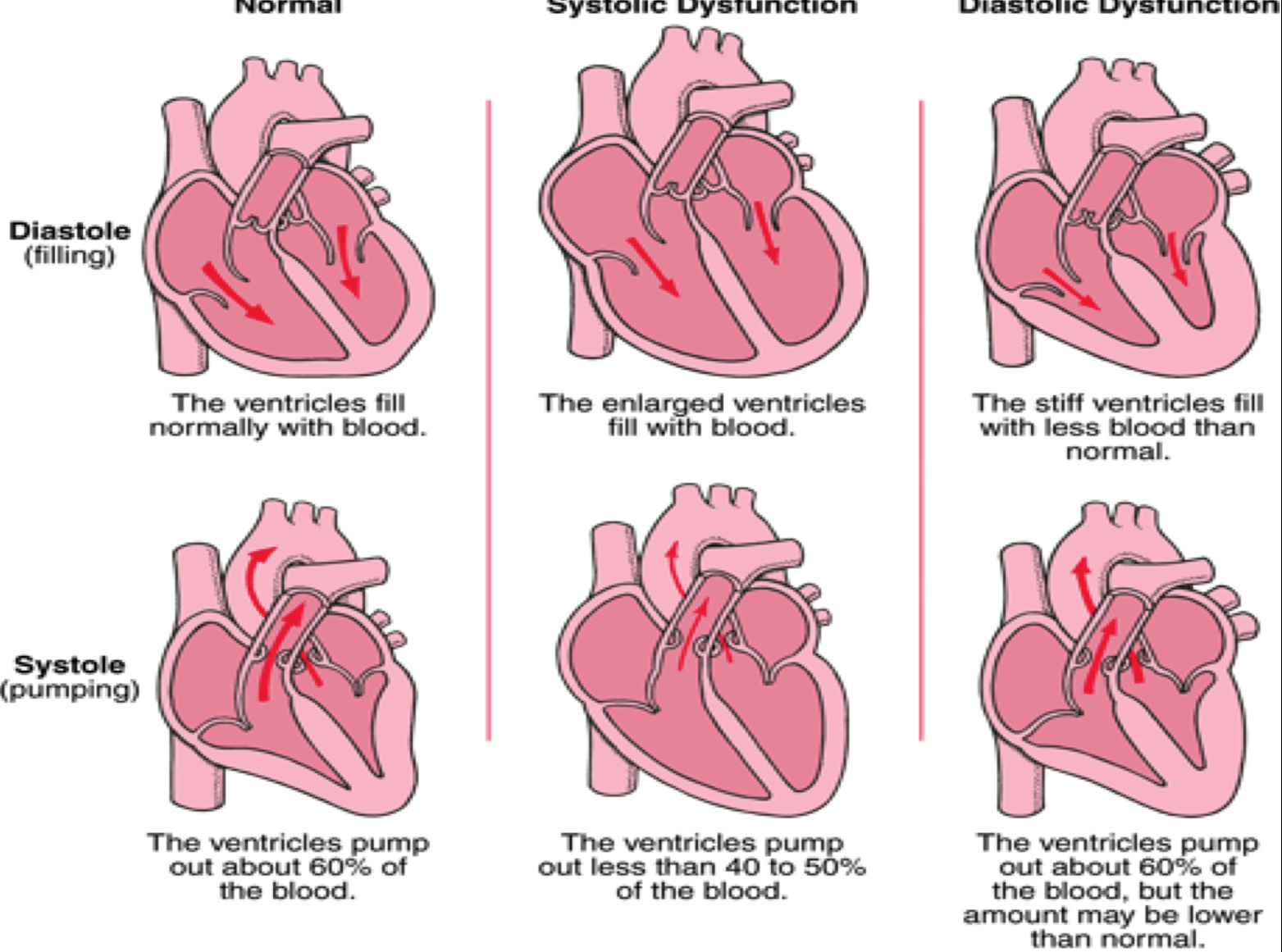
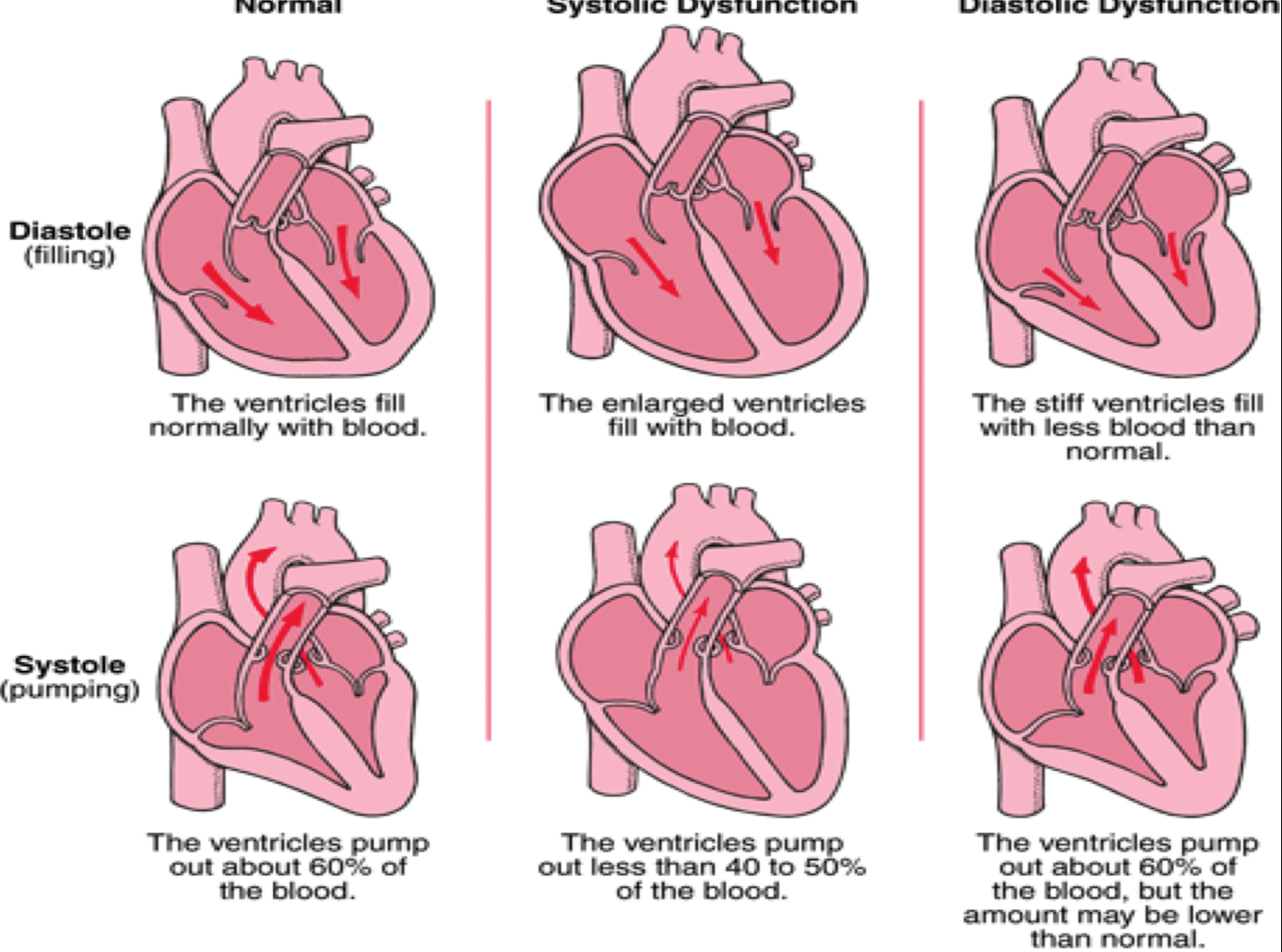
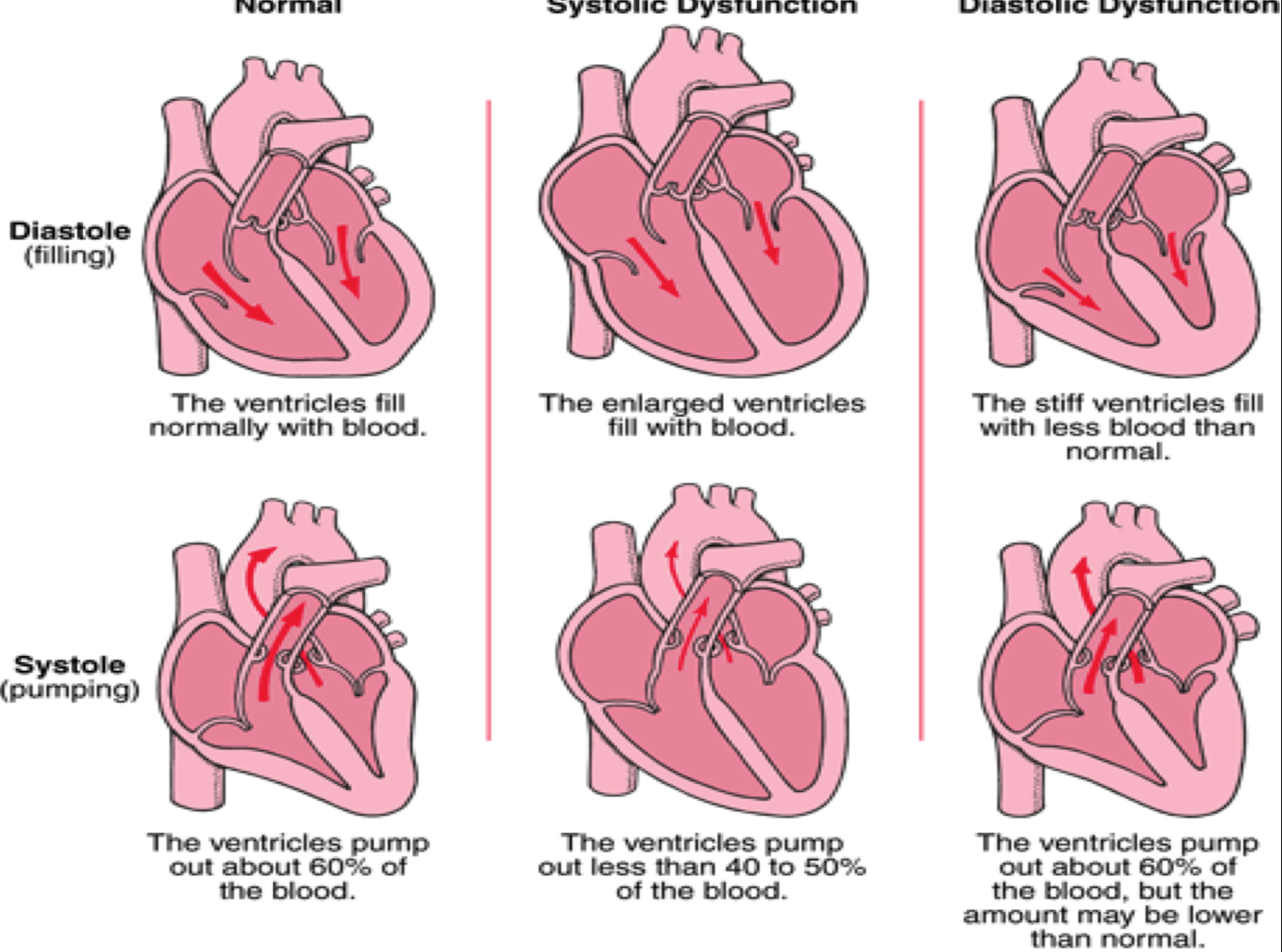
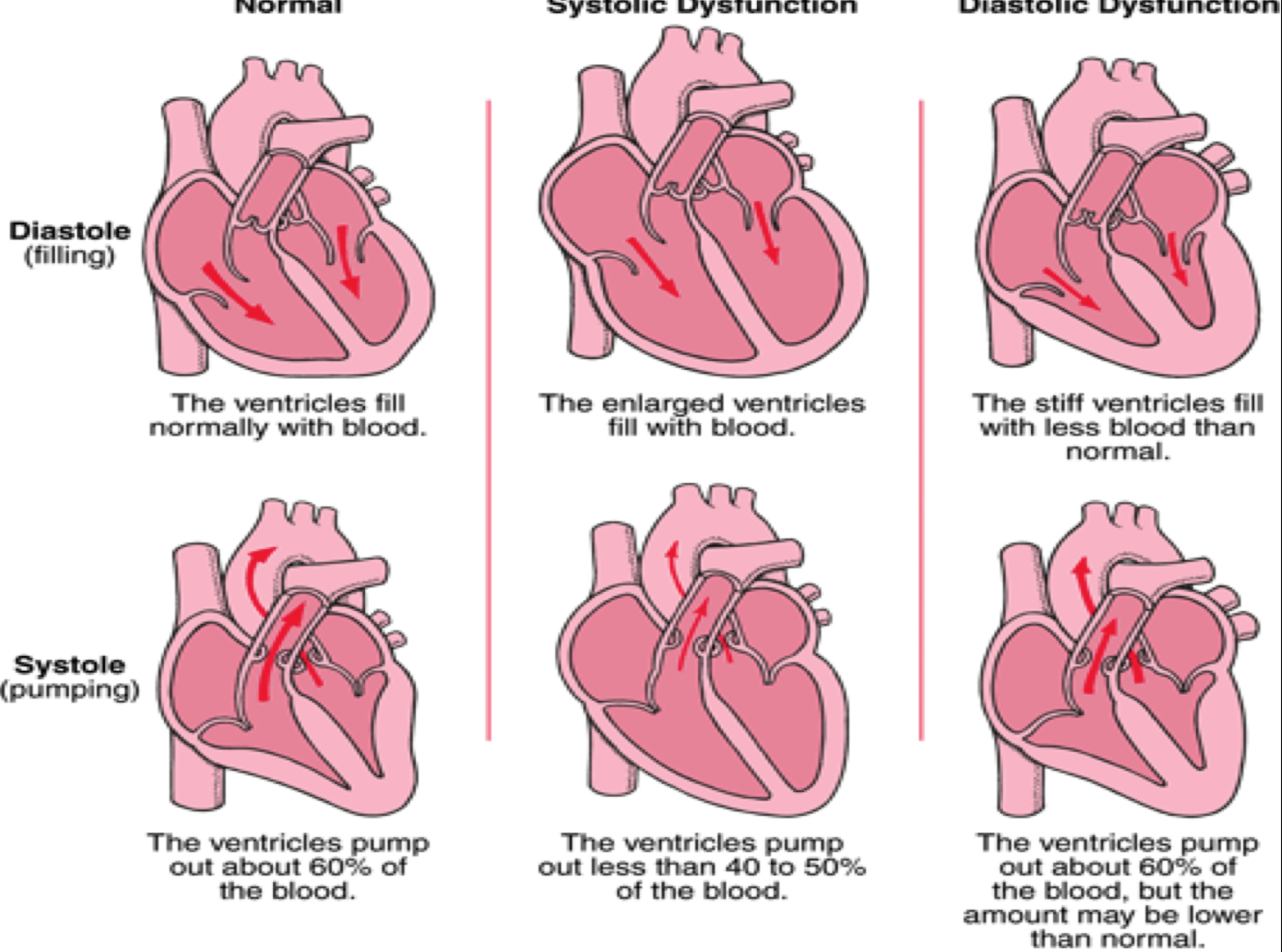
systolic dysfunction - the heart can’t contract effectively - HFrEF is also known as systolic heart failure
what is the main problem in HFpEF?
diastolic dysfunction - the heart can’t relax and fill properly - HFpEF is also known as diastolic heart failure
what does the left ventricle look like in HFrEF
does different type of stress on the heart causes differences in the heart appearances (e.g., pressure overload vs. volume overload/contractility failure)? if so, how?
pressure overload causes the ventricle to appear thick walls and small chamber
volume overload/contractility failure causes the ventricle to appear thin walls, dilated chamber
what are the common causes of HFrEF?
AKA systolic HF - myocardial infarction (ischemic heart disease), dilated cardiomyopathy, viral myocarditis
what are the common causes of HFpEF?
AKA diastolic HF - chronic hypertension, aging, left ventricular hypertrophy, obesity, diabetes
which type of HF (by ejection fraction) has normal contractility but impaired relaxation?
HFpEF
which type of HF (by ejection fraction) shows decreased stroke volume and cardiac output due to weak contraction?
HFrEF
which type of HF (by ejection fraction) is more common in older women wirh hypertension
HFpEF
which type of HF (by ejection fraction) is more common in patient with prior MI?
HFrEF
which type of HF (by ejection fraction) has higher mortality but bettet treatment options?
HFrEF - this is because HFpEF to date, efficacious therapies have not been identified
which type of HF (by ejection fraction) involves eccentric hypertrophy (dilated LV)?
HFrEF
which type of HF (by ejection fraction) involves concentric hypertrophy (thick LV)?
HFpEF
can HFrEF and HFpEF be left or right-sided?
Yes. These terms describe ejection fraction (how well the ventricle pumps). Heart failure can be on the left side, right side, or both. So a patient can have left-sided HFrEF, right-sided HFrEF, left-sided HFpEF, or right-sided HFpEF — but clinically, EF refers mainly to the left ventricle.
the nurse might hear with heart sound if the ventricle if stiff?
S4
is an JVP elevation of more than 4 cm normal?
NO! this can be one indication if right-sided heart failure
can you give ACE and ARBs together?
NO!
why are ARBs (angiotensin II receptor blockers) used for pt with HF?
Purpose: Alternative for patients intolerant to ACE inhibitors.
Mechanism: Block angiotensin II receptors → vasodilation & ↓ aldosterone.
Benefits: Similar to ACE inhibitors (↓ mortality, ↓ afterload).
Key Points:
No cough (unlike ACE inhibitors).
Watch for hyperkalemia & reduced kidney function.
why are beta-adrenergic blockers (e.g., the lols) used for pt with HF?
Purpose: Protect the heart & reduce workload.
Mechanism: Block β-adrenergic receptors → ↓ HR, ↓ contractility, ↓ oxygen demand.
Benefits: ↓ mortality, ↑ ejection fraction long-term.
Key Points:
Start low & go slow (can initially worsen symptoms).
Avoid in acute decompensated HF.
Side effects: bradycardia, hypotension, fatigue.
why are inotropic agents used for pt with HF?
Purpose: Improve cardiac contractility (especially in severe/acute HF).
Mechanism:
Digoxin: ↑ Ca²⁺ in heart cells → ↑ contractility, ↓ HR (via vagal tone).
Dobutamine/milrinone: Used IV in acute HF to boost heart pumping.
Benefits: Symptom relief, reduced hospitalizations (digoxin).
Key Points:Risk of digoxin toxicity (nausea, vision changes, arrhythmias).
Requires close monitoring of potassium & renal function.
why are ACE inhibitors used for t with HF?
Purpose: First-line for HFrEF.
Mechanism: Block ACE → ↓ angiotensin II → vasodilation, ↓ afterload, ↓ preload.
Benefits: ↓ mortality, slows disease progression.
Key Points:
Side effects: dry cough, hyperkalemia, hypotension, angioedema.
Monitor kidney function & potassium.
why are diuretic used for pt with HF?
Purpose: Reduce fluid overload & edema.
Mechanism: Increase urine output → decrease blood volume & venous pressure.
Benefits: Relieves symptoms like edema, pulmonary congestion, dyspnea.
Key Points:
Loop diuretics = most common (furosemide).
Potassium-sparing (spironolactone) also ↓ mortality in HFrEF.
Watch for: electrolyte imbalances (↓K⁺), dehydration, hypotension.
what are the self-management for patient with HF?
MAWDS
medication
activity
weight
diet
symptoms
what are the desired outcomes for HF patients?
normal rate, depth, rhythm of resp, O2 sat larger than 92%
maintain adequate CO
reduction of Na+ and water retention
perform ADLs with walk two blocks without dyspnea
free of pulmonary edema
knowledable of the condition for self-management