3.4 Principal Components Analysis
 Call Kai
 Learn
Learn Practice Test
 Spaced Repetition
 Match
Match Flashcards
 Knowt Play
1/6

Earn XP
Description and Tags
Section 3.4 of Exam MAS-II
Name | Mastery | Learn | Test | Matching | Spaced | Call with Kai | Chat |
|---|
No analytics yet
Send a link to your students to track their progress
7 Terms
Principal Components:
The mth principal component is a _____ ______ of all the features in the dataset.
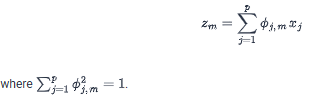
Give mth component equation and it’s constraint
The mth principal component is a linear combination of all the features in the dataset.
Principal Components:
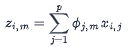
The mth principal component score for the ith observation is defined as
Each principal component is ___ _______ with the others.
Each principal component is not correlated with the others.
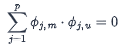
Principal Components: The sum of the product of the principal component _____is ____. Give equation
The variance explained by each subsequent principal component is always ____ than the variance explained by the previous principal component.
The signs of the first principal component loadings indicate the direction of _______.
The sum of the product of the principal component loadings is zero.
The variance explained by each subsequent principal component is always less than the variance explained by the previous principal component.
The signs of the first principal component loadings indicate the direction of correlation.
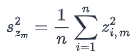
Proportion of Variance Explained: The total variance present in a dataset is
This is just complicated notation saying that the amount of variance explained by one PC divided by the total amount of variance from all PCs is the proportion of variance explained by the first PC

Proportion of Variance Explained:
The variance explained by the mth principal component is (equation)
The proportion of variance explained by a principal component is the ratio of the _____ ______ over the _____ _______ present.
The proportion of variance explained by a principal component is the ratio of the variance explained over the total variance present.
Principal Components: Other Ideas
Principal components are ___-dimensional surfaces in _-dimensional space that are closest to the observations.
Scaling has a ________ effect on the result of PCA.
A ____ plot can be utilized to determine the number of principal components needed to explain a good amount of _________.
Each principal component loading vector is unique up to a ____ flip.
PCA is most useful when _____________ is present in the features.
Principal components are low-dimensional surfaces in -dimensional space that are closest to the observations.
Scaling has a significant effect on the result of PCA.
A scree plot can be utilized to determine the number of principal components needed to explain a good amount of variability.
Each principal component loading vector is unique up to a sign flip.
PCA is most useful when multicollinearity is present in the features.
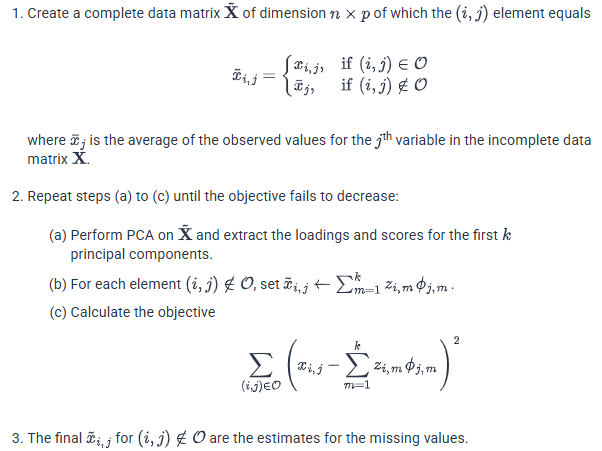
Algorithm for Matrix Completion
Initialize the missing cells with the observed mean of their variable:
x̃ᵢ,ⱼ = xᵢ,ⱼ if observed
x̃ᵢ,ⱼ = x̄ⱼ if missingRun PCA on the completed matrix and retain the first k components.
Use the loadings and scores to reconstruct an estimate for every cell:
x̂ᵢ,ⱼ = ∑ₘ₌₁ᵏ zᵢ,ₘϕⱼ,ₘ
If PCA was performed on centered variables, add the variable mean back:
x̂ᵢ,ⱼ = x̄ⱼ + ∑ₘ₌₁ᵏ zᵢ,ₘϕⱼ,ₘ
Replace only the missing cells with their reconstructed values. The observed cells remain their actual observed values; they are not overwritten.
Calculate the reconstruction error using only the observed cells:
J = ∑₍ᵢ,ⱼ₎∈𝒪 (xᵢ,ⱼ − x̂ᵢ,ⱼ)²
The missing cells cannot be included because their true values are unknown.
Repeat PCA, reconstruction, missing-cell replacement, and error calculation until the objective stops decreasing meaningfully. This is the algorithm shown in the image.