Topic 9 - Central Dogma of Biology
 Studied by 0 people
 Call with Kai
 Learn
Learn Practice Test
 Spaced Repetition
 Match
Match Flashcards
 Knowt Play
1/30

There's no tags or description
Looks like no tags are added yet.
Name | Mastery | Learn | Test | Matching | Spaced | Call with Kai |
|---|
No study sessions yet.
31 Terms
Genes
A nucleotide sequence of DNA that’s transcribed to produce RNA in which protein encoding genes’ RNA(mRNA) can then be translated into proteins (some genes are classified as non-protein coding genes)
RNA Polymerase
An enzyme that uses a DNA strand as a template to synthesize a complimentary RNA strand in transcription
What is the initiation phase of transcription within prokaryotes?
Transcription is initiated by RNA polymerase as it binds to the promoter of a DNA sequence (upstream of the gene) in which RNA polymerase then unwinds DNA to form a “transcription bubble”
How is a “transcription bubble” formed?
When RNA polymerase unwinds DNA at the promoter region of DNA sequence
What is the elongation phase of transcription within prokaryotes?
prokaryotic RNA Polymerase tracks along the DNA template strand, synthesizing mRNA in the 5’→3’ direction (also unwinds and rewinds DNA as it’s read)
What is the non-template strand also known as?
coding strand
What is the termination phase of transcription within prokaryotes?
RNA polymerase reaches the terminator region of DNA sequence and then detaches from the newly synthesized RNA + the gene (allows DNA strands to region)
What is the function of the terminator?
it signals the end of the gene so that RNA polymerase stops transcription to begin termination
What are the different RNA complexes in eukaryotes?
RNA Polymerase I, II, III
What is the function of RNA Polymerase I in eukaryotes?
transcribes rRNA genes
What is the function of RNA Polymerase II in eukaryotes?
transcribes protein-coding genes
What is the function of RNA Polymerase III in eukaryotes?
transcribes rRNA, tRNA, and small nuclear RNA genes
Why do eukaryotes have different promoter sequences?
they assemble a complex composed of transcription factors that’s required to recruit RNA Polymerase II to initiate transcription towards a protein coding gene
Why is termination of transcription specific to certain polymerases?
elongation of RNA Polymerase II in eukaryotes takes 1k-2k nucleotides beyond the end of the gene transcribed
What is the purpose of mRNA processing?
an exclusive eukaryotic process that matures newly transcribed RNA (pre-mRNA) into functional messenger RNA (mRNA) via the addition of 5'cap, poly A-tail, and splicing
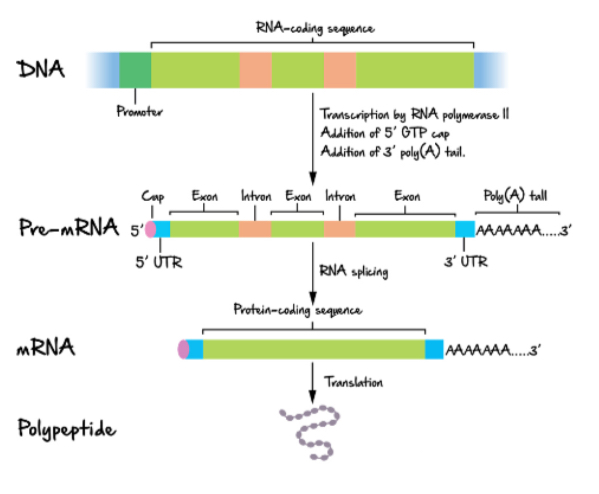
Why is mRNA processing exclusive to eukaryotes?
prokaryotic mRNA is typically mature and ready for translation almost immediately after transcription and they lack introns to be removed/spliced
What is 5’ capping?
The addition of methylguanosine at the 5’ end of pre-mRNA

What is 3’ polyadenylation?
the addition of 100-250 adenosine nucleotides at the 3’ end of pre-mRNA

What is pre-mRNA splicing?
when noncoding sequences called introns are spliced and removed by spliceosomes
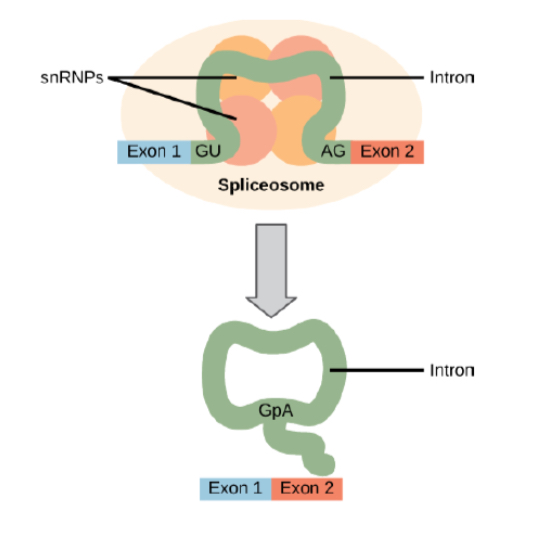
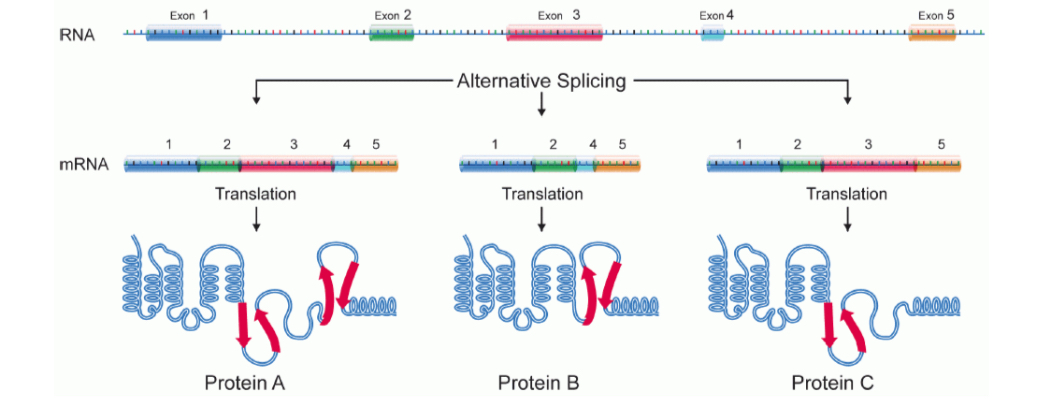
What is alternative splicing?
a splicing mechanism to increase variability of proteins that are produced by a single gene through combining exons in different combinations
What is the purpose of 5’ capping & 3’ polyadenylation?
protect mRNA from being degraded by exonuclease in the cytoplasm
aids in transporting mRNA from the nucleus to the cytoplasm
works with the 5’ end to help ribosomes find/bind to mRNA
length of poly(A) tail signals the cell abt how much protein should be made from the mRNA
What is the purpose of pre-mRNA splicing?
increases the variability of protein produced by a gene via alternative splicing
What players are involved in translation?
mature mRNA(exported to cytoplasm), ribosomes, tRNA
What happens to mRNA after being fully processed?
it is exported from the nucleus to the cytoplasm
What are ribosomes?
a complex macromolecule that is composed of structural and catalytic rRNAs that are composed of 2 subunits
composed of 40s(small) and 60s(large) subunits in mammalian cells
What are transfer RNA?
tRNAs serve to recognize 1+ mRNA codons and carry specific AAs
What are aminoacyl-tRNAs?
they bind to the ribosome and add the corresponding AA to the polypeptide chain
What mechanism ensures that correct AAs are added to the polypeptide chain?
anticidon-codon complementarity
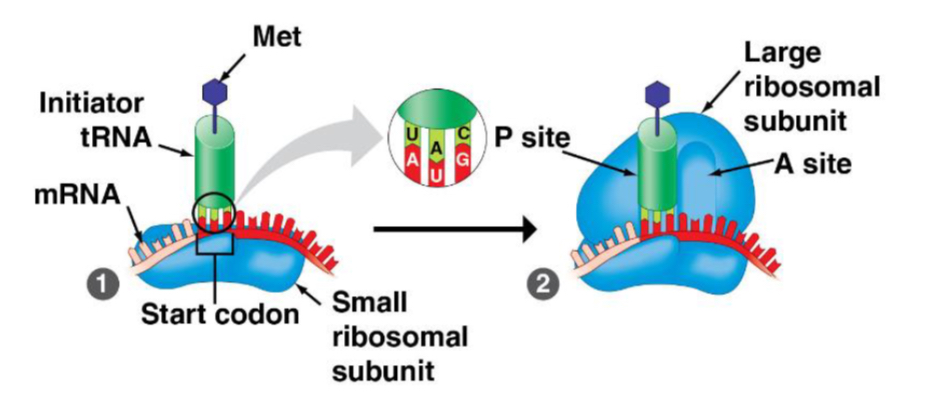
What is the initiation phase of translation?
mRNA attaches to 40s subunit of ribosome and in response to AUG(Met)
an initiator tRNA containing the appropriate anticodon attaches which allows a complete
functional ribosome to be formed (joins w/ 40s subunit + mRNA) as the initiator tRNA is positioned in the “P site” of the 60s subunit of ribosome
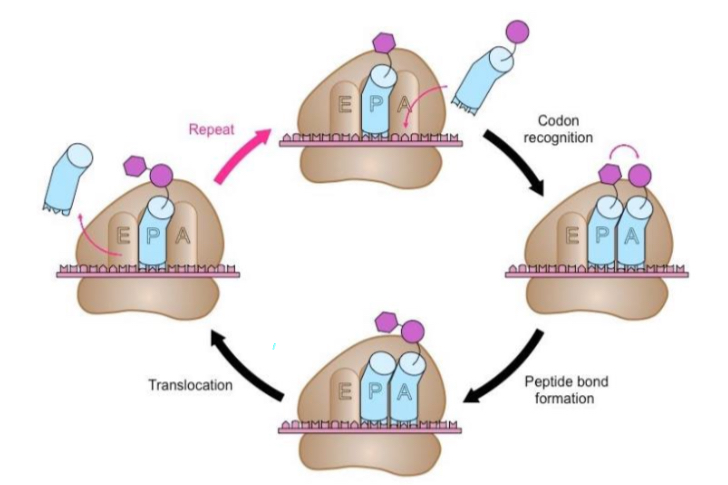
What is the elongation phase of translation?
Aminoacyl-tRNA delivery: aminoacyl-tRNA carries the next AA, entering the ribosome’s “A site”
Codon recognition: the anticodon of incoming tRNA is checked for complementarity with mRNA codon in the “A site” (matches are accepted)
Peptide bond formation: peptidyl transferase activity w/in 60s subunit catalyzes the formation of a peptide bond, transferring the growing polypeptide chain from tRNA in the “P site” to the new AA in the “A site”
Translocation: the ribosome translocates (shifts) one codon down the mRNA, moving the tRNA with the polypeptide from the “A site” to the “P site” with uncharged tRNA from the “P site” to the “E site”
What is the termination phase of translation?
a stop codon reaches the ribosome’s “A site” which frees the completed polypeptide and splits the ribosome back into its subunits