random things i should know
 Call Kai
 Learn
Learn Practice Test
 Spaced Repetition
 Match
Match Flashcards
 Knowt Play
1/7

There's no tags or description
Looks like no tags are added yet.
Name | Mastery | Learn | Test | Matching | Spaced | Call with Kai | Chat |
|---|
No analytics yet
Send a link to your students to track their progress
8 Terms
Actively interacting with the target to discover specific details like users, services, ports, shares, and directories.
enumeration
the initial access an attacker or penetration tester gains to a target system or network
foothold
Broadly gathering information about a target, often before directly interacting with it.
Reconnaissance
how to find common.txt from the root
find / -iname "common.txt" 2>/dev/null
-iname "common.txt"
The search criteria — -iname matches filenames, and the i makes it case-insensitive (so it would match common.txt, Common.txt, COMMON.TXT, etc., all the same). The "common.txt" in quotes is the exact filename pattern being searched for.
(For contrast: -name without the i would be case-sensitive — only matching the exact capitalization you type.)
2— refers to file descriptor 2, which is "standard error" (stderr) — the channel programs use to output error messages (as opposed to1, standard output, which is successful results).>— redirects output somewhere else instead of printing it to the screen./dev/null— a special "black hole" file on Linux/Unix systems — anything sent here is simply discarded/thrown away.
how to undo and redo in nano
Alt + U = undo
Alt + E = redo
less — Views a file or command output one screen at a time and lets you scroll up and down.
lets you go forward AND backward through the file
less /etc/passwdThen practice:
↑ / ↓ → scroll
Spacebar → move down one screen
b → move back one screen
q → quit
more — Views a file or command output one screen at a time, mainly scrolling forward.
lets you go forward through the file, but not easily backward.
more /etc/passwdThen:
Spacebar → move forward
Enter → move down one line
q → quit
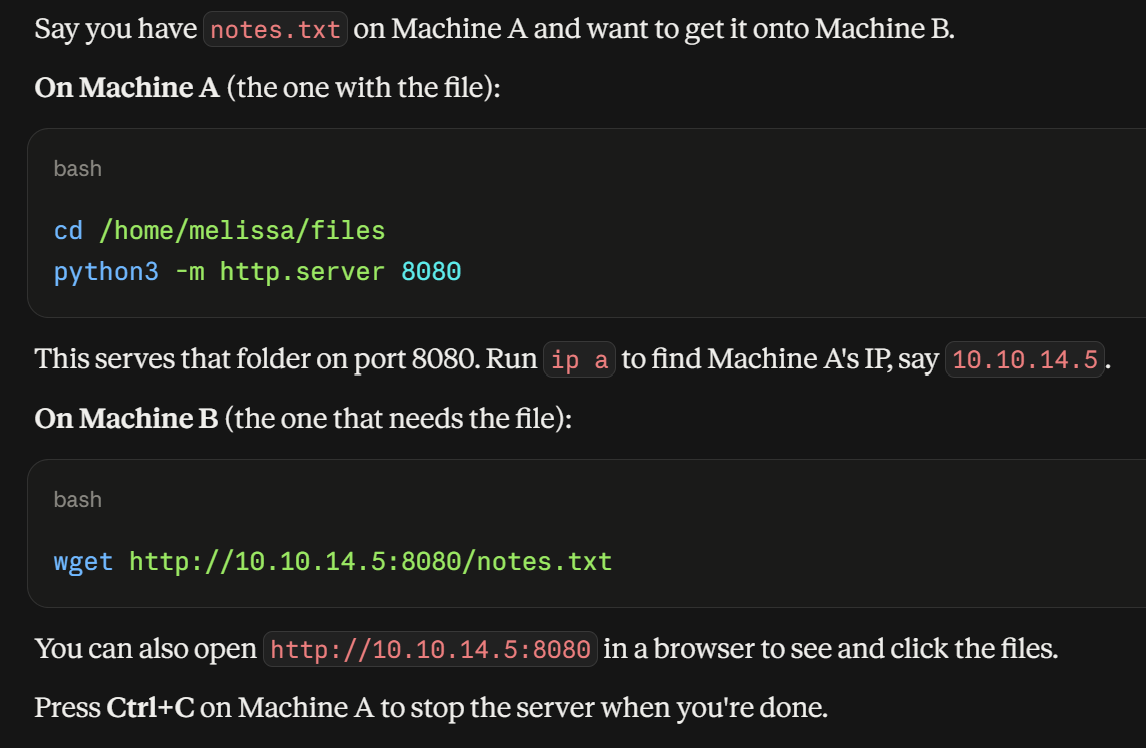
It starts a simple web server on port 8000 by default that serves the files in your current directory, so you can download them from another machine by browsing to http://<your-ip>:8000
python3 -m http.server