ALLEN VERCOE Set 2
 Call Kai
 Learn
Learn Practice Test
 Spaced Repetition
 Match
Match Flashcards
 Knowt Play
1/164

There's no tags or description
Looks like no tags are added yet.
Name | Mastery | Learn | Test | Matching | Spaced | Call with Kai | Chat |
|---|
No analytics yet
Send a link to your students to track their progress
165 Terms
the immune system can respond to any foreign molecular structure (T/F)
T (through cells and soluble proteins)
Inate immune system-
Adaptive immune system-
Inate immune system- born with, first responders, ancient (even inverts have it)
Adaptive immune system- in higher vertabrates
Inate immune system evolved so early we can easily study it in ________
drosophila
the inate immune system is a rapid response system that includes _________ barriers and when those fail ____________ responses
physical barriers, chemical/cellular responses
a contact with an infectious agent means you will get sick (T/F)
F, contact doesn’t guarantee illness
(if number of infecting pathogens small or immune system is good)
to cause disease a pathogen must not only be present but also must:
breach defenses
survive inate immune system
multiply
number of E.Coli needed to cause disease?
number of salmonella needed to cause disease?
3
1 million
physical barriers include:
skin, tight junction epithelial cells, selectively permeable membranes, lungs mucocillatory escalator, nose hairs (if particle larger than 100 microm)
physical barriers are often connected to _____ tissue
lymphoid
what are the two primary lymphoid organs?
bone marrow, thymus
secondary lymphoid organs include ______ encounter stations all over the body with concentrated areas in _______________________
antigen
neck, groin, lower back, throat, close to easily infected areas (oral, fecal, groin, lung)
define:
SALT
GALT
skin associated lymph tissues
gut associated lymph tissues
what is the “surveillance/tripwire system” of the body?
the complement system (evolved very early, senses any breaches of body barriers)
where are compliment proteins made?
liver
compliment is a set of about 30 soluble and membrane bound proteins, 9 of which are C proteins that compliment ______ in ability to kill
antibodies
complement circulates inactive until activated by________
proteolytic cleavgae (hydrolysis)
C3 clevage is irreversible (T/F)
F, C3 is constantly cleaved and then neutralized and only stays active if it finds a target
there are three pathways that activate compliment what are they?
classical
lectin -inate
alternative (most ancient)- inate
all three compliment pathways: classical, lectin, alternative converge on the _____ pathway
lytic (MAC)
C3 when cleaved becomes :
C3a and C3b
does C3a or C3b bind target?
C3b
C3 cleaves into Ca and Cb, Cb binds bacteria and recruits factor ____ and then factor ___, then more and more C proteins until ____ is formed
B, D
MAC (membrane attack complex) pore
all three pathways lead to formation of ____
MAC (membrane attack complex)
C3b acts as an _______
C3a and C5a act as _________
opsonin- bind bacteria
anaphylotoxins- activate immune system and mediate inflammation
cytokines are secreted by cells and can affect other cells, one example of a cytokine is interferons. when are interferons released and what do they do?
interferons are released by viral infected cells to warn nearby cells to increase their defenses and hide surface proteins
when a cell is signaled by an interferon cytokine what can it do to protect itself from a virus?
decrease production of the surface proteins that viruses may bind and up defenses
the mycobacterium _____ is able to switch off interferons, or make them overexpressed and overload the system
TB
in the gut epithelial lining, a layer of ______ and a gradient of _______ keep microbes from being in close contact with our epithelial cells
mucus, defensins
would you find more defensins closer or futher from the epithelial cells?
closer
where are defensins secreted from?
in between epithelial cells there are crypts that secrete defensins
why arent defensins always produced?
while defensins are toxic for microbes, they are also toxic to our cells in high concentrations so they are mostly used as a backup for bacterial that make it past the mucous layer
why are white blood cells called white?
when centrifuge blood it seperates into plasma, red blood cells and a white layer of white blood cells
what are the two major classes of stem cells?
myeloid and lymphoid
the bone myeloid stem cells further diffrentitate into ______, _______ and _______
mast cells (inate immune system), myeloblasts and monoblasts
myeloblasts further become: _______, _______ and _______
neutrophils (inate immune system), esinophils, and basophils
note these are collectively called polymorphonuclear luekocytes (PNMs)
monoblasts further diffrentiate into monocytes which can either become ____ or ____
macrophages or denritic cells
bone lymphoid stem cells differentiate into ______, ________ and _________
natural killer cells (inate immune system), T cells, and B cells
phagocytes diffretiate from myeloid stem cells, they engulf prey into _____ and fuse it with a _______, then reuse the digested bits and immune cells display them as antigens
vacuoles, lysosome (acids and enzymes)
why are bacteria diffucult for a phagocycte to grab?
the phagocyte and bacteria both have a net negative charge
______ can coat bacteria and make it easier for phagocytic cells to grab and engulf them by attaching with their ______ receptors
C3b, C3b (ya its supposed to be C3b for both)
what special feature do neutrophils use to capture pathogens?
the ability to kill themselves by NETosis where they explode and release NETs (neutrophil extracellular traps) to capture bacteria
what are NETs made out of?
chromatin and antibicrobials
NETs trap bacteria and keep them in place for rapid _________
phagocytosis (cleanup)
what condition leads to too much cell death by NETosis?
Lupis, causes inflammation, cleanup not fast enough to keep up
what conditions could be associated with too little NET production?
poor immune system
do neutrophils or macrophages arrive first? which can consume more bateria?
neutrophils arrive first, then machrophages
macrophages can consume a lot more than neutrophils
monocytes diffrentiate into macrophages when they are attracted by _____ to a site they are needed
cytokines
where do monocytes diffrentiate into macrophages?
why do monocytes not diffrentiate into macrophages until needed?
in blood stream by vasation
macrophages release more cytokines to help trigger further immune response, if they were circulating all the time there would be chronic inflammation, internal bleeding and symptoms of septic shock
what are patrolling vs resident macrophages
patrolling macrophages (monocytes) are always circulating the bloodstream waiting for signal cytokines to call them over
resident macrophages stay in certain tissues doing routine cleanups
dendrocytes also come from monocytes and they are phagocytotic and also _____
present antigens to adaptive immune system (so do macrophages tho) both are APC (antigen presenting cells)
dentrocytes have finger like petrutions to do what?
squeeze into tight spaces such as the epithelial junctions and sample the gut lumen microbes and monitor activities
cytokines/chemokines/interferons are the language of the immune system and act like a close range hormone system. some cytokines are important for ________ and some are important for ______
inflammation, anti-inflammation
is acute inflammation normally good or bad, what about chronic?
accute can be good
chronic usually bad
inflammation usually involves the following, describe the biological significance of each:
heat
edema (swelling)
redness
pain
altered function
heat- lots of cellular activity happening
edema (swelling)- lots of white blood cells flooding to the area
redness- dialated blood vessels (to move help in quickly)
pain- indicate problem (cytokines can stimulate pain receptors)
altered function- ex. skin cell may stop producing sebum and give all energy to fighting off the problem
inflammation is usually due to _____
infection
what is pus?
dead neutrophils (and some macrophages) die after eating too much
some diseases of chronic inflammation include:
TB
fish tank granuloma
liver granuloms
chrons disease
why can fever be helpful?
helps speed up immune system and inflammatory response
(some debate of weather NSAIDS should be given out for minor fevers or if the fever is helpful for speedy recovery)
what are the APC (antigen presenting cells)?
dendrocytes and macrophages (display antigens on surface and link the inate and adaptive systems)
what is a peyers patch in the small intestine?
special sites for uptake of antigens (macrophage/dendrocyte under peyers patch), and presentation of antigens to help body differentiate good vs bad when faced with a microbe
how do bacterial capsules make it harder for immune system to attack?
some interfere with antigen recognition, and slippery to avoid NETs, harder to treat with antimicrobials
cells in inate immune system have special receptors that recognize invariant and unique microbial factors. these are refered to as _________
PRRs (pattern recognition receptors)
PRR of inate imune cells recognize ________________
microbe associated molecular patterns (MAMPS)
PRR inate immune cells can diffrentiate between good microbes and bad microbes (T/F)
F
there are two types of PRRs (pattern recognition receptors) ________ and _______
TLRs (toll like receptors) and NLRs (NOD like receptors
TLRs (toll like receptors) are transmembrane proteins on immune cells that recognize viral and bacterial MAMPS (microbe associated molecular patterns). When they bind a ligand what do they do?
Stimulate cytokines to signal inflammatory response, and induce macrophages to produce antimicrobial proteins and peptides
NLRs bind MAMPs (microbe associated molecular patterns) and trigger ________ and form an _______ that activates adaptive immune response and triggers __________
trigger cytokine production
form an inflammasome that activates the adaptive immune response, and triggers apoptosis
what is the main difference in the location that NLRs vs TLRs function
NLRs act inside the cell in the cytoplasm
TLR act on the cell surface and monitor outside the host cell.
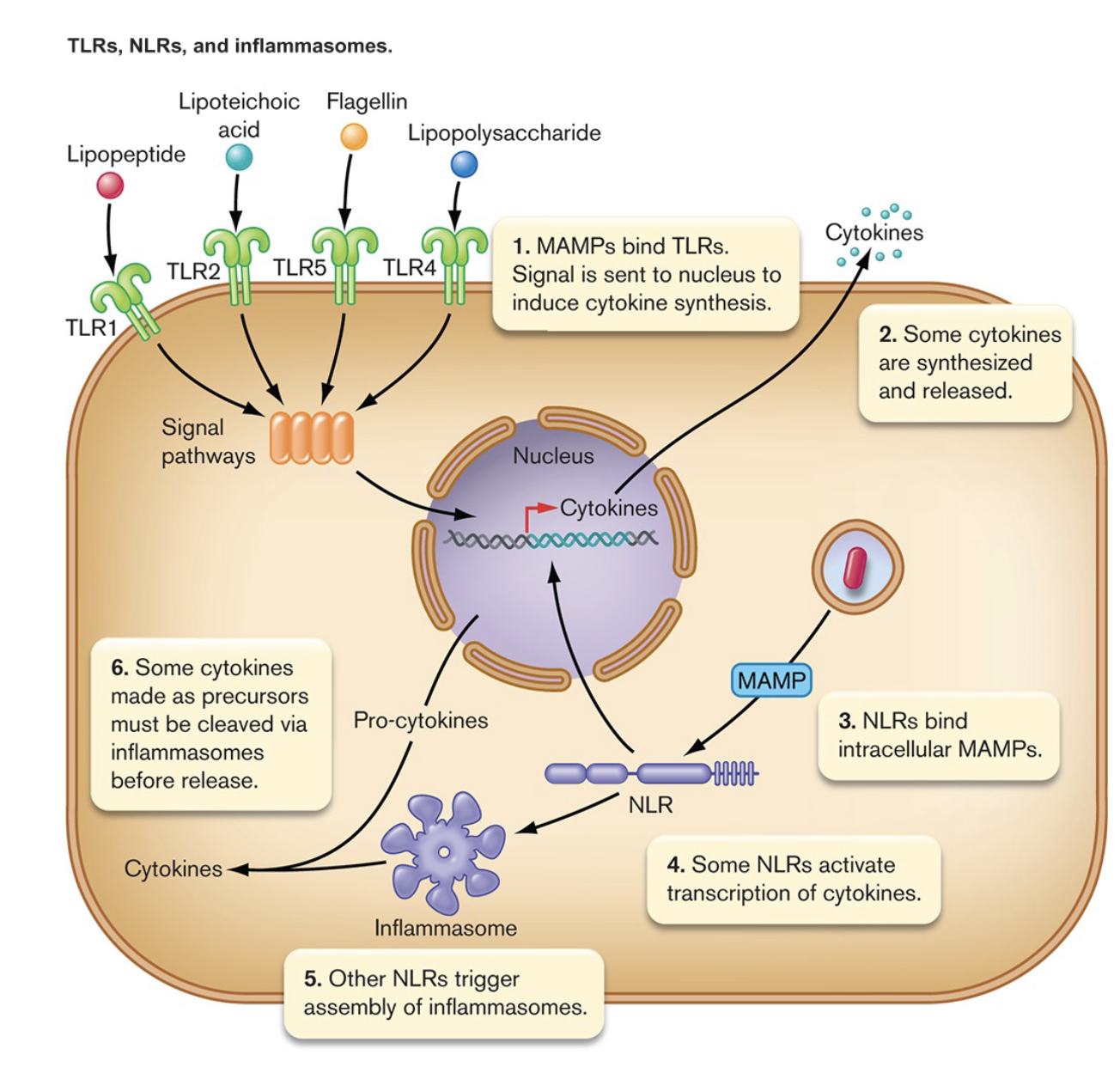
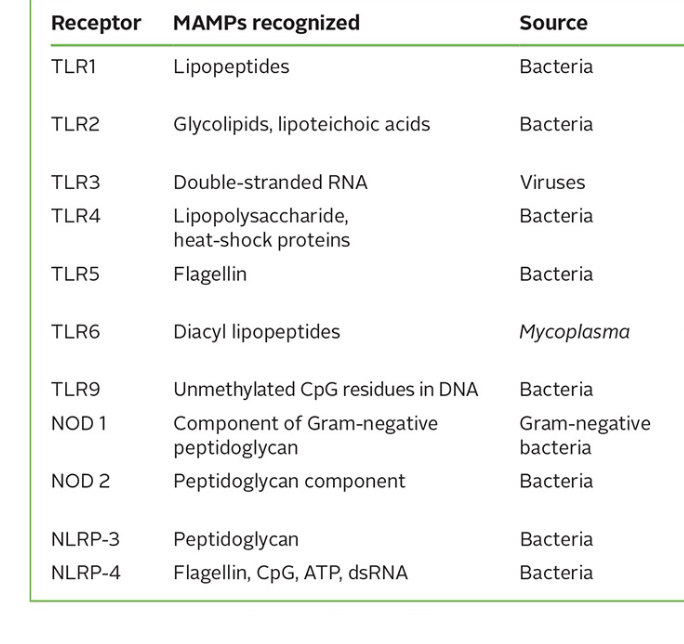
TLR and NLRs respond to MAMPS, what are some examples of MAMPS and the species they are found in?
MAMPS are things unique to non human cells, such as flagella and peptidgolycan (only seen in bacteria), or things like chitin (only seen in fungi)
see image
good cell death aka ______, bad cell death aka _______
apoptosis, necrosis
what linage of stem cells are natural killer cells from
lymphoid (same as T and B cells, but natural killer cells are part of inate whereas T and B are adaptive)
natural killer cells are phagocytic (T/F)
F, (phagocytes are found in myeloid lineage)
natural killer cells make up about ____% of body lymphocytes
2% (but can be a range)
natural killer cells attack pathogens (T/F)
F, natural killer cells actually attack host cells that have been infected rather than pathogens themselves
how do natural killer cells know to attack a host cell, ie. how do they know it is infected?
recognize an altered MHC1 (self ID antigen) that the infected cell is presenting
how do natural killer cells kill infected host cells?
they are alerted by cytokines, interferons, etc.. and come to the infected cell, verify it is infected by recognizing altered MHC1 marker and then perforin punches holes in cell membrane and granzyme moves into cell to induce apoptosis of infected cell.
after apoptosis of infected cell (induced by natural killer cell) apoptotic bodiesare consumed by ______ which disposes of intruders and cell bits (minimal inflammation. this process is called __________
neutrophils, efferocytosis
the adaptive immune system has
______ cells which perform cell mediated immunity which recognizes antigen on cells and targets infection
______ cells which preform humoral immunity in which antibodies target intruders in bodily fluids
T CELLS which perform cell mediated immunity which recognizes antigen on cells and targets infection
B CELLS cells which preform humoral immunity in which antibodies target intruders in bodily fluids
the immune system uses a lot of energy (T/F)
T- needs to be making all types of weapons to target intruders
David Vetter has SCID which means ______
he was missing adaptive immune system and natural killer cells (errors in lymphoid cells)
how many days following exposure does adaptive immunity develop?
3-4 days
Immune system recognizes small pieces of an antigen, called ______, which may be 2 or 3 dimensional
antigenic determinants or epitopes,
epitopes/ antigenic determinants are presented to adaptive immune system by ______
phagocytes
any part of a bacterial surface/ structure can be an antigen (T/F)
T, and each one of these antigens can have many epitopes (smaller components of the antigen)
antigen epitopes are divided into two categories _______ and _________
immunogens and haptens
difference between immunogen and hapten epitopes?
immunogens- can generate immune response on their own
haptens- are too small and need to bind a protein to initiate immune response (ex. nickle allergy, urushiol (poision ivy component)
The effectiveness by which an antigen elicits an iimmune response is called ___________
immunogenicity
order the following in order of increasing immunogenicity: nucleic acids, proteins, carbs, lipids
give an explaination
nucleic acids and lipids, carbs, proteins
shape matters most and proteins have most variable and specific unique shapes and conformations, easy to tell apart- high immunogenicity (ability to initiate immune response)
all immune cells (both lymphoid and myelopid orgin) come from _______
hematopoetic bone marrow stem cells
where are T cells trained?
thymus
when in life is thymus most present in body?
birth and in uetero when training of T cells begins, shrinks as you age past puberty.
in thymus T cells are randomly assigned a unique T cell receptor (each responds to a different epitope) (T/F)
T, each T-cell cell gets a randomly assigned TCR in the thymus
what percent of T cells are killed in thymus (dont pass tests)
98%
what two tests do T cells have to pass in order to be allowed to function and not get killed by thymus?
positive selection: ability to identify self Major Histocompatibility Complex (MHC) peptides. (can the T cell respond to commands and react to antigens)
negative selection: tested for reactivity against self antigens in the thymus. (will the T cell attack any of the host molecules if presented?- if yes T cell killed)
2% pass both tests
most T cells are born with you and the selection largely happens in utero, how do you always have T cells if cells die?
T cells replicate with you for life after they have been trained
there are two types of effector T cells: ______ and ______
Tc- cytotoxic T cell (killers- similar to natural killer cells but specific and recognize antigens rather than just recognizing a altered MHC1 or infected cell)
Th- helper T cell (intelligence agents collect antigens and alert B cells if antigen found)
what markers are expressed on cytotoxic T cells vs helper T cells?
cytotoxic T cell - CD8+
helper T cell- CD4+
some Th cells (helper) can diffrentiate into memory T cells (T/F)
T
what allows helper T cells to pass down memory?
(they dont have a very long lifespan)
colonal replication - overtime memory can get hazy
what do Treg cells do? (regulatory T cells), what does lack of Treg cells result in.
restore homeostasis after infection, lack of Treg results in chronic inflammation