Lecture 5 - Connective Tissue
 Call Kai
 Learn
Learn Practice Test
 Spaced Repetition
 Match
Match Flashcards
 Knowt Play
1/28

There's no tags or description
Looks like no tags are added yet.
Name | Mastery | Learn | Test | Matching | Spaced | Call with Kai | Chat |
|---|
No analytics yet
Send a link to your students to track their progress
29 Terms
What are the main functions of connective tissue?
*most abundant and widely distributed primary tissue
Connective tissue proper: bind and support, insulate, store reserve fuel
Bone: protect, bind and support
Cartilage: protect, bind and support
Blood: transport substances
Defining Characteristics of all Connective Tissues
originated from mesenchyme tissue
varying degrees of vascularity
cells suspended in extracellular matrix (ground substance + fibers
allows tissue to bear weight, withstand tension, etc
What are the types of connective tissue cells?
“Blasts” are immature form of cells that secrete ground substance and ECM fibers
“Cytes” are mature form of cells that maintain the health of the matrix
Fibroblasts/cytes: in connective tissue proper
Chondroblasts/cytes: in cartilage
Osteoblasts/cytes: in bone
What are the types of connective tissue fibers?
Collagen: strongest and most abundant, tough, high tensile strength
Elastic fibers: long, thin elastin fibers that allow for stretch and recoil
Reticular: made of same proteins as collagen fibers but are shorter and highly branched which allows for more “give”/stretch
What is ground substance made of?
gel-like material that fills the space between cells
Made of:
cell adhesion proteins (act like glue)
Sugar proteins (proteoglycans)
water & interstitial fluid
Types of Connective Tissue Proper
Loose connective tissues
areolar
adipose
reticular
Dense connective tissues
dense regular
dense irregular
elastic
Cell type of all: fibroblasts/cytes
White Fat of Adipose Tissue (loose connective)
Cell type: adipocytes
stores nutrients, very small matrix (little room between cells), highly vascular
Functions: shock absorption (found surrounding joints), insulation, & energy storage
Brown Fat of Adipose Tissue (loose connective)
Cell type: fibroblasts/cytes
lots of mitochondria = produces ATP
heats bloodstream
Dense Regular Tissue (dense connective)
Cells: fibroblasts/cytes
make/secrete collagen fibers and ground substance
Fibers: collagen
thick bundles of collagen fibers all running in the same direction
high resistance to pulling, fibers are wavy so they stretch, low vascularity
Where is dense regular tissue found?
tendons and ligaments
What does dense regular tissue look like?

Dense Irregular Tissue (dense connective)
Cells: fibroblasts/cytes
Fibers: collagen
fibers of collagen are thicker and randomly arranged, form sheets
resist tension from MANY directions
Where is dense irregular tissue found?
Dermis of skin (under epidermis)
Fibrous joint capsules
What does dense irregular tissue look like?

Elastic Tissue (dense connective)
Cells: fibroblasts/cytes
Fibers: elastic
allows tissues to recoil after stretching
maintains blood flow by allowing the arteries to stretch when blood enters and recoil when blood goes out
Where is elastic tissue found?
walls of large arteries (ex: aorta)
some ligaments (ex: ones that connect vertebrae)
What does elastic tissue look like?

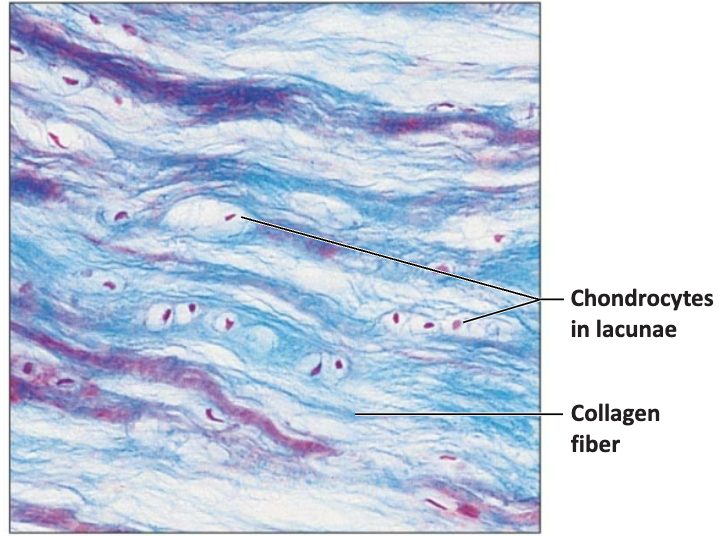
Cartilage as a Connective Tissue
Cells: chondroblasts/cytes
think C in cartilage - C in chondroblasts
Fibers: collagen and elastic (in some)
tough, flexible material with NO nerves
No blood vessels = no blood flow so receives nutrients from the surrounding membrane
Perichondrium produces the fibroblast/cyte cells
matrix made of water, collagen fibers, and sugar proteins
Hyaline Cartilage
most abundant
has collagen and elastic fibers
locations: tips of long bones, nose, trachea, larynx, cartilage of ribs

Elastic Cartilage
more elastic fibers than hyaline
has collagen and elastic fibers
locations: ears and epiglottis (flap in the throat behind the tongue)

Fibrocartilage
the middle man of properties of hyaline and elastic cartilages
only has collagen fibers
locations: intervertebral discs and knee
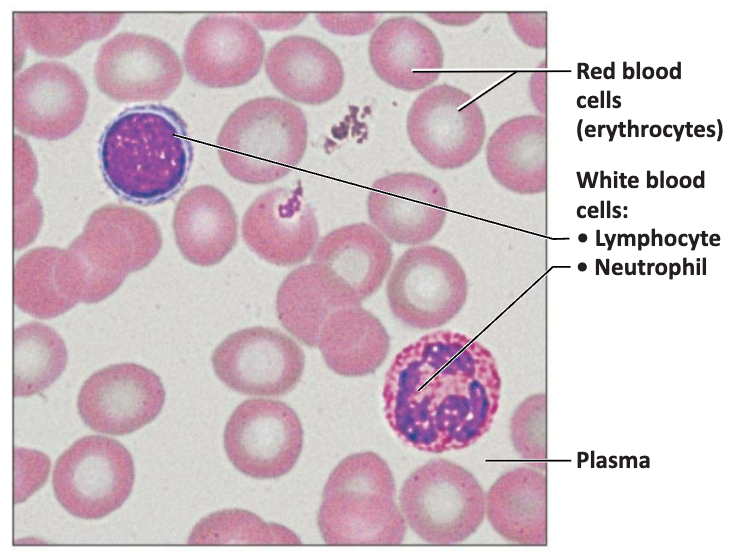
Blood as a Connective Tissue
Cells: red blood cells, white blood cells, platelets
does not contain fibers
matrix is called plasma
transports nutrients, wastes, gases, etc
Bone as a Connective Tissue
Cells: osteoblasts/cytes
think osteoporosis is a bone disease, and cell name is similar
Fibers: collagen
called osseous tissue
matrix is ground substance calcified with inorganic calcium salts
more collagen fibers than cartilage
LOTS of blood vessels
stores calcium and fat
bone marrow inside is where blood cells are created
has cavities in the matrix called lacunae - tiny “canals” where nutrients/waste move through
osteocytes are housed in lacunae

What is bone remodeling?
the replacement of bone through both bone deposition (creation) and bone resorption (getting rid of old bone)
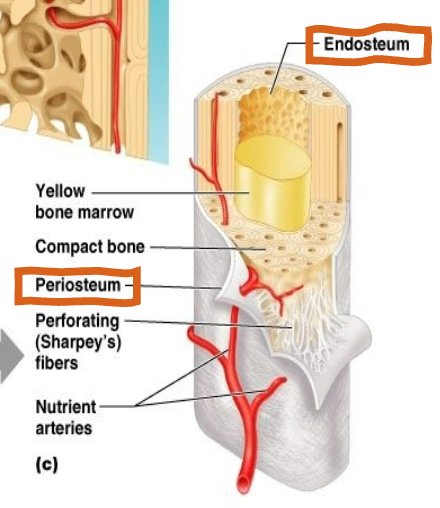
Where does bone remodeling occur?
both spongy and compact bone
both outer and inner surfaces of bones
periosteum: outer surface
endosteum: inner surface
Bone Deposition
osteoblasts creating new bone
Bone Resorption
osteoclasts digesting old bone
secrete lysosomal enzymes that digest the matrix
acidity dissolves calcium salts
also phagocytize dead osteocytes and demineralized matrix
Hormonal Controls of Bone Remodeling
dictates WHEN bone addition/resorption occurs
Parathyroid Hormone is produced by the parathyroid glands when there are low blood calcium levels
stimulates osteoclasts to resorb bone —> takes the calcium from it and releases it into the bloodstream to raise levels
PTH secretion stops when homeostatic level is reached again
negative feedback response
Mechanical Stress Impact on Bone Remodeling
dictates WHERE to add/remove bone
bones directly reflect the stresses that they encounter
The segments of bone experiencing tons of stress will react by adding new bone and making that area thicker
