Microbiology Quiz 1 Study Guide Summer 2026
 Call Kai
 Learn
Learn Practice Test
 Spaced Repetition
 Match
Match Flashcards
 Knowt Play
1/59

There's no tags or description
Looks like no tags are added yet.
Name | Mastery | Learn | Test | Matching | Spaced | Call with Kai |
|---|
No analytics yet
Send a link to your students to track their progress
60 Terms
Basic dyes
Stains with positively charged chromophores.
Gammaproteobacteria
The most diverse class of Proteobacteria containing the most human pathogens.
Staphylococcus aureus (nomenclature)
Staphylococcus is the genus; aureus is the species.
Amensalism
Symbiotic relationship where one population harms another while remaining unaffected.
Psychrophiles
Cold-loving microbes that grow best between 0-15 °C.
Psychrotrophs
Microbes that grow well between 4 °C and 25 °C; cause food spoilage.
Mesophiles
Microbes with an optimal growth temperature range of 20-40 °C.
Thermophiles
Microbes adapted to hot temperatures between 50-80 °C.
Hyperthermophiles
Microbes adapted to extreme heat between 80-110 °C.
Halophiles
Microbes that require high salt concentrations to grow.
Halotolerant
Microbes that do not require salt but can withstand up to 10% salt.
Barophiles
Microbes that grow best under high hydrostatic pressures.
Acidophiles
Microbes with optimal growth at pH 0-5.5.
Alkaliphiles
Microbes with optimal growth at pH 8.0-11.5.
Obligate anaerobes
Organisms for which oxygen is toxic; they cannot survive in its presence.
Facultative anaerobes
Microbes that thrive with oxygen but can grow without it via fermentation.
Microaerophiles
Microbes requiring low oxygen levels (1-10%) for growth.
Aerotolerant anaerobes
Microbes indifferent to oxygen; they do not use it but are not harmed.
Flagellar staining
Staining used to visualize tail-like structures used for bacterial locomotion.
Endospore staining
Staining used to identify structures that allow bacteria to survive harsh conditions.
Capsule staining
Staining used to visualize protective outer structures related to virulence.
Negative staining
Staining that colors the background but not the specimen, creating a halo.
Prokaryotic domains
Archaea and Bacteria.
Universal cell structures
All cells possess a cell membrane, cytoplasm, ribosomes, and DNA.
Rhizobium
Nitrogen-fixing bacteria that form nodules on legume roots.
Bdellovibrio
Predatory bacteria that invade the periplasmic space of gram-negative bacteria.
Bacteroides
Dominant human gut bacteria that prevent pathogen colonization.
Vector transmission
Transmission of an infectious agent via an animal carrier, like an arthropod.
Fomite
An inanimate object that can harbor and transmit pathogens.
Taenia saginata
Beef tapeworm contracted by ingesting undercooked, contaminated meat.
Endosymbiotic theory evidence
Mitochondria/chloroplasts have binary fission, circular DNA, and 70S ribosomes.
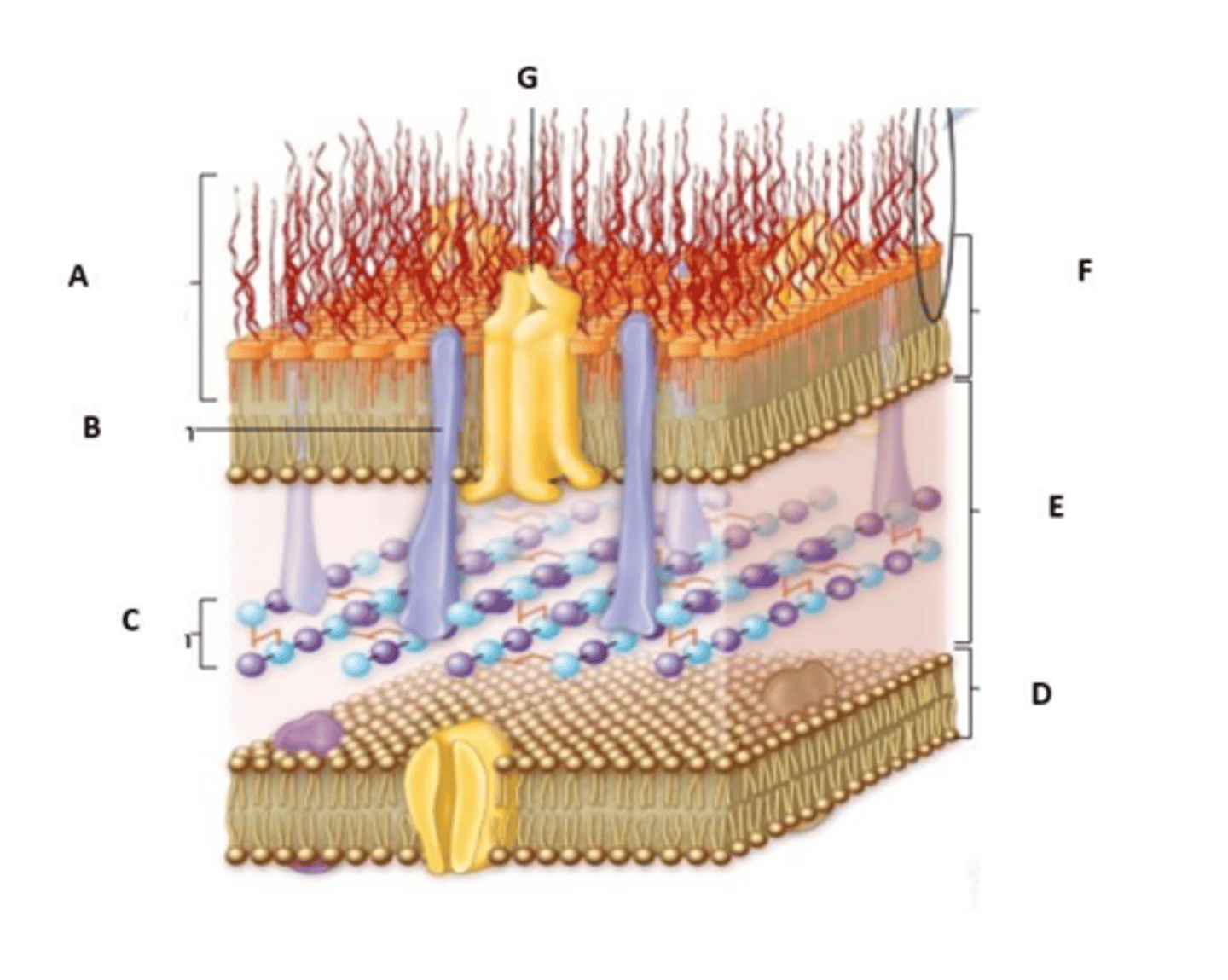
Lipopolysaccharide (LPS)
An endotoxin located in the outer membrane of Gram-negative bacteria.
Eukaryote ribosome size
80S ribosomes in the cytoplasm and rough endoplasmic reticulum.
Toxoplasma gondii
Protozoan parasite dangerous to pregnant women due to birth defect risks.
Gram staining steps
Crystal violet (stain), Gram's iodine (mordant), ethanol (decolorizer), safranin (counterstain).
Peptidoglycan backbone
Alternating polymers of N-acetylglucosamine (NAG) and N-acetylmuramic acid (NAM).
Teichoic acid
Acidic polymers found only in the cell walls of Gram-positive bacteria.
Helicobacter pylori
Bacterium that causes gastric ulcers and stomach cancer.
Robert Koch
Established postulates linking a specific microbe to a specific disease.
Louis Pasteur
Disproved spontaneous generation; developed rabies vaccine and pasteurization.
Carl Woese
Created the three-domain system based on rRNA sequence comparisons.
Anton van Leeuwenhoek
The first person to observe live microbes using simple microscopes.
Viroids
Acellular plant pathogens consisting only of short, circular RNA without a capsid.
Virus properties
Acellular, obligate intracellular parasites containing a DNA or RNA genome.
Trichomonas vaginalis
A flagellated protozoan that causes a sexually transmitted disease.
Fungal cell wall and membrane
Walls contain chitin; membranes contain ergosterol.
Enterobius vermicularis
Pinworm causing sleeplessness and intense itching around the anus.
Chlamydia
Obligate intracellular bacteria that cannot synthesize their own ATP.
Oligotrophs
Organisms capable of living in low-nutrient environments.
Prions
Infectious, misfolded proteins transmitted by contaminated tissue, not casual contact.
Pseudomonas aeruginosa
Opportunistic pathogen resistant to many antibiotics; forms biofilms in wounds.
Lichen
A symbiotic partnership between a fungus and an alga or cyanobacterium.
Naegleria fowleri
Brain-eating amoeba found in warm fresh water.
Encystment
Process where a trophozoite forms a protective wall to become a dormant cyst.
Varicella-zoster reactivation
Causes shingles, presenting as a painful blistering rash on one side.
Scolex
The head of a tapeworm, used to attach to host intestines using suckers/hooks.
Transmission Electron Microscope (TEM)
Best microscope for viewing internal cellular ultrastructure in high detail.
Apical complex
Specialized organelle arrangement in apicomplexans used to penetrate host cells.
Autotroph vs Heterotroph
Autotrophs use inorganic CO₂; heterotrophs use organic carbon sources.
Coliforms vs Noncoliforms
Coliforms ferment lactose completely; noncoliforms cannot or do so incompletely.