Asch
 Call Kai
 Learn
Learn Practice Test
 Spaced Repetition
 Match
Match Flashcards
 Knowt Play
1/20

There's no tags or description
Looks like no tags are added yet.
Name | Mastery | Learn | Test | Matching | Spaced | Call with Kai | Chat |
|---|
No analytics yet
Send a link to your students to track their progress
21 Terms
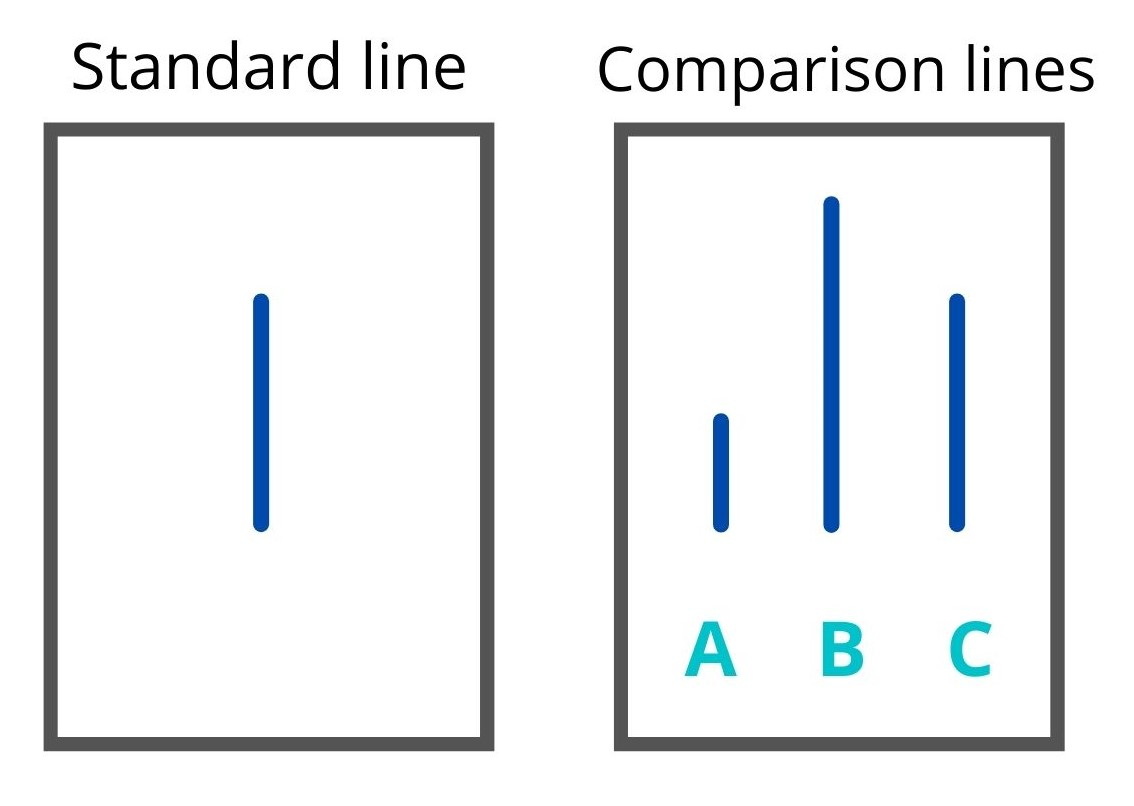
How many lines did Asch use?
3
What was the name given to the lines used?
3 comparison lines & 1 target line
How many participants were used?
123
What was the demographic of participants used?
Male American undergraduates
How many trials did each participant complete and how many were critical trials?
18 trials, of which 12 were critical
How many confederates (stooges) were used?
7
What was the seated position of the real (naïve) participant within the semi-circle?
Penultimate (second-to-last)
The naïve participant gave a wrong answer on what percentage of occasions?
37%
What percentage of participants conformed at least once?
75%
What explanation of conformity did Asch argue was the main reason for conformity?
Normative social influence (NSI)
What are four examples of variations to Asch’s original study?
Group size
Unanimity
Anonymity
Task difficulty
What size group did Asch find conformity levels didn’t increase beyond?
In a group size of 3, conformity increased to 31.8%, but conformity didn’t increase as group size increased → suggests conformity can occur with a small majority
What is meant by unanimity?
Everyone gives the same answer (i.e. it is unanimous)
What did Asch find happened when unanimity was broken with the presence of a dissenter?
Conformity decreased by ¼
What explanation is given for decreased conformity with a dissenter?
The dissenter offers social support, reducing NSI & ISI
How did Asch make the task more difficult?
Made the comparison lines more similar to the target line
What explanation for conformity is associated with task difficulty?
Informational social influence (ISI)
Outline and discuss Asch’s research into conformity (16 marks)
Write your AO1 paragraph
Asch’s three lines study investigated whether participants would conform to a majority view when the correct answer was unambiguous. This involved 3 comparison lines of various lengths, one of which matched a target line.
123 American male undergraduate students were used, each completing 18 trials. 7 confederates were used, with the naïve participant seated in the penultimate position. On 12 critical trials, the confederates gave a unanimous incorrect response.
Results found the naïve participant gave a wrong answer 37% of the time & 75% of participants conformed at least once. Asch concluded that groups exert pressure on individuals to conform to the majority view. As participants referred to the need to avoid ridicule & rejection in interviews afterwards, this supported the view of NSI.
Results found participants gave an incorrect answer 37% of the time & 75% conformed at least once. Asch concluded that groups exert pressure on individuals to conform to the majority view. Interviews conducted afterwards revealed participants conformed to fit in & avoid ridicule & rejection, suggesting NSI.
Asch conducted 4 variations: group size, unanimity, task difficulty, & anonymity. Firstly, conformity increased to 31.8% with a group size of 3, but didn’t increase above this - suggesting conformity can occur when there is a small majority. Secondly, the presence of a dissenter decreased conformity by ¼. Thirdly, conformity increased when the comparison lines were closely matched to the target line, making the answer more ambiguous (testing ISI). Finally, when participants wrote their answers down anonymously (rather than saying aloud), conformity decreased to 12.5%.
Outline and discuss Asch’s research into conformity (16 marks)
Write your strength AO3 PEEL (little ambiguity)
Point: One strength of Asch’s study is that it clearly measured NSI, as there was little ambiguity, compared to alternative research, such as Sherif’s autokinetic effect study.
Evidence: For example, Asch’s study did not involve an ambiguous task, instead it had a clear correct answer (supported by a pilot study where 717 out of 720 trials were answered correctly).
Explanation: This means participants were unlikely to conform due to ISI, suggesting any conformity observed was likely the result of NSI.
Link: Therefore, this increases the internal validity of Asch’s study, as it more accurately isolates the type of social influence being measured.
Outline and discuss Asch’s research into conformity (16 marks)
Write your limitation AO3 PEEL (Perrin & Spencer)
Point: One limitation of Asch’s study is that it suffers from historical bias & low temporal validity.
Evidence: For example, it is considered to be a ‘child of its time’, as it was conducted in 1950s America during the Cold War - a period in time characterised by high conformity rates as people feared being accused as communists.
Explain: Perrin & Spencer replicated Asch’s study using maths & engineering students & found lower conformity rates, with only 1 out of 396 trials showing conformity.
Link: Therefore, this suggests Asch’s study has low test-retest reliability & his findings may not be completely generalisable to the 21st century, as conformity levels change depending on the social & historical context.
Outline and discuss Asch’s research into conformity (16 marks)
Write your limitation AO3 PEEL (low mundane realism)
Point: One limitation of Asch’s study is that it has low mundane realism & may suffer from demand characteristics.
Evidence: For example, participants knew they were in a psychological study & the task of identifying lines was relatively trivial, so there was no reason not to conform.
Explanation: This suggests the findings may not accurately represent how & why people conform in everyday situations (e.g. deciding which political party to vote for or when interacting with friends).
Link: Overall, this means Asch’s study suffers from low ecological validity & his findings may not generalise beyond the setting of a laboratory.