Textiles Exam I Study Cards
 Call Kai
 Learn
Learn Practice Test
 Spaced Repetition
 Match
Match Flashcards
 Knowt Play
1/198

There's no tags or description
Looks like no tags are added yet.
Name | Mastery | Learn | Test | Matching | Spaced | Call with Kai | Chat |
|---|
No analytics yet
Send a link to your students to track their progress
199 Terms
Abrasion resistance
Ability to withstand rubbing.
Absorbency
Ability to take up moisture.
Aesthetics
The look and feel of a textile.
Aging resistance
Ability to resist deterioration or changes associated with aging.
Appearance retention
Ability to maintain appearance during use and care.
Care
Treatment required to maintain a textile product.
Chemical reactivity
How a fiber reacts to chemicals such as acids and alkalis.
Comfort
How a textile performs and feels through use and wear.
Cost
The monetary consideration associated with a textile product.
Cover
Ability of a fiber/fabric to cover or conceal.
Density
Weight of a fiber; specific gravity.
Dimensional stability
Ability to retain size through care.
Drape
The way fabric hangs on a 3-D form.
Durability
Ability to withstand use and wear.
Elastic recovery
Ability to return to original shape after elongation.
Electrical conductivity
Ability to conduct an electrical charge.
Elongation
Ability to stretch without breaking.
Fabric crimp
Waviness created in yarn by the fabric structure.
Fiber chemistry
Chemical composition and structure of a fiber.
Fiber crimp
Waves, bends, or twists along the fiber shaft.
Filament fibers
Long fibers with no visible fiber ends and little/no pilling.
Flammability
How a fiber responds to flame or burning.
Flexibility
Ability to bend repeatedly without breaking.
Hand
How a fiber or fabric feels to the touch.
Heat conductivity
Ability to transfer heat.
Heat retention
Ability to hold heat.
Heat sensitivity
How a fiber responds to high temperatures.
Hydrophilic
Water-loving; readily attracts/takes up moisture.
Hydrophobic
Water-fearing; resists moisture.
Insect resistance
Ability to resist damage from insects.
Light resistance
Ability to resist damage from light/UV exposure.
Loft
Ability to maintain or recover bulk/thickness.
Luster
How light is reflected from a fiber or fabric.
Manufactured fibers
Fibers produced through manufacturing; sources may include petroleum or materials from nature.
Mildew resistance
Ability to resist mildew/fungal damage.
Monofilament
A filament yarn made from one filament.
Multifilament
A filament yarn made from multiple filaments.
Natural fibers
Fibers from natural sources such as plants and animals.
Oleophilic
Oil-loving; attracted to oils.
Performance
How a textile behaves.
Pilling
Fiber-ball formation on a fabric surface caused by abrasion.
Resiliency
Ability to resist/recover from deformation, crushing, or creasing.
Safety
Ability of a textile to perform without creating unacceptable hazards.
Serviceability
How well a textile performs for its intended end use.
Shrinkage resistance
Ability to resist a decrease in dimensions during use or care.
Smooth filament fibers
Filament fibers with a smooth, relatively straight surface.
Staple fibers
Short fibers with visible fiber ends; can pill and lint.
Strength
Ability to withstand a pulling force; tenacity.
Sustainability
Consideration of environmental and resource impacts associated with textiles.
Texture
Surface characteristics.
Textured filament fibers
Filaments modified to add texture, bulk, or crimp.
Wicking
Movement of moisture along or through a textile.
Staple fiber length
Short; measured in inches/cm; fiber ends visible; associated with pilling and lint.
Filament fiber length
Long; measured in yards/meters; no fiber ends; little/no pilling.
Which natural fiber is the exception and occurs as a filament?
Silk.
What yarn type is made from staple fibers?
Spun yarn.
What yarn type is associated with long continuous fibers?
Filament yarn.
What effect does a larger fiber diameter have?
Increased abrasion resistance and bulk.
What effect does a smaller fiber diameter have?
Increased drape and softer hand.
What does cross-sectional shape influence?
Luster, cover, hand, texture, and bulk.
What is surface contour?
The outside shape and characteristics of a fiber.
What influences surface contour?
Cross-sectional shape.
What is fiber crimp?
Waves, bends, or twists along the fiber shaft.
What does greater/3-D crimp increase?
Texture, bulk, resiliency, and cohesion.
What is associated with a linear fiber?
More luster, better drape, and smoother hand.

🖼️ Identify: linear fiber
High luster/drape; smooth hand; low bulk/cohesion.

🖼️ Identify: 2-D crimp
Moderate properties.
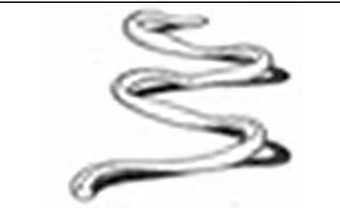
🖼️ Identify: 3-D crimp
High texture, bulk, resiliency and cohesion; soft hand.
Orientation
Molecular arrangement relative to the fiber's lengthwise axis.
Amorphous orientation
Random polymer arrangement.
Oriented structure
Polymers arranged parallel to the fiber length.
What properties increase with an amorphous arrangement?
Absorbency, elongation, and thermal retention.
What happens to strength in an amorphous arrangement?
Strength decreases.
What properties increase with orientation?
Strength and abrasion resistance.
What properties decrease with orientation?
Absorbency and elongation.
Crystallinity
Molecular chains arranged parallel to each other.
What properties are associated with crystalline AND oriented structure?
Increased strength and abrasion resistance.
Drawing
Pulling/stretching a fiber to increase orientation and crystallinity.
What does drawing increase?
Length, strength, and abrasion resistance.
What does drawing decrease?
Diameter, absorbency, and elongation potential.
Protein fibers
Natural fibers composed of amino-acid protein polymers.
Examples of the Big Four protein fibers
Wool and silk.
Protein fiber absorbency
GOOD; moisture regain approximately 11–18%.
Protein fiber elasticity
GOOD.
Protein fiber resiliency
GOOD.
Protein fiber tenacity
LOWER.
Protein fibers when wet
Lower wet strength.
Protein fiber abrasion resistance
POOR.
Protein fiber dimensional stability
POOR, especially wool.
Protein fiber UV/weather resistance
POOR.
Protein fiber resistance to chlorine bleach/oxidizing agents
POOR.
Protein fiber resistance to alkalis
POOR.
Protein fiber resistance to dry heat
POOR.
What insects can damage wool?
Moths and carpet beetles.
Cellulosic fibers
Natural plant fibers composed primarily of cellulose.
Examples of the Big Four cellulosic fibers
Cotton and linen.
Cellulosic absorbency
GOOD; moisture regain approximately 7–12%.
Are cellulosics hydrophilic?
Yes.
Cellulosic tenacity
MODERATE to STRONG.
What happens to cellulosic strength when wet?
Increases approximately 10–30%.