Bacterial DNA Replication
 Call Kai
 Learn
Learn Practice Test
 Spaced Repetition
 Match
Match Flashcards
 Knowt Play
1/36

There's no tags or description
Looks like no tags are added yet.
Name | Mastery | Learn | Test | Matching | Spaced | Call with Kai | Chat |
|---|
No analytics yet
Send a link to your students to track their progress
37 Terms
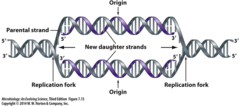
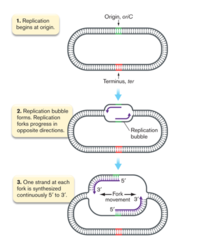
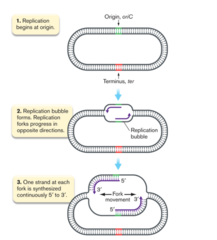
20; 40; There are two replications occurring at once on the circular chromosome. On copy leaves origin and goes one way and another replication also starts at the origin and goes the other way. SO when one is halfway, the other one could only be a quarter done copying. But, when division occurs, only one replication is done completely. This means when cells inherit a chromosome, they actually inherit like 1.5 or 1.25 chromosome, so they don't have to take the whole 40 minutes to copy, bc it is already partially copied.
-E.coli have a doubling time of about ___ minutes.
-But, it takes ___ minutes just to copy its chromosome.
But dna replication is part of cell division, so how is this possible?
3' OH group
An RNA primer has a __' ____ end which is required as a starting point for DNA polymerase to add nucleotides
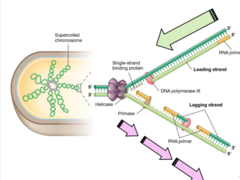
single strand binding proteins
code single strands and protect exposed single strands from attack from nucleases
5' to 3'
direction of DNA synthesis
okazaki fragments
the lagging strand is built in fragments called
helicase; topoisomerase II;
a positive supercoil on both ends
Enzyme responsible for separating two strands from each other? What relieves the tension on both ends? What does this cause?
DNA polymerase III
Which enzyme adds nucleotides to the growing strand on DNA? (elongation)
primase
DNA pol needs a starting point to add nucleotides. DNA _______ makes primer, a tiny piece of RNA, that is complementary to the DNA which allows the start.
Advantage: RNA polymerase does NOT require a starting point for adding nucleotides.
Disadvantage: you will have RNA in your genomes.
Name and advantage and disadvantage to using RNA polymerase
DNA & RNA polymerase can only add nucleotides to the 3' end
One strand is copied in fragments using okazaki fragments, why does it have to do this?
DNA ligase; If a cell does not have ligase, the fragments will never be connected
What enzyme would you choose for a cell to stop making so that you could find if the cell uses fragments in part of its replication?
3'
DNA polymerase III adds nucleotides to the ___ end of the growing dna strand. (elongation)
semiconservative.
Replication of cellular DNA in most cases is _____-Daughter cell receives one parental and one newly synthesized strand.
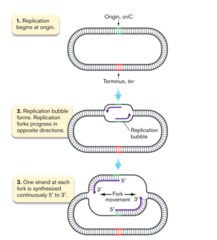
bidirectional
Replication is _____
-Start at a fixed origin and progress in opposite directions
In the cell, DNA bases are added only to a preexisting 3′ OH of a nucleoside monophosphate
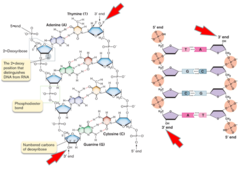
5′-to-3′
okazaki fragments
If polymerases can synthesize DNA only in a __ to __ direction and the two backbones of the double helix are antiparallel, then how are both strands of a moving replication fork synthesized simultaneously
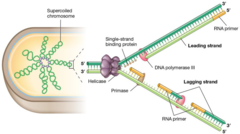
Refer to the textbook.
Pages 249 - 250
-Involves two proteins
1. SeqA
2. DnaA
What determines when replication begins?
origin (oriC).
Replication in bacteria begins at ____
DnaA
binds to the origin of replication and is responsible for the initial steps in unwinding the helix
DnaA
Initiator protein, binds oriC
Primase
DnaB/Helicase
DNA pol III
What enzymes help replication occur bidirectionally?
primase
An enzyme that joins RNA nucleotides to make the primer using the parental DNA strand as a template.
DNA primase
synthesizes RNA primer
DnaB helicase
unwinds DNA double helix
DNA polymerase III
major replication enzyme; synthesizes new DNA only in the 5' to 3' direction
DNA polymerase I
replaces RNA primer with DNA
DNA ligase
joins Okazaki fragments
DNA gyrase
relieves DNA supercoiling
5' to 3'
New DNA strand is always synthesized ___ to __direction
leading strand
the new complementary DNA strand synthesized continuously along the template strand toward the replication fork in the mandatory 5' to 3' direction
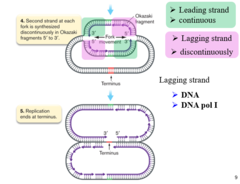
lagging strand
A discontinuously synthesized DNA strand that elongates by means of Okazaki fragments, each synthesized in a 5' to 3' direction away from the replication fork.
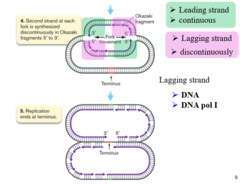
Lagging strand synthesis
- Discontinuous synthesis
• DNA pol III
- RNA primer made by primase for each Okazaki fragment
- All RNA primers removed and replaced by DNA
• DNA pol I
- Backbone sealed
• DNA ligase
•Termination occurs at specific site - DNA gyrase unlinks 2 copies
3. DNA polymerase
4. primase; DNA polymerase
5. DNA
6. DNA ligase
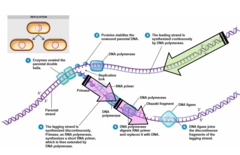
DNA replication fork:
1. enzymes unwind double helix.
2. Proteins stabilize the unwound parental DNA.
3. the leading strand is synthesized continuously by ________.
4. the lagging strand is synthesized discont. _______, an RNA polymerase, synthesizes a short RNA primer, which is then extended by _______.
5. DNA polymerase digests RNA primer and replaces it with _____.
6. ______ joins the discontinuous fragments of the lagging strand
ten;
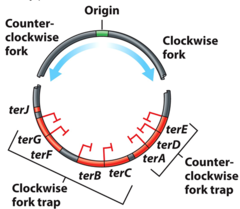
Tus (terminus utilization substance)
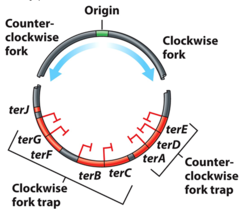
There are as many as ____ terminator sequences (ter) on the E. coli chromosome.
-________ protein binds to ter and acts as a counter-helicase.
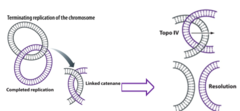
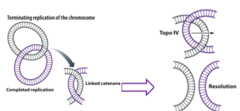
catenanes; topoisomerase IV and XerCD
Terminating replication:
Ringed _____ formed at the completion of replication are separated by ____ and ____ proteins.
On an e. coli chromosome, Replication forks moving clockwise are trapped by terJ, terG, terF, terB, and terC. Counterclockwise-moving forks are trapped by terA, terD, and terE.
Toposomerase IV
Resolution of DNA replication catenanes:
.________ catalyzes a breaking and re-joining event (like DNA gyrase) that passes the chromosomes through one another, resolving the link.