Limiting water loss and structure of human gas-exchange system
 Call Kai
 Learn
Learn Practice Test
 Spaced Repetition
 Match
Match Flashcards
 Knowt Play
1/8

There's no tags or description
Looks like no tags are added yet.
Name | Mastery | Learn | Test | Matching | Spaced | Call with Kai | Chat |
|---|
No analytics yet
Send a link to your students to track their progress
9 Terms
How do insects limit water loss
small surface area to volume ratio - minimise area over which water is lost
waterproof coverings - chitin covered in a waterproof cuticle
spiracles - openings of the tracheae at body surface that can be closed to reduce water loss
What are xerophytes?
plants that are adapted to living in areas where water is in short supply
Plant modification to reduce water loss
thick cuticle - waterproof barrier
rolling up of leaves - traps a region of still air within the rolled leaf which is saturated with water vapour so there is no water potential gradient
hairy leaves - traps moist air next to leaf surface
stomata in pits - traps still, moist air
reduced surface area to volume ratio of leaves - slower rate of diffusion
Gas exchange system components
alveoli
bronchioles
bronchi
trachea
lungs
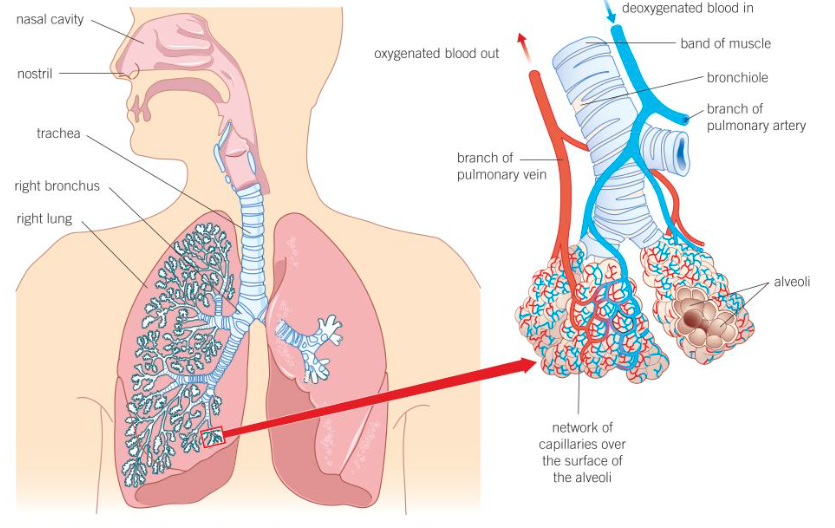
Lungs
pair of lobed structures made up of a series of highly branched tubules called bronchioles which end in tiny air sac called aleoli
Trachea
flexible airway supported by rings of cartilage
walls made of muscle lined with ciliated epithelium and goblet cells
Bronchi
two divisions of the trachea
produce mucus to trap dirt particles
have cilia that move dirt-laden mucus towards throat
Bronchioles
branching subdivisions of bronchi
walls made of muscle lined with epithelial cells
muscle allows them to constrict so they can control flow of air in and out the alveoli
Alveoli
minute air sacs at end of bronchioles
lined with epithelium
stretch (elastic fibres) when breathing in
spring back during breathing out