EXAM FC
 Call Kai
 Learn
Learn Practice Test
 Spaced Repetition
 Match
Match Flashcards
 Knowt Play
1/41

There's no tags or description
Looks like no tags are added yet.
Name | Mastery | Learn | Test | Matching | Spaced | Call with Kai | Chat |
|---|
No analytics yet
Send a link to your students to track their progress
42 Terms
Role of the cardiovascular system:
primary transport system the body, pumping blood daily
Right Side of the Heart
Right Side:
Right Atrium
Right Ventricle
contains deoxy blood
low pressure
sends blood to the lungs to get O2
Left Side:
Left Atrium
Left Ventricle
Contains Oxy Blood
High Pressure due to greater Blood volume
Pushes blood to whole body
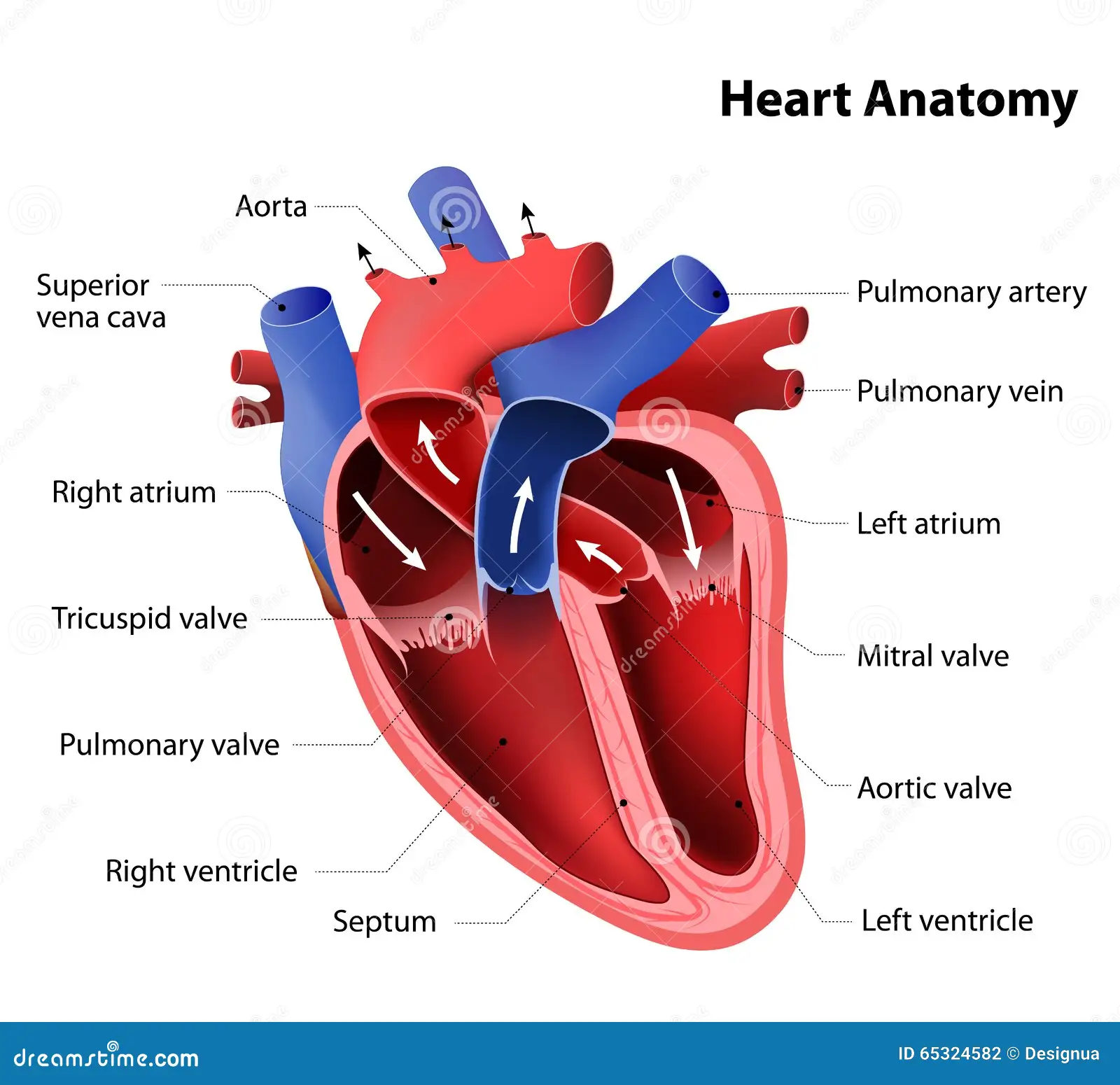
Heart Valves
ensure blood is travelling in one direction based on pressure gradients
prevents backflow
Why is Left side of heart more thicker?
Left ventricle pumps blood around the whole body
Higher Pressure required and more muscle required cox a large amount of blood
t only pumps blood to the lungs and is a low pressure system.
Tricuspid Valve?
RA → RV
Pulmonary Valve
RV → pulmonary artery
Mitral (Bicuspid) Valve
LA → LV
Aortic Valve
LV → Aorta → Body
Describe the Cardiac Cycle?
The events happening during one heartbeat
atria contract → ventricles fill → end diastolic volume reached = atria systole
Ventricles contract → pressure rises → all valves close → volume no change = isovolumetric ventricular contraction
Ventricular pressure is more than arterial pressure → semilunar valves aorta + pulmonary open → blood ejected which is stroke volume = Ventricular Systole
Ventricles Relax → less pressure → less valves closed → volume unchanged = Isometric relaxation
Ventricular pressure is less than arterial pressure → atrioventricular valves open (mitral and bicsupid) → ventricle fill with blood
cycle repeats
Stroke Volume?
The amount of blood ejected from the ventricles
SV = diastolic - systolic volume
Cardiac Output
Amount of blood pumped per minute
CO = SV x HR
e.g. HR = 70bpm SV = 70mL
CO- 70 × 70 = 4900 Ml/min
4.9L/min
Factors that affect CO
Preload
Frank Stirling Mechanism
Contractility
Afterload
What is Venous Return?
flow of blood from body back to the right side of the heart
How does Preload affect CO
Definition: stretch of the heart before contract
Affected by: Venous Return and EDV
higher preload → more stretch → stronger contractions → higher SV → higher CO
How does the Frank Starling Mechanism effect CO
Def: more filling causes an increased force of contraction
more stretch → more actin-myosin cross bridges
stretch increases Ca2+ sensitivity
more EDV = mote stretch → more force → more SV → more CO
How does Contractility affect CO?
force of contraction due to external factors such as NA
more force → more SV → more CO
Afterload
resistance the heart must overcome to pump blood into the body
resistance ventricles must overcome to eject blood
Hypertension → heart works faster → less blood ejected → less SV → Less CO
What is Automaticity?
Ability of cardiac cells to generate spontaneous a.p.
unique ability to pacemaker cells
Describe the structure of the Heart
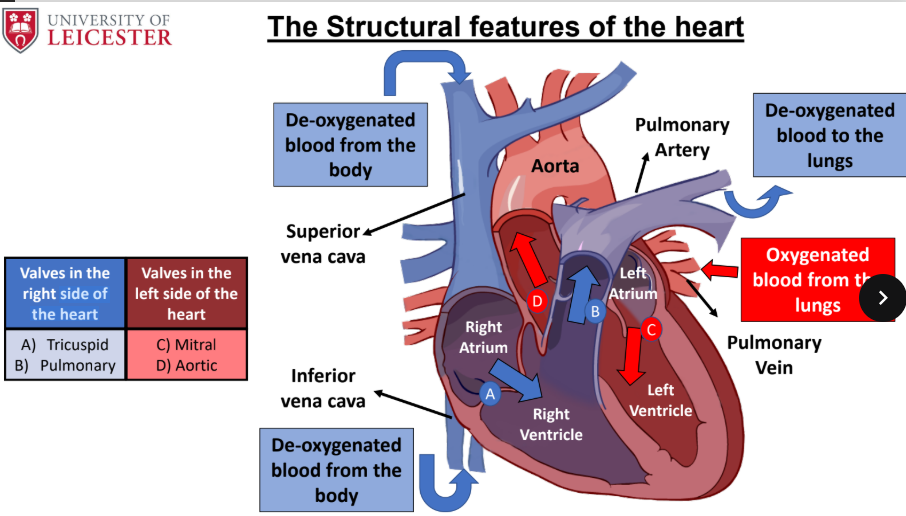
Electrical signals from the Heart
generates and converts electricity into contractions
spread through heart → cardiac muscle depolarise → ca2+ influx → muscle contracts → blood pumped
What does myogenic mean?
The heart generates its own electrical activity w/o nervous system
Cardiac Muscles cells are connected by
intercalated discs - allow for spread of electrical signals between cardiac myocytes
gap junctions - allow ions to spread electrical signal rapidly from one cell to another
NS changes how fast or strong Heart beat is
Where does the electrical signal travel?
SA Node - hearts natural pacemaker in the RA
Atrial Muscles
AV Node - delays the conduction = alllow ventricles to fill up before contracting
Bundles of His
Bundle Branches - fast conduction network delivering electrical impulse and allow both ventricles to contract at same time
Punkenje Fibres
Ventricular Muscles
Factors that affect the Heart Rate
Intrinsic rate of SAN
Extrinsic factors - autonomic nervous system
Why is the AV Nodal delay important?
allows for the ventricle to be filled up before it contracts
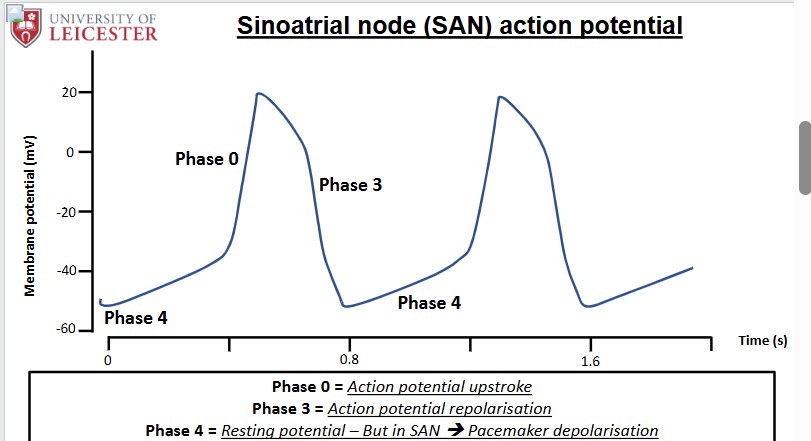
Sino Atrial A.P. Graph?
There is no stable m.p.
Action Potential happens in 3 parts
Phase 4 → depolarisation (relationship between depolarising current and K+ efflux)
Phase 0 → L type Ca2+ influx
Phase 3 → K+ efflux
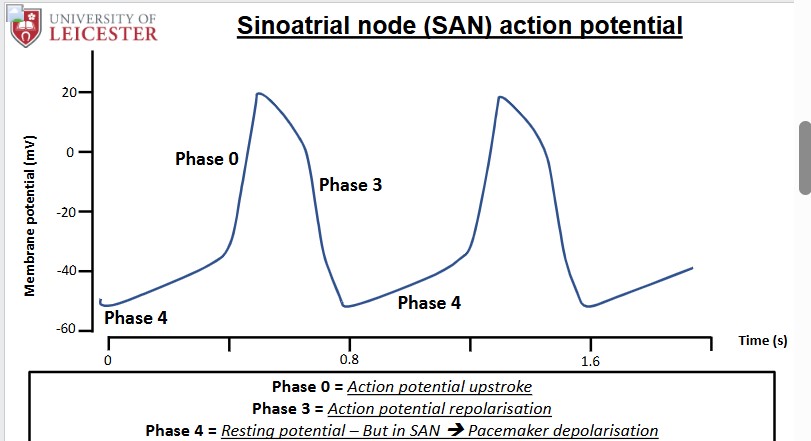
SAN A.P. Phase 4
Pacemaker Depolarisation
M.P. from -60mv to -30mv
membrane slowly depolarises it self
caused by 4 currents
Funny Current
occurs through the HCN channels
Na+ influx and K+ efflux at the same time
NCX Current
3 na+ ions for every ca2+ ion it removes
net (+) charge = depolarisation
Potassium Current
efflux of K+
hyperpolarisation
Ca2+ channels
influx of Ca2+ ions
depolarisation
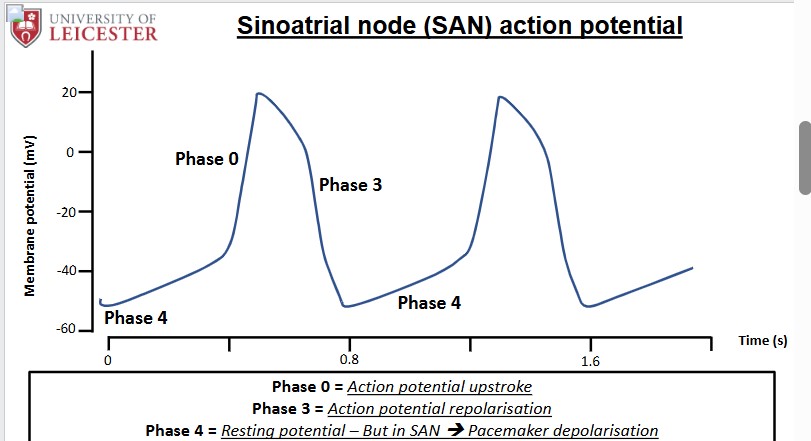
SAN A.P. Phase 0
Upstroke
from -30mv to 20mv
rapid depolarisation
caused by influx of ca2+ through L type Ca2+ channels
SAN A.P. Phase 3
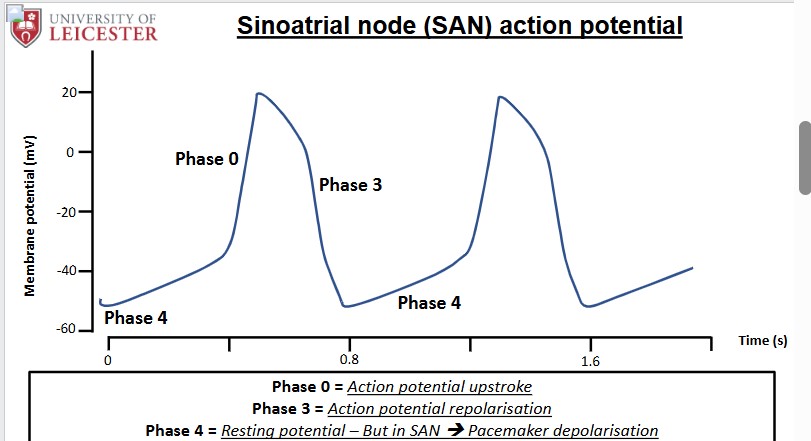
Repolarisation
efflux of K+ ions via channels
goes back to -60mv
Ventricular A.P. Graph
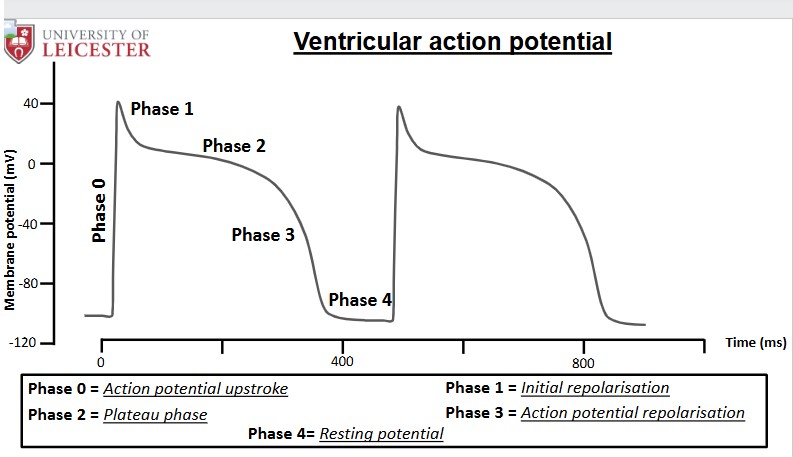
Phase 0: rapid Na+ influx = fast depolarisation
Phase 1: brief k+ efflux = small initial repolarisation
Phase 2: Plateau Phase
ca2+ influx and K+ efflux are equal
m.p. remains constant
allows for ventricle contraction
Phase 3: K+ efflux = repolarisation
Phase 4: Stable m.p. around -85mv
Compare SA A.P. and Ventricle A.P.
SA
Automatic A.P.
3 phases
Phase 0 = Ca2+ influx
No resting M.P.
pacemaker
Ventricle
Not automatic
5 phases
Phase 0 = Na+ influx
Stable M.P.
Contractile Cell
What is CICR
Calcium Induce Calcium Release
How electrical activity = contraction via Ca2+
Ventricular A.P. reaches T tubules → L type Ca2+ channel open → small amount of Ca2+ influx → Ca2+ activates Ryanodine Receptor (RyR) on the SR → releases higher conc of Ca2+ → Ca2+ influx → actin myosin cross bridges formation → contractions
How is Calcium Removed to make relaxed
SERCA
pumps Ca2+ back into SR → less Ca2+ → muslce relaxes
What is the Autonomic Nervous System
Automatic Bodily functions
Split into
Parasym
Sympa
What is the role of the parasympathetic NS
Rest and Digest → Conserve energy
slows HR (negative chronotropic effect)
lessens contracting force (negative inotropic effect) → less SV
less automacity → SA a.p. threshold is met slower → less a.p. firing
More AV delay → Ventricles receive electrical impulse slower → slower contractions
What is the role of the sympathetic NS?
Fight or Flight → preps body for action
increases HR (positive chronotropic effect)
Increases contracting force (positive inotropic effect) → higher SV
higher automacity → SA threshold met faster → more a.p. fired
Less AV conduction delay → ventricle receive electrical impulse quicker → faster contractions
How does the Sympathetic NS prep the Heart for Fight or Flight?
Sympa Nerve releases NA → binds to Beta 1 receptors → activate Gs → GDP to GTP → adenyl cylase → ATP to cAMP → PKA → phosphorylates Ca2+ channels → more Ca2+ → more MLCK → actin myosin cross bridges form → contractions → positive chronotropic
Sympa Nerve releases NA → binds to Beta 1 receptors → activate Gs → GDP to GTP → adenyl cylase → ATP to cAMP → increase Funny current → increases phase 4 depolarisation → threshold reached sooner → faster HR
How does the Parasym prep the heart to conserve energy?
Parasym nerve → release ACh → bind to muscarinic receptors → activate Gi → inhibit adenyl cylase → less cAMP → less PKA → less ca2+ → less MLCK → less contractions → less HR → negative chronotropic
Parasym nerve → release ACh → bind to muscarinic receptors → activate Gi → inhibit adenyl cylase → less cAMP → less HCN channels open → less funny currents → slower Phase 4 → threshold met later → slower HR
What is Vagal tone?
Slows down the SA node intrinsic firing for resting HR
mediated by vagus nerve in parasymp
How would Beta 1 Blockers effect HR
drug: Propanalol
Block Beta 1 receptors → adrenaline cannot bind → no Gs activation → no cAMP → less funny current → less Ca2+ → Less Heart rate
How do muscarinic antagonist effect HR
Drug: atropine
block the M2 receptor → ACh cannot bind → cAMP produced → more Ca2+ → contractions → more funny currents → increased Heart Rt=ate
What do Cardiac Glycosides do for contractions?
DIGOXIN
inhibit Na+/K+ ATPase Pump
normally pumps put 3 NA+ out and 2K+ in
Digoxin blocks this pump → NA+ build up in cell
more NA+ → less sodium gradient so Ca2+ remains in the cell in the SR
More CA+ releases during each heart beat → stronger contractions (positive inotropic)
What do digoxin do for heart rate
slow down HR by increasing vagal tone
slows down SA node firing
slows down AV node conduction