w1-social influence
 Call Kai
 Learn
Learn Practice Test
 Spaced Repetition
 Match
Match Flashcards
 Knowt Play
1/16

There's no tags or description
Looks like no tags are added yet.
Name | Mastery | Learn | Test | Matching | Spaced | Call with Kai | Chat |
|---|
No analytics yet
Send a link to your students to track their progress
17 Terms
what is social influence?
When others actively express opinions, judgments, or expectations, they don’t just affect our arousal — they shape our beliefs, perceptions, and decisions.
what is norm formation?
People gradually develop a shared group norm when they are in an ambiguous situation and look to others for guidance. This happens through informational influence — the belief that others’ judgments are more accurate than one’s own.
Norm formation (Sherif, 1935)
The situation is ambiguous → no obvious correct answer.
Individuals observe others’ responses.
They shift their own judgement toward the group.
Over time, everyone’s answers converge.
The shared norm becomes internalised → people stick to it even when alone
Sherif Autokentic study(1935)
Participants sat in a dark room and looked at a stationary point of light.
Because of tiny eye movements, the light appears to move — this is the autokinetic illusion.
Important:
There is no real movement.
People genuinely don’t know how far the light “moved.”
Because the movement is ambiguous, people rely on internal judgment.
✔ What he found
Individuals first form their own estimate — Alone, people give different answers about how far the light moved.
In groups, estimates converge — When placed with others, people’s judgments shift toward a shared group norm.
The norm persists — Even when later tested alone, people stick to the group norm.
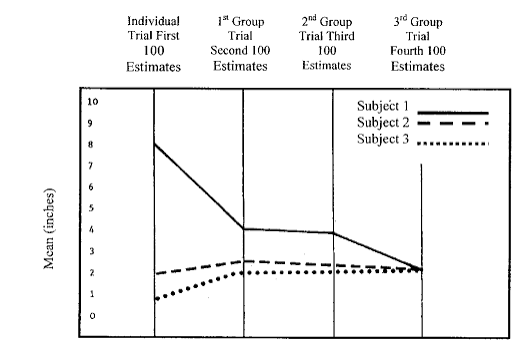
critical eval of autokenetic study
1. High internal validity — but only for informational influence
The autokinetic effect is a genuinely ambiguous task, meaning participants must rely on others.
This makes it a clean test of informational influence, because:
There is no correct answer.
No pressure to conform.
No obvious social cost for disagreeing.
Strength: The design isolates informational influence very well.
Limitation: Because the situation is artificially ambiguous, it tells us little about how people behave when the correct answer is clear (contrast with Asch).
informational social influence
Informational social influence is a psychological phenomenon where people conform to a group because they believe the group has accurate information and they want to be correct
what is the outcome of informational social influence
Internalisation (private acceptance)
normative social influence
people conform to avoid standing out, being ridiculed, or being rejected. conform to be liked
majority influence - Asch(1951)
Majority Influence — Asch (1951)
✔ What Asch studied
Asch removed ambiguity. He used a simple line‑length judgment task where the correct answer was obvious.
Participants sat with 6–8 confederates who intentionally gave wrong answers.
✔ What he found
Participants conformed to the majority on 37% of trials.
75% conformed at least once.
Even though the answer was clearly wrong, people went along with the group.
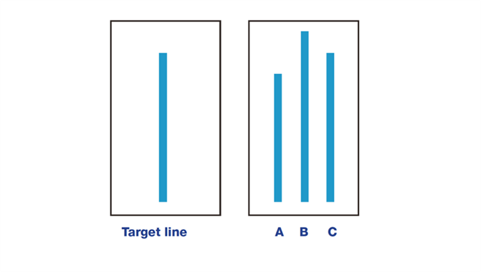
critical eval of Asch 1951
1. High control but low realism
Asch’s line‑judgment task was tightly controlled:
Clear correct answer
Standardised confederate responses
Same procedure for all participants
Strength: High internal validity — we can be confident conformity was caused by group pressure.
Limitation: The situation is highly artificial.
People rarely sit in a room making line judgments with strangers.
This reduces ecological validity.
what is the outcome of normative social influence
Compliance (public acceptance).
what is minority influence? and what makes it different to majority influence?
Minority influence occurs when a small group (or even one person) changes the attitudes, perceptions, or behaviours of the majority.
Unlike majority influence (Asch), which works through pressure, minority influence works through conversion — deeper, internal change.
what is the outcome of minority influence?
Conversion → deep, private, lasting change.
Minority influence model (Moscovici, 1969)
Conditions for effective minority influence
} Minorities should display
} Consistent argument – The minority must repeat the same message over time and within the group.
} Investment – Minorities must show they are dedicated — e.g., personal sacrifice, effort, or risk.
} Autonomy - The minority must appear unbiased, not motivated by personal gain. They must seem to act from principle
} Balance between rigidity and flexibility
Too rigid → seen as dogmatic, unreasonable
Too flexible → seen as weak, inconsistent The minority must show reasoned negotiation, not stubbornness.
what is a real life example of minority influence
The Suffragettes demonstrated:
Consistency → same message for decades
Commitment → personal sacrifice, imprisonment, hunger strikes
Autonomy → principled, independent movement
Balanced flexibility → mix of militant and legal tactics
Conversion → long‑term change in societal attitudes
They transformed from a small minority into a majority‑accepted social norm, exactly as Moscovici’s theory predicts.
Moscovici blue-green study 1969
✔ Setup
Groups of 6 people:
4 genuine participants
2 confederates (the minority)
They viewed 36 blue slides that varied slightly in brightness and had to say the colour out loud.
✔ Minority manipulation
The 2 confederates consistently called the blue slides “green.”
✔ Results
Average conformity = 8.5% Participants said “green” on 8.5% of trials.
Baseline (no minority) = <0.5% When no minority was present, almost nobody ever said “green.”
⭐ Why this matters
Even a small, consistent minority can shift the majority’s perception — not just their behaviour.