26 27 Non-infectious Diseases of the Equine Nervous System 1 and 2
 Call Kai
 Learn
Learn Practice Test
 Spaced Repetition
 Match
Match Flashcards
 Knowt Play
1/85

There's no tags or description
Looks like no tags are added yet.
Name | Mastery | Learn | Test | Matching | Spaced | Call with Kai | Chat |
|---|
No analytics yet
Send a link to your students to track their progress
86 Terms
Polyphasic pattern. 3 hrs of slow wave sleep per day standing or recumbent, 20-30 mins of REM sleep in lateral recumbency
What is normal horse sleep like?
Sleep deprivation
This simply refers to a lack of adequate sleep, excessive daytime sleepiness, collapse, and unexplained abrasions of the carpi and fetlocks
Narcolepsy/cataplexy
This refers to a sleep disorder where there is excessive daytime sleepiness with OR without collapse induced by triggers
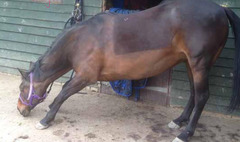
Narcolepsy, sleep deprivation, cataplexy
Name some things which could be happening in this horse
NSAIDs or imipramine (antidepressant)
How do you treat catalepsy or narcolepsy?
Provocation test (physostigimine)
How do you diagnose narcolepsy?
Seizure
This is a manifestation of abnormal electrical activity of the brain
Generalized and Localized
What are the two different types of seizures
Generalized
This type of seizure is described as tonic/clonic with involuntary recumbency, loss of consciousness, and post ictal blindness and depression
Localized
This type of seizure is more subtle, and may or may not have postictal signs
Intracranial and extracranial
What are the two triggers for seizures in adult horses
Extracranial
Metabolic problems like hepatoencephalopathy, hypocalcemia and uremia are causes of *intracranial* or *extracranial* seizure causes?
Intracranial
Traumatic problems, vascular (strongylus, Intracarotid injection), tumors, and infections (EPM, rabies) are examples of *intracranial* or *extracranial* seizure causes?
Arabs
Which horses mostly need genetic tests to diagnose seizures
Diazepam, Phenobarb, Potassium bromide
How do you treat seizures?
Intracarotid injection
This special cause of a seizure occurs when a drug goes to the brain, happens so acutely the animal seizes "under the needle". Often, the only thing you can do is protect yourself and attempt to calm the reaction with diazepam
Reaction to procaine penicillin
This special cause of a seizure occurs when a specific medication that normally goes IM is accidentally injected into a vessel. The horse has an immediate reaction: spooking, circling, snorting, banging in stall, and eventually seizing where the best you can do is attempt to calm the reaction with diazepam
If water soluble: horse may stand within the hour and be clinically normal in 1-7 days
If oil/insoluble: horse may die
What is the difference between a water soluble drug versus an insoluble/oil based drug being injected intracarotid?
Arabian foal noninfectious diseases
Juvenile Idiopathic Epilepsy, Lavender foal syndrome, OAAM (occipito-atlanto-axial malformation), and cerebellar abiotrophy are all examples of?
a. Juvenile Idiopathic Epilepsy
b. Lavender foal syndrome
d. OAAM (occipito-atlanto-axial malformation)
e. cerebellar abiotrophy
Select the arabian foal noninfectious diseases:
a. Juvenile Idiopathic Epilepsy
b. Lavender foal syndrome
c. Bronchopneumonia
d. OAAM (occipito-atlanto-axial malformation)
e. cerebellar abiotrophy
f. lymphonodular hyperplasia
Juvenile Idiopathic Epilepsy
This autosomal dominant arabian foal disease comes from the egyptian lineage, seen at 2 days to 6 months of age (the foals outgrow it after this).
CAUSES tonic clonic seizures and a normal foal between episodes
FALSE: juvenile idiopathic epilepsy in arabian foals is NOT DEADLY because the animal outgrows it by 6 months AND there is *NO genetic test*
TRUE OR FALSE: Juvenile idiopathic epilepsy in Arabian foals is deadly, but often preventable with a genetic test.
1. Cerebellar abiotrophy = neurologic
2. Lavender foal syndrome = neurologic
3. SCID
4. OAAM (occipitoatlantoaxial malformation) = neurologic
Name the genetic diseases tested for on the Arabian health panel. Which of these are neurologic?
Lavender foal syndrome
This disease causes arabian foals with the recessive genes to be born with a dilute coat color, often brown-purple in color
FALSE: while there IS a genetic test for Lavender foal syndrome, the disease is *FATAL* to foals.
TRUE OR FALSE: Lavender foal syndrome in arabians is often outgrown, though there is a genetic test to diagnose it.
Lavender foal syndrome
This syndrome of arabian foals causes repeated seizures, hyperextension, paddling and IS FATAL
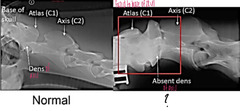
Occipitus (base of skull), Atlas (C1), Axis (C2)
Name the places the malformations occur in in Arabian foals with OAAM
1. Juvenile Idiopathic Epilepsy = dominant
2. Lavender foal syndrome = recessive
3. OAAM (occipito-atlanto-axial malformation) = recessive
4. cerebellar abiotrophy = recessive
Name the dominant and recessive disorders of Arabian foals:
OAAM (occipito-atlanto-axial malformation)
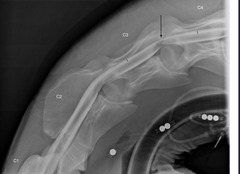
An arabian foal has abnormal head neck carriage, brainstem compression, hyperreflexia, hypertonia, weakness, ataxia in all 4 limbs, and has a click when palpated. He looks like this. Thoughts?
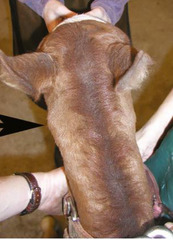
OAAM (occipito-atlanto-axial malformation) in Arabian foal
What is this showing?
Cerebellar abiotrophy
This neurodegeneration in arabian foals occurs AFTER the formation of the cerebellum, showing apoptosis of the Purkinje cells
Cerebellar abiotrophy
An arabian foal presents normal at birth, but at 6 months of age, shows intention head tremor, ataxia such as wide base stance, dysmetria, spasticity, startles easily, and has a lack of menace. Thoughts?
Normal MRI = B
Cerebellar abiotrophy = A
Which of these is normal? What does the abnormal show?
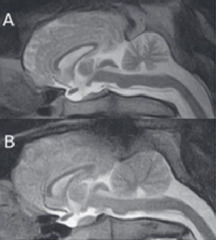
Brain on the left shows a foal with cerebellar abiotrophy, brain on the right is a normal cerebellum
Which of these is normal? What does the abnormal show?
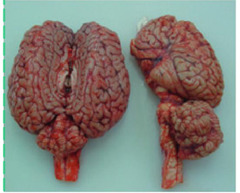
1. Juvenile Idiopathic Epilepsy: onset 2 days-6 mo. = outgrows it
2. Lavender foal syndrome: signs at birth
3. OAAM: signs at birth
4. Cerebellar Abiotrophy: onset 1-6 mo.
What is the difference in onset between all 4 Arabian foal abnormalities?
1. Juvenile Idiopathic Epilepsy: good = grows out of it
2. Lavender foal syndrome: death
3. OAAM: poor
4. Cerebellar Abiotrophy: poor
What is the difference in prognosis between all 4 Arabian foal abnormalities:
Shivers
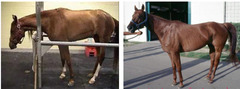
This is a chronic progressive equine movement disorder of horses that presents with difficulty moving backwards, hyperflexed limbs postures, and tremors during backward movement. The horse may also have a hard time picking up the feet for the farrier
Shivers
What is happening to this horse: showing hyperextension, hyperflexion and abduction, shivering hyperflexion, and shivering forward flexion
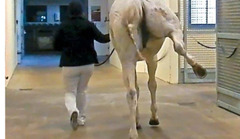
Shivers
In horses, what is caused by neuroaxonal degeneration of deep *cerebellar* nuclei
eNAD (equine neuroaxonal dystrophy) and EDM (equine degenerative myeloencephalopathy)
note: these two are not the same thing, but they are two different forms of the same inherited disease in horses
In horses, what problem is caused by an abnormality of neurons in the brainstem and spinal cord?
1. genetic predisposition (signs in first year of life)
2. environmental trigger: lack of vitamin E
What two factors are involved in horses developing eNAD (equine neuroaxonal dystrophy) and EDM (equine degenerative myeloencephalopathy)?
Ataxia with lack of vitamin E
What is the classic description of eNAD (equine neuroaxonal dystrophy) and EDM (equine degenerative myeloencephalopathy)?
Vitamin E deficiency
Heat treated, pelleted feed and horses on dry lots with low quality hay are poster children for WHAT?
eNAD (equine neuroaxonal dystrophy) and EDM (equine degenerative myeloencephalopathy)
A 2 year old horse presents with acute/insidious symmetric ataxia in the pelvic limbs. It has wide based posture, behavior changes, decreased performance, and hypometria. The slap test is decreased and so is cutaneous trunci reflex. You see the horse is in a dry lot and the owner is only giving the horse hay and pelleted feed. After testing the hay, you see it is low quality. Thoughts
Behavior changes, decreased performance, and older than 12 months of age
Name the signs typical of eNAD (equine neuroaxonal dystrophy) and EDM (equine degenerative myeloencephalopathy)?
NO ANTEMORTEM. Diagnosis of exclusion and low vitamin E
How do you diagnose eNAD (equine neuroaxonal dystrophy) and EDM (equine degenerative myeloencephalopathy)?
Vitamin E (water soluble tocopherol).
DO NOT RIDE OR BREED
How do you treat eNAD (equine neuroaxonal dystrophy) and EDM (equine degenerative myeloencephalopathy)? What do you tell the owner?
2 years
How long does it take for a horse to stabilize from eNAD (equine neuroaxonal dystrophy) and EDM (equine degenerative myeloencephalopathy)?
UMN
eNAD (equine neuroaxonal dystrophy) and EDM (equine degenerative myeloencephalopathy) are poster *UMN or LMN* signs
LMN
EMND are poster *UMN or LMN* signs
Cervical vertebral myelopathy
Wobblers, cervical stenotic myelopathy, and cervical vertebral malformation are all the same name for?
Type 1: C1-C6
Type 2: C5-T1
There are two types of CVM (cervical vertebral myelopathy) in horses. Name the difference in location between the two.
Type 1: dynamic compression
Type 2: static compression
There are two types of CVM (cervical vertebral myelopathy) in horses. Name the difference in the types of compression between the two.
Type 1: caused by development
Type 2: caused by degenerative OA
There are two types of CVM (cervical vertebral myelopathy) in horses. Name the difference in cause between the two.
UMN
CVM are poster *UMN or LMN* signs
CVM (cervical vertebral myelopathy)
This disease in horses causes compression of the spinal cord thru stenosis leading to symmetric ataxia, decreased resistance on tail pull, toe dragging, circumduction pelvic limbs, neck pain and UMN paresis in the hind BUT NORMAL mentation
*Large breed fast growing gelding*
Name factors that predispose a horse to cervical vertebral myelopathy
Plain laterolateral radiographs
How do you diagnose CVM (cervical vertebral myelopathy) in horses?
CVM (cervical vertebral myelopathy)
An 8 months old quarter horse colt presents with grade 4/5 ataxia. Thoughts?
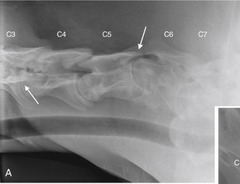
CVM (cervical vertebral myelopathy)
A 17 year old thoroughbred gelding presents with a chronic bilateral front limb lameness and a 1 month history of progressive ataxia. Thoughts?
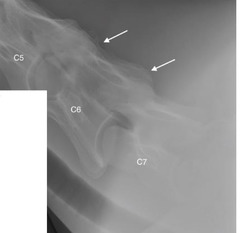
Intravertebral ratio
What ratio gives you an idea of CVM if under 50%?
Positive contrast myelography, CT, MRI
How do you diagnose CVM (cervical vertebral myelopathy)?
CVM (cervical vertebral myelopathy)
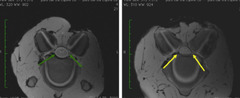
What is this?
CVM (cervical vertebral myelopathy) on the right image
Left image is a normal MRI
What is this?
Restrict protein and energy
How should you change the diet when managing a horse with CVM (cervical vertebral myelopathy)?
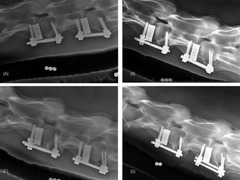
Ventral interbody vertebral fusion, dorsal laminectomy
What are some examples of surgical treatments for CVM (cervical vertebral myelopathy) in horses?
Cauda equina syndrome
This is a progressive granulomatous polyganglioradiculoneuritis of the cauda equine (infiltration of cytotoxic T cells and macrophages)
note: poly:many, ganglio:group of sensory nerve cells, radiculo:nerve roots that emerge directly from spinal cord, neuritis: peripheral inflammation
Cauda equina syndrome
This refers to the destruction of somatic and autonomic LMN and sensory neurons at the level of the nerve roots and dorsal root ganglion leading to flaccid tail, loss of sensation and perineural area and loss of anal tone in horses
Cauda equina syndrome
A horse presents with dysuria, tail rubbing, flaccid tail, loss of sensation in the perineural area (goes from hyperesthesia to desensitization), and loss of anal tone --> fecal retention and urine overflow. Thoughts?
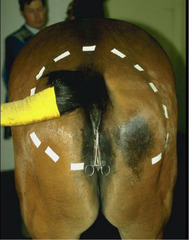
Must rule out trauma. Will see pleocytosis on CSF, and *high circulating antibodies against P2 myelin* on Electromyelography
How do you diagnose cauda equina syndrome in horses?
Cauda equina syndrome
Which noninfectious neuro disease of horses is diagnosed thru high circulating antibodies against P2 myelin in electromyelography?
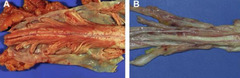
Left is a normal cauda equina, right is nodular and firm thickening of multiple nerve roots of the cauda equine
What is this?
Equine motor neurons disease
This is a spontaneous, progressive, sporadic disease of the motor neurons in horses that causes generalized neuromuscular weakness and neurogenic muscle atrophy
Equine Motor Neuron disease (remember EDM, equine degenerative myeloencephalopathy, has this similar pathogenesis, is a differential)
This noninfectious disease in horses occurs due to a lack of antioxidants, where horses in absence of pasture/good quality hay, heat treated pellets, and in a dirt lot are at risk
Equine motor neuron disease
This 9 year old horse horse presents with muscle fasciculations, narrow based stance, and looks better at the walk than standing (he is VERY uncomfortable standing). He does NOT have ataxia. There is muscle wasting of the gluteal and quadriceps muscles and weight loss despite good appetite. Thoughts?
Muscle biopsy of the sacrocaudalis dorsalis medialis (tail elevator muscle)
How do you diagnose equine motor neuron disease?
Equine motor neuron disease
note: this is the tail elevator muscle
Which test in horses do you diagnose using muscle biopsy of the sacrocaudalis dorsalis medialis muscle?
Dietary change and Vitamin E (tocopherol) = prognosis poor for performance, guarded for life
How do you treat equine motor neuron disease? What is the prognosis?
Equine motor neuron disease and eNAD (equine neuroaxonal dystrophy) and EDM (equine degenerative myeloencephalopathy)
The triggering vitamin E insufficiency factor is the same for what two equine noninfectious diseases?
eNAD (equine neuroaxonal dystrophy)/EDM (equine degenerative myeloencephalopathy): younger around 6-24 months
Equine motor neuron disease: middle age, 9 years old and up
Equine motor neuron disease and eNAD (equine neuroaxonal dystrophy)/EDM (equine degenerative myeloencephalopathy) seem very similar. What is the age predilection difference between them?
b. eNAD, EDM
Which has a hereditary basis:
a. Equine motor neuron disease
b. eNAD, EDM
b. eNAD, EDM
Which has UMN signs:
a. Equine motor neuron disease
b. eNAD, EDM
a. Equine motor neuron disease
Which has LMN signs:
a. Equine motor neuron disease
b. eNAD, EDM
b. eNAD, EDM
Which has ataxia and proprioceptive deficits?
a. Equine motor neuron disease
b. eNAD, EDM
a. Equine motor neuron disease
Which has muscle atrophy and fasciculations?
a. Equine motor neuron disease
b. eNAD, EDM
b. eNAD, EDM
Which does NOT have antemortem diagnosis and is strictly by rule out:
a. Equine motor neuron disease
b. eNAD, EDM