A&P Lab 1 Quiz Terms List
 Call Kai
 Learn
Learn Practice Test
 Spaced Repetition
 Match
Match Flashcards
 Knowt Play
1/90

There's no tags or description
Looks like no tags are added yet.
Name | Mastery | Learn | Test | Matching | Spaced | Call with Kai | Chat |
|---|
No analytics yet
Send a link to your students to track their progress
91 Terms
Cephalic
located near the head
Cranial
located near the skull
Frontal
forehead
Orbital
houses the eyeball
Otic
located near ear
Buccal
cheek region
Mental
chin and lower lip
Occipital
back of head, houses skull and brain
Thoracic
chest area
Sternal
located near the sternum/ breastbone

Coxal
hip bone

Dorsal
houses cranial and spinal cavity
Scapular
shoulder blade

Vertebral
contains spinal cord
Lumbar
lower back

Sacral
bone between spine and hip

Upper Limb
holds the femur
Acromial
bony projection in the shoulder blade

Axillary
armpit region

Brachial
upper arm

Olecranon (cubital)
elbow

Antecubital
inside of elbow
Antebrachial
inside of forearm
Carpal
wrist
Palmar
palm
Pollux
thumb
Inguinal
groin
Femoral
femur region (upper thigh)
Patellar
knee cap
Popliteal
behind the kneecap
Sural
back outer side of the calf
Crural
lower leg between knee and ankle

Fibular (Peroneal)
thin bone on lateral side of the leg
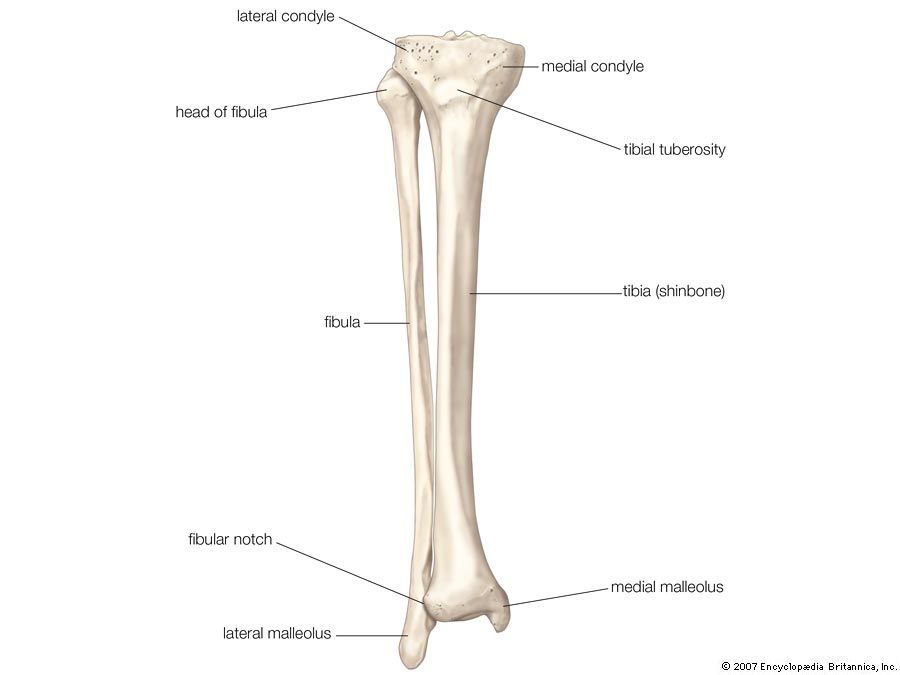
Tarsal
ankle
Calcaneal
heel bone back of foot
Plantar
bottom sole of the foot
Hallux
big toe
Digits
fingers and toes
Planes
…
Midsagittal
splits right and left exactly. *cannot see legs in side section*
parasagittal
vertical plane parallel to midsgital plane

Coronal
frontal separates anterior from posterior
Transverse
splits into superior and inferior
Oblique
on a slant (sides)
Directional Terms
…
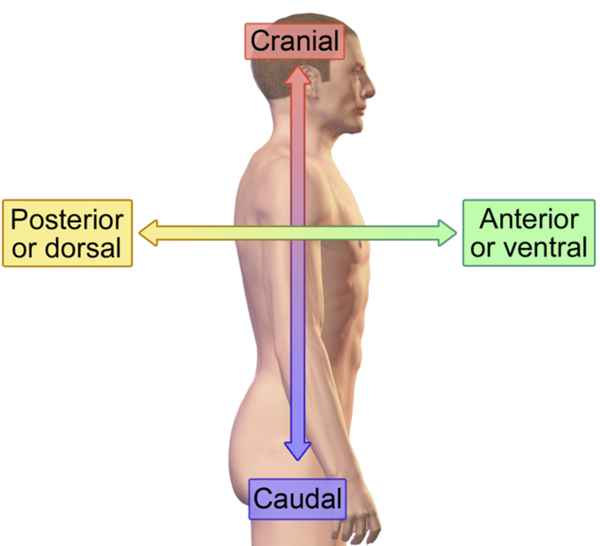
Anterior (ventral)
front of body
Posterior (dorsal)
back
Medial
closer to the midline coming from the right or left
Lateral
further from midline of the body right or left
Proximal
only used when talking about leg or arm (same fro distal too)
means you are closer to the hip (pt of attachment)
Distal
only used when talking about leg or arm further away from pt of attachment
Supine
face forward
Pronated
body part rotated inward and downward
Superficial
surface level
Deep
deep
Cavities & Serous Membranes
continuous membranes (like a balloon)
parietal (wall)
visceral (organ inner layer)
Ventral cavity
whole front side (anterior)
-thoracic cavity
-abdominopelvic cavity
Thoracic cavity
relating to the chest
Mediastinum
contains heart blood vessels and esaphogus etc.. everything in the thoracic cavity BUT the lungs.
lined with pericardium.

Pericardium (serous membrane)
around the heart
Pleural cavities
(2) around lungs
Pleura (serous membrane)
continuous membrane around the lungs
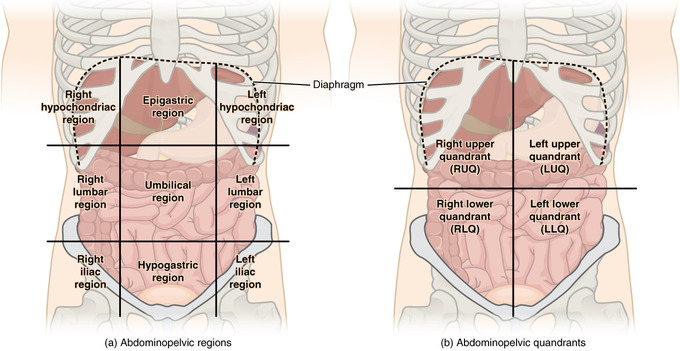
Abdominopelvic cavity
contains all 9 regions of the abdomen: Epigastric, umbilical, and hypogastric regions
Abdominal cavity
houses abdomen
Peritoneum (serous membrane)
around abdominal regions
Pelvic cavity
reproductive organs, urinary and bladder final portion of large intestine
partial peritoneum
Dorsal Cavity
back posterior, holds nervous system and spinal cord etc
Cranial
holds skull
Vertebral Canal
bony hollow space inside spinal column
Abdominopelvic Divisions
…
Quadrants
RUQ, RLQ, LUQ LLQ
parasagittal plane
plane offset the middle
right lower quadrant
appendix, first part of large intestine
left upper quadrant
holds stomach pancreas spleen
left lower quadrant
colon, small intestine
Right upper quadrant
holds liver, gallbladder
Epigastric region
houses stomach liver, and pancreas
Umbilical region
houses small and large intestine

Right/left hypochondriac region
on sides of hypogastric region

Right/left lumbar region
on sides of umbilical region
Hypogastric region
houses urinary and bladder and reproductive organs

Right/left inguinal region
pubic area
caudal
further from the skull (towards the feet)
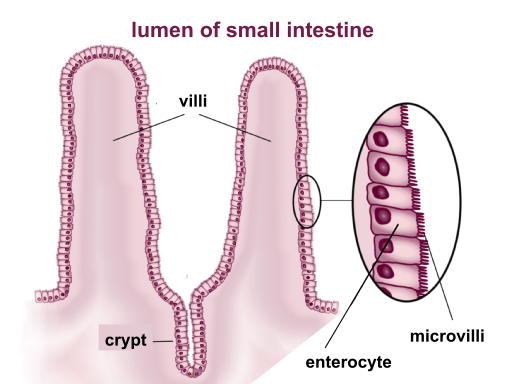
microvilli
finger like projections on the outside of the cell to help the cell absorb nutrients and water
flagellum
hair-like whip that propels a cell forward
cilia
beat in unison to clear mucus

mitochondria
works with oxygen, aerobic respiration occur here
uses ATP
Smooth ER
synthesizes lipids and carbs
Golgi apparatus
modifies, packages, and sorts proteins and lipids using secretory vesicles
chromatin
loosely uncoiled DNA
chromosome
DNA tightly packed in an x shape histones proteins help wind it