Linear Differential Equations
 Call Kai
 Learn
Learn Practice Test
 Spaced Repetition
 Match
Match Flashcards
 Knowt Play
1/3

There's no tags or description
Looks like no tags are added yet.
Name | Mastery | Learn | Test | Matching | Spaced | Call with Kai | Chat |
|---|
No analytics yet
Send a link to your students to track their progress
4 Terms
General Form of a Linear Differential Equation
The general form of a linear, first-order differential equation is that we have a differential term, a function multiplied by y, and then some forcing function g(t).

The Integrating Factor
Normally, linear differential equations cannot be easily solved in their current form; however, if we introduce an integrating factor, then we can easily solve for its solution.
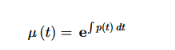
The integrating factor is always the exponent of the integral of the middle term.
Process of Solving
Once we have identified the integrating factor, we then multiply the entire equation by it; from there, we then collapse the left-hand side into a single differential via the product rule as necessary.
From there, we then integrate both sides and obtain our y(t).
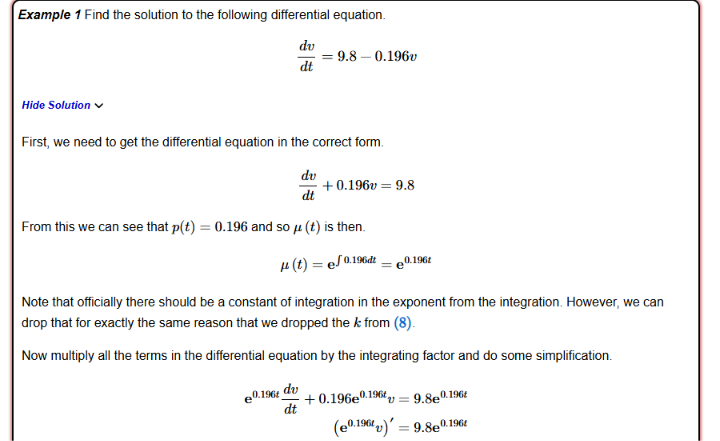
Example of Solving a Linear-Differential Equation
Notice how the expression is reduced to a single differential inside the parantheses; from there, we integrate as necessary to obtain y(t).