Bio II Exam IV (ch. 49, 50, 51, 52)
 Call Kai
 Learn
Learn Practice Test
 Spaced Repetition
 Match
Match Flashcards
 Knowt Play
1/177

There's no tags or description
Looks like no tags are added yet.
Name | Mastery | Learn | Test | Matching | Spaced | Call with Kai | Chat |
|---|
No analytics yet
Send a link to your students to track their progress
178 Terms
Ecology (49)
the study of how organisms interact w/ each other and their environment, and increasingly the impact that humans have
5 main levels of ecological study (49)
organisms
population
community
ecosystem
global/biome
Organismal ecology (49)
level of ecological study
researchers explore morphological, physiological, and behavioral adaptations
e.g., how do individuals interact w/ each other and their physical environment?
Adaptations (49)
heritable traits that increase the fitness of an individual in a particular environment relative to individuals lacking the trait
Population ecology (49)
level of ecological study
researchers focus on how the number and distribution of individuals in a population change over time
e.g., how and why does population size change over species and time?
Population (49)
group of individuals of the same species that lives in the same area at the same time
Community ecology (49)
level of ecological study
researchers focus on the nature of the interactions b/w species and the consequences of those interactions
might focus on predation, parasitism, and competition
or explore how communities respond to fires, floods, and other disturbances
e.g., how do species interact, and what are the consequences?
Community (49)
consists of populations of different species that interact w/ each other within a particular area
Ecosystem ecology (49)
level of ecological study
an extension of organismal, population, and community ecology
researchers study how nutrients and energy move among organisms and through the surrounding atmosphere and soil or water
e.g., how does energy flow and how do nutrients cycle thru the local environment?
Ecosystem (49)
consists of all the organisms in a particular region along w/ nonliving components
these physical and chemical, or abiotic (non-living) components include air, water, and nonliving parts of soil
Global ecology (49)
level of ecological study
researchers focus on the effects of human impacts on the biosphere
humans are modifying landscapes and releasing massive amounts of energy and nutrients to the biosphere
e.g., how is the biosphere affected by global changes in nutrient cycling and climate?
Biosphere (49)
thin zone surrounding the Earth where all life exists
the sum of all terrestrial and aquatic ecosystems
Conservation biology (49)
the effort to study, preserve, and restore threatened genetic diversity in populations, species diversity in communities, and ecosystem function
biologists of this study are like physicians—they identify threatened environments and propose remedies to preserve biodiversity, clean air, pure water, and productive soils
Abiotic (49)
not alive
e.g., air, water, and some components of soil
Niche (49)
the range of conditions that a species can tolerate and the range of resources it can use
it’s a product of many abiotic and biotic factors, both present and past
Biotic (49)
living, or produced by a living organism
Dispersal (49)
the movement of individuals from their place of origin to the location where they live and breed as adults
Continental drift (49)
the slow movement of Earth’s surface plates over million of years
Weather (49)
consists of the specific short-term atmospheric conditions of temperature, precipitation, sunlight, and wind
Climate (49)
the prevailing, long-term weather conditions found in an area
occurs in relatively predictable global patterns
Equator (49)
at this area, sunlight strikes the Earth at an angle allowing maximal amount of solar radiation
as Earth’s surface slopes away from here toward the poles, sunlight arrives at lower angles, minimizing energy (and heat)
sun radiation
areas along here also receive the most moisture
areas abt 30°N and 30°S latitude are among the driest on Earth
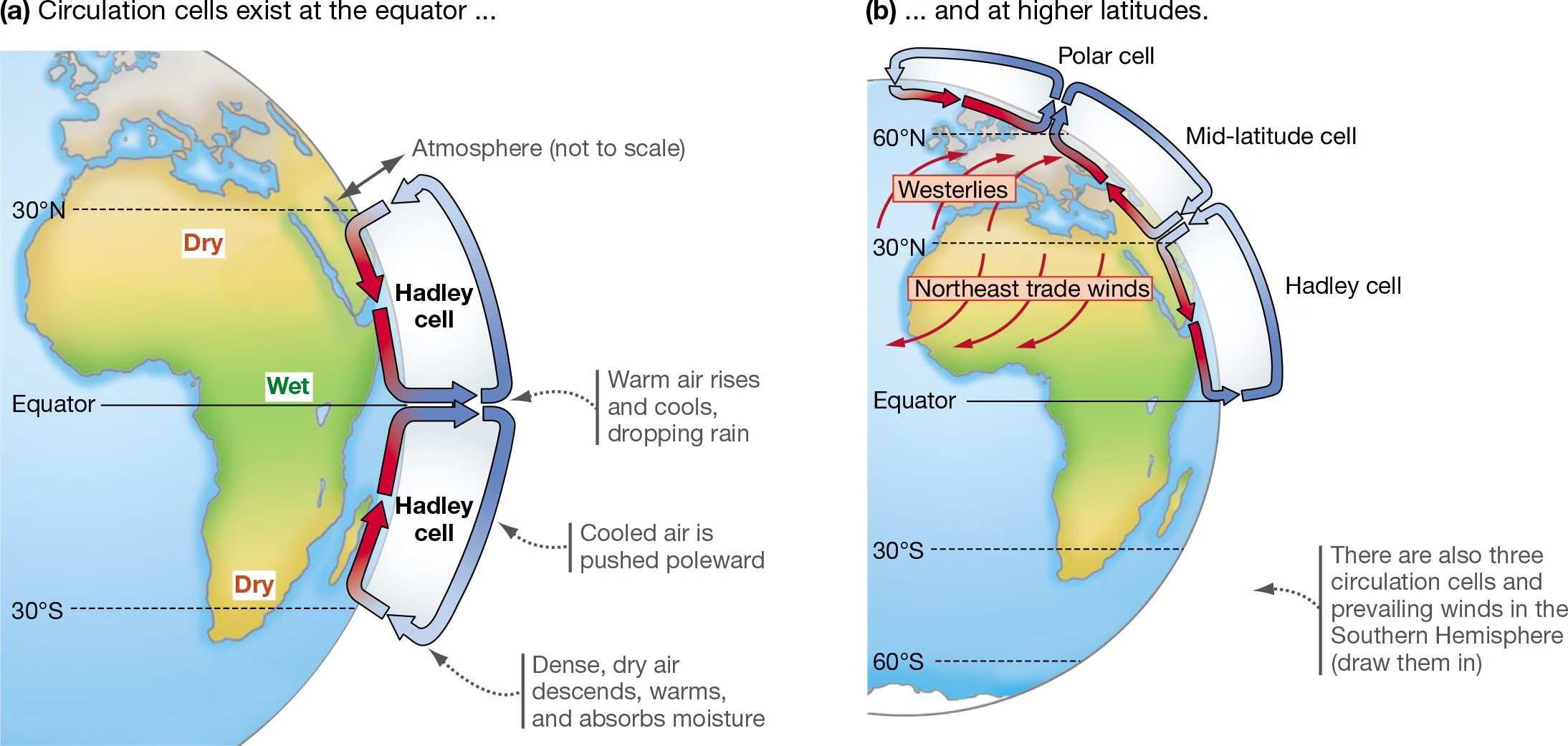
Hadley cell (49)
a major cycle in global air circulation responsible for making the Amazon River basin wet and the Sahara dry
air heated by sunlight along the equator expands and rises; warm air thus holds a lot of moisture
as air rises above the equator, it cools and is less able to hold water, producing rain
Seasons (49)
regular, annual fluctuations in temperature, precipitation, or both
Elevation (49)
the height of land above sea level
an important factor b/c temperature decreases as a function of altitude
it’s colder in the mountains than in lowlands
Rain shadow (49)
the dry region on the side of a mountain range away from prevailing wind
mountain ranges can modify regional climate:
as moist air blows UP a mountain range, it cools and loses its ability to hold water, producing rain
the cool, dry air then passes the mountain ridge; the area on this side of the ridge receives little precipitation and is said to be this
Effects mountains and oceans have on climate (49)
oceans have a moderating effecting on temperature
water has a high specific heat, or capacity for storing heat energy:
water absorbs atmospheric heat in the summer and releases it in winter
coastal areas generally have more moderate climates than inland areas
gyres bring warm water to colder latitudes and vice versa
Biome (49)
regions characterized by distinct abiotic characteristics and dominant types of vegetation
e.g., broad-leaved evergreen forests, deserts, grasslands, tundra
Net primary productivity (NPP) (49)
the total amount of biomass generated by the fixation of carbon per year minus amount that is oxidized during cellular respiration
temperature and moisture influence this
represents organic matter available as food for other organisms
terrestrial environments:
this is often estimated by measuring aboveground biomass
maximized in sunny, warm, wet conditions
Biomass (49)
refers to the total mass of organisms, and primary producers
Aboveground biomass (49)
the total mass of living plants, excluding roots
Simulation studies (49)
one of the ways scientists study the effects of climate change on biomes
these studies are based on computer models of weather patterns in local regions
predict how temperature and precipitation profiles will change w/ increasing temperatures—and how the distribution of biomes might changes as a result
Observational studies (49)
one of the ways scientists study the effects of climate change on biomes
these studies are based on long-term monitoring at fixed sites around the globe
researchers document changes in key physical variables—temperature and precipitation—as well as changes in distribution and abundance of organisms`
Historical studies (49)
one of the ways scientists study the effects of climate change on biomes
these studies examine the relationship b/w CO2 levels, climate change, and the distribution and abundance of organisms during events that occurred millions of years ago
Experiments (49)
one of the ways scientists study the effects of climate change on biomes
these are designed to simulate changed climate conditions and to record responses by the organisms present
Salinity (49)
one of the abiotic factors that distinguish streams from oceans
the proportion of solutes dissolved in water in natural environments
has dramatic effects on osmosis and water balance in organisms:
species are adapted to specific ranges of this
it’s a major determinant of species distributions
Four abiotic factors that distinguish streams from oceans (49)
salinity
water depth
water flow
nutrient availability
Water depth and sunlight availability (49)
one of the abiotic factors that distinguish streams from oceans
water absorbs and scatters light, so the amount and types of wavelengths available to organisms change dramatically as water depth increases
light availability has a major effect on productivity
biologists use water depth and light to define zones in oceans:
intertidal zone
neritic zone
oceanic zone
benthic zone
photic zone
aphotic zone
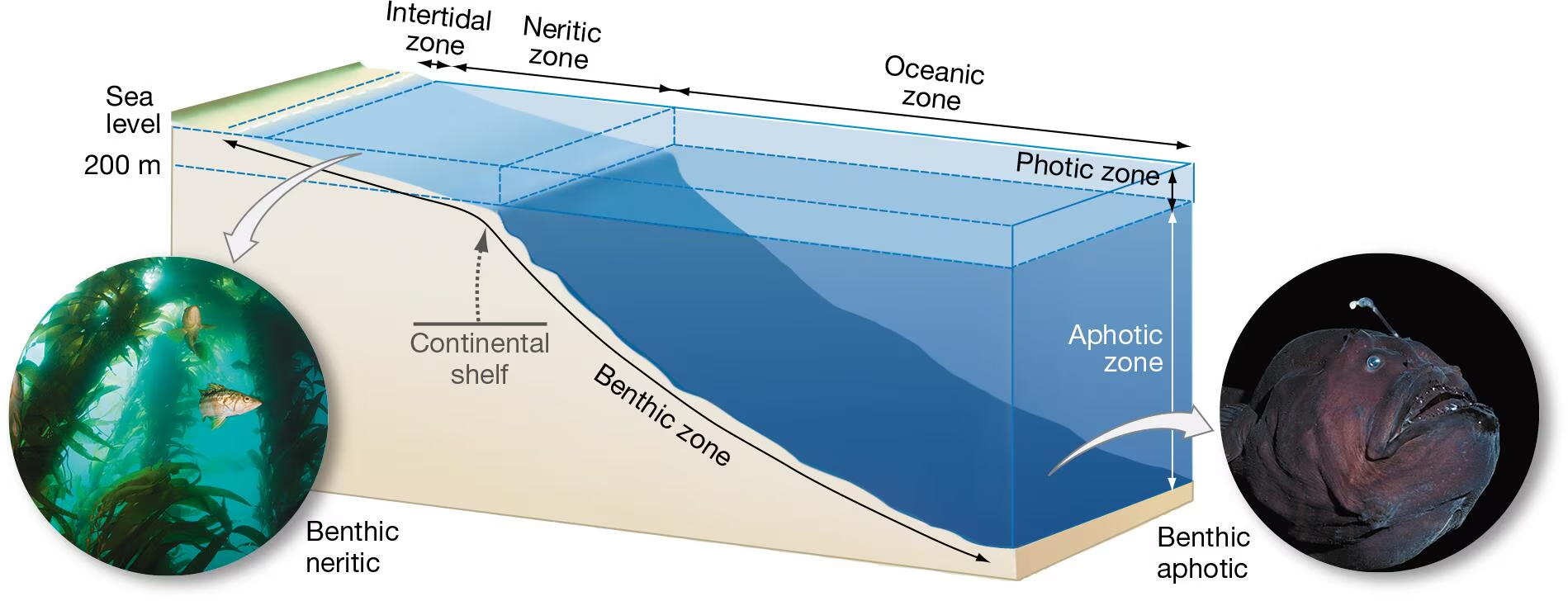
Intertidal zone (49)
one of the most common zones in the ocean
consists of a rocky shoreline, sandy beach, or mud flat that’s exposed to the air at low tide but submerged at high tide
Neritic zone (49)
one of the most common zones in the ocean
extends from the intertidal zone to depths of abt 200 m
its outermost edge is defined by the end of the continental shelf—the gently sloping, submerged portion of a continental plate
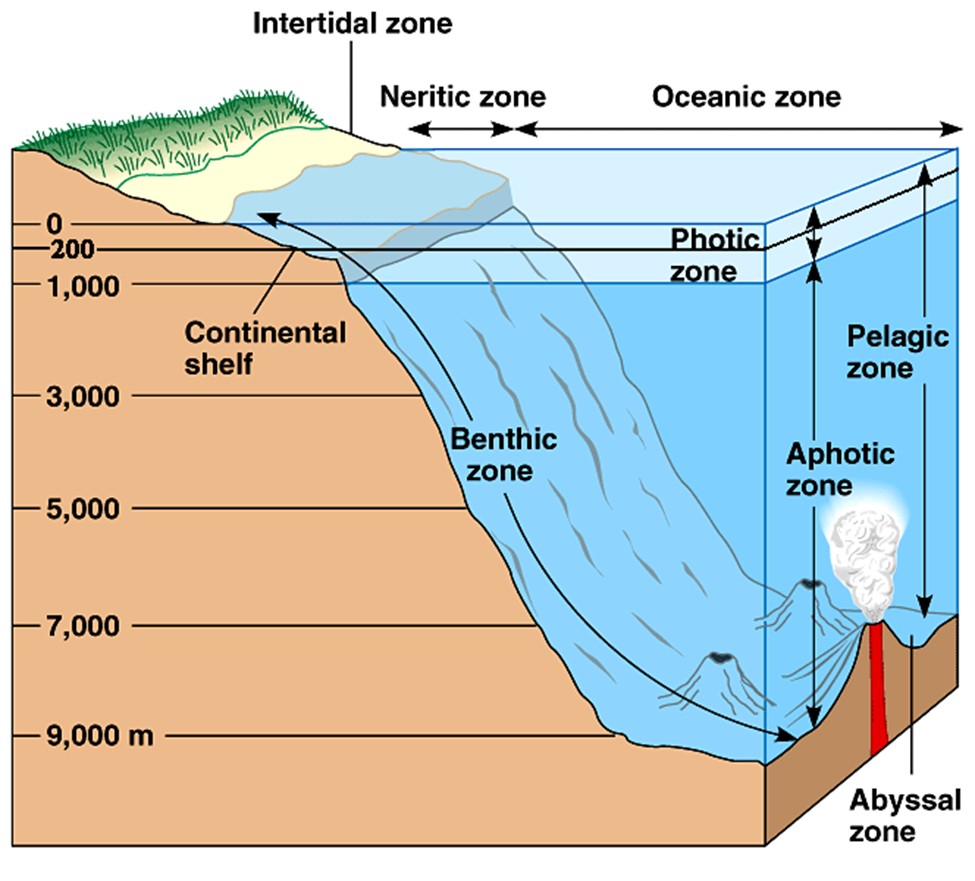
Oceanic zone (49)
one of the most common zones in the ocean
the “open ocean”—the deepwater region beyond the continental shelf
Benthic zone (49)
one of the most common zones in the ocean
the bottom of the ocean at all depths
organisms in this zone survive by consuming the nutrients that drift down from the photic zone
Photic zone (49)
one of the most common zones in the ocean
the intertidal and sunlit regions of the neritic, oceanic, and benthic zones
in this zone, sunlight is abundant, but nutrients are hard to come by
when organisms in the zone die, rather than remain there to provide nutrients, they drift down to the benthic zone
Aphotic zone (49)
one of the most common zones in the ocean
areas that do not receive sunlight
Littoral zone (49)
zone in lakes
comparable to the photic, aphotic, and benthic zones in the ocean
consists of the waters along the shore that are shallow enough for plants to take root
“seashore”
Limnetic zone (49)
zone in lakes
comparable to the photic, aphotic, and benthic zones in the ocean
water that receives enough light to support photosynthesis but too deep for plants to take root
it’s offshore
Nutrient availability (49)
in many aquatic ecosystems, nutrients such as nitrogen and phosphorus are in short supply
these levels are important:
scarcity of nutrients limits growth rates in the photosynthetic organisms that provide food for other species
three types of water flow provide critical nutrients:
coastal runoff
ocean upwelling
lake turnover
Coastal runoff (49)
as water rushes down mountains and streams get wider and slower, nutrients gather, sink, and collect at the bottom as debris
nutrients tend to be plentiful in the shallow estuaries:
sunlight is also plentiful in estuaries, making them among the most productive environments on Earth
Estuaries (49)
where freshwater rivers meet the ocean
nutrients are plentiful here
sunlight is also plentiful here, making them among the most productive environments on Earth
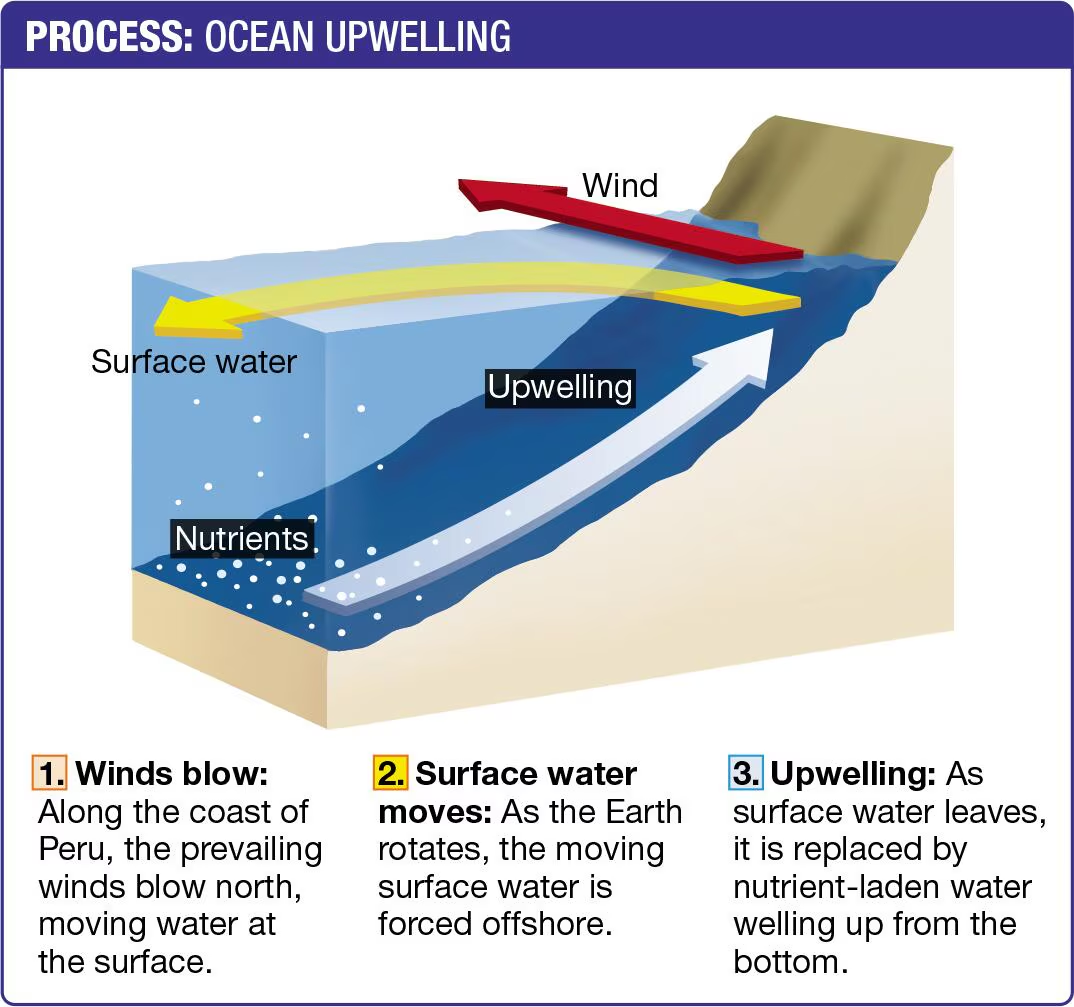
Ocean upwelling (49)
in certain coastal regions, nutrients (that have fallen to benthic zones) are brought up to the surface by currents that cause upwelling
as the surface water moves away from the coast, it is steadily replaced by nutrient-rich water moving up from the ocean bottom
Lake turnover (49)
each year, glacially formed lakes undergo spring and fall turnovers in response to air temperature changes
in winter and summer, the temperature in these lakes varies along a vertical gradient (thermocline)
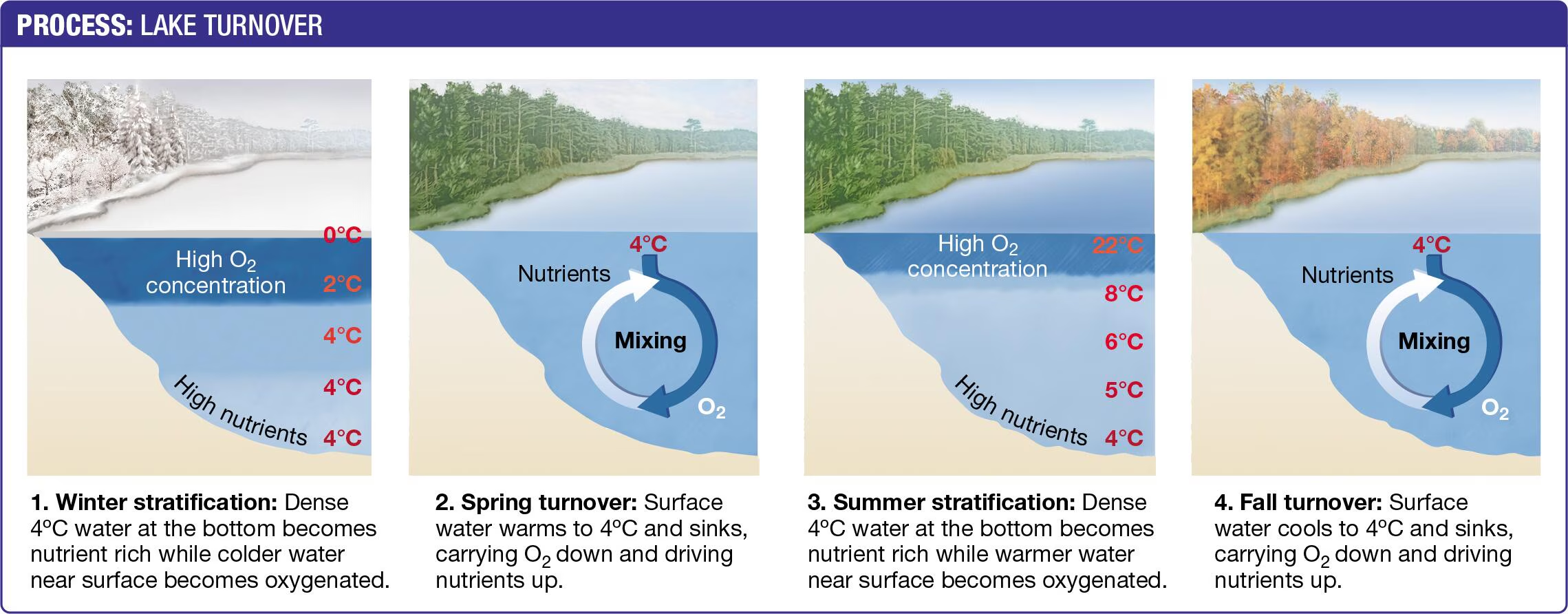
Thermocline (49)
“heat-slope”
a gradient in temperature, or thermal stratification
How aquatic biomes are affected by humans (49)
humans have caused direct and indirect changes to the physical, chemical, and biotic properties of aquatic biomes:
wetlands are filled or drained
streams are dammed
water is removed from ponds and rivers for agriculture
new aquatic anthromes—like reservoirs—have been created
invasive species such as the zebra mussel have been transported
fisheries have been overexploited, leading to cascading food-web effects
debris is intentionally and unintentionally disposed of in aquatic biomes, clogging creeks and creating masses of trash in oceans
chemicals have been released into aquatic habitats
global climate change is leading to ocean acidification, which has negative effects on many species
Behavior (50)
an action; a response to a stimulus
Behavioral ecology (50)
a subset of organismal ecology
the study of the behavioral adaptations that have evolved in response to ecological selection pressures
Proximate causation (50)
a type of biological causation
also known as mechanistic causation
explains how actions occur in terms of the growth and function of genetic, neurological, hormonal, and skeletal-muscular mechanisms
Ultimate causation (50)
a type of biological causation
also known as evolutionary causation
explains why actions occur
based on their evolutionary history and consequences
Proximate causes: consolation behavior (50)
e.g., you see a friend in distress
types of biological consolation:
neurons in your brain process sensory information and cause changes
brain signals adrenal glands to produce cortisol
neural signals in pituitary signal hormone oxytocin
your responses may include consolation behaviors such as speaking softly or physical caresses
Ultimate causes: consolation behavior (50)
traits that strengthen social bonds are favored by natural selection and lead to higher evolutionary fitness:
increased health
increased access to resources
decreased vulnerability to threats
not all behaviors are adaptive in all environments:
oxytocin-mediated consolation behavior in highly social prairie voles observed, but not in less social meadow voles
Innate behavior (50)
type of behavior that’s inherited and tend to be inflexible to environmental changes
requires no learning
shows little variation based on learning or the individual’s condition
Fixed-action patterns (FAPs) (50)
highly inflexible, stereotypical (innate) behavior patterns
e.g., sneezing, yawning in humans, jump-back behavior in kangaroos, rats, etc.`
Learning (50)
an enduring change in behavior that results from a specific experience in an individual’s life
an adaptive behavioral strategy in changing or unpredictable environments
capacity to do this has genetic basis and varies among individuals
Foraging (50)
food seeking behavior
in most cases, animals have a relatively wide range of foods to exploit over a lifetime
even for species that eat limited foods there are still choices to be made:
e.g., giant pandas eat almost entirely bamboo, but they still have to choose which bamboo plants to harvest
Ultimate causes: optimal foraging (50)
rover allele is favored at high population density:
rovers are more likely to find unused food patches
sitter allele is favored at low population density:
sitters do not waste energy searching for food
results link a proximate mechanism w/ an ultimate outcome:
in this case, presence of certain alleles is responsible for a difference in fitness in specific types of habitats
Optimal foraging (50)
hypothesis that animals maximize their feeding efficiency
concept expressed as:
fitness ∝ feeding efficiency ∝ benefits/costs (where ∝ means “is proportional to”)
logic:
if animals maximize benefits and minimize costs, they will have more time and energy for reproduction and higher fitness
Monogamy (50)
one female mates w/ one male, forming a pair bond
common in birds but rare in mammals
Polyandry (50)
one female mates w/ two or more males
rarest of the mating systems
some females choose multiple mates while others are coerced
Polygyny (50)
one male mates w/ two or more females
sometimes called a harem
often occurs in situations where a male defends a territory of resources
Promiscuity (50)
males and females each have two or more sexual partners
some females choose multiple mates while others are coerced
Sexual selection (50)
type of natural selection that favors individuals w/ traits that increase their ability to obtain mates or choose good mates
two types:
intersexual selection
intrasexual selection
Intersexual selection (50)
when individual of one sex chooses individual of another sex as a mate
individuals choose mates that will provide:
direct benefits to them or their offspring (protection & food)
indirect benefits by contributing to “good alleles” to their offspring
Intrasexual selection (50)
two individuals of the same sex compete w/ one another for mates
animals that win physical battles tend to have higher mating success:
competing for mates can be costly (energy), risk of injury, and other factors
but it can also result in large benefits—increased fitness due to reproductive success
Migration (50)
the long-distance movement of a population associated w/ a change of seasons
Navigation (50)
movement of individuals in search of food, mates, shelter, and other resources is explored by biologists
biologists distinguish 3 categories of orientation used by animals:
piloting
compass orientation
true navigation
Piloting (50)
one way animals navigate
movement using visual cues and familiar landmarks
many species use this to find their way
useful along short distances
some species of migratory birds and mammals:
offspring seem to memorize the route by following their parents south in fall and north in spring
Compass orientation (50)
one way animals navigate
movement that’s oriented in a specific direction
animals may be able to detect a compass direction and travel along it in a straight line until they reach destination
using Earth’s magnetic field, chemical cues or sounds
sun or stars may be used, but over long distances the Earth’s rotation must be factored
during cloudy weather, birds and fish appear to orient using Earth’s magnetic field
two hypotheses for how animals detect magnetism:
animals; visual systems—chemical reaction that involves electron transfer among molecules
small particles of magnetic iron (magnetite)
True navigation (50)
one way animals navigate
the ability to locate a specific place on Earth’s surface (map orientation)
animal released in unknown position on globe will know where it' is and can navigate directly home (more precise than compass orientation)
Why do animals migrate? (50)
migratory movements pose enormous challenges and costs (time, energy, and predation risk):
some arctic terns migrate over 32,000km round trip
hypotheses include increasing reproductive success and increasing access to food
Communication (50)
any process in which a signal from one individual modifies the behavior of a recipient individual
crucial component of animal behavior:
it’s not enough that a signal is sent, the signal must be received and acted on
type of signal used by an organism correlates w/ its habitat
signals are diverse: different animals do this by sound, scent, or tactile or visual cues
each mode has advantages and disadvantages
Honeybees: waggle dance (50)
bees move in a circular pattern w/ straight runs down the middle accompanied by vigorous waggles of the abdomen
this contains info abt food location:
length of waggle run proportional to food distance
direction of waggle run correlated w/ direction of food source from hive
direction of food source communicated relative to current position of sun
Deceitful communication (50)
also known as lying
natural selection has favored the evolution of this:
can be deceiving individual of the same or of another species
individuals sometimes increase their fitness by providing inaccurate or misleading information
Altruism (50)
behavior that has a fitness cost to the individual exhibiting the behavior and a fitness benefit to the recipient of the behavior
self-sacrificing behavior
decreases an individual’s ability to produce offspring but helps others produce more offspring
existence of this behavior appears to be paradoxical:
alleles that make an individual more likely to be altruistic should be selected
Kin selection (50)
natural selection of a behavior that may decrease the chance of survival for an individual but increases that of their kin (who share proportion of their genes)
e.g., black-tailed prairie dogs perform risky behavior called alarm calling:
alarm callers draw attention to themselves: much greater danger of being attacked
Hamilton’s Rule (50)
model used to assess how an allele that contributes to altruistic behavior could increase in frequency in a population
states that altruistic behavior is most likely when 3 conditions are met:
fitness benefits of altruistic behavior are high for the recipient (B is high)
altruist and recipient are close relatives (r is high)
fitness costs to the altruist are low (C is low)
expressed as Br > C
where B is fitness benefit to beneficiary
r is the coefficient of relatedness (measure of how closely actor and recipient are related)
C is fitness cost to the actor
B and C are both measured in offspring produced
Direct fitness (50)
derived from an individual’s own offspring
parents can increase this by spending resources to ensure the welfare of their offspring (parental care)
Indirect fitness (50)
derived from helping relatives produce more offspring than they could produce on their own
e.g., a grandparent can increase this by caring for their offspring’s child (grandchild) so that their offspring will have more resources available to have a second child
Inclusive fitness (50)
combination of direct and indirect fitness components
Reciprocal altruism (50)
an exchange of fitness benefits that are separated in time
they help individuals who have either helped them in the past or are likely to help them in future
e.g., vervet monkeys are most likely to groom unrelated individuals that have groomed or helped them in past
Cooperation and mutualism (50)
some behaviors appears altruistic but are selfish b/c they increase (not decrease) direct fitness of animal exhibiting the behavior
when cooperation occurs among individuals of:
same species—cooperation
different species—mutualism
Individuals don’t act for good of species (50)
some apparent acts of cooperation are misunderstood
like when animals sacrifice themselves for good of their species
e.g., “self-sacrificing” and “selfish” alleles
individuals w/ self-sacrificing alleles would die and not reproduce
individuals w/ selfish alleles would survive and reproduce
“selfish” alleles would increase in frequency; “self-sacrificing” alleles would decrease
Geographic distribution (51)
distribution and abundance are two fundamental concepts in ecology
most species identification guides show the range (geographic distribution) of different species:
abiotic and biotic factors determine range
ranges are dynamic (in constant flux) as abiotic and biotic factors change over time
Population density (51)
the number of individuals per unit area
3 different patterns:
random
clumped
uniform
Population: random (51)
the position of each individual is independent of the others
may occur when seeds are dispersed by the wind and currents
the average fitness of populations increases in variable environments when dispersal distributes individuals
Population: clumped (51)
organisms associate in social groups (such as schools of fish) or the quality of the habitat is patchy
individuals associate in social groups for feeding, mating, and/or avoiding predators or resources are patchy
individuals experience higher fitness when they associate in groups
selection favors individuals that find patchy resources
Population: uniform (51)
if negative interactions occur among individuals, such as competition for space, water, or other resources
individuals distance themselves from each other as they compete for nutrients, nesting space, or other resources
competition reduces fitness of individuals
selection favors traits that minimize competition
Metapopulation (51)
a population of populations connected by migration
Demography (51)
the study of factors that determine the size and structure of populations through time
number of individuals present in a population depends on these 4 processes:
birth (grow)
death (decline)
immigration (grow)
emigration (decline)
Immigration (51)
when individuals enter a population by moving from another population
Emigration (51)
when individuals leave a population to join another population
Age structure (51)
how many individuals of each age are alive
Generation time (51)
the average time b/w a female’s first offspring and her offspring’s first offspring