Tribunals - AT
 Call Kai
 Learn
Learn Practice Test
 Spaced Repetition
 Match
Match Flashcards
 Knowt Play
1/22

There's no tags or description
Looks like no tags are added yet.
Name | Mastery | Learn | Test | Matching | Spaced | Call with Kai | Chat |
|---|
No analytics yet
Send a link to your students to track their progress
23 Terms
Transparency in general and how the forms work together
Internal accountability (eg officers of parliament + inquiries)
transparency of the state e.g OIA, Local government act etc
external accountability → citizens getting involved
blurred conception → Ombudsman being officer of Parliament but initiated by us complaining to them.
Statutory appeals
Full consideration of the merits of the case not just legal issues;
If a decision making body decides your decision in a certain way even if it is allowed to by it's discretion given, if a body under which you are appealing to under statute decides differently , the appellate court will replace the original decision with their decision.
Stands in stark contrasts to other mechanisms for challenging the state which only allow for challenges based on law and it only being sent back for reconsideration to original decision maker.
Strong to seek immediate redress.
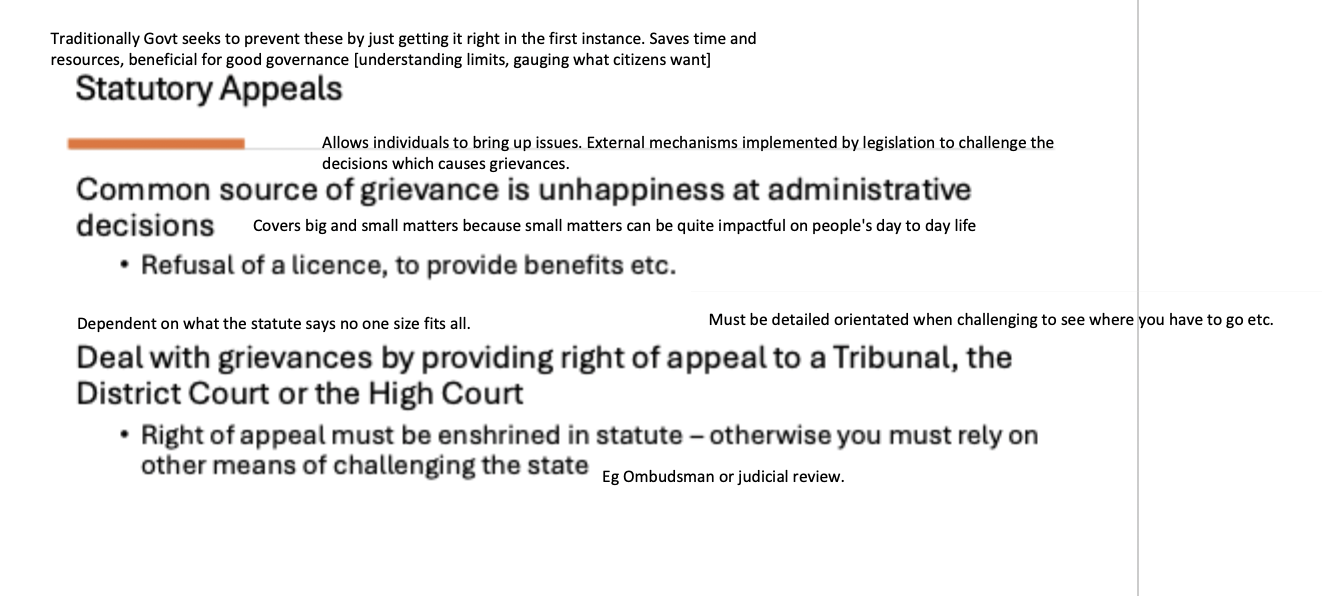
Purpose of tribunals
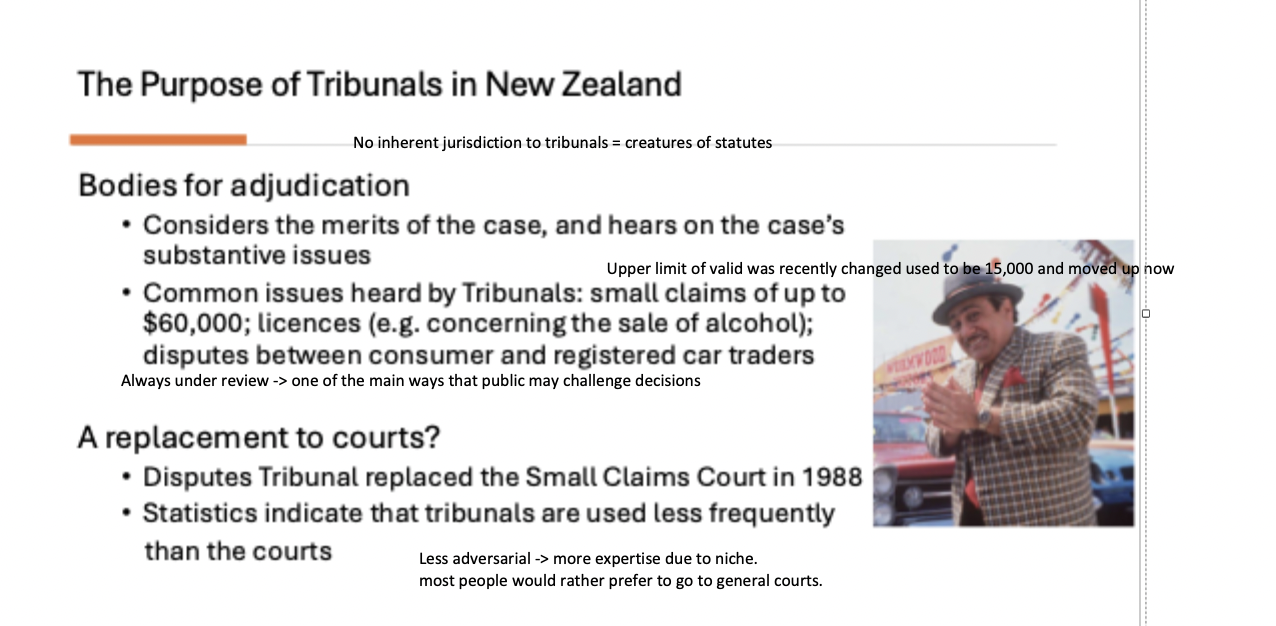
Tribunal procedure
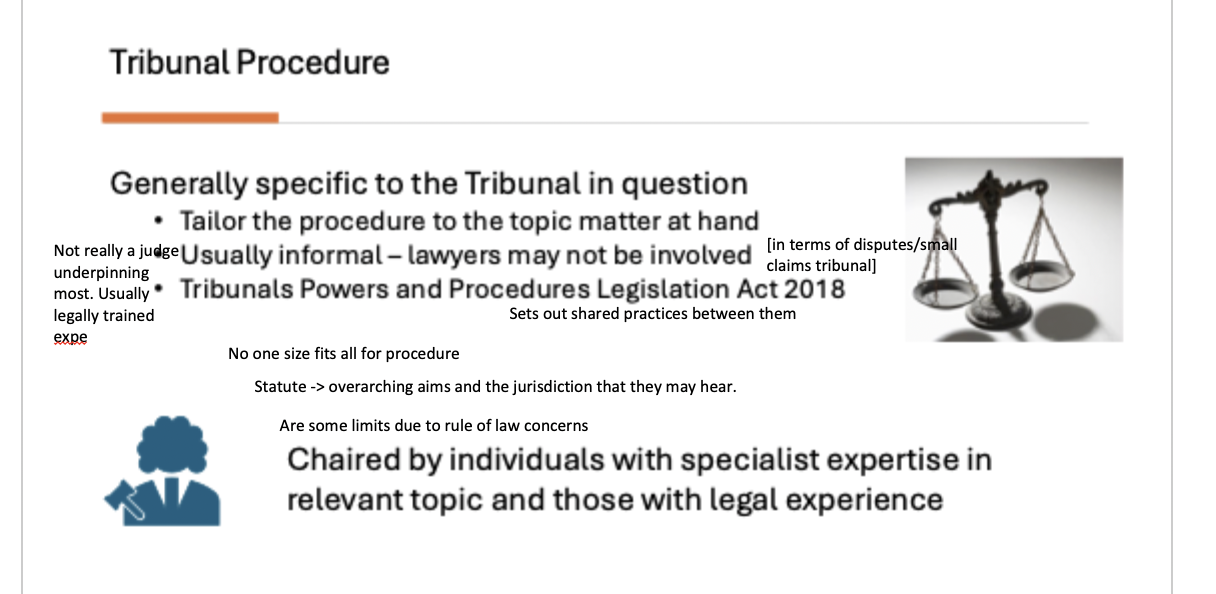
Tribunal procedure pt 2
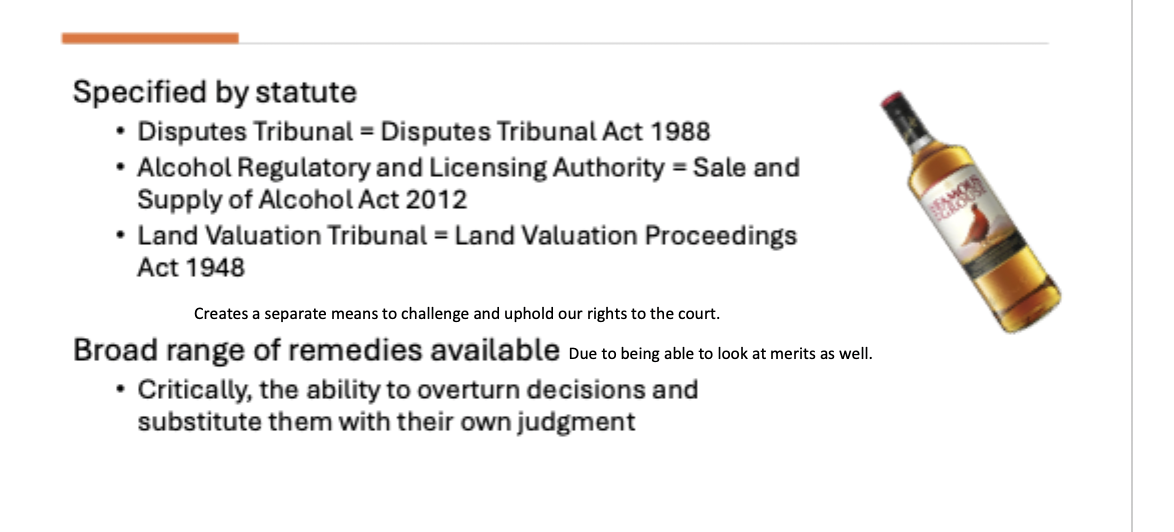
why bother implementing tribunal [Courts vs Tribunal]
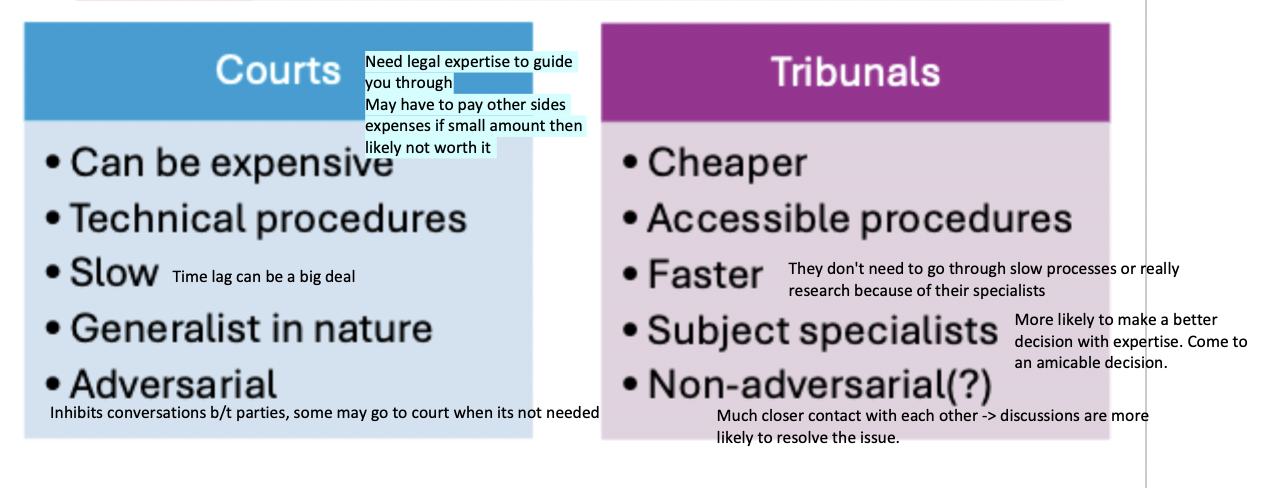
Human rights review tribunal
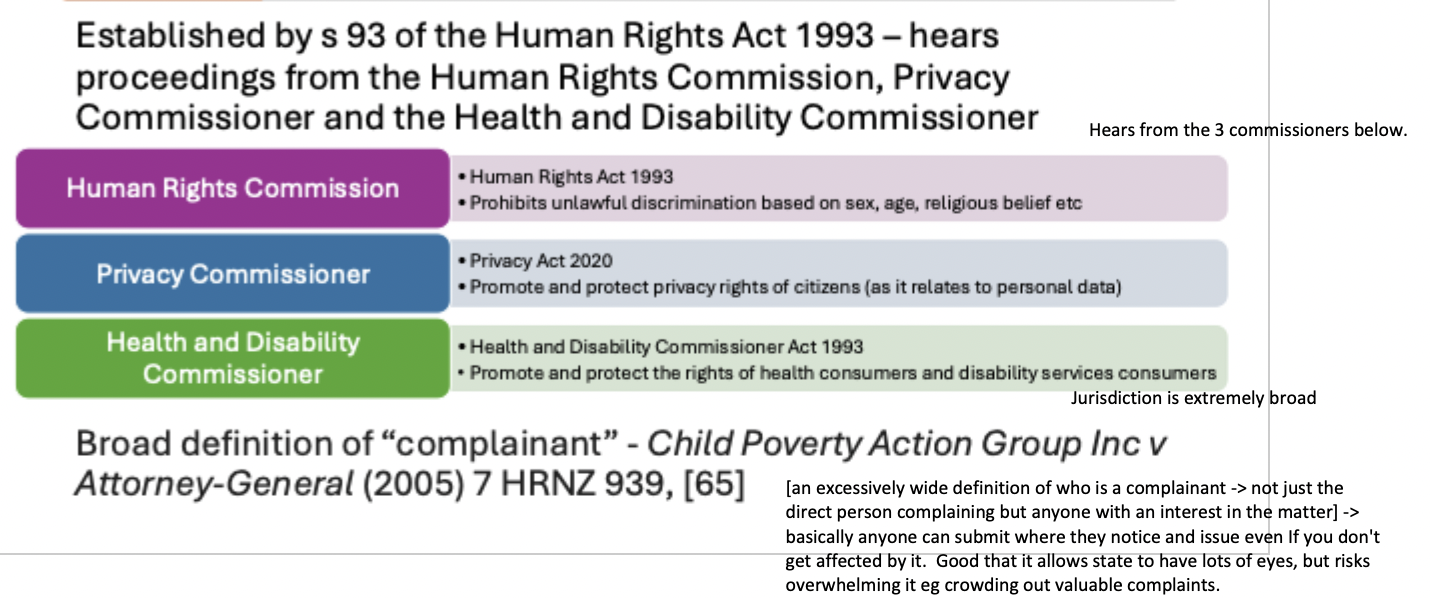
Human rights review tribunal remedies (including not limited to)
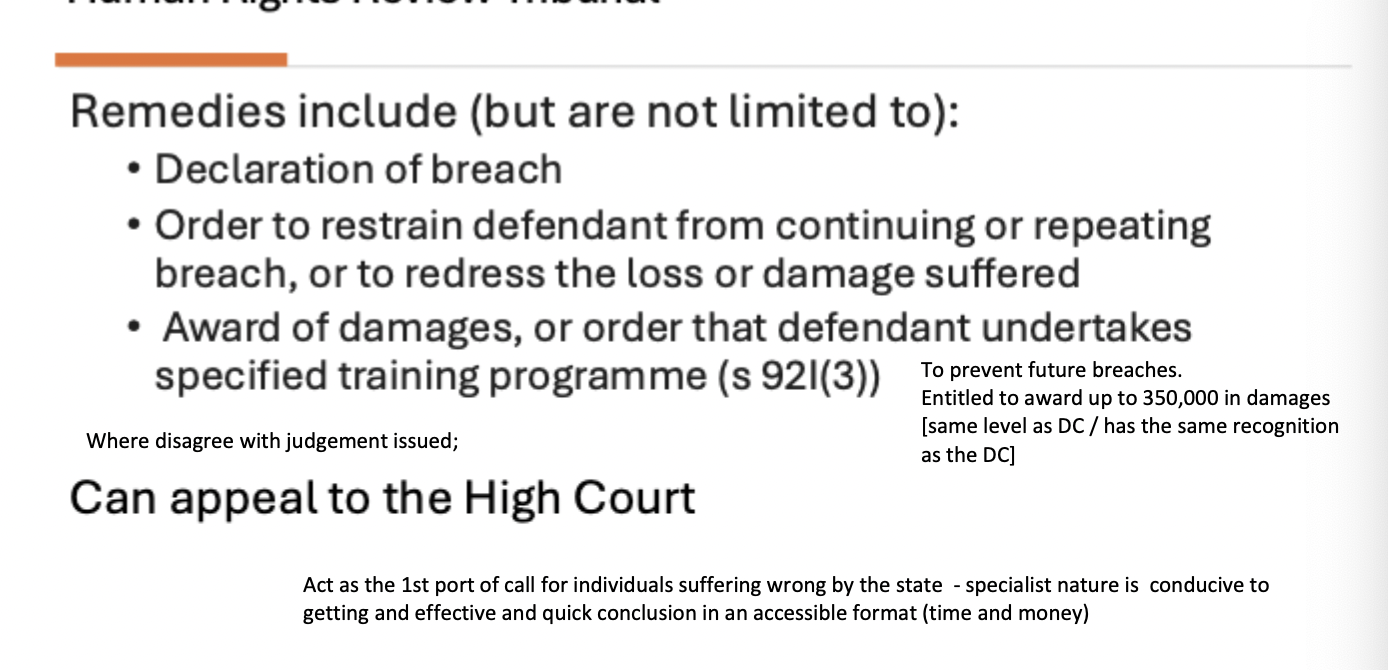
Waitangi Tribunal
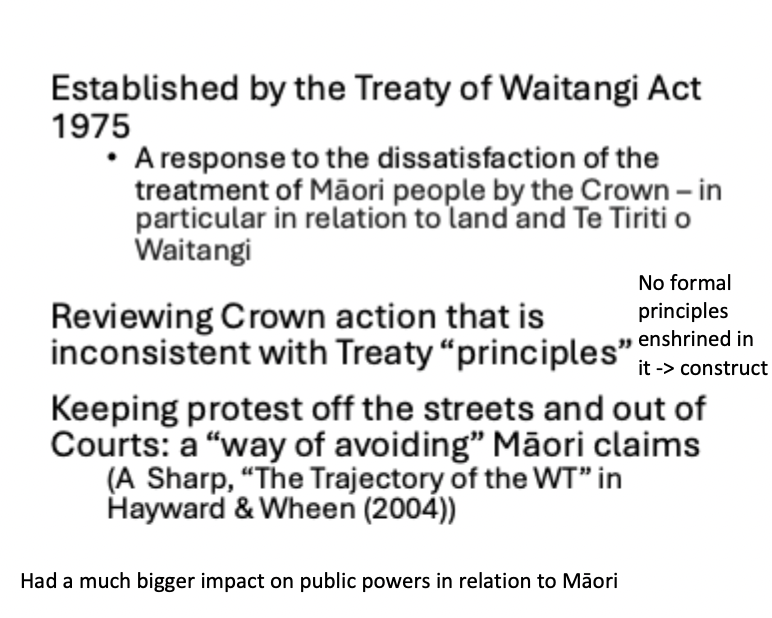
Treaty of Waitangi Act 1975
Establish the Waitangi tribunal
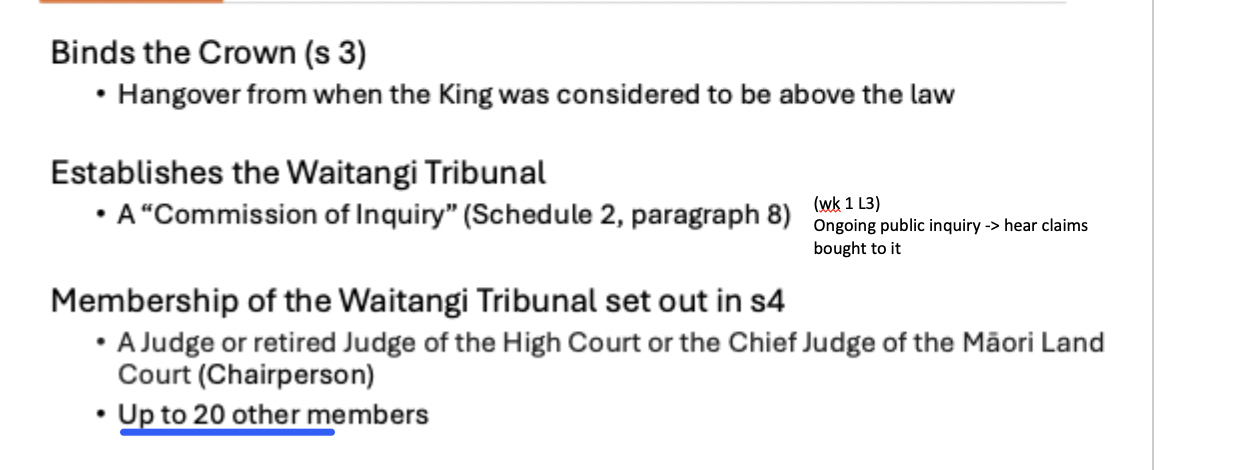
Functions of the Waitangi Tribunal - section 5
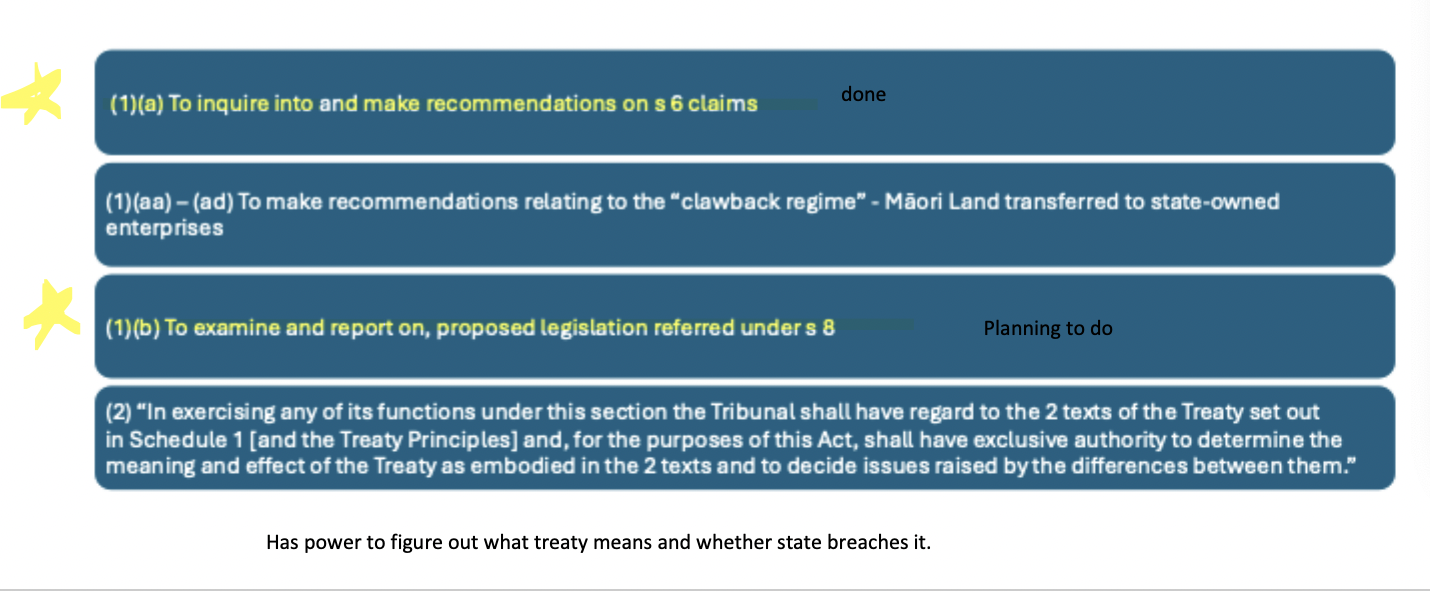
Skerret-White and others v Minister for Children [2024] NZCA 160
Claim in respect of the government’s policy to repeal s 7AA of the Oranga Tamariki Act 1989
relates to the States commitment to complying with treaty principles in looking after children and rehoming the,
Summonsed the Minister to appear and give evidence (she didn’t want to do so and claimed it would breach comity and collective responsibility)
CA said;
tribunal can issue summons (Schedule 2 cl 8(2)(b) and Commissions of Inquiry Act 1908, s 4D);
It was within its power to summons the Minister;
Comity does not prevent it asking for information to assist in an inquiry [78], [117]
The Waitangi tribunal is;
a body of constitutional importance [84] [to regulate and hear between Māori and Crown and crown not fulfilling their treaty obligations]
Is fulfilling a statutory duty; directed by parliament to undertake this work [84]
Can examine any policy, regardless of its origins (e.g. the Coalition Agreement) [103] (Note; Coalition agreement means its apart of comity -> court dismissed that comity was going to be breached)
In terms of Waitangi tribunal exercising its powers:
The tribunal could reasonably take the view the inquiry would be assisted by the ministers evidence
Nothing to suggest the tribunal would have sought a breach of Cabinet confidentiality or collective responsibility [101]
(note: In conducting it's investigations would not act in a way which would breach these.)
Section 6 claim:
Submitted by Māori individual regarding a potential action or inaction by the Crown/state
Where any Māori claims that or any group of Māori -> not Māori you can't make a complaint -> must be of Māori descent.
Even if you are Māori -> need to be apart of the iwi or hapu (group) to complain on their behalf.
Can be predicted or possible prejudicially affect, or already happened prejudicial affects (already happened is easier to prove)
What are the acts by the crown which can be the subject of the claim; Wide range.
Law (a) -> legislation passed by the state
Delegated law (b)
Any policy or practice (in/or not in force) adopted by or on behalf of the crown or any policy or practice proposed to be adopted by or on behalf of the crown [predicted impact]. ( c)
Any act done or omitted at any time after signing of treaty, or proposed to be done by or on behalf of the crown (d) [any use of Crowns power]
Must prove anything ^^ was or is inconsistent with the principles of the Treaty.
If you can't show a potential breach it won't go to the Tribunal.
![<ul><li><p><span>Submitted by Māori individual regarding a potential action or inaction by the Crown/state</span></p></li><li><p><span>Where any Māori claims that or any group of Māori -> not Māori you can't make a complaint -> must be of Māori descent.</span></p></li><li><p><span>Even if you are Māori -> need to be apart of the iwi or hapu (group) to complain on their behalf.</span></p></li><li><p><span>Can be predicted or possible prejudicially affect, or already happened prejudicial affects (already happened is easier to prove)</span></p></li><li><p><span>What are the acts by the crown which can be the subject of the claim; Wide range.</span></p><ul><li><p><span>Law (a) -> legislation passed by the state</span></p></li><li><p><span>Delegated law (b)</span></p></li><li><p><span>Any policy or practice (in/or not in force) adopted by or on behalf of the crown or any policy or practice proposed to be adopted by or on behalf of the crown [predicted impact]. ( c)</span></p></li><li><p><span>Any act done or omitted at any time after signing of treaty, or proposed to be done by or on behalf of the crown (d) [any use of Crowns power]</span></p></li></ul></li><li><p><span>Must prove anything ^^ <u>was or is inconsistent with the principles of the Treaty.</u></span></p><ul><li><p><span>If you can't show a potential breach it won't go to the Tribunal.</span></p></li></ul></li></ul><p></p>](https://assets.knowt.com/user-attachments/a38cf30f-d6cf-46a9-8da4-6925e34e2809.png)
S 6(2): where the Tribunal hears a valid claim it must inquire into it; unless
It's a 'historical Treaty claim' -> arising before 21 September 1992 - s 6AA
Claim is not made in good faith (trivial, vexatious or frivolous) or already an adequate remedy of right to appeal available (beyond house or ombudsman) that would be reasonable to exercise - s7
Claim concerns commercial fishing/fisheries (claims settled) - s 6(7)
The claim concerns a settlement listed in Schedule 3 - s 6(8)
Inconsistent with principles of the treaty
No clear definition in treaty on what principles are.
Janine Hayward; flow from the words of te Tiriti, different compositions [not bound by precedents] of WT evolve the principles throughout the years in relation to specific facts before them.
Early reports (limited jurisdiction); focus on text, emergence of a duty on the Crown to actively protect māori interests.
1987: NZMC v Attorney-General [lands case] -> relating land transfer to SOE [takes away any chance for hapu to make claim in land] - unlawful, no forum to hear their worries etc ; partnership (acting in good faith); active protection (working together etc); Crown's duty to be fully informed (but not necessarily consultation); redress.
Post 1985; active protection by Crown of Māori, mutual benefit; options; consultation; exchange [involving reciprocity]; self-regulation (of M by M); redress for past breaches; partnership
1992 on; reciprocity that guarantees the exercise of tino rangatiratanga; at the very least: Māori self-management; Crown's fiduciary duties to act reasonably and in good faith; right to development.
Simplified list;
Partnership -> the Treaty created a relationship between Māori and the Crown and both parties must act with the utmost good faith.
Participation -> providing tangata whenua w/ opportunities to engage with opportunities to engage w/ decision making processes at all levels.
Protection -> active protection of Māori interests, rights, taonga and tino rangatiratanga must be a government priority.
Redress -> that the Crown should remedy past (and contemporary grievances)
Not limited to these 4 -> no single set to be applied in each claim -> change and evolve with each case.
“Each Tribunal panel must determine not only whether the Crown has Acted in breach of treaty principles, but also which principles should apply to the claim before it […] the Waitangi Tribunal does not have a single set of treaty principles that are to be applied in assessing each claim”
Section 6 -> what can the WT do?
Recommend the crown to take action to compensate for or remove the prejudice
Or to prevent other persons from being similarly affected in the future
Historic claims ; negotiations to a settlement
Contemporary claims; variable -> change policy or legislation.
Recommendations are not binding except for land transferred to a SOE (claw back regime) - limited exception
Waitangi tribunal is a commission of inquiry and it would be inappropriate for such CoI to undercut parliamentary sovereignty.
Despite not being binding in nature - mere position and constitutional importance of WT it has a strong normative influence on the crown - Crown should have a really good reason not to follow it

Treaty settlements Process;
As at 24th Feb 2025, Te Tari Whakatau: the Office of Treaty Settlement and Takutai Moana is responsible for settling historical disputes;
(operate under the guidance of the) The Red Book;
which sets out the guidelines for how the crown will conduct negotiations and settlements with Māori groups or individuals.
WT cannot recommend the return of private land - s 6(4A) of the 1975 Act
But can;
Recommend an apology
Financial transfer (direct or indirect)
Return of land (right of first refusal)
Other cultural redress (eg access to mahinga kai [fish without crowns regulatory efforts])
May be implemented in legislation
Eg Te Awa Tupua (Whanganui River Claims Settlement) Act 2017
Recognising legal personhood of the river.
Examples of the WT in Practice; Early reports;
Kaituna River Report 1984; breach of active protection - led to the abandonment of a proposed waste water treatment plan.
Te reo Māori Report 1986; State wasn't promoting language wasn't taking active measures to grow the language in NZ - Led to various actions aimed at protecting and promoting Te reo Māori [recognition of national language and subject which should be taught at school].
Jurisdiction extended back to 1840 in 1985;
Muriwhenua fishing report 1988 and Ngāi Tahi report 1991 -> led to changes to quotas of fish stock and return of exclusive eel fishing rights among other actions access to mahinga kai
Te Roroa Report 1992 - lead to the return of Crown-owned land and other cultural and finance redress (e.g. correction of place or landmark names)
Examples of the WT in Practice;Contemporary claims post 1992;
The Crown & Disproportionate reoffending rates report (2017)
Prisoner Voting Report (2019)
-> originally drafted as nobody who's been incarcerated could vote, crown failed to provide full information to Select committee [failure of partnership, not allowing proper communication] and failing to look into the impact it has on Māori because of the overrepresented in prison [breach of active protection, by imposing unjust disenfranchment on Māori)- WT agreed with complainants = failure to adhere to principle of partnership.
Oranga Tamariki Report 2021.
S 7 AA was repealed
Held repeal of the obligation of the children's ministry to take into account Māori interests when rehoming children disproportionately affect Māori interests and be a breach of a variety of treaty principles.
Covid-19 priority report 2021 - investigating the crowns vaccination strategy and its covid-19 protection framework
Inquiring into aspects of the Crown response to the pandemic;
Vaccination strategy and plan - age-based priority
November 2021 COVID-19 Protection Framework – decision to transition to this before vaccination rates for Māori were commensurate with those for the general population
Engagement with Māori – neither the strategy nor the framework were co-designed
Haumaru Report pp 43-46;
WT is substantial mission of inquiry which provides an important constitutional body through which Māori groups and individuals are able to hold the state to account specifically regarding the use of public power and breaching of the treaty. It’s the way in which Treaty is enforced in NZ.
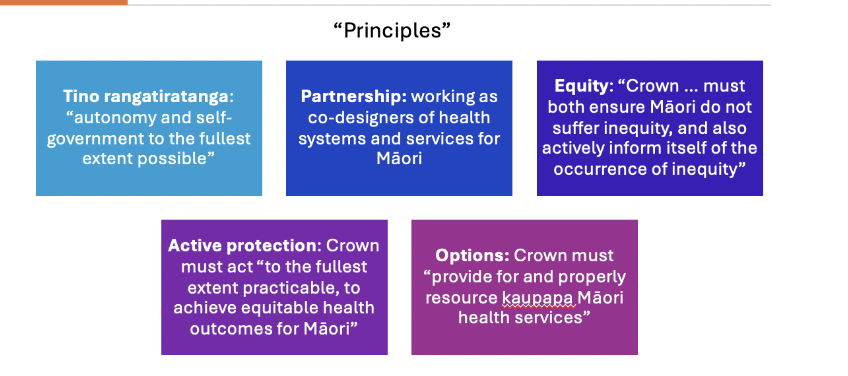
Critical Perspective of the WT;
Done essential work in researching past events and providing a channel for ma9ori to contest the dominant narrative of British colonization
Settlements following the recommendations of the WT are not universally praised;
Not taken as equal bargaining partners -> settlements are offered on a 'take it or leave it' basis -> not really fulfilling partnership principle.
Red book was not developed alongside māori -> redress mechanism itself may be a breach of Te Tiriti.
'The research shows that overall the [settlement] process has traumatized claimants, divided communities, and returned on average less than one percent of their stolen lands'
Section 8; Proposed legislation and the WT
Report back to relevant individual (house or minister) whether the proposed law is compliant with the principles of the treaty
Proposed legislation must be sent onto the tribunal -> by resolution of the house, or any Minister of the Crown = crown lead process
Leads to a potential muddling of jurisdictions.
S 8; concerned with laws going through parliament [primary or delegated legislation]
Once it passes into law it becomes actionable for a claim under s 6.
When a law is being debated as potential policy may fall under policy or practice ground under s 6 and thus can be subject to a section 6 claim (e.g. Regulatory standards bill - issue = submitted under s 6 when it was a policy but before claim was heard it had been put to the House as a bill thus taking it outside of it's jurisdiction. WT able to
Hear it as a matter of urgency
Where the proposed Bill turns into formal bill through parliament can then lead to tribunal losing its jurisdiction. The crown itself can seek to accelerate that process if it wants to
Tension: starting points are a bit blurred - does matter whether its an idea (under s 6) or where it is put as a bill (s 8)
Way the tribunal got around this is because the proposed law was a policy of the coalition government it could asses it under that as well.
![<ul><li><p><span>Report back to relevant individual (house or minister) whether the proposed law is compliant with the principles of the treaty</span></p></li><li><p><span>Proposed legislation must be sent onto the tribunal -> by resolution of the house, or any Minister of the Crown = crown lead process</span></p></li></ul><ul><li><p><span>Leads to a potential muddling of jurisdictions.</span></p><ul><li><p><span>S 8; concerned with laws going through parliament [primary or delegated legislation]</span></p></li><li><p><span>Once it passes into law it becomes actionable for a claim under s 6.</span></p></li><li><p><span>When a law is being debated as potential policy may fall under policy or practice ground under s 6 and thus can be subject to a section 6 claim (e.g. Regulatory standards bill - issue = submitted under s 6 when it was a policy but before claim was heard it had been put to the House as a bill thus taking it outside of it's jurisdiction. WT able to</span></p></li></ul><ol type="1"><li><p><span>Hear it as a matter of urgency</span></p></li><li><p><span>Where the proposed Bill turns into formal bill through parliament can then lead to tribunal losing its jurisdiction. The crown itself can seek to accelerate that process if it wants to</span></p></li></ol></li><li><p><span>Tension: starting points are a bit blurred - does matter whether its an idea (under s 6) or where it is put as a bill (s 8)</span></p><ul><li><p><span>Way the tribunal got around this is because the proposed law was a policy of the coalition government it could asses it under that as well.</span></p></li></ul></li></ul><p></p>](https://assets.knowt.com/user-attachments/179b13f5-ec05-44e6-8eac-7f501ac66a16.png)
The WT and Parliamentary Sovereignty;Is there a risk that parliamentary sovereignty will be impinged?
Parliament wouldn't have designed it this way if they didn’t want it to work this way
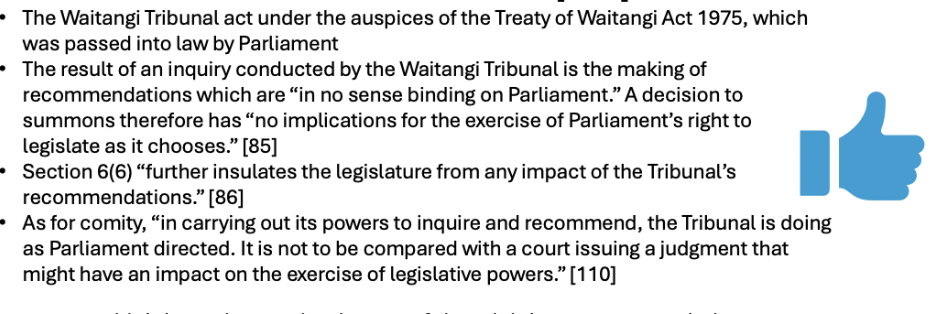
Recommendations and are not binding on Parliament -> has no implications for the exercise of parliaments right to legislate as it chooses.
Comity -> doing as parliament directed, its no adversarial or a court, makes recommendations no legislative powers.
So it won't impinge. It operates under an act