Topic 3 - Mundell's 2 country model / interdependence
 Call Kai
 Learn
Learn Practice Test
 Spaced Repetition
 Match
Match Flashcards
 Knowt Play
1/35

There's no tags or description
Looks like no tags are added yet.
Name | Mastery | Learn | Test | Matching | Spaced | Call with Kai | Chat |
|---|
No analytics yet
Send a link to your students to track their progress
36 Terms
Why do we care about interdependence
We are motivated by spillover effects of a shock in 1 country on another
e.g. financial crisis
Assumptions of Interdependence model
2 symmetric countries → H & F
Perfect Capital mobility → UIP holds
Adoptive expectations → expected change in ER = 0
makes model static
Fixed prices → S & Q move together
Marshall-Lerner condition is satisfied
Real depreciation → rise in NX
Output determined by Demand
Channels of interdependence
Marginal propensity to import (MPI)
AD changes affecting trading partner
AD UP leads to increased imports and higher NX in F
Interest rates (i)
i change may affect i*
Exchange rate (when flexible)
If p fixed, then a change to nom ER (S) will affect relative p and lead to expenditure switching
If S increases -> depreciation -> dom good relatively cheaper -> dom output may increase
H output equation - Flexible ER

H Money Market equation - Flexible ER

M = MS
RHS - MD (as a function of i & y)
no P as Fixed P so we say p=0
M is a level so not log transformed
UIP with adoptive expectations
i = i*
what is the term u
Captures FP or government spending
What relationship do i & y have
if real i increases then I falls -> AD falls -> output falls
- Negative relationship of i & y
What relationship do s & y have
s increases (nom depreciation) -> q changes -> relative p changes -> NX increase -> y increase
If ML condition holds which we assume
- Positive relationship between s & y
Exogenous variables - Flexible ER
M & u
Used for FP & MP + shocks
Relationship between y & y*
MPI drives y* effect
y* increase -> higher D for imports → H exports increase -> NX increase → y increase
- Positive relationship between y & y*
Relationship between u & y
u increases -> AD increases -> y increases
- Positive relationship between y & u
M & CB balance sheet
M = D + F
D - CB holding of govt bonds
F - Foreign exchange reserves
F output & money market equation - Flex ER
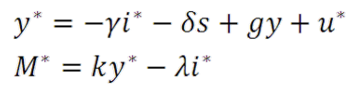
Conversion into y, y* space - Combine IS
Incorporate i = i*
Sum IS + IS* = ISW

Conversion into y, y* space - Combine IS & LM
Combine ISW with LM curves
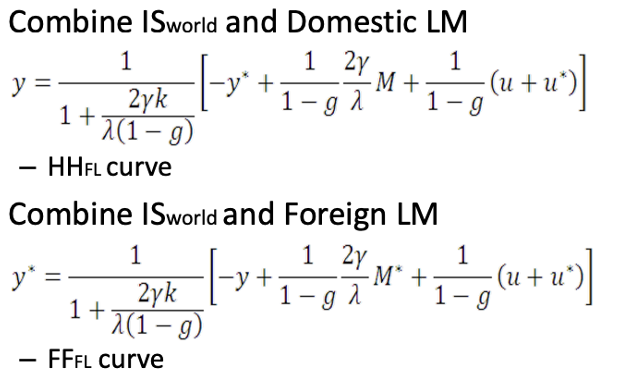
If FFFL slope < 1 - diagram
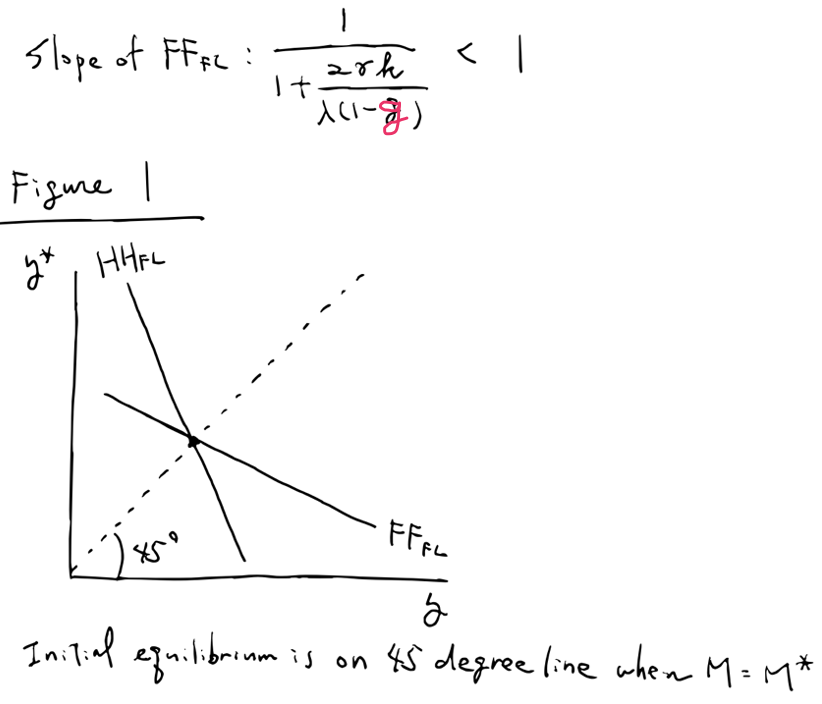
g
MPI
<1 as only part of the increase falls in increased imports
Therefore slope in HHFL < 1 in absolute terms
As denominator > 1
Why is HHFL & FFFL equilibrium on 45o
countries identical / symmetrical initially
HHFL slope vs FF
Inverse
-0.5 = -2
Negative shock in Foreign Money supply - graph
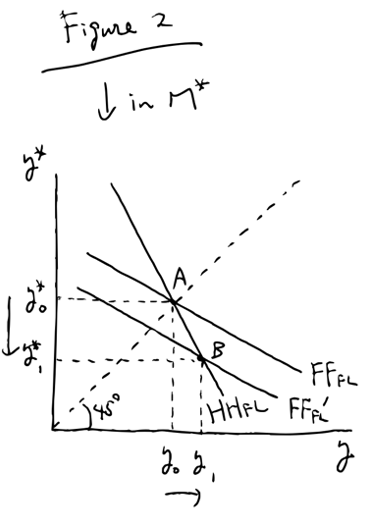
- M* only part of intercept term in FFFL not the slope -> shifts curve
- not in HHFL at all -> no shift
Positive shock in foreign FP or GS
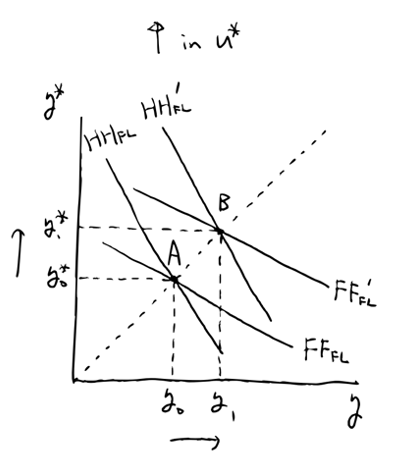
u*
- in both FFFL & HHFL intercept term -> shifts both curves
- stays on 45o line (increase in y = increase in y*)
Breakdown of channels from u* increase
MPI - expansionary
u* increase → ADF increase → D for imports increase → XH increase
y* increase = y increase
Relatively small impact as g < 1
Interest rate - Contractionary
M exogenous so fixed
To balance money market equilibrium as y* rises, i* must rise too
i = i* because of UIP (nom & real i rise as inflation rate = 0 from fixed prices)
i increase → I decrease → y decrease
Exchange rate channel - Expansionary
i has fallen + g < 1
To keep equilibrium s needs to rise to match fall in i
s rises → depreciation
As p is fixed, real ER falls as well (nom = real depreciation)
NX rises from ML condition → AD rises
Fixed ER - CB intervention
CB needs to intervene to correct currency if there is a shock
- Using F reserves
Ms becomes endogenous
Home / F output equation - Fixed ER


Money market equation - H - Fixed ER
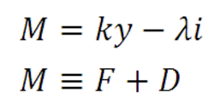
Variables with * for F version
M becomes endogenous under fixed ER
Are F reserves endogenous under fixed ER
Yes
Add together to get World reserves
F + F* = FW
Conversion into y, y* space - fixed ER
incorporate i = i*
Sum LM + LM* = LMW

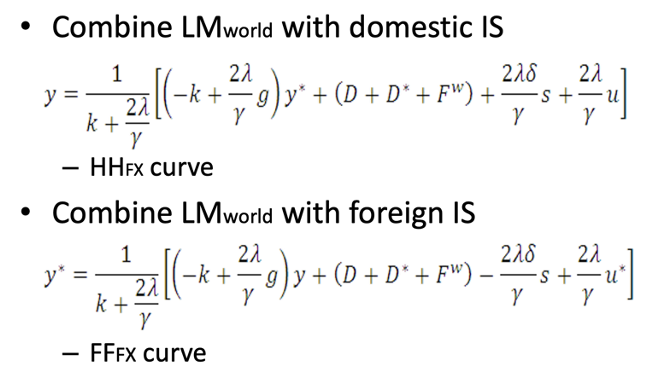
Combine LMW with Dom & F IS
Graph if FFFX slope > 0
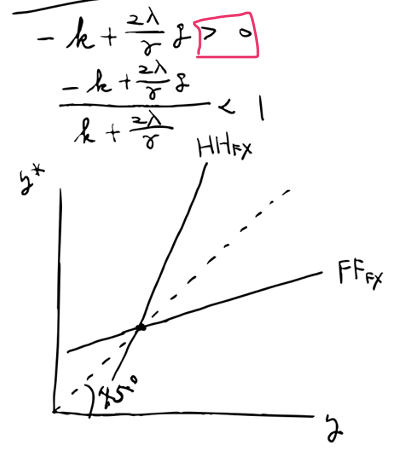
g<1 so slope<1 → crosses 45o
HHFX is inverse and symmetrical
equilibrium at 45o
Graph if FFFX slope < 0
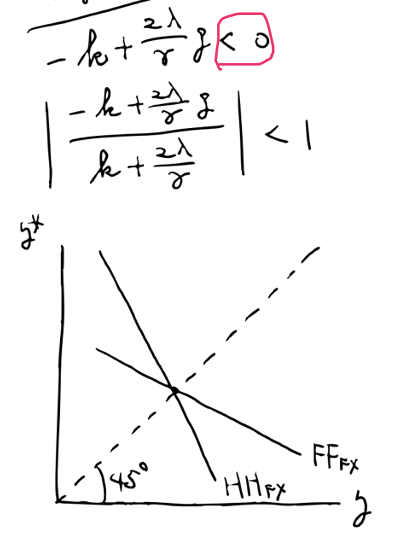
-k > RHS
absolute value still < 1
FFFX still flatter than 45o
Negative shock to Foreign Govt bonds - Fixed ER - slope > 0
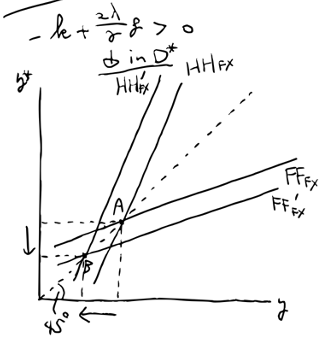
D* down = decrease in OMOs in F
- affects both HH & FF so both shift
Positive shock to Foreign FP or GS - Fixed ER - slope > 0
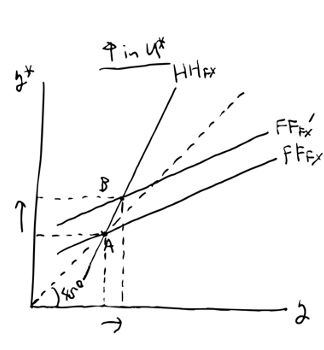
U* change
- Only affects FF
Positive shock to Foreign FP or GS - Fixed ER - slope < 0
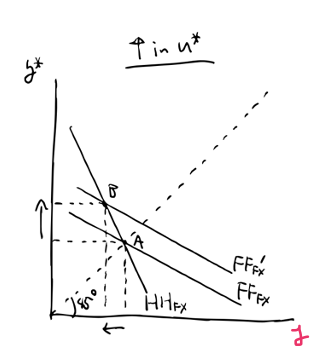
u* change only affects FF
- However, it has flipped the sign on effect on y
Negative shock to Foreign Govt bonds - Fixed ER - slope < 0
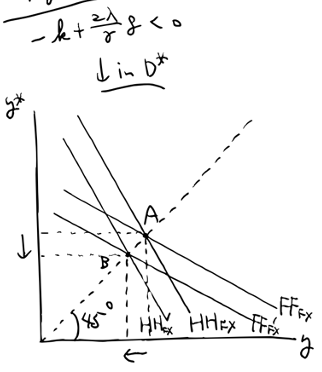
D* change affects both HH & FF
y* falls → y fall from MPI (contractionary effect)
no ER effect as fixed ER
y* falls → g < 1 so not full effect → i rises to correct → y falls (contractionary effect)
Effects of larger g
g - MPI
larger g means greater impact on domestic output for any F shock
as g increases → higher chance of positive impact of F positive shock