Comprehensive Mastery Test #2 Review
0.0(0)
Studied by 5 people Call Kai
 Learn
Learn Practice Test
 Spaced Repetition
 Match
Match Flashcards
 Knowt Play
Card Sorting
1/24

Last updated 1:34 AM on 2/3/23
Name | Mastery | Learn | Test | Matching | Spaced | Call with Kai | Chat |
|---|
No analytics yet
Send a link to your students to track their progress
25 Terms
1
New cards
What are the 4 characteristics of useful financial information?
Understandable, relevant, reliable, comparable
2
New cards
Why must financial information by understandable?
So it can be used by anyone who needs it.
3
New cards
Describe what makes financial information relevant?
Appropriate to the situation at hand
4
New cards
Describe what makes financial information reliable?
Information is accurate
5
New cards
Why must financial information be comparable?
For consistency
6
New cards
The overall purpose of accounting is to…
keep financial records
7
New cards
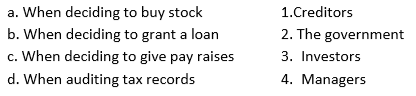
Match the groups that use a business’s accounting information with the ways these groups use the information.
A3, B1, C4, D2
8
New cards
Distinguish between managerial accounting and financial accounting.
Managerial: preparing and reporting for internal users
Financial: preparing and reporting for external users
Financial: preparing and reporting for external users
9
New cards
What are the five characteristics that are common to all effective accounting systems?
easy to use, processes data quickly, expandable, affordable to operate, protects the business.
10
New cards
What are the six steps in the accounting cycle?
Analyzing financial transactions,
journalizing transactions,
posting to ledgers, balancing the books, preparing financial statements, closing the books
journalizing transactions,
posting to ledgers, balancing the books, preparing financial statements, closing the books
11
New cards
What type of businesses often use the accrual accounting method?
Large businesses
12
New cards
Explain the three important categories of financial information presented in a balance sheet.
Assets: anything of value, liabilities: debts, owner’s equity: assets minus liabilities
13
New cards
What does an income statement show?
How much a business made or lost
14
New cards
What does a cash flow statement contain?
A summary of when, where, and how much money will flow in and out of a business during a specific amount of time
15
New cards
What is finance?
The function that involves all money and money management matters
16
New cards
Explain the difference between finance and accounting?
Finance: all money and money management
Accounting: keeping and interpreting financial information
Accounting: keeping and interpreting financial information
17
New cards
Describe two main finance activities.
Administration of assets (decisions about investments) and acquisition of funds (decisions about financing)
18
New cards
Discuss five ways that the finance function contributes to a business organization.
Goals for the future, planning and controlling company spending, ensuring sufficient funding, accounts receivable payed, investing wisely
19
New cards
Explain the differences between capital investment decisions and working capital management.
CID: determines investments, how investments will be financed, and whether to pay dividends to shareholders
WCM: focuses on current balance of assets and liabilities
WCM: focuses on current balance of assets and liabilities
20
New cards
What is capital budgeting?
A process in which a firm's financial managers determine which projects it should invest in
21
New cards
Describe capital structure.
“Optimal mix” of financing
22
New cards
What is the difference between debt and equity funding?
Loan from bank vs raising funds through selling shares of the company
23
New cards
What dividend-related decisions must financial managers make?
Decide whether or not to pay shareholders dividends
24
New cards
What is the role of the cash conversion cycle in managing working capital?
It estimates days taken to produce sellable products from raw materials which then tells whether the company has good working capital or not
25
New cards
What is the role of return on capital in managing working capital?
It measure how well a business is generating cash in relation to capital which expresses the company’s value